



Table of Contents
- What Homeowners Insurance Covers for Roof Wind Damage
- Signs of Wind Damage on Roof Shingles to Look For
- How to Document Storm Damage for Insurance
- The Roof Insurance Claim Process Step by Step
- ACV vs. RCV: How Your Payout Is Calculated
- The Matching Clause and Depreciation Schedules
- When Wind Damage Claims Get Denied and How to Appeal
- Frequently Asked Questions
Last Updated: September 14, 2026
What Homeowners Insurance Covers for Roof Wind Damage
Most standard homeowners policies cover roof wind damage, because windstorm is a named peril in the typical HO-3 policy form, whether it arrives with a hurricane, a squall line, or a thunderstorm. At Rescue Roofing, we help homeowners file these claims every storm season, and the pattern is consistent: wind damage is usually covered, while age or neglect usually is not.
The dividing line matters more than most people realize. According to the Insurance Information Institute’s homeowners insurance overview, wind and hail rank among the most common causes of homeowner insurance claims in the United States. The National Association of Insurance Commissioners publishes a consumer guide to homeowners insurance that spells out how named perils work, and it is worth reading before you file anything.
Covered Perils and Sudden Accidental Damage
Covered perils are the events a policy promises to pay for, and windstorm is almost always on that list. The key phrase is sudden and accidental damage: a gust tears off shingles on a Tuesday afternoon, covered; twenty years of sun cooking the sealant off your shingles, gradual, not covered.
Policy Exclusions: Wear and Tear vs. Wind Damage
Policy exclusions remove wear and tear, deterioration, and poor maintenance from coverage, but a roof can suffer both at once, and the adjuster has to separate them. A denied claim often means the adjuster judged the decline gradual rather than sudden, not that the damage wasn’t wind-related. Documenting the storm event itself tips that judgment in your favor. Maintaining detailed records of these repairs becomes even more critical when securing coverage for older roofs that are frequently scrutinized for signs of structural fatigue.
Signs of Wind Damage on Roof Shingles to Look For
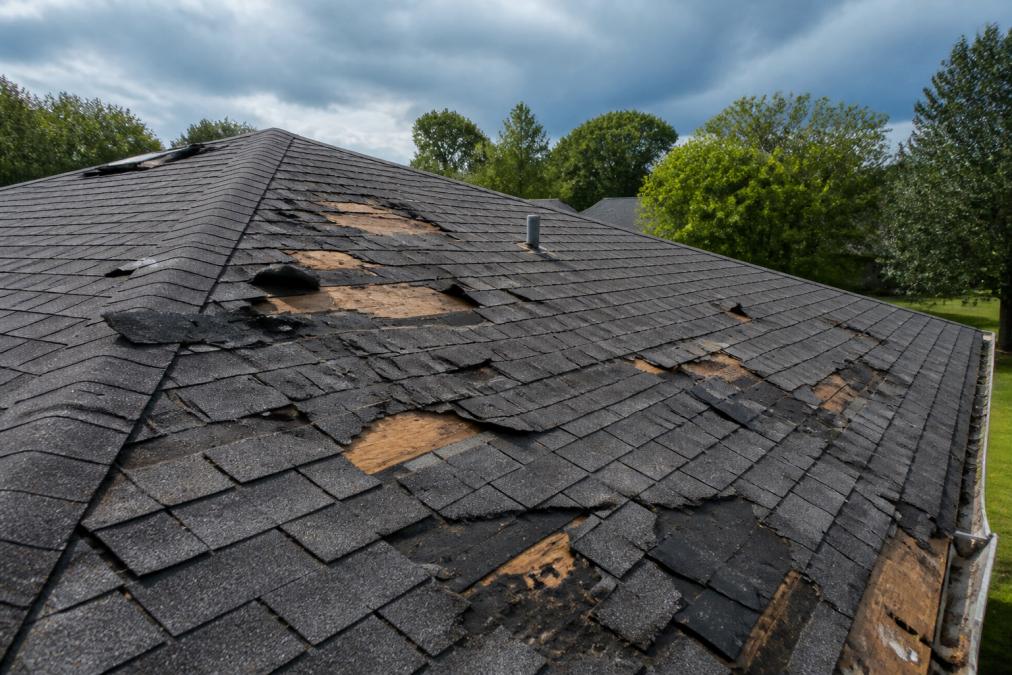
The clearest signs of wind damage on roof shingles are missing, lifted, or creased shingles, granule loss, and exposed nail heads, often on one slope rather than all of it. Wind attacks the windward edge, the ridge, and any spot where the shingle seal has weakened.
Look for these markers after a storm:
- Shingles that are torn, curled, or completely gone
- Horizontal creases across shingle surfaces, a sign the tab lifted and bent back
- Bald patches where granules have stripped away, leaving the asphalt mat exposed
- Lifted or broken flashing around chimneys, vents, and skylights
- Granules collecting in gutters or at the base of downspouts
- Water intrusion stains on attic sheathing or ceiling drywall below
Wind-driven rain is the quiet culprit: a roof can lose its shingle seal without losing a single shingle, and the next rain pushes water under the tabs. An inspection after every major storm beats waiting for a leak.
How to Document Storm Damage for Insurance
Document storm damage for insurance by photographing everything before you repair anything and writing down the date, time, and weather conditions while they are fresh. Evidence collected after a contractor has tarped or replaced the roof is worth far less.
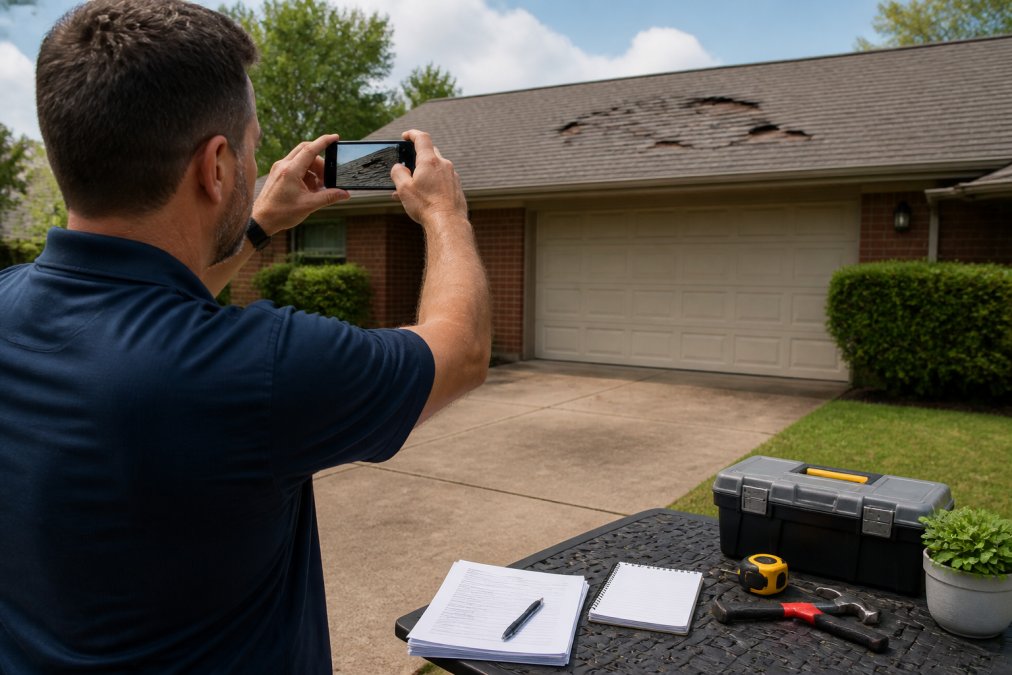
Build a documentation file that includes:
- Wide shots of each roof slope, plus close-ups of every damaged area
- Photos of fallen limbs, hail on the ground, or debris that shows the storm’s force
- A dated weather report or news clip from the storm day
- Receipts for any emergency tarping or temporary repairs
- Notes on interior water stains, with photos of the ceiling and the attic decking
Photograph the same damaged shingle from three distances: from the street, from the roof edge, and a close-up with a coin or tape measure in frame for scale. Adjusters respond to scale references, and a close-up with no size context gets discounted.
The Roof Insurance Claim Process Step by Step
The roof insurance claim process moves through five stages: report the loss, schedule the adjuster, document everything, review the settlement, and negotiate or appeal. What separates a full settlement from a lowball one is rarely the storm, it is how the file is built in the first two weeks.
- File the claim. Call your insurer’s claims line and report the date and cause of the loss. Get a claim number the same day, and confirm your deductible and whether your policy pays Actual Cash Value or Replacement Cost Value.
- Protect the property. Tarp or board up anything open to the weather. Policies require you to mitigate further damage, and that cost is often reimbursable, but keep receipts and photograph the tarp installation, since a tarp that hides undocumented damage can cost you the claim.
- Meet the insurance adjuster. Be present, and walk the roof with them if it is safe. Adjusters work from the ground more often than homeowners expect, and a slope that looks intact from the driveway can be missing half its sealant. Point out creased tabs, exposed nail heads, and interior staining.
- Submit proof of loss. This sworn statement details what was damaged and what it is worth. Deadlines apply, commonly 60 days from the date of loss, so get the date in writing and calendar it.
- Review the estimate and settle. Compare the adjuster’s line items against your contractor’s scope of work before signing. The gap is usually in items the adjuster could not see: decking condition, underlayment, drip edge, ridge vent, flashing, and code-required upgrades such as ice-and-water shield or high-wind fastening.
Never sign a contract that assigns your claim rights to a contractor before your insurer has issued a settlement. Signing early can leave you with no standing to dispute a low offer, and some states restrict the practice outright.
Working With the Insurance Adjuster
The insurance adjuster works for the insurer, not for you. Their estimate reflects what the carrier believes the loss is worth; your contractor’s reflects the full scope of work. When the two disagree, the gap is usually in line items the adjuster could not see from the ground: decking, underlayment, flashing, and code-required upgrades.
A common mistake is handing the adjuster a verbal summary instead of a written scope, the written scope wins almost every time. Rescue Roofing communicates directly with insurance companies and adjusters on behalf of homeowners.
What to Do Immediately After a Windstorm
The first 48 hours set the tone for the claim. Work through this sequence before calling a contractor or your insurer:
- Photograph before you touch anything. Wide shots of every slope, close-ups of damaged tabs, and debris that shows the storm’s force. Timestamped phone photos are admissible; a verbal description is not.
- Pull the weather record. A dated National Weather Service storm report, a news clip, or a neighbor’s ring-camera footage corroborates that a qualifying wind event occurred on the date you are claiming. Insurers deny claims when the storm record does not match the reported date.
- Tarp only what is open. Emergency mitigation is required, but leave the damaged area visible until photos are captured.
- Do not authorize permanent repairs. A signed work order before the adjuster inspects can be read as acceptance of the loss scope.
- Notify your insurer within the policy’s prompt-notice window. Most policies require notice “as soon as practicable,” and delays beyond a few weeks invite a late-notice denial even when the damage is genuine.
Understanding Policy Exclusions Before You File
Before you file, read the exclusions page. The exclusions that most often sink a wind claim are not the obvious ones:
- Wear and tear, deterioration, and neglect, gradual decline is excluded, and adjusters attribute damage to age when granule loss appears across the whole roof rather than one slope.
- Faulty workmanship or installation, if shingles were nailed too high or the starter course was installed wrong, the carrier may deny the wind claim and point to the installer. Keep the original installation invoice and warranty paperwork in your claim file.
- Cosmetic damage exclusions, some policies exclude damage that is only cosmetic, so a roof that still sheds water but has visible granule loss or color change may not qualify. Read your policy’s definition of “cosmetic”; it varies by carrier.
- Matching and repair-vs-replace language, a policy may pay to repair a slope rather than replace the roof, even when the repair leaves a visible mismatch.
Ask your adjuster, in writing, which exclusions they applied and the specific policy language they relied on. A denial that cites no policy language is the easiest kind to appeal.
The Denied Claim Appeal Process
If the adjuster denies the claim or issues a settlement below your contractor’s scope, you have a defined path, and most homeowners never use it, which is why denials stick.
- Request the denial in writing with the specific policy language cited. A verbal denial is not appealable.
- Get an independent roof inspection and a written scope of work from a licensed contractor who documents the damage with photos and measurements.
- File a formal appeal or reconsideration request with your carrier, including the independent scope, the storm record, and a rebuttal of each exclusion cited.
- Escalate to your state’s department of insurance if the carrier upholds the denial. Every state insurance department accepts consumer complaints and can review the file on your behalf.
- Check your policy for an appraisal clause. Many policies let both sides hire independent appraisers when they disagree on the amount of loss, not coverage, but value. Appraisal is often faster and cheaper than litigation.
Deadlines matter at every step. Policies typically include a suit-limitation clause that caps how long you have to bring a legal action after a denial, and the window is often shorter than homeowners assume. Read that clause before you let a denial sit.
ACV vs. RCV: How Your Payout Is Calculated
Actual Cash Value (ACV) pays replacement cost minus depreciation, while Replacement Cost Value (RCV) pays the full cost to replace the roof at today’s prices. The difference can decide whether a claim covers a full roof replacement or a fraction of it. What determines your check is how depreciation is calculated and when the withheld money is released.
Here is how the two payout structures compare:
| Feature | ACV Policy | RCV Policy |
|---|---|---|
| Payout basis | Replacement cost minus depreciation | Full replacement cost |
| Upfront payment | Depreciated amount only | Depreciated amount, then recoverable depreciation |
| Roof age impact | Larger deduction as roof ages | Smaller net impact if roof is maintained |
| Out-of-pocket risk | Higher | Lower |
| Typical use case | Older roofs, budget premiums | Roofs under 15 years, full-recovery goals |
How Depreciation Is Actually Applied to a Roof
Depreciation is not a flat percentage from a table; it is based on the roof’s expected service life, current age, and condition at the time of loss. A 20-year roof that is 12 years old may be depreciated roughly 60 percent, with 40 percent of replacement cost paid upfront and the rest held as recoverable depreciation. The schedule varies by carrier and material.
What most homeowners miss is that the depreciation schedule is negotiable. If your roof has a 30-year architectural shingle but the adjuster applied a 20-year schedule, the difference can be thousands of dollars. Ask for the schedule in writing and compare it against the manufacturer’s warranty and installation invoice.
Recoverable Depreciation: How to Get the Second Check
On an RCV policy, the carrier pays the depreciated amount first and releases recoverable depreciation after the work is complete. To collect it, you generally need to:
- Complete the repairs or replacement within the policy’s stated window, often 180 days from the date of loss but sometimes shorter.
- Submit the final invoice showing the actual cost of the completed work.
- Provide proof of payment, and in some cases a certificate of completion from the contractor.
If you sell the home or miss the deadline, the recoverable depreciation can be forfeited. Calendar the deadline the day you receive the first check.
The Matching Clause and Depreciation Schedules
The matching clause requires an insurer to replace undamaged shingles when a repair cannot reasonably match the existing roof’s color, texture, or dimensions. Not every policy includes one, and state insurance departments treat matching disputes differently, so read your policy language before assuming it applies. A discontinued shingle color is the classic trigger: the carrier may want to repair one slope, but no matching shingle exists and the mismatch is visible from the street.
Depreciation schedules are the other half of this equation. Insurers depreciate based on age and expected service life, and the schedule is rarely linear, a roof in its first third of life might depreciate slowly, then fall off a cliff in the final years. A denied or reduced settlement can often be challenged with a documented maintenance history.
Ask your insurer for the depreciation schedule applied to your roof in writing. If the schedule assumes a shorter service life than your roof’s actual condition supports, that is a concrete basis for a revised settlement.
How Roof Age Affects Claim Approval
Roof age influences a wind claim in three places:
- Eligibility. Some carriers will not write or renew a policy on a roof past a certain age, commonly 20 to 25 years for asphalt shingles, unless an inspection confirms remaining life. If the roof was already flagged, the carrier may deny a wind claim because the roof was near the end of its service life.
- Valuation. Even when approved, age drives the depreciation deduction. A 5-year-old roof on an RCV policy may net close to full replacement cost; a 20-year-old roof may net a fraction.
- Settlement type. Carriers sometimes settle older roofs on an ACV basis even when the policy is nominally RCV, arguing the roof had no remaining useful life. This is the most common dispute in roof claims, and where a documented maintenance history, annual inspections, prior repairs, warranty records, does the most work.
If your roof is more than 15 years old, gather that documentation before you file.
The Matching Clause and Depreciation Schedules
Ask your insurer for the depreciation schedule applied to your roof in writing. If the schedule assumes a shorter service life than your roof’s actual condition supports, that is a concrete basis for a revised settlement.
When Wind Damage Claims Get Denied and How to Appeal
Wind damage claims get denied most often for three reasons: the adjuster attributed the damage to wear and tear, the loss fell below the deductible, or the policy excluded the peril in that circumstance. Each has a different appeal path.
The denied claim appeal process generally runs like this:
- Request the denial in writing with the specific policy language cited.
- Get an independent roof inspection and a written scope of work.
- File a formal appeal or reconsideration request with your carrier.
- If the carrier upholds the denial, escalate to your state’s department of insurance.
- As a last resort, review your policy for an appraisal clause, which lets both sides hire independent appraisers.
The Oklahoma Insurance Department accepts consumer complaints about claim handling and can review a denial on your behalf. Deadlines matter here too, so check your policy’s suit-limitation clause before you let a denial sit.
Wind damage claims reward preparation and punish improvisation. The homeowners who get full settlements are the ones with dated photos, written scopes, and a contractor who speaks the adjuster’s language. Rescue Roofing handles that side of the process for you, with thorough inspections, accurate aerial quotes, direct communication with insurance companies and adjusters, and 24-hour availability when a storm hits. We also offer financing options for the portion your claim does not cover. Get started with Rescue Roofing and protect what matters most.
Frequently Asked Questions
What not to say to a roof insurance adjuster?
Avoid speculating about the cause of damage or admitting you are unsure when it happened. Do not say the roof is old or that you have not maintained it, as this can be used to deny a roof wind damage claim. Stick to facts: describe what you observed after the storm, show your documentation, and let the adjuster do their assessment. If you feel pressured, you can ask to reschedule or have a contractor present during the inspection.
Will insurance cover a 20-year-old roof with wind damage?
Coverage depends on your policy and the roof’s condition. Many policies cover wind damage regardless of roof age if the damage is sudden and accidental. However, if the roof was already degraded by wear and tear, the insurer may only pay actual cash value rather than replacement cost. Some policies require a roof inspection before renewal once a roof passes the 20-year mark. Check your policy limits and depreciation schedule before filing.
How long do you have to claim roof damage from a storm?
Most policies require you to report roof wind damage promptly, often within a reasonable timeframe after the storm. While some states allow up to one year, waiting can lead to denial if the insurer argues the damage worsened due to neglect. File as soon as you notice signs of wind damage on roof shingles, such as missing granules, lifted shingles, or leaks. Document everything with photos and dates to support your roof insurance claim process.
Will my insurance go up after making a claim for wind damage?
A single weather-related claim may not raise your premium, especially if your area experienced a widespread storm. However, multiple claims or claims on an aging roof can lead to a premium increase or non-renewal. Insurers view repeated claims as higher risk. Before filing, ask your agent how the claim might affect your policy. Sometimes paying out of pocket for minor repairs is cheaper than facing a premium hike.