




What if the “missing” money on your first insurance check isn’t actually lost at all? For many Tulsa homeowners, opening that initial claim estimate after a hailstorm feels like a second disaster. You see a total that’s thousands of dollars less than the actual cost of a new roof, leaving you worried about how you’ll cover the gap. It’s completely natural to feel overwhelmed by the jargon. However, understanding depreciation on a roof insurance claim is the first step toward realizing that the insurance company isn’t necessarily shortchanging you. They’re often just holding onto a portion of the funds until the work is finished.
We’re here to help you navigate this process with confidence. In this guide, you’ll learn exactly how roof depreciation works and the vital differences between Actual Cash Value (ACV) and Replacement Cost Value (RCV). We’ll show you how to confirm if your depreciation is recoverable and explain the “two-check” system used by most providers. By the end, you’ll know how to work with your contractor to recover those held funds, ensuring you get a high-quality roof replacement while minimizing your out-of-pocket expenses. Let’s turn that confusion into a clear plan for your home.
Key Takeaways
- Learn how depreciation acts as a “held” payment rather than a lost cost, ensuring your claim reflects the true value of your home’s protection.
- Simplify the process by understanding depreciation on a roof insurance claim, specifically the critical difference between Actual Cash Value (ACV) and Replacement Cost Value (RCV) policies.
- Discover how to identify “Recoverable Depreciation” on your insurance estimate so you can successfully reclaim those funds after your roof is installed.
- Follow a clear process to release your final insurance check by working with a contractor who understands local Tulsa storm damage documentation.
- See how partnering with a local expert removes the administrative burden of insurance paperwork, helping you focus on a high-quality roof replacement.
What is Roof Depreciation on Your Insurance Claim?
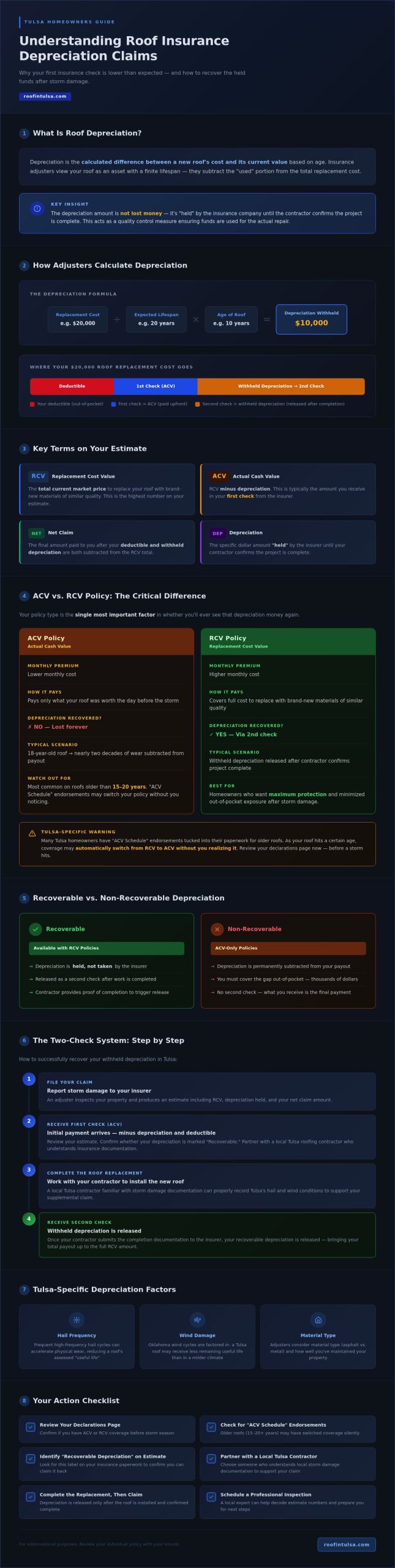
When you receive your first insurance estimate after a Tulsa storm, the total might look surprisingly low. This confusion often stems from the way adjusters calculate value; however, understanding depreciation on a roof insurance claim helps clarify why that initial check doesn’t cover the full replacement cost. Depreciation is the calculated difference between a new roof’s cost and its current value based on age.
Adjusters view your roof as an asset with a finite lifespan. When damage occurs, they subtract the “used” portion of that lifespan from the total replacement cost. This is why most insurance companies use a “two-check” system. They withhold the depreciated amount until the work is actually finished. This process acts as a quality control measure, ensuring the funds are used for the intended repair rather than other expenses. In the context of property insurance, depreciation represents the loss in value of your roof due to age, wear, and tear.
How Insurance Adjusters Calculate Depreciation
The math used by adjusters is relatively straightforward. They typically use a formula: (Replacement Cost) divided by (Expected Lifespan) multiplied by (Age). For example, if a roof costs $20,000 to replace and has a 20-year lifespan, it loses $1,000 in value every year. If the roof is 10 years old when a storm hits, the adjuster will calculate $10,000 in depreciation. Understanding depreciation on a roof insurance claim also requires looking at local environmental factors. In Tulsa, our frequent cycles of high-frequency hail and wind can accelerate physical wear. An adjuster might determine that a roof in Oklahoma has less remaining “useful life” than a similar roof in a milder climate, even if they are the same age. They also consider material type, such as asphalt vs. metal, and how well you’ve maintained the property over the years.
Common Terms You’ll See on Your Estimate
You’ll likely encounter several acronyms on your paperwork that can feel like a different language. Here are the most common terms you need to know:
- RCV (Replacement Cost Value): This is the total, current market price to replace your roof with brand-new materials of similar quality.
- ACV (Actual Cash Value): This is the RCV minus the depreciation. It’s often the amount you receive in your first check.
- Net Claim: This is the final amount paid to you by the insurance company after your deductible and the withheld depreciation are subtracted from the total.
- Depreciation: The specific dollar amount “held” by the insurance company until the contractor confirms the project is complete.
ACV vs. RCV: The Two Ways Insurance Calculates Your Roof’s Value
Your insurance policy type is the single most important factor in whether you’ll ever see that depreciation money again. While understanding depreciation on a roof insurance claim is helpful, knowing which policy you hold determines your final financial outcome. In Tulsa, many homeowners are surprised to find “ACV Schedule” endorsements tucked into their paperwork for older roofs. This means that as your roof hits a certain age, your coverage might automatically switch from full replacement to a depreciated value. This often happens without the homeowner realizing their level of protection has changed.
The difference between these two policy types often spells the difference between a smooth restoration and a heavy financial burden. It’s essential to review your declarations page before a storm hits. If you’re currently looking at an estimate and feel confused, scheduling a professional inspection with a local expert can help you decode those numbers and prepare for the next steps.
Actual Cash Value (ACV) Explained
Actual Cash Value policies are often considered the budget-friendly option for monthly premiums. However, they work by paying you only for what your roof was worth the day before the storm hit. If your roof is 18 years old, the insurer subtracts nearly two decades of wear and tear from your payout. This creates an “out-of-pocket” trap. You’re left with a check that doesn’t cover the cost of a modern, high-quality roof. This forces you to pay thousands of dollars to bridge the gap. ACV is most common on roofs older than 15 to 20 years or in specific policies designed to lower costs at the expense of long-term coverage.
Replacement Cost Value (RCV) Explained
Replacement Cost Value is the standard for comprehensive protection. With RCV, your insurance company covers the full cost of replacing your roof with modern materials of similar quality. It provides a much-needed safety net after severe weather. You can learn more about the physical process in our Roof Replacement Tulsa: The Ultimate Homeowner’s Guide. It’s helpful to remember that even with RCV, your deductible is always your responsibility. Industry experts at the Insurance Information Institute explain how homeowners insurance calculates claim payments, and the deductible is the first part of that equation. Understanding depreciation on a roof insurance claim under an RCV policy means knowing that the “held” money is eventually yours once the work is verified.
Recoverable vs. Non-Recoverable Depreciation: Can You Get Your Money Back?
The most important moment in understanding depreciation on a roof insurance claim occurs when you look at the specific labels on your adjuster’s report. You’ll likely see two distinct categories: recoverable and non-recoverable. If your estimate features a “Recoverable” label, there is good news. This indicates that the insurance company is prepared to pay you the full amount once the work is finished. However, if the amount is listed as “Non-Recoverable,” that money is effectively gone. This usually happens because of the specific way your policy was written or the age of your roofing materials.
Insurance companies don’t hold onto this money to be difficult. They withhold these funds to ensure the homeowner actually uses the payout for a professional repair roof or full replacement. It acts as a safeguard against insurance fraud and ensures the property is restored to its proper value. Recoverable depreciation is only paid out after proof of completion is submitted.
How to Identify Recoverable Depreciation on Your Claim
To find these numbers, look at the summary page of your adjuster’s report. You should see a column specifically titled “Recoverable Depreciation.” This figure represents the “held” funds we discussed earlier. The “Total Amount” or “Replacement Cost Value” listed on the summary is the most critical number; it shows the total price the insurance company agrees the job should cost. If your depreciation is listed as non-recoverable, don’t lose hope. You should still have a professional contractor review the scope of loss. Sometimes, an adjuster might misidentify a material or age, and a local expert can help provide the documentation needed to correct the record.
Factors That Make Depreciation Non-Recoverable
Several factors can lead to non-recoverable funds. The most common reason is having an Actual Cash Value (ACV) policy, which we explored in the previous section. Other times, specific policy exclusions or endorsements might limit payouts on roofs that have exceeded a certain age. According to the Insurance Information Institute, these policy structures are designed to manage the risk of older assets. Additionally, a lack of consistent roof maintenance can sometimes influence how an adjuster views the “wear and tear” portion of your claim. If the roof was already failing due to neglect before the storm, the insurer may argue that the value was already lost, making that portion of the depreciation non-recoverable. Staying proactive with your home’s care is the best way to protect your claim’s value.
How to Successfully Claim Your Recoverable Depreciation in Tulsa
Recovering your funds doesn’t have to be a “black box” experience. Once you’ve confirmed your policy allows for recovery, you need a clear roadmap to get that second check into your hands. Understanding depreciation on a roof insurance claim means realizing that the process is highly dependent on precise documentation and timing. It’s a sequential process that ensures your home is restored to its full value without leaving you with an unnecessary bill.
The first step is to hire a reputable tulsa roofing contractor who has experience working with local adjusters. Your contractor must perform the full replacement exactly as described in the insurance company’s “scope of loss.” After the installation is finished, you or your contractor will submit the final invoice and a signed “Certificate of Completion” to your insurance carrier. Once the carrier verifies the work, they process the “second check” for the withheld depreciation amount. We can help you manage this paperwork to ensure nothing is missed. Contact us for expert insurance claim assistance to get your project started.
The Importance of the Final Invoice
The final invoice is the most critical piece of evidence in your claim. It must match the price your adjuster agreed to pay. If your contractor discovers unforeseen damage during the tear-off process, they’ll need to submit “supplements.” These are common in Tulsa because high-velocity winds often damage the underlying decking in ways that aren’t visible from the ground. These supplements are added to your depreciation recovery to ensure the total cost of the repair is covered. Common mistakes, such as submitting an invoice that doesn’t reflect the actual work completed, can lead to lengthy delays or even a denial of the second check.
Working with Your Mortgage Company
Don’t be alarmed if you see your mortgage company’s name on your insurance check. Because the lender has a financial interest in your home, they’re often included as a payee. This requires an endorsement process where the bank must sign off on the funds. To speed this up, reach out to your mortgage company’s “loss draft” department as soon as the claim is opened. They’ll provide a list of required documents, which usually includes the contractor’s contract and a copy of their license. Proactively scheduling any required inspections with your lender will help you get the funds released to your contractor much faster.
Why Partnering with a Local Tulsa Roofing Contractor Simplifies the Claim
Managing the administrative burden of an insurance claim can feel like a full-time job. Between decoding adjuster reports and coordinating with your mortgage company, the stress of storm damage often lingers long after the clouds have cleared. Understanding depreciation on a roof insurance claim is much easier when you have a neighborly expert by your side. At Rescue Roofing Tulsa, we believe you shouldn’t have to navigate this bureaucracy alone. We specialize in removing that weight from your shoulders by handling the complex paperwork and documentation required to release your funds.
Local expertise matters when it comes to documenting hail and wind damage for adjusters. Our team understands the specific environmental challenges of the Tulsa area, from the high-velocity winds of spring to the heavy ice of winter. We provide the transparency you need, ensuring you understand every line item on your estimate before the first shingle is removed. Unlike national “storm chasers” who disappear once the initial check is cut, we are a locally owned entity invested in the well-being of our community. This means you get a reliable local warranty and a partner who stays until the very last check is processed.
The Rescue Roofing Claim Assistance Process
We’ve refined our methodology to build confidence at every step. Our process begins with a comprehensive initial inspection. We often identify subtle storm damage that adjusters might miss, such as granular loss or small bruising that compromises the roof’s integrity. When your insurance adjuster visits your property, we are there to meet them. We provide a professional second opinion on the roof’s condition, ensuring the scope of loss is accurate and fair. Finally, we handle the submission of all necessary certificates of completion. This unhurried, methodical approach ensures that every penny of your recoverable depreciation is accounted for and paid out correctly.
Ready to Start Your Claim?
Don’t let the confusion of depreciation or insurance jargon hold you back from protecting your home. We are committed to providing the Tulsa community with honest guidance and high-quality roof repair tulsa. Whether you are dealing with a minor leak or need a full replacement, our team is here to act as your trusted advisor. We handle the administrative details so you can focus on getting your life back to normal. Contact Rescue Roofing Tulsa for a Professional Inspection Today!
Take the Next Step Toward Your New Roof
Dealing with storm damage is stressful, but you don’t have to face the insurance company alone. By understanding depreciation on a roof insurance claim, you’ve already taken a huge step toward protecting your home’s value. You now know that your policy type is the deciding factor for recovering funds and that those “held” payments are within reach once the work is verified. Whether you’re navigating an ACV schedule or submitting a final certificate of completion, the right documentation makes all the difference.
As a Tulsa-owned and operated business, we take pride in our expertise in Oklahoma storm damage claims. We’re here to handle the administrative details and provide 24/7 emergency response when you need it most. Let us help you turn your insurance estimate into a high-quality, durable roof replacement. You can move forward with total confidence knowing your property is in expert hands.
Schedule Your Free Roof Inspection and Claim Consultation
Frequently Asked Questions
Is roof depreciation recoverable?
Yes, roof depreciation is recoverable if your policy is a Replacement Cost Value (RCV) type. Most standard homeowners policies in Oklahoma are written this way. You receive the first check for the actual cash value of the roof and then collect the second check for the withheld depreciation once the work is finished. Understanding depreciation on a roof insurance claim ensures you know to submit your final invoice to release these held funds.
How long do I have to claim my recoverable depreciation?
Most insurance companies require you to complete the work and submit the final invoice within 180 days of the date of loss. However, some policies allow up to one year. It’s critical to check your specific policy language or ask your adjuster for the exact deadline. If you’re running behind due to weather or contractor scheduling, you can often request an extension in writing to ensure you don’t lose those funds.
Can I keep the depreciation money if I don’t fix the roof?
No, you cannot keep the depreciation money without completing the repairs. The insurance company only pays out recoverable depreciation as a reimbursement for money actually spent on the restoration. If you choose not to fix the roof, you only keep the initial Actual Cash Value (ACV) check. Attempting to claim depreciation for work that wasn’t performed is considered insurance fraud and can lead to serious legal consequences and policy cancellation.
What happens if my contractor’s bid is lower than the insurance estimate?
If your contractor’s final invoice is lower than the insurance estimate, the insurance company will adjust the depreciation payout accordingly. They only pay the amount necessary to cover the actual cost of the work performed, minus your deductible. You won’t be able to “pocket” the difference between a low bid and a high estimate. This is why it’s best to focus on quality and hiring a reputable Tulsa contractor rather than seeking the lowest price.
Does every insurance policy include recoverable depreciation?
Not every policy includes this benefit. Actual Cash Value (ACV) policies don’t allow you to recover depreciation; they only pay for the value of the roof at its current age. Additionally, some RCV policies have “ACV endorsements” for roofs older than 15 or 20 years. Understanding depreciation on a roof insurance claim requires a careful review of your policy’s declarations page to confirm your specific level of coverage before a storm hits.
How do I know if I have an ACV or RCV policy?
You can find this information on the declarations page of your insurance policy, usually listed under “Loss Settlement” or “Coverage A.” Look for the terms “Replacement Cost” or “Actual Cash Value.” If you’re still unsure, you can call your insurance agent or have a professional roofing contractor review your paperwork. Knowing your policy type ahead of time helps you prepare for any potential out-of-pocket expenses when a replacement becomes necessary.
Will my insurance rates go up if I claim for storm damage in Tulsa?
In Oklahoma, insurance companies generally cannot raise your individual rates solely because you filed a claim for “acts of God,” such as hail or wind damage. However, insurance premiums are based on risk across a geographic area. If a major storm hits Tulsa and many homeowners file claims, rates for the entire zip code may increase. Filing a legitimate claim to protect your home’s value is usually the most financially sound decision you can make.
Can I use the depreciation check to pay my deductible?
No, using the depreciation check to cover your deductible is illegal in Oklahoma. State law requires homeowners to pay their own deductible, and contractors are prohibited from “waiving” or “absorbing” this cost. The depreciation check is meant to reimburse the cost of materials and labor already provided. Any agreement to bypass the deductible is considered insurance fraud. A reputable contractor will always provide a clear invoice that reflects your responsibility for the deductible amount.