




Is the cheapest roofing bid you received actually the most expensive mistake your business will make over the next twenty years? In Tulsa, we’re all too familiar with the sudden stress of a spring hailstorm or the relentless heat of an Oklahoma July. It’s natural to look at a stack of estimates and feel drawn to the lowest number, especially when your maintenance budget is already stretched thin. However, performing a commercial roof life cycle cost analysis shows that the initial sticker price is only a small fraction of what you’ll actually pay. You want to protect your investment without overspending, but the lowest bid often hides a future of frequent repairs and business interruptions.
By shifting your focus to the total cost of ownership, you can protect your building from premature failure and turn an unpredictable expense into a manageable asset. This guide provides a clear framework to compare different roofing systems for the 2026 season. You’ll learn how to move beyond the upfront price tag to achieve a predictable twenty-year maintenance schedule and a significantly lower total investment for your property. We’re here to help you navigate these complex decisions with the confidence of a local expert who understands our unique climate.
Key Takeaways
- Avoid the “initial cost trap” by understanding why the lowest bid often leads to significantly higher expenses over the lifespan of your building.
- Use a commercial roof life cycle cost analysis to transform your roofing project from a stressful emergency into a predictable 20-year financial plan.
- Identify how Tulsa’s unique hail and UV patterns specifically impact the long-term performance of TPO, EPDM, and modified bitumen systems.
- Learn a practical framework for facility managers to aggregate installation quotes, energy savings, and warranty values into a single ROI calculation.
- Discover how expert insurance claim assistance can help offset major repair expenses and protect your property’s long-term asset value.
Beyond the Lowest Bid: Why LCCA is Critical for Tulsa Commercial Property
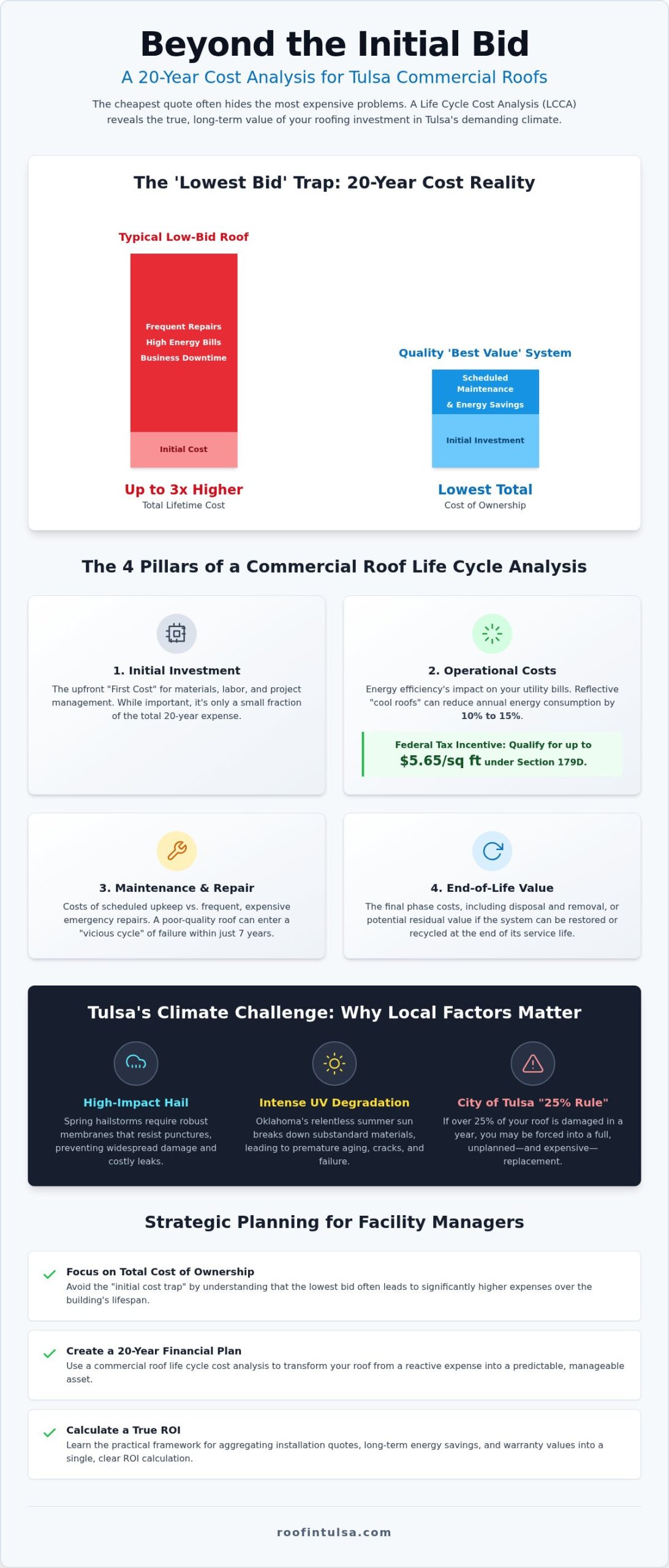
In 2026, Tulsa property owners are facing a shift in how they manage their buildings. A commercial roof is no longer just a line item on an expense report; it’s a critical asset that requires strategic management. When you receive multiple bids for a project, the temptation to choose the lowest number is strong. However, that initial price tag is often a financial trap. In our volatile Oklahoma climate, a “cheap” roof frequently results in lifetime expenses that are three times higher than a quality installation. A professional commercial roof life cycle cost analysis allows you to see past the immediate cost and understand the true value of your investment over its entire lifespan.
What Exactly is Life Cycle Cost Analysis?
Life-cycle cost analysis (LCCA) is a financial tool for evaluating the long-term economic performance of a building enclosure. It helps you move beyond “First Cost” thinking and look at the “Total Cost of Ownership” (TCO). While the first cost is simply what you pay for materials and labor today, the TCO includes every dollar you’ll spend until the roof is eventually replaced again. This framework is essential for deciding whether to repair a leak, restore a membrane, or commit to a full replacement. It considers several factors:
- Initial capital outlay and project management costs.
- Expected maintenance and routine repair schedules.
- Energy consumption and HVAC efficiency impacts.
- Potential downtime costs and tenant disruptions.
- Residual value or disposal costs at the end of the service life.
The Hidden Risks of ‘Lowest Bid’ Roofing
Low-cost bids often achieve their pricing by cutting corners in areas that aren’t immediately visible. This might include using thinner membranes, lower-grade insulation, or substandard edge metal and flashing. In Tulsa, these shortcuts are dangerous. Under the 2024 International Building Code adopted in 2026, specific requirements for wind uplift and moisture barriers are mandatory for a reason. Cutting corners leads to a “vicious cycle” where the cost of frequent repairs exceeds the price of a new, high-quality roof within just seven years.
Tulsa’s weather doesn’t play favorites. Between intense UV degradation in the summer and the high-impact hailstorms of spring, a substandard roof will fail prematurely. This leads to business interruptions that can cost far more than the original roofing project. Furthermore, the City of Tulsa enforces a “25% Rule,” meaning if more than a quarter of your roof is damaged within a year, you may be forced into a full tear-off. Using a commercial roof life cycle cost analysis ensures you choose a system built to withstand these local pressures while keeping your long-term budget predictable and secure.
The Four Pillars of Commercial Roof Life Cycle Costing
A comprehensive commercial roof life cycle cost analysis is built on four essential pillars. These categories help you move away from viewing a roof as a one-time bill and toward viewing it as a 20 year financial commitment. By breaking down costs into initial investment, operational expenses, maintenance, and end of life disposal, you gain a clear picture of your total liability. Understanding these buckets allows CFOs and facility managers to make decisions based on data rather than just the lowest estimate on the table.
Initial Investment vs. Energy Performance
Selecting the right materials involves weighing the upfront price against future utility savings. For instance, reflective “cool roof” membranes like TPO can reduce a building’s annual energy consumption by 10% to 15%. While these materials might require a slightly higher initial outlay, the operational savings over two decades often pay for the difference several times over. High R-value insulation also plays a vital role in keeping your HVAC system from working overtime during our 100 degree Tulsa summers.
In 2026, these energy efficient choices are even more attractive due to federal tax incentives. Under Section 179D, you may qualify for a deduction of up to $5.65 per square foot for roofing improvements that meet specific energy standards. This significantly offsets the “first cost” and improves your overall ROI. Choosing a system that balances durability with thermal performance is the smartest way to lower your total cost of ownership.
Maintenance: The Most Overlooked Cost Bucket
Maintenance is where many Tulsa business owners lose the most money over time. It’s helpful to contrast the predictable expense of a scheduled inspection plan with the chaotic costs of emergency storm repairs. When you delay minor fixes, you’re essentially choosing “deferred maintenance,” which is the primary driver of high life cycle costs. A small leak ignored today can lead to saturated insulation and decking rot by next season, potentially doubling the cost of the eventual repair.
For a deeper look at managing these assets, you can read our Commercial Roofing in Tulsa: A Complete Guide for Business Owners. Proactive care ensures that your roof reaches its full 20 or 30 year potential rather than failing at year 12. If you aren’t sure where your current system stands, a professional commercial roof inspection can identify potential issues before they become budget breaking emergencies.
Finally, don’t forget end of life costs. When the time comes for a replacement, you must account for the removal and disposal of old materials. In 2026, environmental regulations and landfill fees continue to rise, making it important to choose systems that are recyclable or can be restored rather than fully torn off. Factoring in these “cradle to grave” expenses is the only way to master a true commercial roof life cycle cost analysis.
Tulsa Weather Factors: How Oklahoma Climate Impacts LCCA
A realistic commercial roof life cycle cost analysis in Oklahoma must account for the high probability of major weather events. While generic industry data might suggest a membrane lasts thirty years, the reality in Tulsa is often different. Our region experiences some of the most intense environmental stress in the country. Between sudden spring hailstorms and relentless summer heat, your roofing materials are constantly under attack. When we calculate long-term value, we look at how different systems like TPO, EPDM, and Modified Bitumen stand up to these local forces. For example, while EPDM is highly durable, it can be more susceptible to puncture damage from large hail compared to a reinforced, thicker 80-mil TPO system.
Wind is another silent budget killer. Tulsa’s frequent high-wind events test the limits of even the best installations. If a system isn’t designed with the correct wind uplift rating, the entire structure is at risk. Proper drainage and well-maintained gutters are also critical. In our heavy downpours, standing water can quickly lead to membrane degradation and structural weight issues. Ensuring your gutter system is clear and functional is one of the simplest ways to prevent premature failure and keep your life cycle costs manageable.
Storm Resilience as a Cost-Saving Strategy
Investing in storm-resistant upgrades is a proactive way to lower your total cost of ownership. Many Tulsa owners are now opting for UL 2218 Class 4 impact-resistant materials. These systems are specifically engineered to withstand the energy of falling hail without fracturing. While the initial investment is higher, these upgrades often pay for themselves by reducing the frequency of insurance claims and potentially lowering your deductibles over time.
We also pay close attention to wind uplift during the planning phase. Wind uplift is the force created by air pressure differences that pulls a roofing system away from the building deck, often starting at the corners and edges. By using enhanced fastening patterns and high-quality edge metal, we ensure your roof stays put during Oklahoma’s 80 mph gusts. This level of resilience is a cornerstone of a smart commercial roof life cycle cost analysis for 2026.
Thermal Cycling and Membrane Stress
Oklahoma’s temperature swings are legendary. It’s common to see 100°F afternoons followed by rapid cooling, or bitter winter freezes that last for weeks. This constant thermal cycling causes roofing materials to expand and contract daily. This movement puts immense stress on seams and adhesives. In our experience, “cheaper” adhesives often lose their flexibility and fail early in this environment, leading to costly leaks that appear long before the membrane itself has aged out.
To combat this, we emphasize the use of high-performance flashing and flexible sealants at all penetration points. These areas are the most vulnerable to thermal movement. By choosing materials that can handle the “stretch” of an Oklahoma summer, you avoid the recurring repair costs that plague lower-quality installations. Protecting these transition points ensures your roof remains watertight through every season, safeguarding your building’s interior and your long-term maintenance budget.
Calculating Your ROI: A Step-by-Step Framework for Facility Managers
Calculating the true return on investment for a commercial roofing project requires a methodical approach. It’s about looking past the immediate quote to see the financial reality of the next two decades. A commercial roof life cycle cost analysis provides a structured way to compare different bids on an even playing field. This process moves the conversation from “how much does it cost today?” to “how much will this asset cost over its life?” Follow these five steps to build a reliable budget for your facility.
Setting Your Study Period
The “Study Period” is the timeframe you use for your financial calculations. For most commercial properties in Tulsa, a 20 year period is the sweet spot. This duration is long enough to capture major maintenance events but short enough to remain financially relevant. If you plan to sell the building in ten years, align your study period with that hold time. However, don’t forget to account for the “residual value” of a high quality roof. A well-maintained system with ten years of life remaining can be a strong selling point for a future buyer.
Once you’ve set your period, aggregate every initial installation quote and pay close attention to the material warranties. It’s helpful to remember that a 30 year warranty doesn’t mean you’ll have zero maintenance costs. Most warranties require documented annual inspections to remain valid. Next, estimate your annual maintenance based on local Tulsa averages. You must also factor in energy savings, such as the 10% to 15% reduction in HVAC costs provided by reflective membranes. Don’t forget the 2026 tax benefits, like the Section 179D deduction of up to $5.65 per square foot for energy efficient systems. Finally, calculate the Net Present Value (NPV). With 2026 commercial interest rates ranging from 5.50% to 8.50%, the time value of money is a critical factor in your ROI.
Comparing Material Lifespans
Choosing between TPO, PVC, and Modified Bitumen requires understanding their distinct lifespans in Oklahoma’s climate. While TPO is the current gold standard for reflectivity and heat resistance, Modified Bitumen offers multi-layer redundancy. This is often preferred for roofs with high foot traffic or heavy equipment. If you’re seeing water stains or cracked membranes now, it’s time to evaluate these options before a small leak becomes a major structural issue. Check out our guide on Signs You Need a New Roof in Oklahoma to see if your current system is reaching its limit.
Ready to see the data for your own property? Our team can help you perform a professional commercial roof life cycle cost analysis to ensure you make the most informed decision for your business.
Maximizing Asset Value with Rescue Roofing Tulsa
At Rescue Roofing Tulsa, we believe a quote should be more than a single number on a page. We integrate a detailed commercial roof life cycle cost analysis into our consultation process to give you a clear financial roadmap. This allows you to see the true economic impact of your roofing decisions over the next twenty years. We focus on materials that meet the 2024 International Building Code requirements effective in 2026, ensuring your property is resilient against the specific wind and hail patterns of our region. Our goal is to move you away from the stress of emergency fixes and toward the confidence of a managed asset.
Leveraging Insurance for Better LCCA
One of the most effective ways to improve your commercial roof life cycle cost analysis is through expert insurance claim assistance. If your building has suffered storm damage, a successful claim can cover a significant portion of your replacement costs. This effectively resets your initial capital outlay, which dramatically increases your long-term ROI. We specialize in documenting moisture intrusion and decking rot to justify full replacements when a simple repair isn’t enough to protect the structure.
We provide the photographic evidence and technical reports needed to prove that a partial repair might violate the City of Tulsa’s 25% Rule. By securing a full replacement through insurance, you transform a potential financial liability into a fresh start with a new, long-term warranty. Our team handles the complex paperwork and communication with adjusters. This removes the administrative burden from your shoulders so you can focus on running your business while we secure your building’s future.
Your Local Partner in Long-Term Protection
We position ourselves as a steady partner for Tulsa property owners rather than just another contractor. Our 24/7 emergency repair service acts as a vital safety net. This responsiveness prevents minor storm damage from escalating into a premature roof failure that could ruin your financial projections. We maintain high-level industry certifications to ensure every installation follows the rigorous standards necessary to meet our twenty-year performance goals.
Our proactive approach includes setting up a predictable maintenance schedule that aligns with your long-term budget. This prevents the deferred maintenance trap that often leads to business interruptions. When you work with a local expert, you’re not just buying a roof; you’re securing a guide to navigate the technical and administrative challenges of property management in Oklahoma. Ready to move beyond the lowest bid and invest in long-term durability? Get a Commercial Roofing Quote in Tulsa and see the long-term value for yourself.
Securing Your Tulsa Property for the Decades Ahead
Managing a commercial property in Tulsa requires balancing immediate budgets with the harsh reality of our volatile weather. You’ve seen how the lowest bid often hides high long-term expenses that can drain your resources over time. By utilizing a professional commercial roof life cycle cost analysis, you can accurately predict maintenance needs and maximize the lifespan of your investment. It’s about shifting your mindset from reactive repairs to proactive asset management. This data-driven approach ensures your building remains protected without the stress of unpredictable financial surprises.
Rescue Roofing Tulsa is here to simplify this complex process for you. As a locally owned and operated business, we understand the specific environmental challenges our community faces in 2026. We remove the administrative burden from your plate by providing expert insurance claim assistance and 24/7 emergency storm repair when you need it most. Our team is dedicated to building lasting relationships with our neighbors through transparency and dependable craftsmanship. You don’t have to navigate these technical decisions alone.
Request Your Custom Commercial Roof Life Cycle Analysis Today and gain the financial clarity you need for your next project. We look forward to helping you protect your business and your bottom line for years to come.
Frequently Asked Questions
What is the typical life cycle of a commercial flat roof in Tulsa?
A commercial flat roof in Tulsa typically lasts between 20 and 30 years for single ply membranes like TPO or PVC. Metal systems can extend up to 50 years, while asphalt based roofs often fall in the 15 to 40 year range. These lifespans depend heavily on local weather exposure and proactive care. Intense Oklahoma heat and frequent hail can shorten these windows significantly if the system isn’t specifically designed for our 2026 climate standards.
How much does a commercial roof life cycle cost analysis cost to perform?
The cost to perform a professional analysis varies based on the building’s size and the complexity of the existing roofing system. Many local experts include this evaluation as part of a comprehensive commercial bid or asset management consultation. Investing in this data early prevents expensive surprises later. It’s a strategic tool that helps you understand the total cost of ownership rather than just the initial price of materials and labor.
Can LCCA help me decide between a roof repair and a full replacement?
Yes, LCCA is the most reliable way to make this decision. Generally, a repair is recommended if the cost is less than 15% of a total replacement and the roof is under 12 years old. If repair costs exceed 20% or the system is over 20 years old, a full replacement is usually the better long term value. A commercial roof life cycle cost analysis clarifies which path leads to the lowest total investment for your property.
Do insurance companies recognize Life Cycle Cost Analysis for claims?
Insurance carriers increasingly value data that justifies a full replacement over minor repairs, especially regarding code compliance. In 2026, Oklahoma follows the 2024 International Building Code. If your analysis shows that a repair won’t meet these safety standards or will lead to premature failure, it provides a strong technical argument for your adjuster. Professional documentation of storm damage and material degradation is essential for navigating complex commercial claims and securing the full value of your policy.
How often should I schedule maintenance to keep my life cycle costs low?
You should schedule professional inspections at least twice a year, typically in the spring and fall. In Tulsa, it’s also vital to request an inspection after any major hailstorm or high wind event. Regular maintenance prevents small issues from turning into saturated insulation or decking rot. By catching leaks early, you ensure your roof reaches its full 20 or 30 year potential while keeping your annual operating budget predictable and manageable.
What are the most durable commercial roofing materials for Oklahoma hail?
Thicker 80-mil TPO membranes and UL 2218 Class 4 rated materials are currently the gold standard for hail resistance in Tulsa. Metal roofing also offers exceptional durability with a lifespan of 40 to 50 years. These high performance systems are designed to withstand the impact of large hail without fracturing. Choosing impact resistant materials is a primary strategy for lowering your long term expenses and reducing the frequency of disruptive insurance claims.
Does a ‘Cool Roof’ really save enough money to justify the higher cost?
A reflective “cool roof” can reduce your building’s annual energy consumption by 10% to 15%. For a typical 20,000 square foot building in Tulsa, this can result in savings of approximately $3,600 every year. These utility savings, combined with 2026 federal tax deductions like Section 179D, often pay for the higher initial material cost within just a few years. It’s an effective way to improve your commercial roof life cycle cost analysis results.
Is LCCA only for large industrial buildings or for small businesses too?
Life cycle costing is valuable for any property owner, regardless of the building’s size. Small businesses often have tighter margins, making an unpredictable roofing emergency even more damaging to their cash flow. Whether you manage a small retail storefront or a large condominium complex, understanding your 20 year maintenance schedule allows you to plan for future expenses. It ensures that your roofing system remains a managed asset rather than a sudden financial burden.