




What if that first insurance check for your roof replacement isn’t actually the full amount you’re owed, but just a down payment on the total value of your claim? It’s incredibly stressful to open an insurance settlement letter only to see a number that feels thousands of dollars short of what a new roof actually costs here in Tulsa. You’ve paid your premiums for years, and now, when you finally need help after an Oklahoma storm, it can feel like the insurance company is leaving you to cover the difference yourself.
We understand that feeling of confusion, especially when you’re trying to figure out what is recoverable depreciation on a roof. The good news is that this “missing” money isn’t gone; it’s simply held back until the work is finished. This guide will show you exactly how to unlock the full value of your claim and get your roof replaced with zero out-of-pocket confusion. We’ll walk through the specific steps to secure your second check, explain the tricky terminology, and show you how to find a local contractor who handles the administrative burden for you.
Key Takeaways
- Learn the difference between Actual Cash Value and Replacement Cost Value so you don’t feel shortchanged by the initial insurance offer.
- Discover how the “two-check” system works and why your insurer holds back a portion of your settlement until the new roof is installed.
- Understand exactly what is recoverable depreciation on a roof and how it acts as a guaranteed reimbursement for your project.
- Find out which documents, like the Certificate of Completion, are necessary to release your final funds and finish your claim.
- See how partnering with a local Tulsa roofing expert can simplify the administrative process and ensure you receive every dollar you’re owed.
Understanding ACV vs. RCV: The Foundation of Your Claim
When you receive your insurance estimate, you’ll see two different totals. Understanding the difference between Actual Cash Value (ACV) and Replacement Cost Value (RCV) is the first step in making sense of your claim. ACV is essentially the “garage sale” value of your current roof. It accounts for the years of Oklahoma sun and wind that have worn down your shingles. In contrast, RCV is the real-world cost to purchase and install a brand-new roof at today’s prices.
The distance between these two numbers is where many homeowners get confused. This gap represents the depreciation. If you have a Replacement Cost Value policy, which is common for most Tulsa homeowners, that gap is “recoverable.” Essentially, you’re entitled to the full cost of the roof, but the insurance company doesn’t hand it all over at once. Understanding what is recoverable depreciation on a roof helps you realize that the first check isn’t the final word on your claim’s value. You only receive these additional funds if your policy specifically includes RCV coverage; otherwise, you’re only entitled to the depreciated value.
What Does ‘Recoverable’ Actually Mean?
Insurance companies use the term “recoverable” as a promise of future payment. It isn’t an immediate payout because insurers want to verify that the repairs are actually performed. By holding back a portion of the funds, the company ensures the money is used to restore the home’s value rather than being spent elsewhere. It’s a system of checks and balances. Recoverable depreciation is the portion of your claim released only after the work is completed.
How Age and Condition Affect the Calculation
In Tulsa, adjusters determine your roof’s “useful life” based on local weather patterns and material quality. Shingle type plays a major role here. Standard asphalt shingles might be depreciated more aggressively than durable metal roofing because they have a shorter expected lifespan. Age is the most significant factor in this math. A 15-year-old roof has significantly more depreciation than a 5-year-old one because it has reached a larger percentage of its expected lifespan. This calculation determines how much of the total claim will be “held back” until your contractor finishes the installation. Knowing what is recoverable depreciation on a roof allows you to plan for these two separate payments without feeling stressed by the initial estimate.
The Two-Check System: How Roof Insurance Payments Work
Receiving an insurance settlement can feel like a complex puzzle, but the process usually follows a predictable five-step sequence. This “two-check” system is designed to protect both you and the insurer. It ensures that the funds are used specifically for the restoration of your home. Understanding this flow helps remove the anxiety of seeing a low initial number on your settlement letter.
- Step 1: The ACV Check. Your insurer issues a check for the Actual Cash Value. This amount is the current value of your roof minus your deductible.
- Step 2: Selecting a Partner. You hire a qualified Tulsa roofing contractor to begin the work. This first check is often used to cover material costs and secure your spot on the schedule.
- Step 3: Installation. The roof replacement is completed according to the agreed-upon scope.
- Step 4: Verification. Your contractor submits a final, itemized invoice and a Certificate of Completion to the insurance carrier.
- Step 5: The Final Payout. The insurer releases the remaining funds, which is the recoverable depreciation.
By following these steps, you ensure that you aren’t left guessing about what is recoverable depreciation on a roof or when you will receive it. It’s a methodical path to a fully funded project. If you’re feeling overwhelmed by the paperwork, you can ask a local expert to review your claim to ensure everything is on the right track.
The Role of Your Deductible
It’s vital to remember that your deductible is your financial responsibility. This amount is always paid by the homeowner, not the insurance company. The insurer subtracts this from the first check they send you, not the second. Be extremely cautious of any “storm chasers” who offer to waive your deductible. In Oklahoma, this practice is often a red flag for insurance fraud or sub-par workmanship. A reputable company will always be transparent about these costs from day one. They’ll help you understand how your deductible fits into the total project budget without cutting corners.
Why the First Check Seems Too Small
It’s completely normal to feel a sense of shock when you see that first check. Often, it covers only a fraction of the total replacement cost. Don’t worry; this is just the “start” of your project funds. You can use this initial payment to secure a trusted roofing contractor and get the process moving. The insurance company holds back the rest of the money to confirm the work actually gets done. Once the job is finished and the final paperwork is filed, the second check will cover the remaining balance of the replacement cost.
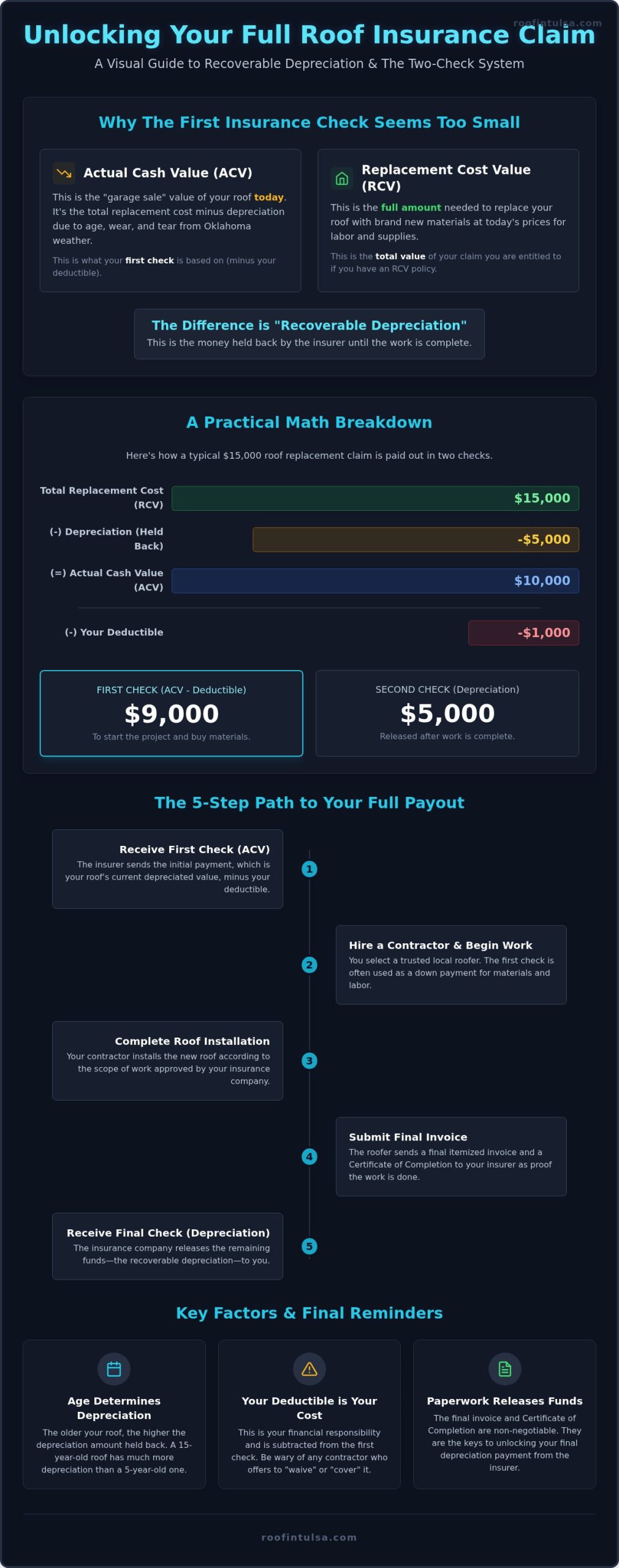
Calculating Your Roof’s Value: A Practical Math Breakdown
Seeing the numbers on an insurance settlement statement can be overwhelming. Let’s look at a common scenario for a Tulsa home to simplify the math and see how the payments actually work. Imagine your roof replacement costs $20,000. If your roof is 10 years old, the insurance adjuster might calculate a 50% depreciation rate. This means they subtract $10,000 from the total value because of the roof’s age and wear. This initial reduction reflects the “Actual Cash Value” of the shingles that have been protecting your home for a decade.
Next, the insurance company subtracts your deductible. If you have a $2,000 deductible, the calculation looks like this: $20,000 (Total Replacement Cost) minus $10,000 (Depreciation) minus $2,000 (Deductible). In this case, your first check will be for only $8,000. While this feels like a small amount for a major project, the $10,000 that was subtracted for age is the amount we call recoverable depreciation. You’ll get that money back in a second check once the new roof is installed. Understanding what is recoverable depreciation on a roof helps you realize that your total benefit is still $18,000, even if the first check doesn’t cover the full cost of materials.
Recoverable vs. Non-Recoverable Depreciation
Not every policy allows you to get this money back. If you have an “ACV-only” policy, the depreciation is non-recoverable. This means the $10,000 from our example would stay in the insurance company’s pocket, and you’d have to pay it yourself. You can find this detail on your policy’s declarations page. Look for terms like “Replacement Cost Value” to ensure you have the better coverage. In many modern Oklahoma estimates, labor is considered non-depreciable. This means the insurer only subtracts value from the physical materials, which can help increase your initial payout and lower your out-of-pocket stress.
What Are Insurance Supplements?
Sometimes the initial estimate doesn’t cover everything. When a contractor removes the old shingles, they might find rotted decking or extra layers of felt that the adjuster missed from the ground. These items are called supplements. Your contractor will submit these additional costs to the insurer to be added to the total Replacement Cost Value (RCV) of the claim. This ensures the full cost of the repair is covered by the insurance company. Having a Tulsa roofing expert present during the initial adjustment is vital. They can point out these details early, which makes the process much smoother. When you know what is recoverable depreciation on a roof and how supplements work, you can manage your project with confidence and peace of mind.
How to Release Your Depreciation Funds from the Insurer
Once your new roof is installed, the physical work is over, but the administrative process enters its final phase. To receive your second check, you must prove to the insurance company that the repairs were completed exactly as outlined in the original scope. Understanding what is recoverable depreciation on a roof includes knowing how to trigger that final payment. The most important document in this step is the Certificate of Completion. This form is a formal statement, usually signed by both you and your contractor, confirming that the roof replacement is finished and meets all professional standards.
In addition to the Certificate of Completion, you must submit a final, itemized invoice from your roofing company. In 2026, many insurance carriers have increased their documentation requirements. It’s now standard for adjusters to request comprehensive photo documentation of the finished project, including close-ups of the new shingles, flashing, and ventilation. Once these documents are submitted, the timeline for receiving your final check is typically 7 to 14 days. If your paperwork is in order, the carrier will release the funds that were previously “held back” as depreciation.
Handling the Mortgage Company Endorsement
If you have a mortgage, don’t be surprised to see your bank’s name on the settlement check. The lender has a financial interest in your home and wants to ensure the funds are actually used for repairs. This can be a frustrating hurdle, as you’ll need to send the check to your mortgage company’s loss draft department for an endorsement. To speed this up, ask your bank if they require a third-party inspection of the work. Providing them with your contractor’s final invoice and the insurance scope of loss immediately can help bypass weeks of waiting. If you need help managing this paperwork, our team can assist with the insurance claim process to ensure your funds are released as quickly as possible.
Common Reasons Depreciation is Denied
Even when you understand what is recoverable depreciation on a roof, certain pitfalls can lead to a denial. Missing the filing deadline is a frequent mistake; most Oklahoma policies require you to submit your final proof of completion within 180 to 365 days of the date of loss. Another risk is “cutting corners.” If you decide to skip certain repairs mentioned in the adjuster’s report to save money, the insurer may reduce your depreciation payout proportionally. Finally, ensure your contractor’s final invoice matches the adjuster’s scope. Any inconsistencies in material types or labor costs can trigger an audit, delaying your payment or resulting in a lower reimbursement than expected.
How Rescue Roofing Tulsa Simplifies Tulsa Insurance Claims
Oklahoma storms are notoriously unpredictable. Between the sudden hail and high straight-line winds, Tulsa homeowners often find themselves staring at a damaged roof and a stack of confusing insurance paperwork. At Rescue Roofing Tulsa, we believe you shouldn’t have to navigate the administrative burden of a claim by yourself. Our specialized insurance claim assistance service is designed to remove the friction from the process. We don’t just fix roofs; we act as your local advocate from the moment you call us until that final check arrives in your mailbox.
One of the most critical steps we take is meeting your insurance adjuster on-site. By being present during the initial inspection, we can point out specific storm damage that might be overlooked from the ground. This ensures that your Actual Cash Value is calculated fairly from day one. Once the project is underway, we manage the final invoicing and documentation required to release your funds. We understand exactly what is recoverable depreciation on a roof and how to present the “proof of loss” in a way that minimizes delays with your carrier.
Our team lives and works in this community. We’ve seen how Tulsa’s intense storm seasons can create a backlog of claims, often slowing down the reimbursement process for months. Because we are familiar with local Oklahoma storm damage patterns, we know how to document hail impact and wind uplift according to the standards adjusters expect. This proactive approach helps keep your claim moving forward even during peak storm season when insurance companies are at their busiest.
Expertise in Tulsa Roofing Codes
Building regulations are constantly evolving to keep homes safer. We ensure every residential roof replacement we perform meets the local 2026 Tulsa building codes. This is a vital part of your claim because many older roofs don’t meet current safety standards for ventilation or shingle attachment. These code upgrades are often handled as a separate part of your insurance claim, and we help document these requirements so your insurer covers the necessary improvements. Our commitment to using high-quality materials means your home will be better protected against future Oklahoma weather events.
Get a Professional Roof Inspection Today
Filing a claim without a professional assessment can lead to denials or underpayment. We provide a thorough inspection to determine if your roof has sustained enough damage to warrant a full replacement. This gives you the documentation you need to file with confidence. If you’re still wondering what is recoverable depreciation on a roof or how to start your claim, our team is here to guide you through every step. Contact Rescue Roofing Tulsa for a Free Inspection and let us handle the heavy lifting for you.
Secure Your Full Insurance Reimbursement Today
Navigating an insurance claim after a Tulsa storm doesn’t have to be a source of anxiety. Now that you understand what is recoverable depreciation on a roof, you can move forward with the confidence that your initial check is just the beginning of your project’s funding. By documenting the work correctly and following the two-check system, you ensure that your home’s value is fully restored without unnecessary out-of-pocket costs.
As A+ Rated Tulsa Roofing Experts, Rescue Roofing Tulsa is here to handle the heavy lifting for you. We provide specialized insurance claim assistance and 24/7 emergency storm response to protect your property when it matters most. You don’t have to manage the bank endorsements or final invoicing alone. Our team is dedicated to being your trusted local partner throughout the entire replacement process.
Take the first step toward a worry-free roof replacement. Schedule Your Free Storm Damage Inspection Today and let us help you unlock the full value of your claim. We’re ready to help you protect your home with the quality and care you deserve.
Frequently Asked Questions
Can I keep the recoverable depreciation money if I don’t fix the roof?
No, you cannot keep this money without completing the repairs. Recoverable depreciation is a reimbursement for expenses you’ve actually incurred during the replacement process. If you choose not to replace the roof, the insurance company simply won’t release the second check. You’re only entitled to keep the Actual Cash Value payment, which was the first check you received. This system ensures that insurance settlements are used to maintain the home’s safety.
What happens if my contractor’s bill is lower than the insurance estimate?
If your contractor’s final bill is lower than the insurance estimate, the insurer will reduce the depreciation payout accordingly. They only reimburse you for the amount you actually spent on the project. You won’t “pocket” the difference between a low bid and the high estimate. For example, if the estimate was for $20,000 but the final bill was $18,000, the insurance company will adjust the second check so the total payout matches the $18,000 cost.
How long do I have to claim my recoverable depreciation in Oklahoma?
In Oklahoma, most policies require you to complete repairs and submit your final invoice within 180 to 365 days from the date of the storm. It’s vital to check your specific policy declarations for the exact 2026 deadline. If you miss this window, the funds stay with the insurer. We recommend starting your project early to avoid weather delays that could cause you to miss out on what is recoverable depreciation on a roof.
Why is my mortgage company listed on my insurance check?
Your mortgage company is listed because they have a legal stake in your home’s condition and value. They want to guarantee that the insurance funds are used to restore the property rather than being spent elsewhere. You’ll need to work with their loss draft department to get the check endorsed. This process often requires a final inspection or a copy of the contractor’s invoice. We often help our Tulsa clients navigate these bank requirements to keep the project moving.
Is the deductible taken out of the first check or the second?
The deductible is always subtracted from the first check, which is the Actual Cash Value payment. The insurance company expects you to pay this amount directly to your contractor when the work begins. The second check, which covers the depreciation, is issued only after the job is done. It’s designed to bring the total payment up to the full replacement cost, but it doesn’t include the deductible you’ve already paid from your own pocket.
Can my roofing contractor pay my deductible for me?
No, it’s actually illegal in Oklahoma for a contractor to cover your deductible. This practice is a form of insurance fraud that can lead to serious legal consequences for both the homeowner and the roofer. When people ask what is recoverable depreciation on a roof, they often worry about the out-of-pocket costs. However, a trustworthy contractor will help you plan your budget honestly rather than offering “free” deductibles that compromise your claim’s integrity and quality.
What if I have an ACV-only policy instead of an RCV policy?
If you have an ACV-only policy, you aren’t eligible for a second check at all. These policies only pay for the value of the roof as it stood on the day of the storm, accounting for its age and wear. You’ll be responsible for paying the entire difference between that depreciated amount and the cost of a brand-new roof. It’s a much higher out-of-pocket expense compared to the Replacement Cost Value policies held by most Tulsa homeowners.
Do I have to use the same materials as my old roof to get the depreciation?
You don’t have to use the exact same materials, but you must complete the replacement to receive the second check. Many Tulsa homeowners choose to upgrade to impact-resistant shingles during this process. The insurance company will still release the depreciation based on their original estimate for standard materials. This is an excellent opportunity to improve your home’s durability against future hail storms while the insurance company covers the bulk of the baseline replacement costs.