



Table of Contents
- What Drives the Cost of Roof Storm Damage Repairs in Oklahoma
- Hail Damage Roof Repair Cost: What You Can Expect
- The Roof Insurance Claim Process: A Step-by-Step Roadmap
- Your Roof Inspection Checklist After a Storm
- Repair vs. Replacement: How to Decide
- Oklahoma Building Codes and Tax Implications for Storm Damage
- Frequently Asked Questions
Last Updated: September 11, 2026
What Drives the Cost of Roof Storm Damage Repairs in Oklahoma
Storm damage repair pricing is never a flat number, and any contractor who quotes one before inspecting your roof is guessing. This guide from Rescue Roofing breaks down the real variables that move the cost of roof storm damage repairs in Oklahoma, from storm severity to material grade, so you can read an estimate with confidence.
Two homes on the same street can receive quotes that differ by thousands of dollars after the same hail event. The difference comes down to damage type, roof geometry, and material selection.
Storm Severity and Damage Type
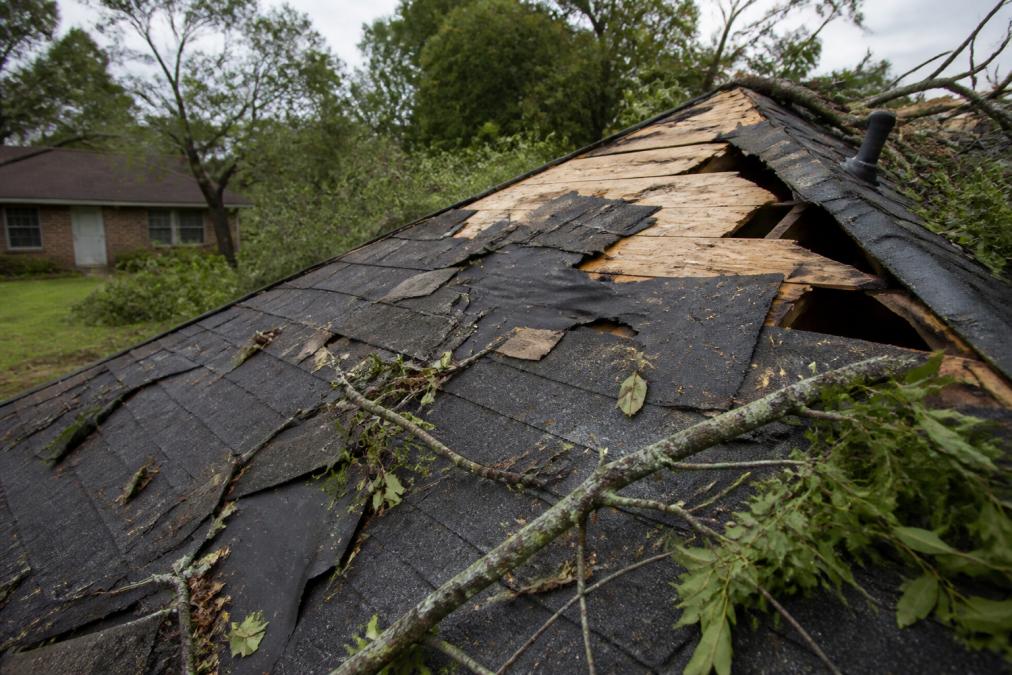
Hail damage is the most common driver of repair costs in this region. Hailstones crack the mat behind asphalt shingles, dislodge granules, and bruise the substrate, and the damage often isn’t visible from the ground. Wind uplift is the second major factor: sustained gusts break the sealant bond between shingles, lifting them at the edges and exposing underlayment. Debris impact from fallen limbs and storm debris adds punctures and cracked flashing to the list.
The size and density of the hail matters as much as the storm itself. Larger stones cause deeper impact damage and typically require replacing more shingles, while smaller stones may only require spot repairs.
Roof Size, Pitch, and Material Grade
Square footage sets the baseline for every estimate, since materials and labor scale directly with roof area. Pitch matters just as much: steep roofs require fall protection, staging, and slower, more careful labor, all of which raise the labor line. Material grade is the third lever. Standard three-tab asphalt shingles cost less per square than architectural shingles, while higher hail impact resistance ratings carry a higher material cost but often earn insurance discounts.
What most homeowners miss is that underlayment and flashing upgrades are frequently folded into a repair quote without explanation. Ask your contractor to itemize those line items before you sign.
Hail Damage Roof Repair Cost: What You Can Expect
Hail damage roof repair cost depends on three things: how many shingles need replacement, whether underlayment or decking was compromised, and how steep or complex your roof is. Repairs confined to a few shingles cost far less than repairs that require tearing off sections of decking.
Because every roof is different, we don’t publish flat pricing. Rescue Roofing provides accurate aerial quotes so you can see a real number before anyone climbs a ladder.
The table below shows how damage type maps to repair scope and typical out-of-pocket exposure:
| Damage Type | Typical Repair Scope | Out-of-Pocket Exposure |
|---|---|---|
| Minor shingle bruising | Spot repair, 1-2 squares | Deductible only |
| Wind-lifted shingles | Partial re-roof, underlayment | Deductible + upgrades |
| Hail-cracked mat | Full slope replacement | Deductible + depreciation |
| Decking water intrusion | Decking + underlayment + shingles | Deductible + structural |
Never authorize a repair that skips underlayment replacement. A shingle patch over compromised underlayment traps moisture and causes water intrusion within one or two seasons, turning a small claim into a full replacement.
The Roof Insurance Claim Process: A Step-by-Step Roadmap
The roof insurance claim process moves faster when you document everything before you call your insurer. Most delays trace back to incomplete evidence, not slow adjusters.
- Photograph all damage from the ground before any temporary repairs
- File your claim and request a written claim number
- Schedule a professional roof inspection and keep the report
- Meet the claims adjuster on-site with your contractor present
- Review the adjuster’s scope line by line against your inspection report
- Negotiate disputed items with photo evidence and code citations
- Approve the final scope and schedule the work
Rescue Roofing handles steps three through six for our customers, communicating directly with insurance companies and adjusters so you aren’t translating between two parties who never speak.
Ask your adjuster for the scope sheet in writing before you sign anything. Scope sheets often list “matching shingles” at actual cash value, which means depreciation gets deducted. A replacement cost value endorsement recovers that difference after the work is complete.
What to Do If Your Claim Is Denied
A denial is not the end of the claim. Most denials cite one of three reasons: damage below your deductible, a determination that damage predates the storm, or a finding that the damage is cosmetic rather than functional.
You have the right to appeal. Request the denial in writing, then submit a contractor’s inspection report that documents functional damage with photographs, measurements, and building code references. If the appeal fails, most policies allow a formal appraisal process where each side hires an independent appraiser.
The gap competitors miss here is documentation quality. A one-page denial letter is easy to overturn with a fifteen-page inspection report. A vague appeal rarely wins.
Your Roof Inspection Checklist After a Storm
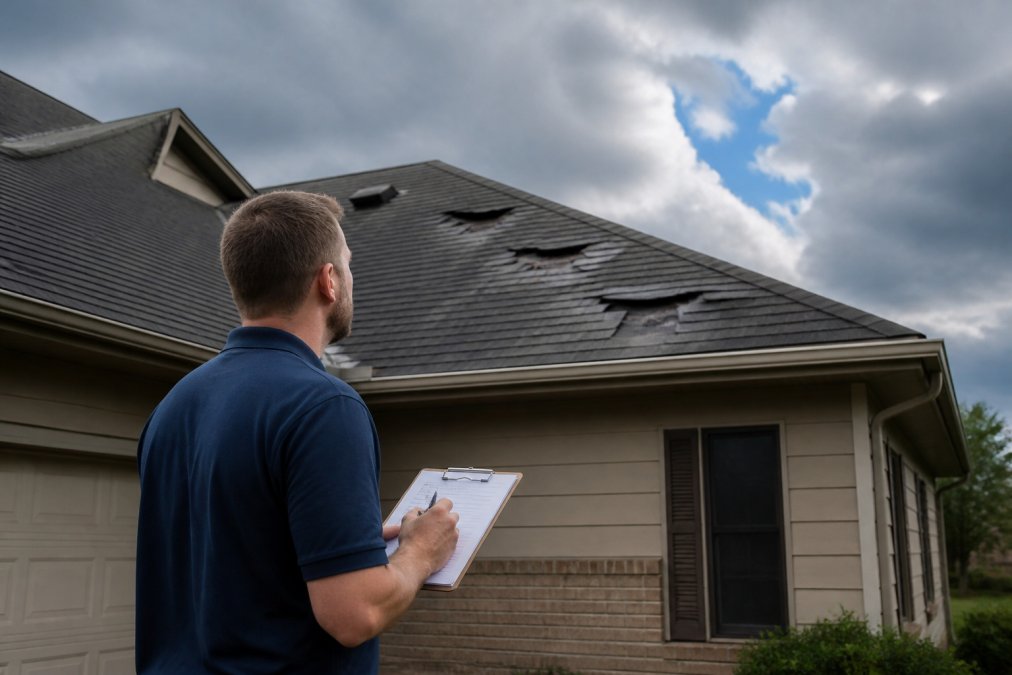
A post-storm roof inspection is a ground-level assessment of visible damage, and it should never involve climbing onto the roof yourself. Water intrusion, structural compromise, and loose shingles make walking a storm-damaged roof genuinely dangerous, and the risk is highest in the first 48 hours, before a professional has confirmed the decking is sound.
Ground-Level Inspection: What You Can Safely Check Yourself
Everything below can be done from the yard, a ladder placed against a wall (not the roof), or through a window. If a step requires stepping onto a slope, stop and call a professional.
- Check gutters and downspouts for accumulated granules, a heavy granule load after a hail event usually signals shingle mat damage, not just surface wear
- Look for shingles on the lawn, driveway, or in flower beds, and note which slope they came from
- Inspect flashing around chimneys, vents, and skylights for dents, lifted edges, or separation
- Check ceilings and the attic for brown stains, active drips, or daylight showing through the deck
- Photograph soft metal surfaces, gutters, vents, downspouts, and any metal roof jacks, because hail leaves clear impact dimples on soft metal even when shingles look intact
- Note the date, time, and duration of the storm, plus the approximate hail size, for your claim file
- Walk the perimeter and look for sagging ridgelines, popped nails, or displaced ridge caps
When to Stop and Call a Professional
Some conditions mean the roof is no longer safe to inspect from a ladder, let alone walk on. Call a licensed contractor immediately if you see any of the following:
- Visible sagging or deflection in the roof plane
- Cracked, split, or displaced rafters visible from the attic
- Water actively dripping through a ceiling or light fixture
- A chimney that has shifted, cracked, or separated from the roof line
- Any downed power line touching the roof or gutters
A common pattern in storm-damage claims is a homeowner who climbs up to “take a quick look,” slips on wet granules, and ends up with a medical claim that has nothing to do with the roof. The inspection report a contractor produces from a safe, systematic assessment is also more useful to your adjuster than a phone photo taken from a ladder.
Never pressure-wash, tarp, or patch a storm-damaged roof yourself before an adjuster has documented the damage. Altering the roof surface before the inspection can void the claim and shift the loss back onto you.
What a Professional Inspection Adds
A qualified inspector documents functional damage, not just cosmetic damage, with measurements, slope-by-slope photo sets, chalk-marked test squares, and code citations. That documentation is what separates a one-page denial from a paid claim. Ask any contractor you hire for the written inspection report before you authorize work, and confirm they carry general liability and workers’ compensation coverage before anyone goes on the roof.
Repair vs. Replacement: How to Decide
Repair makes sense when damage is isolated and the roof has meaningful service life remaining. Replacement makes sense when damage covers multiple slopes, the roof is near the end of its life, or repairs would cost a large fraction of a full replacement.
The rule of thumb many contractors use: if repair costs exceed roughly a third of replacement cost, replace (nadca.com). That threshold isn’t universal, but it’s a useful starting point for the conversation with your contractor.
Three questions decide it:
- How old is the roof, and how much warranty coverage remains?
- Does the damage affect structural integrity or only appearance?
- Will a repair void an existing manufacturer warranty?
A repair that preserves a five-year-old roof is almost always the right call. A repair on a twenty-year-old roof usually just delays the inevitable and spends money twice.
Oklahoma Building Codes and Tax Implications for Storm Damage
Building codes matter because insurance pays to bring your roof up to current code, not just to its pre-storm condition. When a repair scope includes code-required upgrades, those upgrades are typically covered as part of the claim, but only if your contractor documents them.
Which Codes Apply to Your Roof
There is no single statewide residential roofing code. Local jurisdictions adopt and enforce their own editions and amendments, so the requirements that apply to your roof depend on where your property sits. Most jurisdictions in the state have adopted a version of the International Residential Code (IRC) or the International Building Code (IBC), often with local wind-speed and fastener amendments layered on top. Ask your contractor which code edition governs your address and what upgrades the scope includes.
For specifics on adopted codes and permit requirements, check the Oklahoma Uniform Building Code Commission and your local permitting office.
Wind-Resistance Requirements That Affect Repair Cost
Wind is the second major driver of storm damage in this region, and code requirements for wind resistance directly change what a repair costs. The key variables are:
- Design wind speed for your address. Wind-speed maps divide the state into zones, and higher design speeds require more fasteners, closer nailing patterns, and in some cases a secondary water barrier.
- Fastener schedule. Six nails per shingle instead of four, or ring-shank nails instead of smooth-shank, adds labor and material cost but is often required in higher-wind zones.
- Starter strip and ridge cap requirements. These are frequently upgraded to a manufacturer’s high-wind system, which adds a line item most homeowners don’t expect.
- Underlayment type. A synthetic underlayment or a peel-and-stick ice-and-water membrane may be required in certain applications, and both cost more than standard felt.
If your contractor’s scope doesn’t mention the design wind speed for your address, ask. A scope that ignores wind requirements can fail inspection and leave you paying for a re-do out of pocket.
Tax Treatment of Storm Damage Repairs
Tax treatment is the second piece most homeowners overlook, and the rules changed significantly with the Tax Cuts and Jobs Act of 2017. For tax years 2018 through 2025, personal casualty losses on a primary residence are generally deductible only if the loss occurred in a federally declared disaster area (irs.gov). Outside a declared disaster, most homeowners cannot deduct storm damage repairs on a personal residence.
Where deductions commonly still apply:
- Rental and commercial property. Repairs are typically treated as a business expense, and casualty losses on business property are not subject to the personal-loss restrictions.
- Federally declared disaster areas. If your county is included in a presidential disaster declaration, personal casualty losses may be deductible, subject to the 10% of adjusted gross income floor and a $100 per-event reduction.
- Capital improvements. If a repair also improves the property (for example, upgrading to a higher wind rating), the improvement portion may be treated as a capital improvement rather than a repair.
Keep every receipt, the adjuster’s scope sheet, and the contractor’s final invoice. If your insurer pays less than the repair cost, the unreimbursed portion is what you would evaluate for a deduction. Consult a tax professional about your specific situation before assuming either way, the rules are fact-specific and the disaster-declaration requirement is easy to miss.
Rescue Roofing provides financing options and 24-hour availability for storm emergencies.
Frequently Asked Questions
Should I have homeowners insurance cover roof repairs from a storm?
Homeowners insurance typically covers sudden damage from hail, wind, or debris, but not wear and tear. Your policy has an insurance deductible you must pay before coverage kicks in. If damage is clearly storm-related, filing a claim is usually worth it. However, for minor repairs costing less than your deductible, paying out-of-pocket may be better to avoid a premium increase. Always get a professional roof inspection first to confirm the damage is storm-related.
How much does it cost to fix minor vs. major roof damage?
Minor damage like a few missing shingles or a small leak often costs a few hundred dollars to fix. Major damage involving structural integrity, widespread hail damage, or water intrusion can run into thousands of dollars. The final cost depends on square footage, roof pitch, material grade, and labor costs. For an accurate estimate, request a contractor estimate. Rescue Roofing offers free inspections and aerial quotes to give you a precise figure.
What is the 25% rule for roofing?
The 25% rule is a common insurance guideline: if storm damage affects more than 25% of your roof’s surface, many insurers will pay to replace the entire roof rather than just repair the damaged section. This helps maintain uniform appearance and structural integrity. However, this rule varies by policy and state. Always review your policy and consult your claims adjuster.
How often should a roof be inspected after severe weather?
You should inspect your roof after any major storm that produces hail, high winds, or flying debris. Even if you don’t see obvious damage from the ground, hail impact resistance can be compromised. A professional roof inspection checklist includes checking for wind uplift, leak detection, flashing damage, and roof ventilation issues. Rescue Roofing recommends an inspection after every significant storm, and at least annually for aging roofs.
Storm damage never arrives at a convenient time, and the gap between a fast, correct repair and a delayed one is measured in water intrusion and interior damage. Rescue Roofing handles the full scope: accurate aerial quotes, direct communication with your insurance company and adjuster, 24-hour emergency availability, and flexible financing so the work isn’t held up by cash flow. Get started with Rescue Roofing and protect your property before the next storm.