




Could a form you sign to get help with a roof claim give a contractor more control than you intended? If you’re asking “what is assignment of benefits for roofing,” the answer depends on the document’s exact wording. An assignment may transfer certain insurance claim rights or benefits, while another form may only let a roofer communicate with your insurer. Those are not the same thing.
It’s reasonable to want help documenting roof damage and understanding the repair or replacement scope, especially when insurance language feels unfamiliar. Before signing, check what the document authorizes. An assignment doesn’t guarantee that your insurer will approve the claim or pay the contractor, and its legal effect can depend on the agreement and applicable state rules.
This guide explains what a roofing assignment of benefits may authorize, how it compares with communication permissions and payment directions, and what to review before signing. You’ll also find practical questions to ask your roofer and insurer about scope, claim decisions, payments, and cancellation terms. A roofer can provide roof-damage documentation and project information, but isn’t a substitute for your insurer or legal counsel.
Key Takeaways
- To understand what is assignment of benefits for roofing, check which specific claim benefits or rights the agreement says may be transferred.
- Compare an assignment with a direction to pay or communication authorization. Check what each document permits and how it handles payment.
- Before signing, ask the roofer and insurer how the agreement affects claim decisions, payments, and your ability to change course.
- Compare the paperwork with the roof inspection findings, written estimate, proposed work, and any other documents you’re asked to sign.
- A roof inspection and clear project documentation can help inform next steps, but they don’t guarantee claim approval or payment.
What Is an Assignment of Benefits for Roofing?
After roof damage, insurance paperwork can feel consequential, especially when it uses unfamiliar legal terms. If you’re asking what is assignment of benefits for roofing, start with the document itself. An assignment of benefits, or AOB, is a written agreement that may transfer specified insurance benefits or rights related to a roofing project. The exact scope depends on its wording and applicable state law.
A roofing AOB assigns specified claim-related benefits or rights. It doesn’t transfer ownership of your home or automatically hand over your entire insurance policy. In legal usage, an assignment generally concerns transferring rights from one party to another, but the signed agreement determines what is being assigned. You can read more about the underlying legal term.
That distinction matters because not every AOB has the same scope or effect. Read the complete agreement, including attachments and any terms incorporated by reference, before deciding whether to sign.
What rights might a roofing AOB cover?
An agreement may address specified insurance benefits related to a roof repair or replacement. Before signing, identify who may receive payment, what work the document covers, and whether its scope is limited to a particular project or claim. Check whether the wording reaches beyond the work described in your estimate. The document’s terms control, so don’t rely on a verbal summary alone.
- Payment: Who does the agreement name as the recipient of any assigned benefits?
- Work: Does its scope match the roof work described in the project documents?
- Limits: Does it explain what is excluded and how long the assignment applies?
If the wording is unclear, ask the roofer to explain the specific language and check with your insurer about its claim procedures. For an interpretation of your legal rights under Oklahoma law, consider speaking with a qualified Oklahoma attorney.
Does signing an AOB guarantee insurance payment?
No. Signing an assignment alone doesn’t establish that the roof has covered damage, determine what caused it, set the repair scope, or decide the claim’s value. It also doesn’t require an insurer to approve a claim or pay a contractor. Those decisions depend on the policy, the facts of the loss, the insurer’s review, and applicable procedures.
A roofer’s inspection findings, photos, estimate, and proposed work can provide project information. They are not the insurer’s coverage decision. Compare the assignment with the estimate and proposed work, and ask your insurer what the agreement may mean for claim handling and payment. For Oklahoma-specific legal interpretations, consult qualified counsel.
How Does a Roofing Assignment of Benefits Work?
The process can vary, so treat this sequence as a guide rather than a fixed rule. Your insurer’s procedures and the agreement’s language may change what happens and when. In general, a homeowner might:
- Review the roof damage. A roofer can describe observed conditions and proposed repair or replacement work, supported by project documentation.
- Discuss the paperwork. Ask what the roofer’s claim-assistance process involves and whether signing an assignment is being requested.
- Read the full agreement. Compare its scope with the estimate and proposed work. Don’t rely only on a verbal explanation.
- Contact the insurer. Ask how it handles the specific document and what information or steps it requires.
- Decide on next steps. Sign only if you understand the terms and are comfortable proceeding. Consider qualified legal advice if the agreement’s effect is unclear.
An AOB’s effect depends on its written scope and applicable law. A roofer can explain roof conditions and project details, but that isn’t the same as interpreting your insurance coverage. In practical terms, both the agreement and your insurer’s process matter.
What should homeowners check before signing?
Read the document from start to finish. Identify the parties, the benefits or rights involved, the roofing work covered, how payment is addressed, and any stated duration. Look for terms about cancellation, disputes, additional work, and out-of-pocket responsibility. If a clause is unclear, ask for an explanation in writing. Request a copy and enough time to review the complete agreement before signing.
What happens after an AOB is signed?
If the agreement and applicable rules allow it, the roofer may communicate with the insurer about assigned benefits or related project details. The insurer may still inspect the roof, request documentation, and make its own coverage decision. Signing doesn’t guarantee approval, payment, a particular settlement, or a payment date. Ask the insurer what the document changes in its process and who will receive updates or payment information.
Clear roof documentation can help you understand the proposed work, but it doesn’t replace the insurer’s review. If you’re in Tulsa or a surrounding area, a roof inspection and damage documentation can help clarify project information to discuss with your insurer. Ask about the roofer’s claim-assistance process before deciding what paperwork to sign.
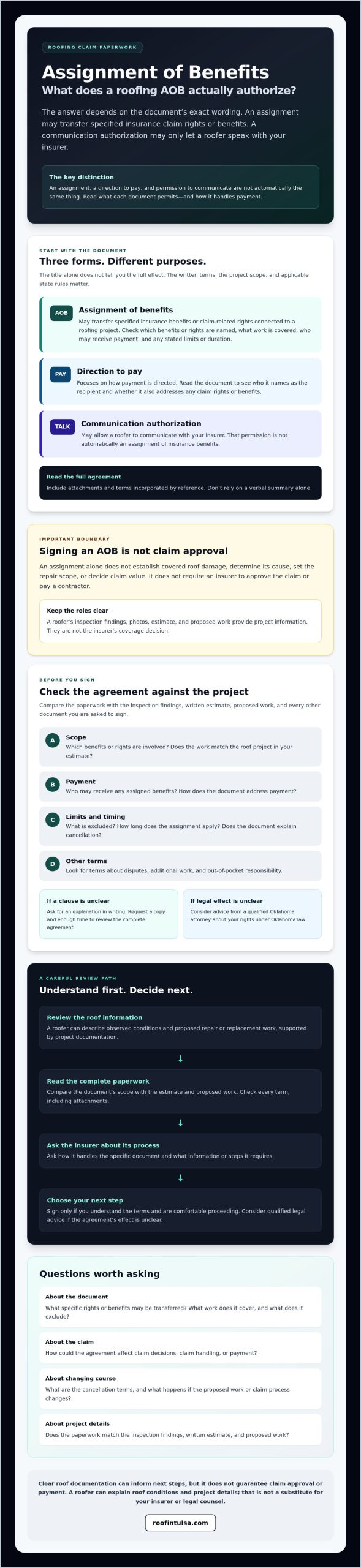
AOB vs. Direction to Pay vs. Authorization: What Is Different?
These documents may sound similar, but they can address different things. An assignment may transfer specified benefits or rights. A direction to pay may instruct an insurer to send payment to someone else. An authorization may permit specific communication or action. These are general descriptions, not guarantees of what a particular form does. The full wording and applicable law matter more than the title printed at the top.
| Document type | Purpose | Rights potentially affected | Payment implications | Questions to ask |
|---|---|---|---|---|
| Assignment of benefits | May transfer specified insurance benefits or rights related to roofing work. | Could affect the rights identified in the agreement. The scope depends on its terms. | May address who receives assigned benefits, but doesn’t itself guarantee insurer payment. | What exact benefits or rights are assigned, and for which work? |
| Direction to pay | If its wording supports this description, instructs payment to be made to a named recipient. | May address payment handling without necessarily transferring other claim rights. | Could direct payment to the roofer, subject to the document and insurer’s procedures. | Does it only direct payment, or does it also transfer rights or authorize other actions? |
| Authorization | May permit specified communication or action, but only as stated in the document. | Could allow limited communication without assigning benefits, depending on its language. | Doesn’t necessarily change who receives payment. | Who may communicate, about what, and what actions are permitted? |
Is an AOB the same as permission to talk to an insurer?
Not necessarily. A communication authorization and an assignment of specified benefits can serve different purposes. One form might permit a roofer to discuss project information with an insurer, while another may address rights or benefits. Ask the roofer to identify each act the document permits or each right it transfers. Don’t assume that permission to communicate includes authority over claim decisions or payments.
Which arrangement gives a homeowner more control?
There’s no reliable answer based on the label alone. Compare the language about claim decisions, communication, payment, and changes to the work. Ask who must approve additional work and who remains responsible for invoices if insurance proceeds don’t cover the full amount. If the wording is broad, unclear, or disputed, consider advice from a qualified Oklahoma attorney. Focus on the specific terms and applicable law, not just the document’s name.
Questions to Ask Before Signing a Roofing AOB
Before signing, compare the agreement with the roofer’s estimate, proposed work, and any other documents you’ve been asked to sign. A clear inspection and written work scope can help you spot differences. If you’re still asking what is assignment of benefits for roofing, use these questions to pin down what this particular agreement would do.
What should I ask the roofer and insurer?
- What specific benefits or rights does this agreement cover? Ask whether it applies only to identified roofing work or has broader terms.
- Is signing this document optional? Ask the roofer to explain the purpose of each form separately.
- Who receives insurance funds, and who pays for uncovered work? Clarify your payment responsibilities if the insurer doesn’t cover all proposed work.
- How are changes to the work approved? Find out who must authorize additional work and how changes will be documented.
- How will this affect the claim process? Ask your insurer how it handles the specific document before you sign.
Request time to read the complete paperwork and keep a copy of every signed document. Don’t sign a blank, incomplete, or unexplained form. If someone asks you to sign before you’ve had a chance to review the terms, pause and ask why.
When should I pause and get independent advice?
Pause if the agreement is broad, unclear, incomplete, or inconsistent with the estimate or proposed work. Check its payment, cancellation, dispute, duration, and out-of-pocket responsibility terms. If the explanation you receive doesn’t match the written language, ask for clarification in writing before proceeding.
Oklahoma rules and the legal effect of contract language can depend on the document and circumstances. This checklist isn’t legal advice. For an interpretation of unclear or disputed terms, consult an Oklahoma attorney or another appropriately qualified professional. You can also review this Tulsa roofing guide to insurance and roof protection for related homeowner information.
If you’re considering a roofing project in Tulsa or surrounding areas, request a roof inspection and discuss claim assistance to understand the observed roof conditions and proposed work before deciding what paperwork to sign.
How Rescue Roofing Tulsa Can Help With Roof Claim Questions
After a storm, it can be hard to tell what the roof needs and what paperwork to sign. A roof inspection and clear project documentation can help you understand the observed conditions and potential repair or replacement scope. They are useful starting points, not a coverage decision. Your insurer determines how it evaluates the claim, and you decide whether to sign an assignment or other agreement.
What can a roofing contractor clarify?
Rescue Roofing Tulsa serves Tulsa and surrounding areas with roof inspections, repairs, replacements, and insurance claim assistance. A roofing contractor can explain inspection findings, describe visible roof conditions, and answer questions about an estimate or proposed work. You can also ask what the company’s claim-assistance process involves and what role, if any, it would have in communications with your insurer. Get clear answers before signing paperwork.
A roofer can provide roofing and project information, but isn’t your insurer or legal counsel. The contractor’s observations don’t establish coverage, and claim assistance doesn’t guarantee approval or payment. Keep those roles distinct: ask the roofer about the work and document, and ask the insurer about its claim process. You remain responsible for deciding what to sign, and can seek independent legal guidance if terms are unclear.
What is a sensible next step after storm damage?
From a safe location, document visible damage with notes or photos. Don’t climb onto a damaged or wet roof to inspect it yourself. Contact your insurer to ask how to report the loss, what information it needs, and what inspections or other steps may follow. A roofer’s inspection and written project information may help you understand the roof work under consideration, but they don’t replace the insurer’s review.
Before agreeing to work or claim paperwork, compare the proposed scope with the estimate and read each document in full. Ask questions at your own pace. Rescue Roofing Tulsa can discuss observed roof conditions, available roofing next steps, and its insurance claim assistance process. If your Tulsa-area roof has storm damage, reach out to discuss an inspection or repair options. Decide what paperwork to sign after you understand the terms.
Make Your Next Roofing Decision With Confidence
Understanding what is assignment of benefits for roofing starts with reading the agreement’s actual terms. An assignment may transfer specified claim benefits or rights, while a communication authorization or payment direction may serve a narrower purpose. The document’s title alone doesn’t tell you its full effect.
Before signing, compare the agreement with the estimate and proposed work. Ask who may receive insurance funds, what work is covered, and who is responsible for costs the insurer doesn’t cover. An assignment doesn’t establish damage, guarantee claim approval, or determine payment. For questions about how Oklahoma law applies to your agreement, consider independent legal guidance.
Rescue Roofing Tulsa serves the Tulsa area with residential and commercial roofing, roof inspections, and insurance claim assistance. A clear inspection and project scope can help you understand the roofing work being considered, while your insurer remains responsible for its coverage decision. You choose what paperwork to sign.
Have questions about roof damage or possible next steps? Talk with Rescue Roofing Tulsa about your roof and claim questions. Ask what you need and move forward when the paperwork and project details are clear.
Frequently Asked Questions
Is signing an assignment of benefits required to get a roof repaired?
Don’t assume an assignment is required simply because you need a roof repair. Ask the roofer whether signing is optional and what alternatives are available, then confirm with your insurer how it handles claim paperwork. You can discuss an inspection, estimate, or proposed work without treating those project documents as an assignment. If someone says you must sign, ask them to explain that requirement in writing before deciding.
Does an assignment of benefits give a roofer control of my insurance claim?
It may transfer specified rights, but the degree of authority depends on the agreement’s language and applicable law. Don’t assume every AOB gives a roofer control of every claim decision, or that it is limited to routine communication. Check whether the document addresses negotiating, settling, or pursuing disputes, and ask your insurer what it means for your claim. Consider qualified legal advice if the scope is broad or unclear.
Can a roofer collect insurance money directly with an AOB?
An AOB may address payment of assigned benefits to a roofer, depending on its terms and the insurer’s procedures. Signing one doesn’t guarantee that the insurer will approve the claim or pay the contractor. Before signing, confirm who the document names as payment recipient, which work it covers, and who is responsible for any balance not paid by insurance. Ask the insurer how it handles the specific agreement.
What is the difference between an assignment of benefits and a direction to pay?
An assignment may transfer specified insurance benefits or rights. A direction to pay may instruct payment to go to a named recipient, if that is what its wording says. The documents may have different effects, so their titles aren’t enough to tell you what you’re agreeing to. Read the full text and ask whether it transfers claim rights, changes payment handling, or permits other actions.
Can I cancel a roofing assignment of benefits after signing?
Possibly, but don’t assume you can cancel an AOB in a particular way or within a particular period. Check the agreement for cancellation terms, including any instructions about how and where to send notice. Applicable law may also matter. Keep a copy of the signed document and any communications. If you’re unsure about your options or face a dispute, ask an Oklahoma attorney to review the agreement.
Should I have a lawyer review an assignment of benefits for roofing?
Consider asking an Oklahoma attorney to review the document if its language is broad, confusing, disputed, or inconsistent with the estimate and proposed work. A roofer can explain observed roof conditions and project details, but that isn’t the same as legal advice. You can also ask your insurer how it handles the agreement. Take time to understand the terms before signing, and keep a copy of all completed paperwork.