



Table of Contents
- Signs of Flat Roof Water Pooling and Why It Matters
- How Weather and UV Exposure Break Down a Flat Roof Membrane
- EPDM vs TPO Roofing Pros and Cons for Flat Roofs
- Installation Errors and Mechanical Damage That Cause Membrane Failure
- Your Flat Roof Maintenance Checklist to Prevent Costly Repairs
- How Insurance Companies Assess Flat Roof Membrane Risk
- Protecting Your Flat Roof Membrane: Next Steps
- Frequently Asked Questions
Last Updated: September 24, 2026
Signs of Flat Roof Water Pooling and Why It Matters
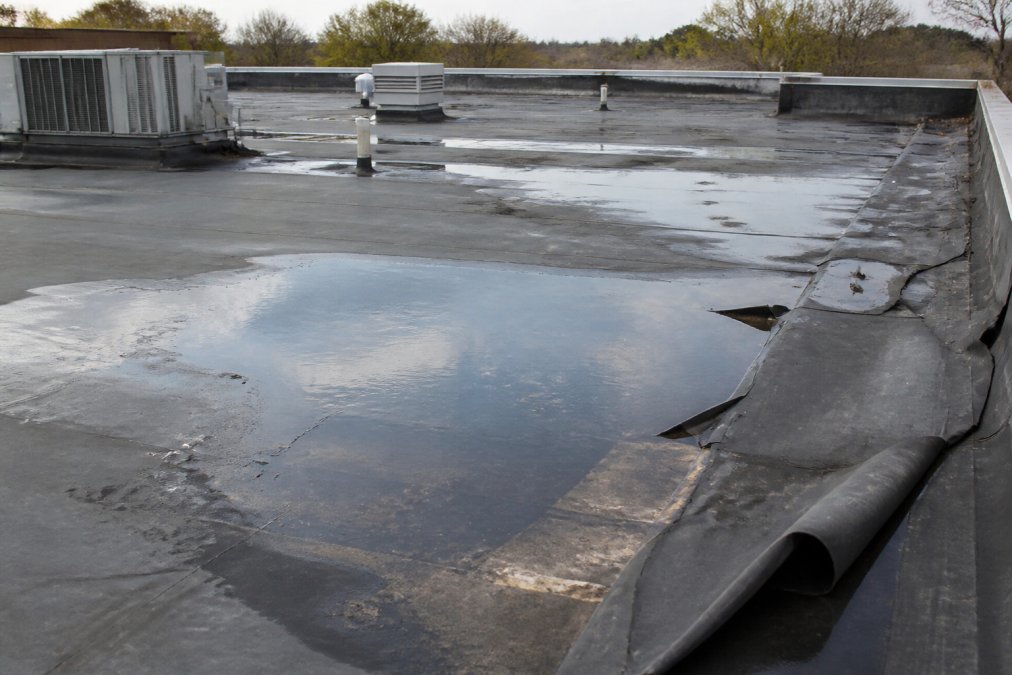
If you own a building with a low-slope roof, the risks of a flat roof membrane start with water that never leaves. A flat roof membrane is the waterproof layer, typically EPDM, TPO, or PVC, that seals a low-slope roof deck against rain and snow. Standing water for days drops its service life sharply.
The signs are easy to spot: dark reflective patches that linger 48 hours after rain, rust rings around drains, and sagging between joists. This guide from Rescue Roofing covers what causes those failures, how weather and installation errors accelerate them, and how to prevent them before a repair turns into a full replacement.
How Ponding Water Destroys Membrane Systems
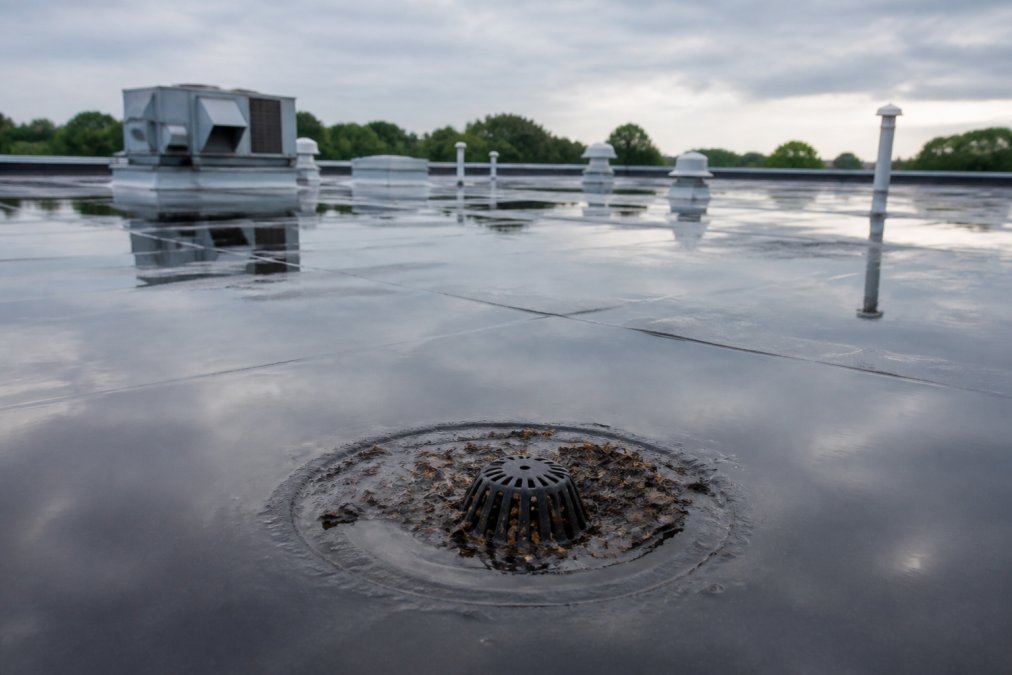
Water weighs roughly 5 pounds per square foot at just 1 inch deep, and that load never rests. Ponding attacks a membrane three ways at once: hydrostatic pressure pushes moisture through seams and fastener penetrations, sub-membrane vapor drive traps damp air against the deck, and constant saturation weakens lap adhesive.
The damage compounds quietly.
Drainage Problems That Make Pooling Worse
Most ponding traces back to drainage, not the membrane itself. Common culprits include:
- Debris-clogged drains and scuppers that back water up across the field
- Too few drains for the roof area, or drains set higher than the low point
- Settled insulation that creates new low spots away from any drain
- Blocked gutters that push overflow back onto the roof edge
How Weather and UV Exposure Break Down a Flat Roof Membrane
Sun and temperature swings do more cumulative damage to a flat roof membrane than any single storm. UV radiation breaks down the polymers that give the membrane its flexibility, and thermal cycling works the seams daily.
Climate-Specific Risk: Not Every Roof Ages the Same Way
The dominant failure mode shifts with the climate zone, and that shift should drive your inspection schedule and material choice.
- High-UV and desert climates: UV degradation and heat aging lead. Membranes chalk, thin, and lose tensile strength faster, and dark EPDM absorbs enough heat to accelerate the thermal cycling that stresses seams. Reflective white TPO or PVC coatings help here, but only if the coating itself is maintained.
- Freeze-thaw climates: Water that seeps into seams, flashing terminations, and around fasteners expands when it freezes and pries those details open. The damage is concentrated at penetrations and perimeters, not the open field. Inspect those details before the first hard freeze, not after.
- Coastal and high-wind zones: Wind uplift and salt-laden air dominate. Wind gets under a lifted edge and peels the membrane back in a single event, while salt exposure corrodes fasteners and metal flashings from underneath.
- Hail belts: Impact punctures and bruising lead. A hail strike may not tear the membrane but can fracture the mat underneath, creating a slow leak that only shows up after the next rain.
- Humid and heavy-rain regions: Ponding and hydrostatic pressure dominate, which is why drainage design matters more than membrane brand in these zones.
Thermal Cycling and Membrane Shrinkage
Membrane shrinkage is the slow failure most owners miss. As the roof heats and cools, the sheet contracts slightly each cycle. Over years, that contraction pulls the membrane tight against mechanical fasteners and flashings, stressing seams until adhesive failure begins.
Catching Weather Damage Before It Fails
By the time a weather-related failure shows up as a ceiling stain, moisture has usually traveled under the membrane for months. Modern tools find it earlier:
- Infrared moisture scanning reads surface temperature differences to map saturated insulation under an intact-looking membrane, so you can locate the wet area without tearing the roof open.
- Drone and aerial imaging surveys large or hard-to-access roofs quickly and documents conditions with dated photos, which is useful for both maintenance planning and insurance claims.
- Moisture meters and nuclear gauges confirm what the thermal scan suggests at specific points before anyone commits to a repair scope.
Match your inspection priorities to your climate zone. In a freeze-thaw market, the seams and flashings are the risk. In a high-UV market, the membrane surface itself is the risk. Inspecting for the wrong failure mode wastes the trip.
EPDM vs TPO Roofing Pros and Cons for Flat Roofs
Choosing between EPDM and TPO roofing pros and cons comes down to climate, foot traffic, and maintenance. Both are proven single-ply options, but they fail differently.
| Material | Strengths | Weaknesses | Best For |
|---|---|---|---|
| EPDM | Excellent UV and ozone resistance, flexible in cold | Seams rely on adhesive, dark color adds heat | Large, low-traffic roofs |
| TPO | Heat-welded seams, reflective white surface | Can chalk and thin with age, seam quality varies | Energy-conscious commercial roofs |
| PVC | Strong chemical and fire resistance | Plasticizers can migrate, higher material cost | Restaurants and industrial roofs |
Material-Specific Risks: EPDM, TPO, and PVC
Each membrane has a specific weak point worth knowing.
EPDM resists UV degradation better than most single-plys, but its adhesive-bonded seams are the vulnerable joint: poor surface prep leads to seam failure years later. Dark EPDM also drives thermal cycling harder than a white membrane.
Never pressure-wash a single-ply membrane to clear debris. High-pressure water can force moisture past seams and flashings, turning a cosmetic cleaning job into a moisture infiltration problem that shows up as ceiling stains months later.
Installation Errors and Mechanical Damage That Cause Membrane Failure
Workmanship causes more premature membrane failures than weather does. The mistakes repeat across every material: inadequate surface prep before bonding, seams welded or glued at the wrong temperature, fasteners driven too deep, and flashings without proper termination.
Your Flat Roof Maintenance Checklist to Prevent Costly Repairs
A flat roof maintenance checklist catches most failures while they are still small. Inspect twice a year, once in spring and once before winter, plus after any major hail or wind event.
- Clear all drains, scuppers, and gutters of debris
- Check for ponding 48 hours after rainfall
- Walk the perimeter and inspect flashings and terminations
- Look for blisters, wrinkles, and open seams
- Check rooftop unit curbs and pipe boots for cracked sealant
- Note any new sagging or soft spots underfoot
- Photograph and date anything that looks suspect
The Environmental Cost of a Neglected Membrane
Most maintenance advice stops at protecting the building. A second reason to stay ahead of membrane degradation: what a failing roof releases into the environment.
Detection Technology: Finding Problems Before They Surface
A visual walk-through only catches what you can see from above. Modern tools extend the inspection:
- Infrared moisture scanning maps wet insulation under an intact membrane by reading temperature differences, so hidden saturation is located before it spreads.
- Drone inspections cover large, steep, or equipment-cluttered roofs quickly and produce dated aerial photos that document condition over time.
- Electronic leak detection uses a charged grid or conductive method to pinpoint breaches in the membrane, which is far faster than flooding a roof to find a leak.
DIY vs. Professional Repair: What You Need to Know
Small issues, like a single cracked sealant bead at a flashing, are reasonable DIY territory for a careful owner. Anything involving seams, ponding, soft decking, or active leaks is not.
Keep a simple roof file: inspection dates, photos, repair receipts, and the original installation paperwork. When you file a claim, that folder does more for your case than any argument at the kitchen table.
How Insurance Companies Assess Flat Roof Membrane Risk
Insurers assess flat roof membrane risk through maintenance history and age. A well-documented roof with regular inspections and prompt repairs is lower risk than an identical roof with no records, even at the same age.
Protecting Your Flat Roof Membrane: Next Steps
The risks of a flat roof membrane are cumulative, not sudden. Water that ponds today weakens a seam that fails next year, and UV exposure that seems harmless this summer becomes a brittle crack by the next hail season. Small, scheduled attention separates a roof that lasts its full service life from one that fails early.
Frequently Asked Questions
What is the typical lifespan of a flat roof membrane?
Most flat roof membranes last 15 to 30 years depending on material, installation quality, and maintenance. EPDM typically reaches 20 to 25 years, while TPO often lasts 15 to 20 years. PVC can exceed 20 years in commercial settings. Regular inspections and prompt repairs extend lifespan significantly. Without a flat roof maintenance checklist, even quality membranes can fail years earlier due to undetected ponding water or seam separation.
How can you tell if a flat roof membrane is failing?
Watch for signs of flat roof water pooling that lingers more than 48 hours after rain, visible cracks, blisters, or peeling seams. Interior water stains on ceilings or walls signal moisture infiltration. You may also notice membrane shrinkage pulling away from flashings or a spongy feel underfoot. Any of these warrant a professional inspection before small issues become structural damage.
Why do insurance companies view flat roofs as high-risk?
Insurance carriers associate low-slope roofing with higher claim frequency because flat roofs are prone to ponding water, seam failure, and hidden moisture infiltration. These issues often go undetected until significant damage occurs. Many policies include actual cash value coverage for older flat roofs rather than replacement cost, and some require proof of preventative maintenance. Understanding EPDM vs TPO roofing pros and cons helps property owners choose materials that may reduce underwriting concerns.
What is the best membrane for a flat roof?
The best choice depends on climate, building use, and budget. TPO offers strong UV resistance and energy efficiency, making it popular for commercial buildings. EPDM excels in temperature extremes and costs less upfront. PVC performs well in chemical-heavy environments like restaurants. Each has trade-offs in puncture resistance, seam strength, and fire rating. A roofing professional can match the right membrane to your specific building and climate risks.