


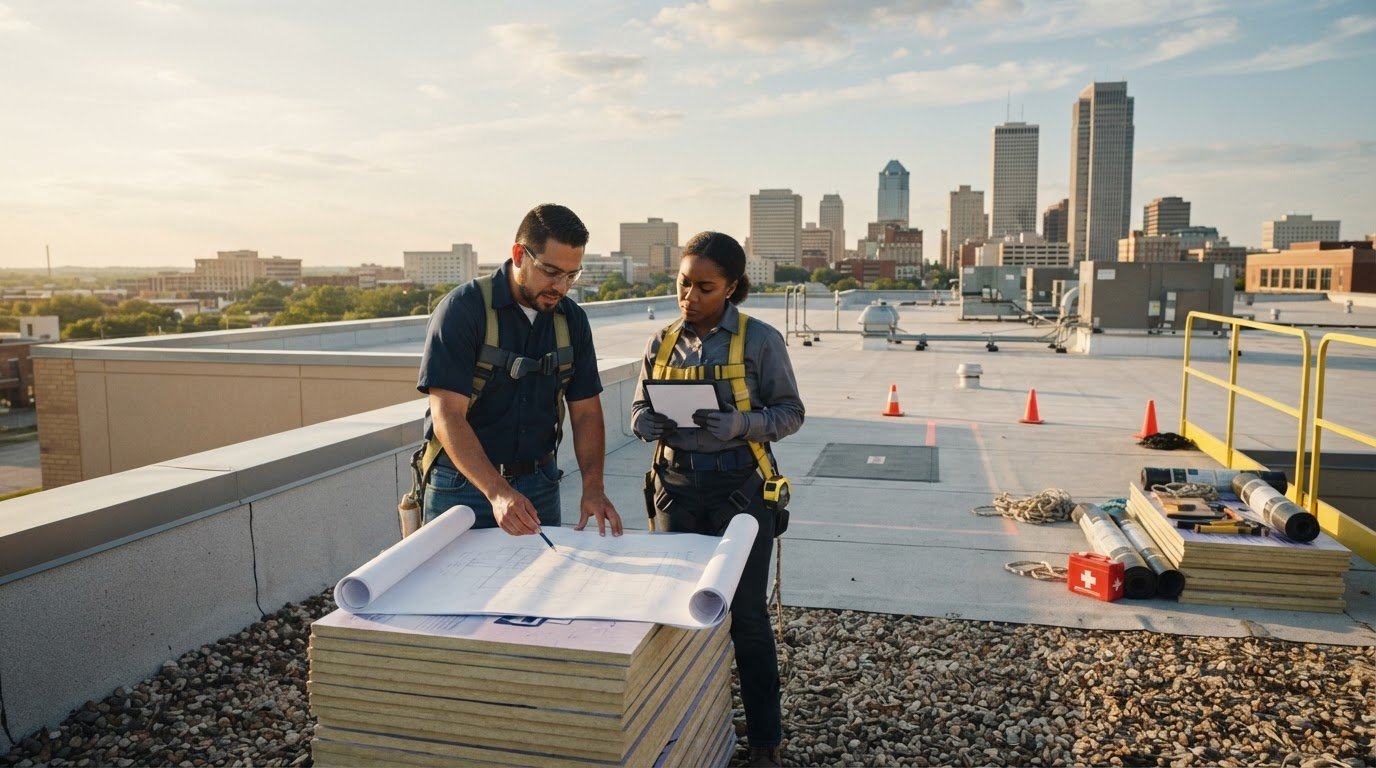

The permit question can shape a commercial roofing project before work begins. In Tulsa, commercial roof replacement and other new roofing work require a building permit, while repairs may be exempt. Identifying which category your project falls into is a practical first step in planning.
It’s reasonable to want a clear picture of the work before comparing estimates. The scope depends on the existing roof, its damage or wear, and the materials selected. A useful estimate explains the proposed work clearly, so you know what is included.
This guide explains how replacement and repair differ, what to consider when planning a project, and how safety and installation expertise fit into the process. It also shows how to compare estimates by reviewing their scope and included work, helping you make an informed decision for your Tulsa property.
Key Takeaways
- Learn how recurring ponding water and damaged flashing can signal roof problems that need attention.
- See how roof condition, material choice, and the work required shape a replacement plan.
- Use a consistent scope of work to compare estimates and understand what each proposal includes.
- Understand how installation expertise and careful project planning support a sound commercial roofing project.
- Find out when repair may address a problem and when replacement is the more suitable path.
Commercial roof replacement and repair services
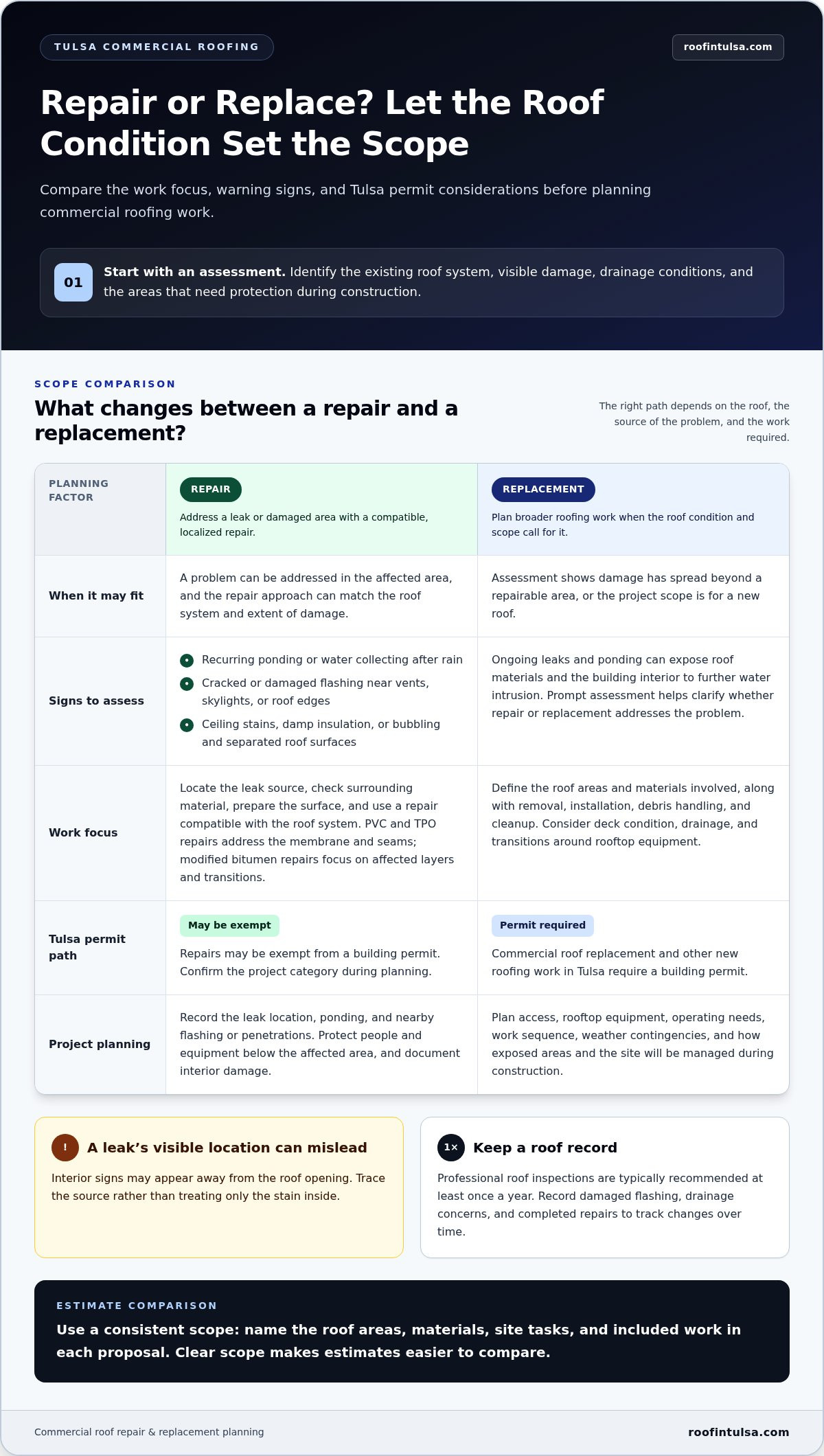
Commercial roof repair starts by identifying where water enters and what is allowing it through. On a flat roof, recurring ponding can lead to leaks and other problems. Cracked or damaged flashing around vents, skylights, and roof edges can also let water penetrate. A careful inspection connects visible symptoms to their likely source, rather than treating only the stain inside.
Which commercial roofing systems suit Tulsa’s climate and severe weather? There’s no single best system for every building. Rubber, PVC, and TPO are commonly used on Tulsa flat commercial roofs. The right fit depends on the existing roof, drainage, and the building’s needs.
Watch for ceiling stains, damp insulation, bubbling or separated roof surfaces, and water collecting after rain. A leak near a skylight, vent, or roof edge may point to flashing damage. These signs deserve attention even if water appears only during heavy rain. Interior signs may show up away from the roof opening, so the visible leak location may not reveal its source.
Repair methods depend on the roofing material and damaged area. For PVC and TPO, the repair plan must address the membrane and its seams. Modified bitumen repairs focus on the affected roof layers and transitions around details. In each case, the roofer locates the leak, checks surrounding material, prepares the surface, and makes a compatible repair. A patch that ignores nearby wear can leave another weak point.
- After a leak: Protect people and equipment below the affected area, then document interior damage.
- For the roof assessment: Record the leak location, visible ponding, and nearby flashing or penetrations.
- For repair: Match the repair approach to the roof system and the extent of damage.
Commercial roof repair and emergency response address active leaks, while maintenance helps reduce the chance of new problems. Regular maintenance can extend a roof’s life and prevent costly repairs. Experts typically recommend a professional roof inspection at least once a year. After an inspection, keep a written record of damaged flashing, drainage concerns, and completed repairs to track changes over time.
What are the risks of delaying commercial roof replacement in Oklahoma? Ongoing leaks and ponding can expose roof materials and the building interior to further water intrusion. If damage spreads beyond a repairable area, the work may grow from a localized fix into a broader replacement. Assessing the roof promptly helps clarify whether repair or replacement addresses the problem.
Project planning, safety, and service delivery
Start planning a Tulsa commercial roofing project with a roof assessment and a clear scope. The contractor should identify the existing system, visible damage, drainage conditions, and areas that need protection during construction. For example, a warehouse with rooftop equipment needs a work plan that accounts for access around units and keeps building operations in view.
How long does commercial roof replacement take in Tulsa? The schedule depends on roof size, system choice, existing conditions, access, and weather. A defined scope and sequence for material removal, installation, and cleanup help property teams understand how the work will progress.
Permit planning matters too. Roof replacement or new roofing work in Tulsa requires a building permit, while repairs may be exempt. Clarifying whether the work is a replacement or repair helps determine the project’s permit path. Include that distinction in planning discussions, along with the work area and expected construction sequence.
Safety planning should address the building and jobsite. Before work begins, define where crews and materials will enter, how occupants will avoid active work areas, and how deliveries will be coordinated. At a property with customer traffic, separating public access from roofing work reduces confusion. The site plan should also account for roof access and equipment placement.
- Document the building: Note operating hours, access points, rooftop equipment, and sensitive interior areas.
- Set the work sequence: Coordinate removal, installation, debris handling, and site cleanup.
- Plan for weather: Discuss how changing weather affects exposed roof areas and the order of work.
Weather can affect when roofing work proceeds and how the crew protects exposed sections during construction. A practical plan explains how work areas will be managed if conditions interrupt installation. It also outlines how the site will be left at the end of each work period, helping building managers plan around active work without assuming the whole roof will be open at once.
A contractor’s specialty should match the building’s roof system and project scope. A contractor experienced with commercial flat roofing may plan work differently from one focused on another roof type. Ask for a scope that names the roof areas involved, materials to be installed, and site tasks included. These details make it easier to coordinate roofing work with tenants, staff, and facility operations.
Service coverage also affects coordination. A roofing contractor serving Tulsa and surrounding areas can plan around the property’s location, access, and delivery needs. Keep one project record for site notes, scope revisions, and schedule updates. For a clearer starting point, use this roofing project planning resource as you organize the work.
Commercial roof installation expertise
Commercial roofing installation involves more than placing a new surface over a building. The crew must understand the roof assembly, deck condition, drainage, and transitions around rooftop equipment. For example, a membrane that reaches a vent needs a secure, properly detailed connection. If that edge is missed, water can enter at the penetration even when the main roof area appears complete.
Experienced installation follows a deliberate sequence. First, crews prepare the work area and inspect the exposed substrate. Next, they address surface conditions and install the specified roofing system. Then they complete seams, edges, drains, and penetrations. A project scope should identify these details so building owners can see how the installation addresses both broad roof areas and vulnerable transitions.
- Roof field: Confirm the new system covers the areas named in the scope.
- Seams and edges: Review how adjoining sections and roof perimeters are finished.
- Penetrations: Account for vents, skylights, and rooftop equipment.
- Drainage: Include drains and paths where water leaves the roof.
Material knowledge matters because systems require different installation methods. A roofing crew should follow the selected system’s requirements for preparing surfaces, joining sections, and finishing edges. For example, a membrane seam needs a consistent connection, while a roof edge needs detailing suited to the perimeter. These steps help the completed assembly function as a connected system, rather than a collection of separate patches.
Installation expertise also means recognizing when replacement is not the immediate answer. A localized defect may call for commercial roof repair, while widespread deterioration can require a broader project. An emergency roof leak needs prompt assessment to limit further water entry, followed by a decision about permanent repairs. The visible leak location alone may not reveal the full extent of affected materials.
Useful closeout records make the finished work easier to understand. Keep the agreed scope, material details, and notes about completed roof areas together. For example, a facilities manager can use these records when planning future maintenance or reporting a new leak. A final walkthrough can also compare visible edges, drains, and rooftop transitions with the work described in the project documents.
For a Tulsa commercial roof replacement, installation quality depends on matching the work to the building’s roof design and documenting how critical details are handled. Clear plans help property teams understand what crews will install, how the system connects at vulnerable points, and what work was completed.
Getting estimates and comparing contractors
A useful commercial roofing estimate begins with an inspection, not a generic description. It should connect observed roof conditions to the proposed work. For example, if a Tulsa warehouse has worn membrane and damaged edge details, the scope should identify those areas and explain whether the plan calls for repair or replacement.
Tulsa roofing contractors have an average lead time to bid of 14 days. Plan the estimate process around that timing, especially when coordinating building operations or upcoming construction. A complete proposal should describe the roof system, work areas, installation steps, cleanup, and any exclusions. Clear details make it easier to compare the same scope across proposals.
Compare the substance, not just the final total. A lower estimate may cover fewer roof areas or omit important details. Review each document for the materials named, existing conditions, project sequence, and treatment of drains, edges, and rooftop penetrations. In Oklahoma, weather also affects scheduling, so note how the proposed sequence accounts for exposed roof areas and changing conditions.
- Scope: Match each roof area and repair item to the inspection findings.
- Materials: Check that the proposed system and installation details are clearly named.
- Project work: Compare preparation, debris removal, and cleanup descriptions.
- Documentation: Keep inspection notes and estimate revisions together.
What warranties are available for commercial roof replacement in Tulsa? Proposals may distinguish manufacturer coverage for roofing materials from contractor workmanship coverage. Read the written terms, including covered work, exclusions, and any conditions for maintaining coverage.
Are rebates, tax incentives, or financing available for commercial roof replacement in Tulsa? These are separate from the roofing estimate and depend on program eligibility, tax circumstances, or financing terms. Treat them as separate considerations, not automatic parts of a contractor’s scope.
Quality work is easier to assess when the estimate explains how the roof system will be installed and how critical details will be handled. An inspection record can connect the recommended work to visible conditions. For example, a proposal addressing a drain area should show that the drain is included, rather than merely listing general membrane work.
Before comparing proposals, put their scopes side by side. Note differences in roof areas, materials, schedule assumptions, and written coverage. This helps clarify what each estimate includes and gives property decision-makers a consistent basis for choosing a project plan.
Commercial roof replacement in Tulsa
For a commercial roof replacement in Tulsa, start with the local permit requirement: roof replacement or new roofing work requires a building permit, while repairs may be exempt. Classifying the scope correctly helps owners plan the approval step before construction begins. A project replacing the roof should not be treated as a minor repair simply because the new material covers only part of the building.
Tulsa roofing projects have an average size of 20,892 square feet. That figure gives property owners a sense of local project scale, not a measurement for every building. A warehouse, retail property, and office building can differ in roof area, access, drainage, and rooftop equipment. Those details shape the scope, installation sequence, and material needs.
Commercial properties often have low-slope roofs, where drainage and membrane details matter. Rubber, PVC, and TPO are commonly used for flat commercial roofs in Tulsa. A metal roof may suit a different roof design. Choose based on the building’s structure, current system, drainage, and intended use, rather than assuming one material fits every property.
Material lifespan figures also need context. A properly installed metal roof has an expected lifespan of 50 years. That is a general expectation, not a schedule for an individual roof. Installation quality, maintenance, and the building’s conditions affect how the system performs over time. For properties with a shingle roof, identify the exact roofing system before comparing replacement options, since commercial roofs vary.
Use a simple planning sequence for Tulsa projects:
- Record the roof areas, drainage points, and rooftop equipment included in the scope.
- Classify the work as repair, replacement, or new roofing work to plan for the permit requirement.
- Compare proposed systems against the building’s roof design and operating needs.
- Coordinate construction access, material delivery, and protection of occupied areas.
“Years of experience” is useful only when it relates to the project. For example, a contractor’s experience with flat commercial roofs matters most when a property has a low-slope membrane system. A clear scope should identify the proposed material, roof areas, edges, drains, and penetrations so owners can see how the design fits the building.
The takeaway for Tulsa property owners is straightforward: establish the permit path, document the roof’s actual conditions, then compare systems against the building’s needs. To discuss a commercial roof replacement plan, share the property’s roof type and project scope.
Rescue Roofing Tulsa: Residential Roof Replacement
Rescue Roofing Tulsa provides commercial roof replacement for Tulsa property owners when an inspection points to widespread wear or damage. If the problem is limited to a specific area, roof repair may be more suitable. A roof inspection can help clarify the condition and scope before you decide how to proceed.
For owners managing both business and residential properties, Rescue Roofing Tulsa also offers residential roof replacement. The right service depends on the building and the roofing work needed. Sharing the inspection findings and project goals can help start a practical conversation about next steps.
Contact Rescue Roofing Tulsa to discuss your roofing needs.
Make a Clear Plan for Your Roof
Turn your roof concerns into a practical plan for the property. For commercial roof replacement in Tulsa, a focused conversation can connect the building’s needs with the work under consideration. Rescue Roofing Tulsa offers commercial roof replacement and roof repair, so property owners can discuss the appropriate scope for their situation. Residential roof replacement is also available for owners managing more than one type of property.
Bring your observations, inspection notes, or questions about the roof’s condition. Clear details about the building and the areas causing concern can help guide a useful discussion. If you’re ready to talk through your roofing needs, contact Rescue Roofing Tulsa. A considered next step can make the project feel more manageable and help you move forward with confidence.
Frequently Asked Questions
Do I need a Roofing permit for commercial work in Tulsa, OK?
Yes, commercial roof replacement or new roofing work in Tulsa requires a building permit; repairs may be exempt. The distinction depends on the work being performed, not simply the size of the property. Describe the proposed scope accurately in project documents so replacement work is not categorized as a repair. For a large commercial building, define which roof areas are being removed and replaced before planning construction.
How do you know when you need a new roof?
A new roof may be appropriate when problems affect broad sections or keep returning after repairs. Consider the overall pattern, not just the latest leak: repeated work in separate areas can indicate that isolated fixes no longer address the roof’s condition. Inspection records help reveal whether damage is spreading or recurring. If problems remain localized, repair may still be reasonable; widespread deterioration points to the need to assess replacement.
How long does a roof last?
Roof lifespan depends on material and installation. Asphalt roofing is listed at 20 years, metal roofing at 40 to 80 years, copper roofing at 70 years, and clay or concrete roofing at more than 100 years. Slate roofing is listed at 60 to 250 years. These figures describe material lifespans, not a guarantee for every commercial roof. Maintenance and roof conditions influence how a particular system performs.
What is the average cost of commercial roof replacement in Tulsa, OK?
The price depends on the specific project and is provided after a quote request. Roof area, selected material, removal needs, access, and roof deck condition all affect the scope. For example, a building with equipment and complex roof edges requires different work from an open roof with straightforward access. A written estimate based on the property’s actual conditions gives you a more useful basis for budgeting.
What factors affect commercial roof replacement pricing in Tulsa?
Material selection, roof dimensions, existing layers, deck condition, drainage details, and access all affect the project scope. A roof with multiple penetrations may require more detail work than a simple open surface. Removal and disposal also affect the work involved. For a commercial roof replacement in Tulsa, compare estimates by matching their listed areas, materials, preparation, and finishing details, rather than comparing totals without reviewing what each includes.
What permits or building code requirements apply to commercial roof replacement in Tulsa?
In Tulsa, roof replacement and new roofing work require a building permit, while repairs may be exempt. Identify the work type and roof areas in the project scope, then account for the permit requirement in planning. Building-code requirements can relate to the proposed construction and building conditions. Keep project documents aligned with the actual work so the permit review addresses the replacement being planned.
How do I choose a licensed and insured commercial roofing contractor in Tulsa?
Look for a contractor with relevant commercial roofing experience and clear project documentation. Rescue Roofing Tulsa is a licensed and certified roofing contractor and provides commercial roofing services. Review the estimate’s scope, materials, and installation details alongside the contractor’s credentials. For an insured contractor, request documentation showing the applicable coverage for the work and property before the project begins.
What are the steps involved in replacing a commercial roof?
A commercial replacement generally moves from assessment to scope, permit planning, material selection, installation, and closeout. First, document roof conditions and identify the areas included. Next, define the system and project details, then plan required permitting and building access. During construction, crews remove and install roofing according to the scope. At completion, review the finished work and keep project records for future maintenance and reference.