



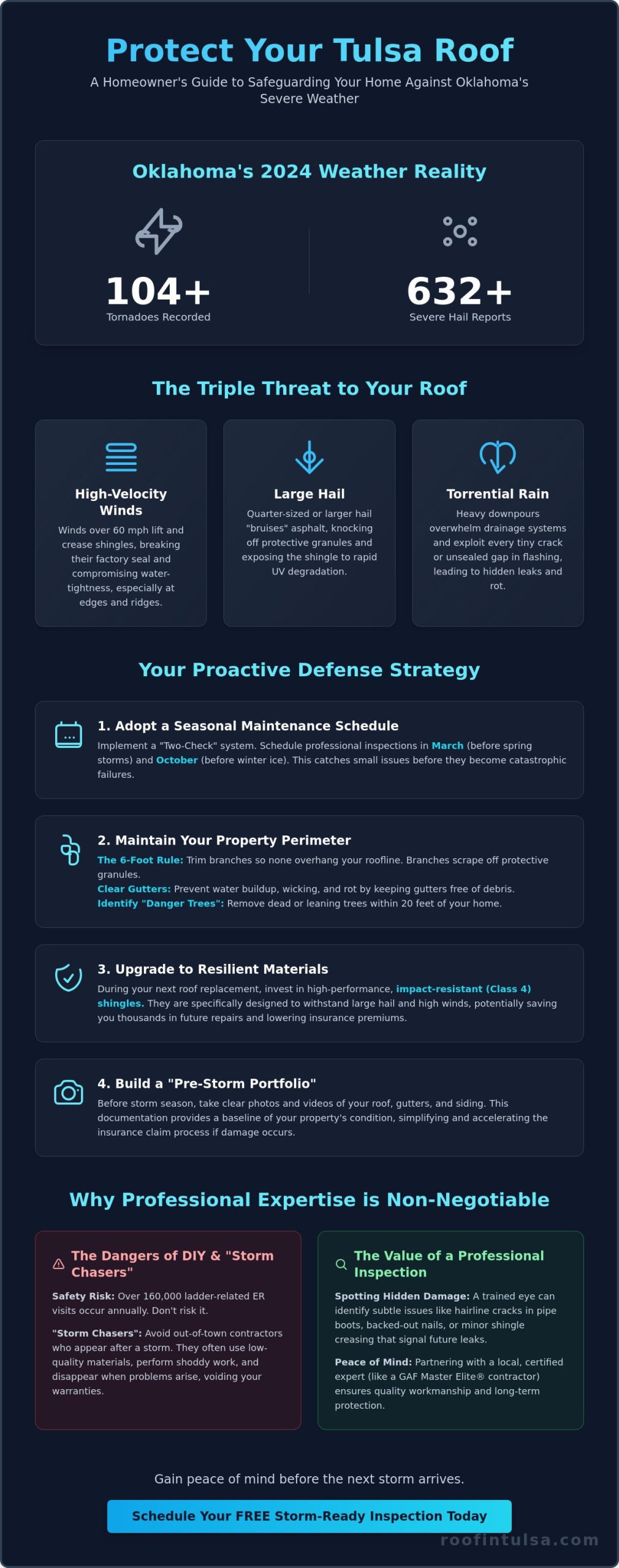
Did you know that Oklahoma recorded over 104 tornadoes and 632 reports of severe hail in 2024? As a Tulsa homeowner, you likely know the sinking feeling of watching a dark wall of clouds move in from the west. It’s perfectly natural to worry about your family’s safety and the high cost of potential repairs. We understand that the stress of hidden leaks and the fear of dealing with “storm chaser” contractors can make Oklahoma’s severe weather seasons feel overwhelming, which is why learning how to protect your roof from storm damage is your best line of defense.
You deserve peace of mind during every severe weather alert. We’ll show you exactly what proactive steps and professional strategies are needed to safeguard your home against our unique local climate. This guide provides a clear maintenance checklist and explains how to keep the insurance claim process simple and hassle-free. From identifying small issues before they become disasters to understanding the benefits of a GAF Master Elite certification, you’ll gain the confidence to protect your family for 2026 and beyond.
Key Takeaways
- Understand how a consistent seasonal maintenance schedule acts as your first line of defense against the unpredictable Oklahoma weather.
- Discover how to protect your roof from storm damage by upgrading to high-performance, impact-resistant materials during your next replacement.
- Learn how to build a “Pre-Storm Portfolio” to ensure your financial interests are protected and your insurance claims remain hassle-free.
- Identify the subtle signs of damage that only a professional eye can spot and learn how to avoid the “storm chasers” that often follow Tulsa’s severe weather.
- Gain peace of mind by understanding the specific stressors Tornado Alley places on your home and how to mitigate those risks before the clouds roll in.
Understanding the Risks: Common Types of Storm Damage in Tulsa
Storm damage is any weather-related event that breaks your roof’s water-tight seal or weakens its physical structure. In Tulsa, our homes sit right in the heart of Tornado Alley. This means our roofs face extreme pressure that standard building materials weren’t always designed to handle indefinitely. Understanding these risks is the first step in learning how to protect your roof from storm damage. Even if a storm seems minor, it can leave behind subtle issues that turn into expensive rot within 12 to 18 months.
We typically see three main threats in Northeast Oklahoma that every homeowner should watch for:
- High-Velocity Winds: These often exceed 60 mph during spring squall lines, putting immense stress on shingle adhesives.
- Large Hail: Stones the size of quarters or larger are common in Tulsa County and can destroy roofing surfaces in minutes.
- Torrential Rain: Heavy downpours test your roof’s drainage system and find every tiny crack or gap in the flashing.
These elements often work together to accelerate wear and tear. While a single storm might not cause an immediate leak, the cumulative effect of these stressors creates “hidden” damage. As a local, family-owned business, we’ve seen how small compromises in a roof’s integrity lead to structural issues if they aren’t caught early.
Wind Damage: Beyond Missing Shingles
Most homeowners look for missing shingles after a storm, but wind damage is often more subtle. High-velocity winds create a “chimney effect” where pressure differences between your attic and the outside air pull upward on your roof deck. This causes shingles to “lift” or “crease.” When a shingle lifts, the factory seal breaks. Even if it lays back down, it’s no longer water-tight. We see this most often at ridges, rakes, and eaves, where the wind catches the edges of the materials first. If your shingles are creased, they’ve lost their structural bond and will likely fail during the next big gust.
Hail Impact: The Silent Roof Killer
Hail is a unique threat because it’s difficult to see from the ground. When stones hit your roof, they “bruise” the asphalt mat. This impact knocks off the protective granules that shield your shingles from the sun. Once those granules are gone, UV rays make the asphalt brittle in as little as 90 days. You should understand the Common Types of Storm Damage caused by ice, as “cosmetic” dents on metal vents often signal “functional” damage to the shingles themselves. If your roof has lost its protective layer, you’ll need a professional repair of roofing to prevent leaks. Knowing how to protect your roof from storm damage starts with identifying these bruises before the next rainy season arrives.
Proactive Roof Maintenance: Your First Line of Defense
Investing in regular upkeep is the smartest way to learn how to protect your roof from storm damage without breaking the bank. Minor repairs typically cost a fraction of a full emergency replacement. In Tulsa, your roof faces two major stress tests every year: the severe spring storms and the heavy ice loads of winter. We recommend a “two-check” system in March and October. This schedule ensures your home is ready for 80 mph winds and heavy precipitation before the peak seasons hit.
While some homeowners feel comfortable on a ladder, the safety risks are high. The Consumer Product Safety Commission reports over 160,000 ladder-related emergency room visits annually. A professional inspection identifies small issues, like a single backed-out nail or a hairline crack in a pipe boot, that a homeowner might miss from the ground. Catching these early prevents catastrophic structural failure when the next siren sounds.
Tree Trimming and Perimeter Clearing
Maintaining your property is essential for roof health. We suggest the 6-foot rule: no branches should ever overhang your roof line. During high winds, even small branches act like sandpaper on asphalt shingles. They scrape away the protective granules that shield your roof from UV rays and rain. You should also identify “danger trees,” which are dead or leaning trees within 20 feet of your home. These are the first to fall during a Green Country microburst, often causing massive structural damage.
Gutter Maintenance and Water Diversion
Clogged gutters are a primary cause of roof rot. When debris traps water, it leads to “wicking,” where moisture seeps backward under the roof deck and shingles. This process eventually rots the wood and causes leaks inside your walls. Ensure your downspouts are clear and direct water at least 5 feet away from your foundation. For more detailed cleaning techniques, you can read our roof maintenance guide for a deep-dive on protecting your Tulsa home.
Securing Loose Shingles and Flashing
High winds don’t always rip shingles off immediately. Often, they just loosen the seal. Once a shingle is lifted, the next gust can catch it like a sail and peel it away. Pay close attention to your flashing. Flashing is the metal transition material used at roof intersections, such as chimneys, dormers, and vents. If this metal is bent or the sealant is cracked, water will find its way in. If you want to go beyond basic repairs, the Federal Alliance for Safe Homes (FLASH) recommends considering impact-resistant roofing options to better withstand our local hail cycles.
Upgrading for Resilience: High-Performance Materials for Oklahoma Weather
A roof replacement isn’t just a necessary repair. It’s an opportunity to fortify your home against the unpredictable Oklahoma sky. When you’re considering how to protect your roof from storm damage, the materials you choose today determine your home’s safety for the next two decades. Investing in premium, storm-proof materials provides a high return on investment by preventing costly interior water damage and increasing your property’s resale value. According to industry data, high-quality roofing can recoup over 60% of its installation cost in home value alone.
Choosing a professional roof replacement tulsa allows you to integrate a complete protection system. This process turns a vulnerable structure into a resilient shield. Many homeowners find that these upgrades pay for themselves through reduced maintenance and lower insurance costs. It’s about building back stronger so you don’t have to worry the next time the sirens sound.
Class 4 Impact-Resistant Shingles
The UL 2218 Class 4 rating is the highest impact standard in the industry. During testing, labs drop a 2-inch steel ball from a height of 20 feet onto the shingle twice in the same spot. While standard shingles often crack or lose granules under this force, Class 4 shingles remain intact. Because these materials significantly reduce the likelihood of a claim, many Oklahoma insurance providers offer premium discounts ranging from 15% to 25% for homeowners who install them. This makes the upgrade a financially savvy choice for the Tulsa climate.
Enhanced Underlayment and Ice and Water Shields
Modern protection goes far beyond old-fashioned felt paper. We use synthetic underlayment that is up to 20 times more tear-resistant than traditional felt. It doesn’t absorb moisture or rot over time. To provide even deeper protection, we install ice and water shields in high-risk areas like valleys, eaves, and around chimneys. This creates a “sealed roof deck.” Even if high winds strip away your shingles, this secondary barrier keeps wind-driven rain from entering your attic and damaging your ceiling.
Wind-Rated Starter Shingles and Ridge Vents
Wind damage often starts at the edges of your roof. Standard shingles installed at the perimeter can easily lift, but we use specialized starter strips with aggressive adhesive to lock the edges down. As a GAF Master Elite contractor, we follow strict installation standards that ensure your roof can withstand winds up to 130 mph. We also prioritize attic ventilation. Proper ridge vents prevent heat from “cooking” your shingles from the inside out. This keeps the asphalt flexible and resilient, which is a key factor in how to protect your roof from storm damage as the roof ages.
Documentation and Insurance Readiness: Preparing for a Hassle-Free Claim
Protecting your home means more than just installing impact-resistant shingles. You need to protect your financial interests too. A major part of learning how to protect your roof from storm damage involves being ready for the insurance process before the first siren sounds. Documentation is your best defense against claim denials. When you have clear evidence of your roof’s condition, you remove the guesswork for the insurance company.
A “Pre-Storm Portfolio” is a collection of digital files that prove the condition of your property. It’s your most valuable asset during a claim dispute. Oklahoma ranks in the top three states for hail loss according to 2024 insurance industry data. This means Tulsa homeowners face higher scrutiny during the claims process. Having an organized file ready to go can save you weeks of back-and-forth communication.
The 15-Minute Pre-Storm Photo Tour
Take 15 minutes this weekend to build your digital evidence. Walk around your home and photograph every side of the roof, siding, and gutters. Don’t forget the interior. Take date-stamped photos of your ceilings and attic spaces. If a leak appears after a 2026 spring supercell, you’ll have proof that the spot wasn’t there before. Upload these to a cloud service like Google Drive or iCloud. If your phone is damaged during a storm, you’ll still be able to access your evidence from any device.
- Capture wide shots of each roof slope.
- Take close-ups of the siding and window wraps.
- Document the condition of your downspouts and gutter runs.
- Store a digital copy of your current policy in the same folder.
Understanding Your Policy Before the Clouds Gather
Review your policy today to avoid surprises later. Many Oklahoma policies now include a separate “hail deductible.” This is often 1% or 2% of your home’s total insured value. This is much higher than a standard $500 or $1,000 flat deductible. You also need to know if you have Replacement Cost Value (RCV) or Actual Cash Value (ACV). RCV pays to replace the roof at current 2026 market prices. ACV only pays for the depreciated value based on the roof’s age. Knowing these limits is the first step toward a hassle-free claim.
A local contractor acts as your expert witness during this process. We identify the difference between normal thermal cracking and a fresh 2026 hail strike. Adjusters often look for reasons to categorize damage as “pre-existing wear and tear.” Having a trusted professional on the roof during the adjuster’s inspection significantly reduces the risk of a partial denial. We’re here to help you get the coverage you deserve. Schedule a free inspection to document your roof’s current condition and start your portfolio today.
Professional Protection: Why Expert Inspections Are Essential
While clearing your gutters and trimming branches are vital steps, a ground-level view only reveals part of the story. Learning how to protect your roof from storm damage starts with consistent maintenance, but it ends with professional verification. A trained eye identifies hairline fractures in shingles or weakened flashing that a homeowner might miss from the driveway. These small vulnerabilities often turn into major leaks during a 70-mph wind gust or a heavy Tulsa downpour.
Tulsa homeowners should be wary of “storm chasers” who appear at your door immediately after a severe weather event. These out-of-state contractors often provide quick, sub-par repairs and vanish before you notice a problem. They don’t understand the specific wind patterns or humidity challenges of Green Country. Choosing a local partner ensures you have someone to call if a leak appears six months later. We’ve seen many homeowners left with voided warranties because a non-local crew didn’t follow Oklahoma building codes.
What Happens During a Professional Storm-Ready Inspection?
A professional inspection goes far beyond a quick glance. Our team evaluates the structural integrity of the decking, the strength of shingle seals, and the health of your ventilation system. Proper airflow is critical; poor ventilation causes heat buildup that weakens shingles from the inside out. We provide a detailed digital report that documents the current state of your roof. This document serves as a vital baseline if you ever need to file an insurance claim after a storm in 2026.
- Seal Strength: We check for shingle uplift that occurs when adhesives fail over time.
- Ventilation Health: We ensure your attic isn’t trapping moisture that rots your roof deck.
- Structural Integrity: We look for sagging or soft spots that indicate long-term water damage.
Our deep knowledge of roofing tulsa allows us to spot regional issues, such as specific wear patterns caused by Oklahoma’s extreme temperature swings. This is the most effective way to understand how to protect your roof from storm damage before the next supercell arrives.
The Rescue Roofing Difference: Local, Honest, and GAF Certified
We believe in building relationships, not just replacing shingles. As a GAF Master Elite contractor, we belong to the top 2% of roofing professionals nationwide. This certification means we adhere to the highest installation standards and can offer warranties that others cannot. We focus on a hassle-free experience. Our team handles the technical details so you can focus on your family’s safety. Protecting your home is a journey that moves from proactive DIY care to a trusted professional partnership. We’re here to provide the peace of mind that your largest investment is truly secure.
Don’t wait for the next sirens to wonder if your roof will hold up. Schedule your free, no-obligation storm-ready inspection today!
Secure Your Tulsa Home Before the Next Storm Hits
Living in Oklahoma means facing unpredictable weather every year. You’ve learned how to protect your roof from storm damage by prioritizing routine maintenance and choosing high-performance materials designed for our local climate. Since 2026 is projected to bring its own set of weather challenges, being proactive with your documentation and insurance readiness is the best way to ensure a hassle-free recovery if a storm strikes. Your home is your biggest investment, and keeping it dry starts with a resilient exterior.
Don’t wait for a leak to reveal hidden issues. As Tulsa’s Most Trusted Roofer, T-Town Roofing provides the expertise you need to stay safe. We are GAF Master Elite Certified, a status held by less than 2 percent of roofing contractors nationwide. This elite certification allows us to offer a 10-year workmanship warranty on our projects, giving you long-term peace of mind. We handle the hard work so you can focus on what matters most.
Get Your Free Storm-Ready Roof Inspection
We’re proud to be a local, family-owned business serving our neighbors. Let’s work together to keep your home strong and secure for years to come.
Frequently Asked Questions
How often should I have my roof inspected for storm damage in Tulsa?
You should schedule a professional roof inspection at least twice a year, typically in the spring and fall. Tulsa experiences an average of 65 thunderstorm days annually according to National Weather Service data, so it’s vital to check for issues after any major weather event. Regular maintenance helps you catch small problems before they turn into expensive leaks that threaten your home’s structural integrity.
Does homeowners insurance cover roof damage from any storm?
Most standard insurance policies cover roof damage caused by specific events like wind, hail, or fallen trees. However, they typically exclude damage resulting from flooding or lack of maintenance. According to the Insurance Information Institute, wind and hail account for 45.5 percent of all homeowners insurance claims, making it the most frequent type of loss for residents in the Tulsa area.
What are Class 4 shingles, and are they worth the extra cost?
Class 4 shingles are impact-resistant materials that have passed the UL 2218 test by surviving a 2 inch steel ball dropped from 20 feet. They’re a smart investment because they significantly reduce the risk of punctures during Oklahoma’s frequent hail storms. Many insurance providers in Oklahoma offer premium discounts of up to 25 percent for homes with these shingles, which helps the upgrade pay for itself.
Can I protect my roof from a tornado?
You can’t fully protect a roof from a direct hit by an EF4 or EF5 tornado, but you can strengthen it against lower-intensity winds. Using hurricane clips and roof tie-downs improves the connection between your roof deck and the walls of your home. Learning how to protect your roof from storm damage often starts with these structural reinforcements that help your home stay intact during high-wind events.
What should I do immediately after a storm hits my home?
Your first step is to perform a visual inspection from the ground to check for missing shingles, dented flashing, or fallen debris. Don’t climb on the roof yourself, as storm-damaged structures can be unstable and dangerous. Document any visible damage with photos for your records and contact a local professional to schedule a detailed inspection. This documentation is a critical part of the insurance claim process.
How do I know if I have hail damage if my roof isn’t leaking?
Hail damage often appears as “bruising” or a loss of protective granules that you can’t see from the ground. Even without a leak, these impact points weaken the shingle and lead to UV degradation or leaks within 12 to 24 months. A professional inspection identifies these subtle signs of damage before the window for filing an insurance claim or utilizing a warranty expires.
Is it better to repair or replace a storm-damaged roof?
The choice depends on the extent of the damage and the current age of your roofing system. If more than 25 percent of the roof surface is damaged, local building codes and industry standards often require a full replacement rather than a patch. Understanding how to protect your roof from storm damage involves knowing when a repair is a reliable fix and when a full replacement is necessary for safety.
How can I tell if a roofing contractor is a “storm chaser”?
Look for out-of-state license plates and high-pressure sales tactics that demand an immediate signature or cash deposit. Legitimate local contractors have a permanent physical office in the Tulsa area and can provide proof of GAF Master Elite certification. Avoid anyone who offers to “waive” your deductible, as this practice is illegal under Oklahoma’s SB 489 law which was enacted in 2022.