


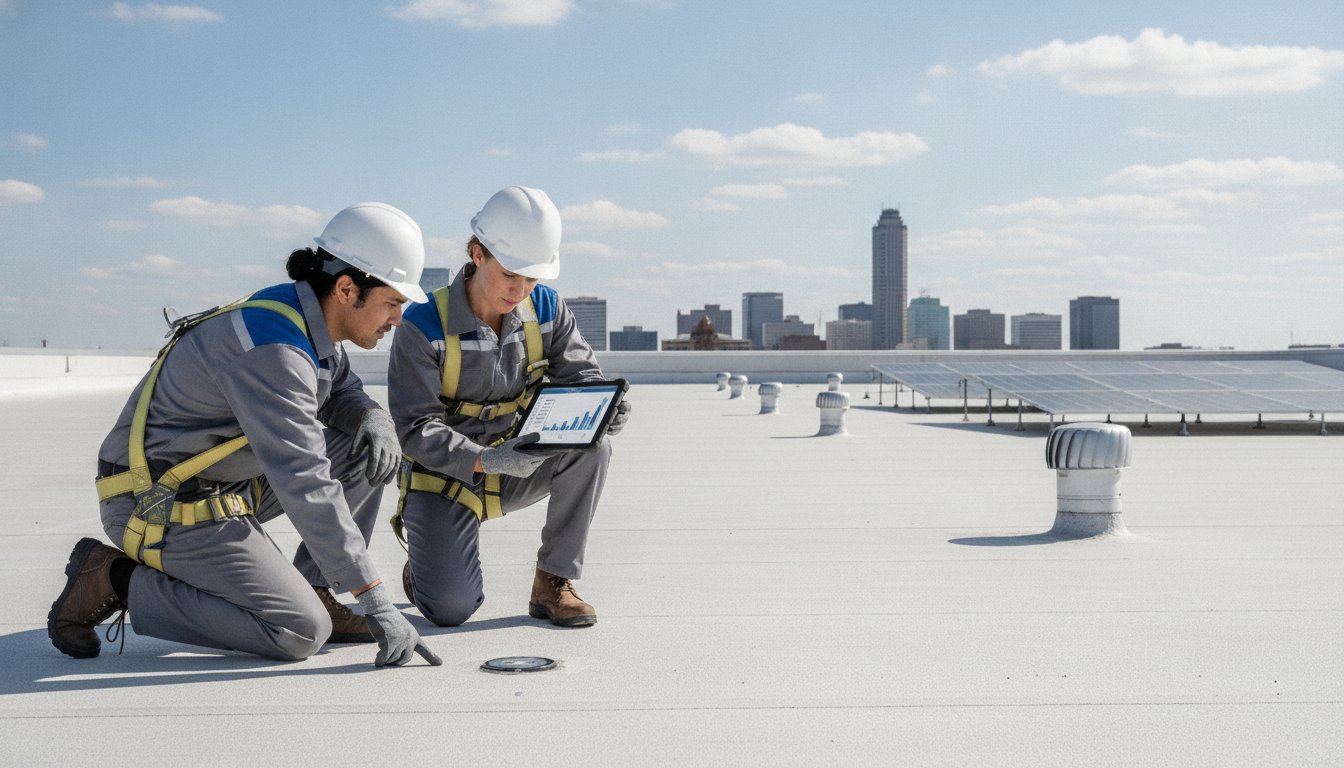

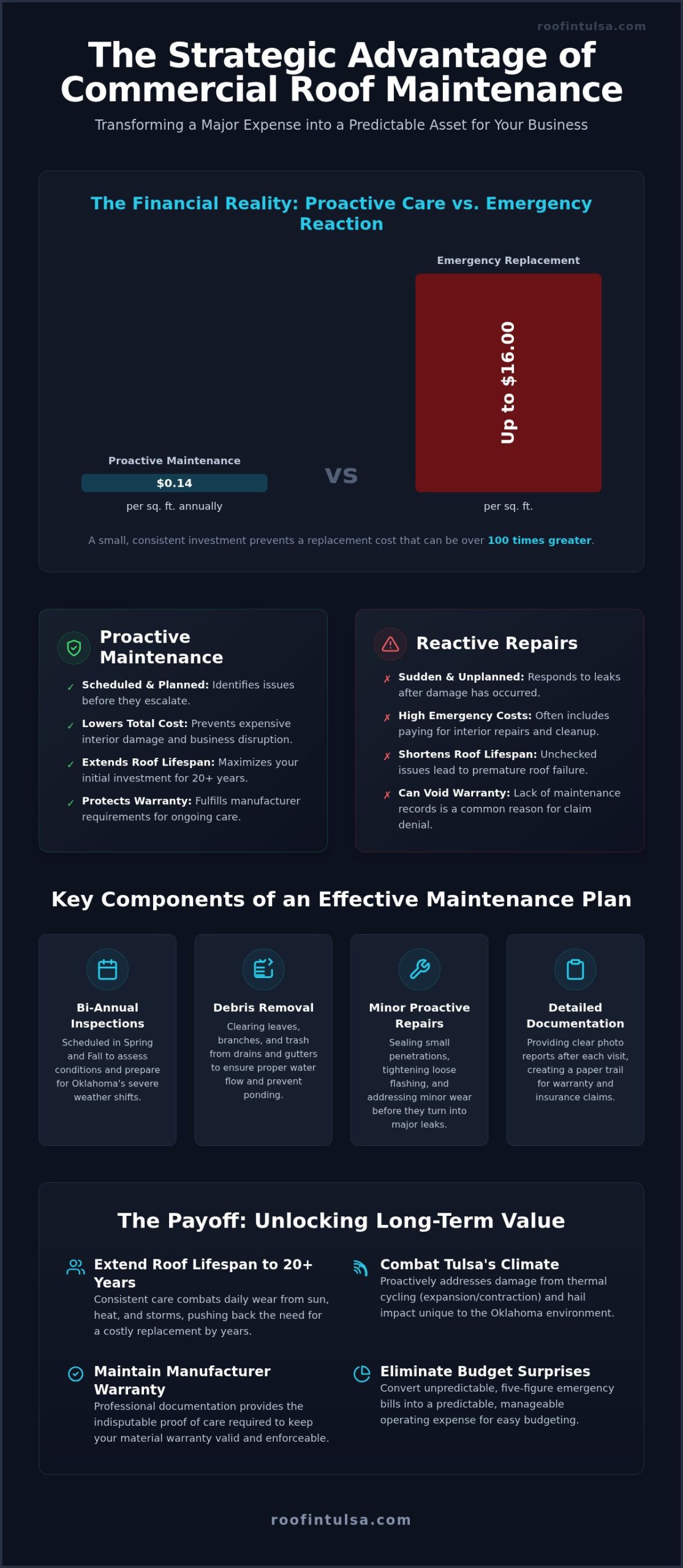
Did you know that proactive care for your facility can cost as little as $0.14 per square foot annually, while a full roof replacement can cost up to $16 per square foot? For many Tulsa business owners, the roof is a “set it and forget it” asset until a spring hailstorm or a sudden leak disrupts daily operations. It’s incredibly stressful to face an unexpected five-figure repair bill because a small, preventable issue went unnoticed for too long. Investing in a commercial roof maintenance agreement is the most reliable way to gain peace of mind and ensure your property is prepared for whatever the Oklahoma sky delivers.
In this guide, you’ll learn how a structured agreement protects your investment and eliminates budget surprises. We will show you how these plans can extend your roof’s life to 20 years or more while keeping you in compliance with strict manufacturer warranty requirements. We also explain how professional documentation simplifies the insurance claim process after a major storm. By the end of this article, you’ll understand how to turn your roof maintenance from a stressful chore into a strategic advantage for your business.
Key Takeaways
- Understand why a commercial roof maintenance agreement is a strategic investment that prevents unexpected budget hits from leaks and storm damage.
- Identify the critical components of an effective plan, including bi-annual inspections and professional debris removal to maintain proper drainage.
- Learn how to combat Tulsa’s unique environmental challenges, such as thermal cycling and hail impact, to extend your roof’s life by 20 years or more.
- Gain clarity on how detailed maintenance records provide the essential documentation needed for manufacturer warranty and insurance claims.
- Discover the long-term ROI of proactive care compared to the significantly higher costs of deferred maintenance and premature roof failure.
What is a Commercial Roof Maintenance Agreement?
A commercial roof maintenance agreement is a formal, ongoing contract between a property owner and a professional roofing partner. It is much more than a simple service call. This agreement establishes a structured schedule of care where your roof receives professional oversight, typically twice a year. While many owners think of roofing services as something they only need after a major Oklahoma storm, a maintenance plan shifts the focus to prevention. It aligns with facility management best practices by treating the roof as a critical asset that requires consistent oversight to perform correctly.
These agreements include comprehensive inspections, cleaning of drainage systems, and minor proactive repairs. The goal is to catch “silent killers” before they lead to a catastrophic failure. For example, a small puncture caused by an HVAC technician or a drain clogged with seasonal debris might not cause a leak today. However, these issues eventually lead to ponding water and structural damage. By identifying these problems early, you protect your building and your budget from sudden, expensive surprises.
Maintenance vs. Standard Roof Repair
The primary difference between maintenance and repair is timing and intent. A standard roof repair is reactive. It happens after a problem, such as a ceiling leak or wet insulation, has already been discovered. By that point, the damage is already done. You aren’t just paying for the roof fix; you’re often paying for interior repairs and potentially facing business interruptions that hurt your bottom line.
Maintenance is different because it’s proactive. It focuses on keeping the roof in its original, high-performing state. This approach significantly reduces the total cost of ownership over the lifespan of the roof. By spending a small amount on regular check-ups, you can often push back the need for a full commercial roofing replacement by several years.
The Role of Manufacturer Warranties
Maintaining the validity of your manufacturer warranty is a critical benefit of a commercial roof maintenance agreement. Most major manufacturers of TPO and EPDM roofing systems require documented maintenance to keep their warranties in effect. If you ever need to file a claim for a material defect, the manufacturer will likely ask for detailed service records. Without a professional agreement, you may lack the specific proof of care these companies demand. This documentation gap is a frequent reason for denied claims. A structured plan ensures that every inspection is recorded, providing a clear paper trail that protects your financial interests.
Key Components of an Effective Maintenance Plan
An effective commercial roof maintenance agreement isn’t just a piece of paper; it’s a comprehensive strategy for your building’s health. At its core, the plan must include bi-annual visits. We typically recommend scheduling these in the spring and fall to prepare for Oklahoma’s severe weather shifts. Following NRCA inspection guidelines ensures that every square foot of your roof is evaluated against industry standards.
Beyond just looking at the roof, a good plan includes active labor. This means removing limbs, leaves, and trash that collect on the surface or clog your primary drainage points. It also includes small-scale preventative repairs. Technicians should proactively seal small penetrations or tighten loose flashing before they become entry points for water. A high-quality agreement also defines clear response times for emergencies and outlines exactly which minor repairs are included in your flat fee, so there’s no confusion when work begins. This clarity helps you avoid the “fine print” traps that often lead to unexpected costs in lower-quality contracts.
The Inspection Checklist
The checklist serves as a roadmap for your roof’s longevity. For flat roofing systems, we prioritize checking for ponding water. If water stays on the surface for more than 48 hours, it adds immense weight and stresses the membrane. We also examine the seams and welds. In Tulsa’s heat, these can expand and separate. Finally, we evaluate the condition of your UV protection layers. If your roof coating is thinning, your roof is essentially getting a “sunburn” every day, which accelerates aging and leads to brittleness. These small details are often what distinguish a professional inspection from a casual walk-through.
Documentation and Reporting
Documentation is perhaps the most overlooked part of a commercial roof maintenance agreement. You need a comprehensive digital report with photographic evidence of every finding. This photo-documented history is your best defense if an insurance company tries to deny a claim by citing “wear and tear.” It proves that you’ve been a responsible owner who took care of the property. It also helps you track the “aging curve” of your roof. By seeing how the system degrades over time, you can plan your capital expenditures years in advance rather than being hit with a surprise bill. This level of transparency is essential for accurate budgeting and long-term facility planning.
Rescue Roofing Tulsa provides these transparent, easy-to-read reports so you’re never left in the dark about your asset’s condition. We believe in providing the documentation manufacturers demand to keep your warranty valid. If you’re ready to secure your building’s future, consider scheduling a professional commercial roof inspection to see where your system stands today.
Why Tulsa Businesses Need Preventative Maintenance
Tulsa’s weather is notoriously unpredictable. For a commercial building owner, this volatility is the single greatest threat to your roof’s integrity. While a commercial roof maintenance agreement is beneficial in any climate, it’s essential here in “Hail Alley.” Our region’s unique combination of high-velocity winds, heavy spring rains, and extreme temperature shifts creates a high-stress environment for flat roofing systems. Without a plan in place, you’re essentially waiting for a storm to reveal a weakness you could’ve fixed months ago.
Oklahoma winds often reach speeds between 60 and 140 mph during severe weather outbreaks. These gusts don’t just blow debris around; they create significant uplift pressure that can loosen edge metal, flashing, and even the membrane itself. A maintenance professional ensures that all perimeter details and equipment are properly secured before these winds arrive. Additionally, clearing your drainage systems before the heavy spring storm season prevents water from backing up and causing structural stress or interior leaks.
Managing Thermal Expansion in Oklahoma
Tulsa businesses face temperature swings of over 100 degrees between the peak of summer and the depths of winter. This creates intense “thermal cycling,” where roofing materials constantly expand and contract. This movement puts immense pressure on seams and welds. Over time, it leads to “bridging,” where the membrane pulls away from the roof deck at the angles.
Seasonal checks help identify these seam failures and cracks before they lead to structural damage. Repeated freeze-thaw cycles in the winter are particularly dangerous. If water enters a small crack and freezes, it expands, making the opening even larger. By catching these issues during a scheduled visit, we prevent the slow degradation that eventually forces a premature replacement.
Storm Readiness and Post-Storm Priority
When a massive storm hits Green Country, every roofing company in the region is flooded with calls. One of the most significant benefits for our clients is priority status. Maintenance agreement holders don’t have to wait at the back of the line; they receive priority during emergency roof repair surges. This rapid response is critical for preventing secondary damage to your inventory or equipment.
Proactive care also has a massive impact on your bottom line. According to A Roofing Industry Alliance for Progress study, proactive maintenance can nearly double a roof’s lifespan. This data is especially relevant for Tulsa businesses facing high-impact hail events that punish older, brittle membranes. Having a roofing partner who already knows your building’s layout and repair history saves critical time. It removes the bureaucratic stress of finding a trustworthy contractor in the middle of a crisis, allowing you to focus on running your business while we handle the protection of your facility.
Evaluating Costs vs. Long-Term ROI
Viewing a commercial roof maintenance agreement as a mere line item on a budget is a mistake. Instead, think of it as a strategic asset for your building’s most expensive component. A premature roof replacement for a typical Tulsa facility can easily exceed $50,000. When you compare that to the manageable annual cost of a structured plan, the financial logic is clear. You aren’t just paying for inspections; you’re paying to keep that massive replacement cost at bay for as long as possible.
The savings extend beyond the roof itself. When a roof fails unexpectedly, the resulting water damage often ruins inventory, electronics, and expensive interior finishes. Even worse, it can lead to “business interruption” losses. If your retail space or office has to close for repairs, the lost revenue often dwarfs the cost of the roofing work. There are also tax advantages to consider. Maintenance is usually classified as an operating expense, allowing for a full deduction in the year the work is performed. In contrast, a new roof is a capital expenditure that must be depreciated over decades. Finally, if you ever decide to sell your property, a binder full of professional maintenance records significantly increases the resale value by proving the asset’s health to potential buyers.
Avoiding the “Emergency Premium”
Reactive repairs are almost always more expensive than planned care. When you call for a technician in the middle of a storm, you’re often paying an “emergency premium” that can be 2 to 3 times higher than a standard service rate. A maintenance plan eliminates the need for these stressful, after-hours calls. Regular oversight prevents small punctures from evolving into structural catastrophes that compromise the safety of your entire building.
Insurance Claim Support
One of the biggest hurdles in a storm claim is the “wear and tear” exclusion. Insurance adjusters often try to deny claims by arguing that the roof was already in poor condition before the storm hit. Your maintenance logs are your best defense. They provide undeniable proof that the roof was well-cared for and that the damage was caused by a specific weather event. By providing clear “before and after” documentation, we help you navigate the bureaucratic stress of the claims process. For a deeper look at how this works, read our guide on commercial roofing in Tulsa.
Protecting your bottom line starts with a proactive strategy. If you’re ready to stop gambling on your facility’s future, contact us to discuss a customized commercial roof maintenance agreement that fits your specific needs.
Partnering with Rescue Roofing Tulsa for Commercial Protection
Hiring a roofing company shouldn’t feel like a simple transaction. It’s about finding a partner who values your business as much as you do. Rescue Roofing Tulsa specializes in high-stakes commercial roofing for local enterprises. We don’t believe in one-size-fits-all solutions. Instead, we offer a customized commercial roof maintenance agreement tailored to your building’s specific architecture and your company’s budget. Whether you manage a retail center with multiple TPO units or a condominium complex, our team ensures your plan addresses your unique vulnerabilities.
Our local team understands the specific insurance and weather landscape of Oklahoma. We know how to speak the language of adjusters and manufacturers. This expertise allows us to provide a seamless transition when the time for maintenance ends and the need for repair or replacement begins. You won’t have to explain your roof’s history to a stranger because we’ve been there for every inspection and minor fix along the way. This continuity is a major advantage during the stressful weeks following a major storm.
Our Local Tulsa Commitment
Choosing a local roofing contractor matters for long-term accountability. We live and work in the same community as our clients. This regional focus means we’re here to stand by our work long after the storm clouds have cleared. We take a “no-stress” approach to handling the administrative and insurance burdens that often overwhelm property managers. Our goal is to act as your trusted advisor. We remove the bureaucratic weight from your shoulders so you can focus on your daily operations. You can request a professional consultation for your building today to start building that relationship.
Next Steps for Your Property
Securing your facility’s future is a straightforward process. It begins with a comprehensive initial roof health assessment. During this visit, we’ll document your system’s current state and identify any immediate needs. We’ll also review your existing manufacturer warranty to ensure your new commercial roof maintenance agreement keeps you in full compliance. This step is vital for protecting your long-term financial interests. Don’t wait for a leak to tell you there’s a problem. Protect your investment with a Rescue Roofing Tulsa Maintenance Agreement and gain the peace of mind that comes with professional, local oversight.
Secure Your Facility’s Future Today
Your commercial roof is a major investment that deserves professional protection. By choosing a structured approach, you turn a reactive expense into a strategic advantage. You’ve learned how regular care prevents the “silent killers” of flat roofing and ensures you remain in full compliance with manufacturer warranties. In a region where storm damage is a constant threat, having a documented history of care is your best defense during an insurance claim.
Rescue Roofing Tulsa is here to handle the bureaucratic stress for you. As a company that is locally owned and operated in Tulsa, we understand the specific challenges of our Oklahoma climate. Our team includes certified insurance claim specialists ready to support you, and we provide a 24/7 emergency response for our maintenance partners. It’s time to stop worrying about the next storm and start planning for your building’s longevity.
Get a Custom Commercial Maintenance Quote and let us build a commercial roof maintenance agreement that works for you. We look forward to being your trusted roofing partner.
Frequently Asked Questions
How often should a commercial roof be inspected under a maintenance agreement?
Most commercial roofs should be inspected at least twice per year. We typically recommend scheduling these visits in the spring and fall to prepare your facility for Oklahoma’s severe weather shifts. These bi-annual check-ups allow technicians to identify issues caused by winter freezes or summer heat before they escalate. Regular oversight is the most effective way to ensure your building remains watertight throughout the entire year.
Will a maintenance agreement cover the cost of major repairs?
A standard agreement typically covers preventative care and minor repairs rather than major structural overhauls. It includes essential tasks like clearing drains, removing debris, and sealing small penetrations. If a significant issue is discovered during a scheduled inspection, we provide a detailed quote for the necessary work. The primary goal of the plan is to prevent these major expenses by catching problems while they’re still small and manageable.
Does my manufacturer warranty require a professional maintenance plan?
Yes, most major manufacturers of TPO and EPDM systems require documented professional care to keep warranties valid. If you ever file a claim for a material failure, the manufacturer will likely ask for service records. Without a commercial roof maintenance agreement, you may struggle to prove you’ve met these specific requirements. Professional documentation provides the “proof of care” needed to protect your long-term investment and your warranty rights.
How much does a commercial roof maintenance agreement typically cost in Tulsa?
The cost of a maintenance plan varies based on the size of your building, the roof type, and the complexity of the drainage system. Every facility has different needs, so we provide customized quotes after an initial health assessment. While the annual cost is a small investment, it’s significantly lower than the expense of emergency repairs. We focus on providing a plan that fits your specific budget and property requirements.
Can a maintenance plan help with my commercial insurance claims?
A maintenance plan is one of your best tools during the insurance claim process. By maintaining a photo-documented history of your roof’s condition, you can prove that damage was caused by a specific storm event rather than neglect. This documentation helps our insurance claim specialists advocate for you. It makes it much harder for adjusters to deny a claim by citing “wear and tear” or pre-existing damage exclusions.
What happens if a leak occurs between scheduled maintenance visits?
If a leak occurs between scheduled visits, maintenance clients receive priority status for service calls. We offer 24/7 emergency repair services to ensure your operations aren’t disrupted for long. Having an existing commercial roof maintenance agreement means we already know your building’s layout. This familiarity allows our technicians to locate and resolve the issue much faster than a contractor who is seeing your facility for the first time.
Can I customize my maintenance agreement for multiple properties?
We can definitely customize agreements for owners or property managers who oversee multiple locations. We tailor each plan to the specific roof type and condition of each individual building in your portfolio. This approach allows you to consolidate your facility management while ensuring every property receives the exact level of care it requires. It also simplifies your budgeting by providing predictable maintenance costs across all your Tulsa area holdings.
What is the difference between a roof inspection and a maintenance visit?
A roof inspection is a visual assessment designed to identify existing problems or potential risks. A maintenance visit goes a step further by including active labor to preserve the roof’s health. This includes cleaning out gutters, clearing primary drainage points, and performing minor preventative repairs. While an inspection tells you what is wrong, a maintenance visit takes proactive steps to keep your roofing system in peak performing condition for years.