



The insulation with the highest R-value isn’t automatically the best choice for a commercial roof. In Tulsa, heat, moisture, wind, hail, and the condition of the existing roof all affect how an assembly performs. Comparing commercial roof insulation options tulsa property owners may consider means looking beyond a single rating.
Energy performance matters, but insulation also has to work with the roof membrane, deck, drainage, and building use. A mismatch can create problems that a higher R-value alone won’t solve.
This guide compares common insulation materials and roof assemblies, including rigid boards, fiberglass, and spray foam, and explains which building needs can shape the decision. It also lists practical questions to prepare before discussing an upgrade or replacement with a Tulsa roofing professional. Use them to clarify the existing roof’s condition, moisture concerns, and possible project disruptions before comparing options.
Key Takeaways
- Compare polyiso, EPS, XPS, and mineral wool by more than R-value. Consider how each material may fit the roof design and building needs.
- Explore commercial roof insulation options tulsa buildings may use, then verify material suitability and performance details for the specific project.
- Retrofit choices depend on existing roof materials, moisture conditions, roof design, and manufacturer guidance.
- Gather roof records, leak history, maintenance notes, and building-operation constraints before talking with a roofing professional.
- Start with the roof’s condition and the building’s priorities, then discuss compatible assemblies as part of a commercial roof assessment or replacement conversation.
Commercial Roof Insulation in Tulsa: What It Does and Why the Assembly Matters
Commercial roof decisions can affect indoor comfort, daily operations, and future maintenance needs. Comparing commercial roof insulation options tulsa property owners may encounter is a useful start, but the material alone can’t show whether a roof system suits a particular building.
Roof insulation slows heat transfer through the roof, helping manage how readily heat moves between the interior and outdoors. It serves a different purpose from the roof membrane, the outer layer designed to keep water out. Both matter, and insulation performance also depends on the layers beneath the membrane, how they’re attached, and the existing roof’s condition. A general overview of building insulation materials can introduce the options, but choosing one for a roof calls for project-specific review.
Commercial roof insulation is selected as part of an assembly, not in isolation. A material’s stated thermal performance doesn’t account for every factor, including moisture, roof design, installation details, and compatibility with other components. Those considerations help determine which options are practical to evaluate.
How insulation fits into a low-slope commercial roof
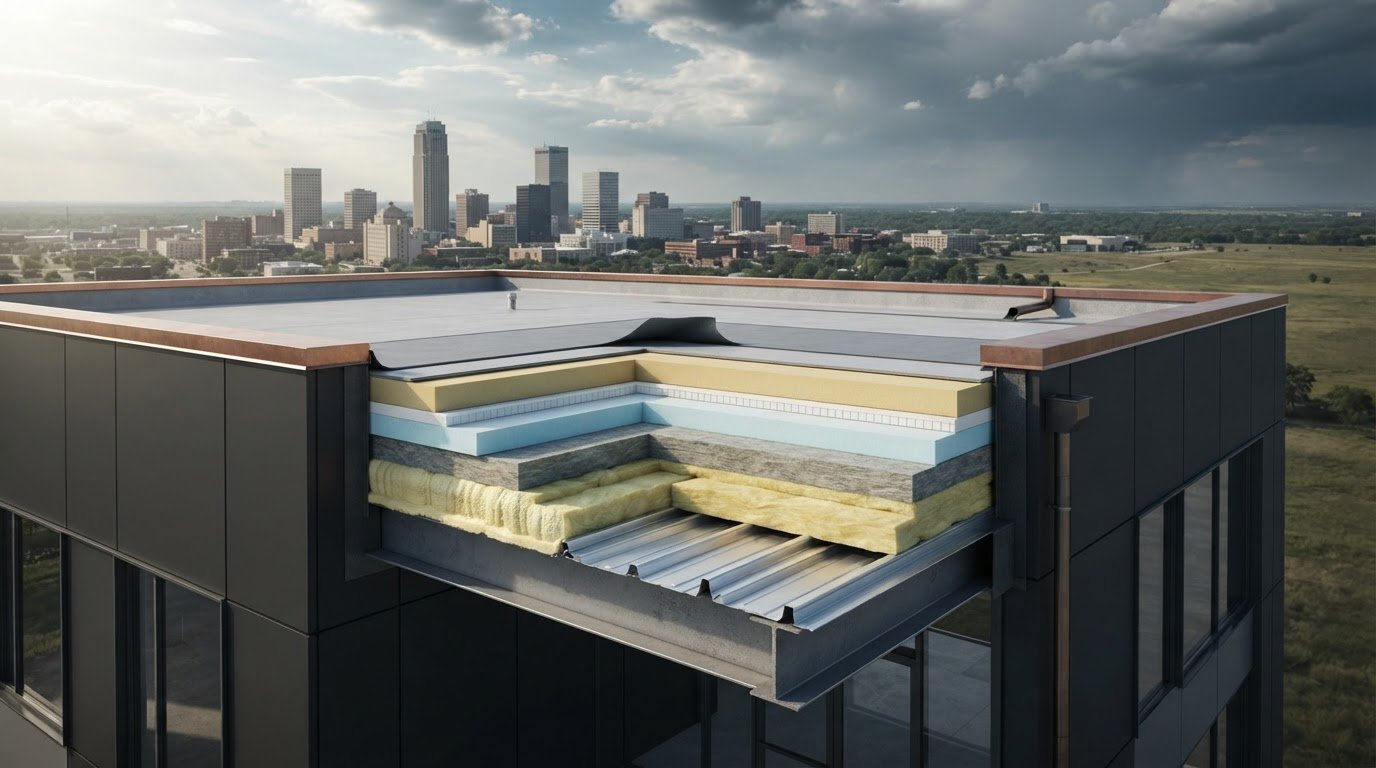
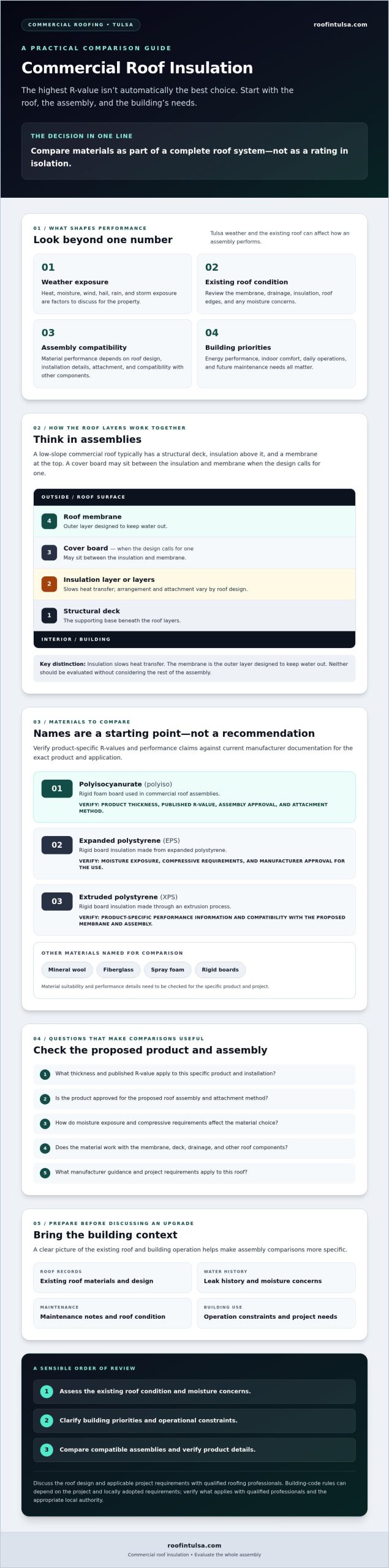
A low-slope roof typically has a structural deck, insulation layers above it, and a roof membrane at the top. A cover board may sit between the insulation and membrane when the design calls for one. Together, these layers form an assembly. Their arrangement and attachment vary by roof design and manufacturer specifications, so a site assessment is important before changing an existing roof.
Why Tulsa building conditions belong in the decision
Seasonal heat, rain, and storm exposure are practical factors to discuss for a Tulsa property. They can make the condition of the membrane, drainage, insulation, and roof edges relevant when considering an upgrade. The questions to ask depend on the building’s exposure and existing roof, rather than a broad assumption about every local property.
Before choosing materials or planning replacement work, ask a qualified roofing professional to review the roof design and applicable project requirements. Building-code rules can depend on the project and locally adopted requirements. Verify what applies with qualified professionals and the appropriate local authority instead of relying on general online guidance.
Commercial Roof Insulation Materials: Compare Common Options for Tulsa Buildings
Material names are a starting point, not a complete recommendation. Polyisocyanurate, expanded polystyrene, extruded polystyrene, and mineral wool differ in composition, but the right comparison also depends on the roof assembly and building requirements. For commercial roof insulation options tulsa property owners are considering, verify published R-values and performance claims against current manufacturer documentation for the specific product and application.
Polyisocyanurate, EPS, and XPS: where comparisons begin
Polyisocyanurate, often called polyiso, is a rigid foam insulation category commonly considered for commercial roofs. The Polyisocyanurate Insulation Manufacturers Association provides information about this material category. EPS means expanded polystyrene, while XPS means extruded polystyrene. Both are rigid foam boards, but their manufacturing processes differ. These general descriptions don’t establish how a particular board will perform in a specific roof system.
Use the comparison below to guide questions, not to select a material without reviewing the roof design. Check thickness, moisture exposure, compressive requirements, attachment, and compatibility against product documents and the proposed assembly.
| Material category | General characteristics | Questions to verify for the project |
|---|---|---|
| Polyisocyanurate (polyiso) | Rigid foam board used in commercial roof assemblies. | What thickness and published R-value apply to this product and installation? Is it approved for the proposed assembly and attachment method? |
| Expanded polystyrene (EPS) | Rigid board insulation made from expanded polystyrene. | How does the selected product address the roof’s moisture exposure and compressive requirements? Does the manufacturer approve it for this use? |
| Extruded polystyrene (XPS) | Rigid board insulation made through an extrusion process. | What product-specific performance information applies, and is the board compatible with the membrane and other assembly layers? |
| Mineral wool | Fibrous insulation category that may be evaluated for roof assemblies. | Does the assembly meet the project’s fire, acoustic, structural, and attachment needs? Is this application manufacturer-approved? |
When mineral wool or other options enter the discussion
A project’s priorities can broaden the material discussion. Fire performance, acoustics, structural demands, available roof depth, and the complete assembly may all influence what deserves review. Mineral wool is one option to evaluate, not a guaranteed fit. Ask for current product documentation and confirmation of manufacturer-approved applications before naming or specifying a product.
No single insulation material suits every commercial roof. The best fit depends on the building, existing conditions, and a compatible assembly. If a roof inspection or replacement discussion is underway, a commercial roof inspection can help clarify the roof’s condition before you compare insulation choices.
Which Tulsa Commercial Roof Insulation Assembly Fits Your Building?
The same insulation can function differently depending on where it sits in the roof. In many low-slope designs, insulation is installed above the structural deck, sometimes in multiple layers. Other projects may add insulation as part of a recover assembly over an existing roof, if the existing conditions and applicable requirements allow it. The membrane, insulation, and any cover board must work together as a system.
A higher stated R-value isn’t automatically the better choice. A roof also needs a suitable moisture strategy, compatible materials, reliable drainage, and an assembly that fits the building. Comparing commercial roof insulation options tulsa property owners may consider means evaluating these factors alongside thermal performance.
Recover, retrofit, or replace: how project scope changes the options
A recover project evaluates whether some existing roof layers can remain beneath new materials. A full replacement involves removing the existing assembly and planning a new one. Neither approach should be assumed suitable without a roof review. Before considering added layers, ask a qualified professional to assess:
- Roof condition: Look for damaged membrane areas, failed details, or recurring leaks.
- Moisture: Determine whether water may be trapped within existing materials.
- Drainage: Check whether drains and slopes can manage water with the proposed assembly.
- Deck integrity: Confirm the deck’s condition before building over it or attaching new layers.
These findings help clarify whether retaining any existing assembly is worth evaluating or whether replacement deserves discussion. Don’t cover an existing roof without professional inspection and confirmation of applicable approvals.
Roof membrane, drainage, and structural considerations
Membrane compatibility is another part of the decision. For example, if a project involves TPO, the insulation, cover board, attachment approach, and membrane details must be checked as parts of the proposed assembly. The membrane type alone doesn’t confirm that an insulation board or installation method is suitable. Ask the roofing professional to verify manufacturer requirements for the specific combination.
Added layers can change roof height and affect details at drains, edges, penetrations, and transitions. Review those connections for the proposed project so the assembly can be coordinated with drainage and the existing roof design. Confirm structural load limits and attachment requirements before specifying materials or describing technical thresholds.
A commercial roof inspection can help establish existing conditions before a replacement or upgrade discussion. For broader context, consult a guide to commercial roofing in Tulsa alongside a project-specific assessment. A general overview isn’t a recommendation for your building.
How to Evaluate Commercial Roof Insulation Options in Tulsa
A little preparation can make a roofing conversation more useful. Before comparing commercial roof insulation options tulsa properties might need, record how the building is used, what comfort concerns occupants have, and what’s known about the roof’s history. Use these steps to organize the discussion.
- Describe the building’s use. Note occupancy patterns, areas that feel too hot or cold, and any sensitive equipment or spaces with special comfort needs. Include planned building changes that could affect roof or insulation decisions.
- Gather roof history. Collect available roof records, documented roof age, leak history, repair invoices, and maintenance notes. Mark recurring trouble spots and share what you know about past work, even if some details are uncertain.
- Identify operational constraints. Consider roof access, preferred scheduling, and how work could affect customers, tenants, staff, deliveries, or business operations. Sharing these constraints helps keep the project discussion grounded in day-to-day needs.
- Request an assessment of existing conditions. Ask which inspection findings support the proposed approach and whether potential moisture concerns were evaluated. Findings should help explain whether the discussion concerns the current roof, a possible recover, or replacement.
- Compare the complete proposed scope. Review assembly layers and placement, documented materials, membrane compatibility, drainage details, and any assumptions or exclusions. Compare proposals by the work they describe, not by an R-value or material name alone.
Questions to ask when comparing recommendations
Ask the roofing professional to connect the inspection findings to the proposed assembly. Which existing conditions affect the recommendation? How were moisture concerns considered? What materials and placement are specified, and how will membrane and drainage details be addressed? Request current product documentation and clarification of assumptions so you can tell what is confirmed and what still needs verification.
A useful insulation proposal identifies the full roof assembly, connects recommendations to inspection findings, and documents the materials, compatibility, and assumptions behind the scope. If proposals differ, ask each contractor to clarify what the assessment established and which project details remain unresolved before comparing approaches.
Once you’ve gathered your records and questions, discuss your commercial roofing project with a local team. Rescue Roofing Tulsa provides commercial roofing services in Tulsa and surrounding areas, and commercial roof replacement is an available service. Discuss how insulation fits into the project without assuming a particular material or outcome before the roof is assessed.
Plan Your Tulsa Commercial Roof Insulation Project with a Roofing Assessment
You don’t need to choose an insulation material before understanding the roof. Start with the building’s needs and the roof’s observed condition, then compare assemblies that may be compatible with both. This keeps commercial roof insulation options tulsa property owners consider tied to the project, rather than a product label or R-value alone.
A roofing assessment can help clarify visible roof conditions, areas that may need further investigation, and whether repair or replacement should be part of the discussion. It can also identify questions about the existing assembly, drainage, and documentation that need answers before a proposal is prepared. An assessment doesn’t guarantee a particular insulation recommendation. Confirm directly with the roofing company whether insulation-specific evaluation or installation is available.
What to have ready for an initial conversation
Sharing the basics helps make an early discussion more focused. Gather what you have, and note when information is unknown rather than guessing.
- Property and roof details: Share the property location, roof type if known, and any available drawings, prior proposals, or roof records.
- History and concerns: Describe maintenance, past repairs, water intrusion, and indoor comfort concerns. Include which areas are affected and whether the issue is recurring.
- Building operations: Explain operating hours, access considerations, and timing preferences. Mention sensitive equipment or business activities that could be affected by roof work.
- Open questions: Ask what the roofing professional can determine from an inspection and which findings need further investigation or confirmation before a proposal is prepared.
Choosing a next step without guessing at the solution
A qualified local commercial roofer can review the existing roof and explain which options may merit further evaluation. If replacement is being considered, Rescue Roofing Tulsa offers commercial roof replacement in Tulsa and surrounding areas. Insulation-specific products, assemblies, and services aren’t established here, so verify their availability directly before treating them as part of a proposed scope.
For broader background, a guide to commercial roofing in Tulsa can help you understand the terminology, while an assessment addresses your building’s conditions. Keep the roles distinct: general guidance can inform questions, but the roof’s condition and project details should shape any recommendation.
Ready to discuss the roof and confirm what services are available? Contact Rescue Roofing Tulsa about your commercial roof. Bring your records and concerns, and ask whether the company can address the insulation questions involved in your project.
Make Your Next Roof Decision with Confidence
The key takeaway from comparing commercial roof insulation options tulsa is that material choice should follow the building’s needs and roof condition. R-value matters, but so do moisture concerns, roof design, drainage, and compatibility across the complete assembly.
Before discussing options, gather what you know about the roof’s history, leaks, maintenance, and building operations. Then ask how inspection findings support the proposed scope and which materials or project details still need verification. This keeps the conversation practical without guessing at a solution before the roof is reviewed.
Rescue Roofing Tulsa provides commercial roofing services in Tulsa and surrounding areas, including commercial roof replacement. Confirm directly whether insulation-specific services or scope are available. Talk with Rescue Roofing Tulsa about your commercial roofing project and take the next step with clear questions and your building’s needs in view.
Frequently Asked Questions
Which insulation is best for a commercial flat roof in Tulsa?
There isn’t one best insulation for every commercial flat roof. The right choice depends on the existing roof condition, moisture concerns, building use, structural needs, and compatibility with the membrane and other assembly layers. Compare documented product performance and manufacturer-approved applications, not just material names or R-value. For commercial roof insulation options tulsa property owners are considering, a roof-specific assessment can help narrow the choices without assuming a particular product will fit.
What is the difference between polyiso, EPS, and XPS roof insulation?
Polyiso, expanded polystyrene (EPS), and extruded polystyrene (XPS) are different categories of rigid foam insulation. EPS and XPS are both forms of polystyrene, made using different manufacturing processes; polyiso is a separate insulation category. Product performance and approved uses can vary. Check current manufacturer documentation for the specific board, including stated R-value, installation guidance, and compatibility with the proposed roof assembly.
Can insulation be added to an existing commercial roof without replacing it?
Sometimes, but an assessment must determine whether adding layers is suitable for the existing roof. A roofing professional should evaluate the membrane, roof deck, drainage, and signs of water intrusion or trapped moisture. The review can help establish whether a recover approach is worth considering or whether removal and replacement should be discussed. Don’t cover an existing assembly based on appearance alone. Confirm applicable project approvals and manufacturer requirements first.
How does roof insulation affect a commercial building’s energy use?
Roof insulation slows heat transfer between the building interior and outdoors, which can influence heating and cooling demand. The effect depends on the existing roof, insulation assembly, building use, and other factors that affect energy performance. Insulation alone doesn’t establish a specific reduction in energy use, and results shouldn’t be promised without project-specific evidence. Ask a qualified professional how the proposed assembly addresses your building’s needs and what performance information supports the recommendation.
What happens if moisture is trapped beneath commercial roof insulation?
Trapped moisture can compromise roof materials and may contribute to deterioration or ongoing roof problems. It can also make it harder to assess concealed layers. The actual risk depends on where moisture is present, how much has entered, and the roof design. If leaks or damp areas are known, share that history before discussing added insulation. Ask how the assessment will investigate moisture concerns and what findings support the proposed scope.
Does Tulsa require a specific R-value for commercial roof insulation?
Requirements can depend on the project type, scope, and applicable locally adopted codes. Don’t rely on a general online answer to determine the R-value for your building. Ask a qualified local roofing professional and the appropriate building authority to verify current requirements for the property and proposed work. Request that any applicable code basis be identified in the project documents, along with the proposed insulation assembly and performance details.
How do I compare commercial roof insulation proposals from contractors?
Compare what each proposal documents, not only its material name or stated R-value. Check whether it identifies inspection findings, the proposed assembly and insulation placement, specific materials, membrane compatibility, drainage details, and assumptions or exclusions. Ask whether moisture concerns were assessed and request current manufacturer documentation for specified products. If scopes differ, have each contractor explain how their findings support the recommendation and what still needs confirmation before work is planned.