


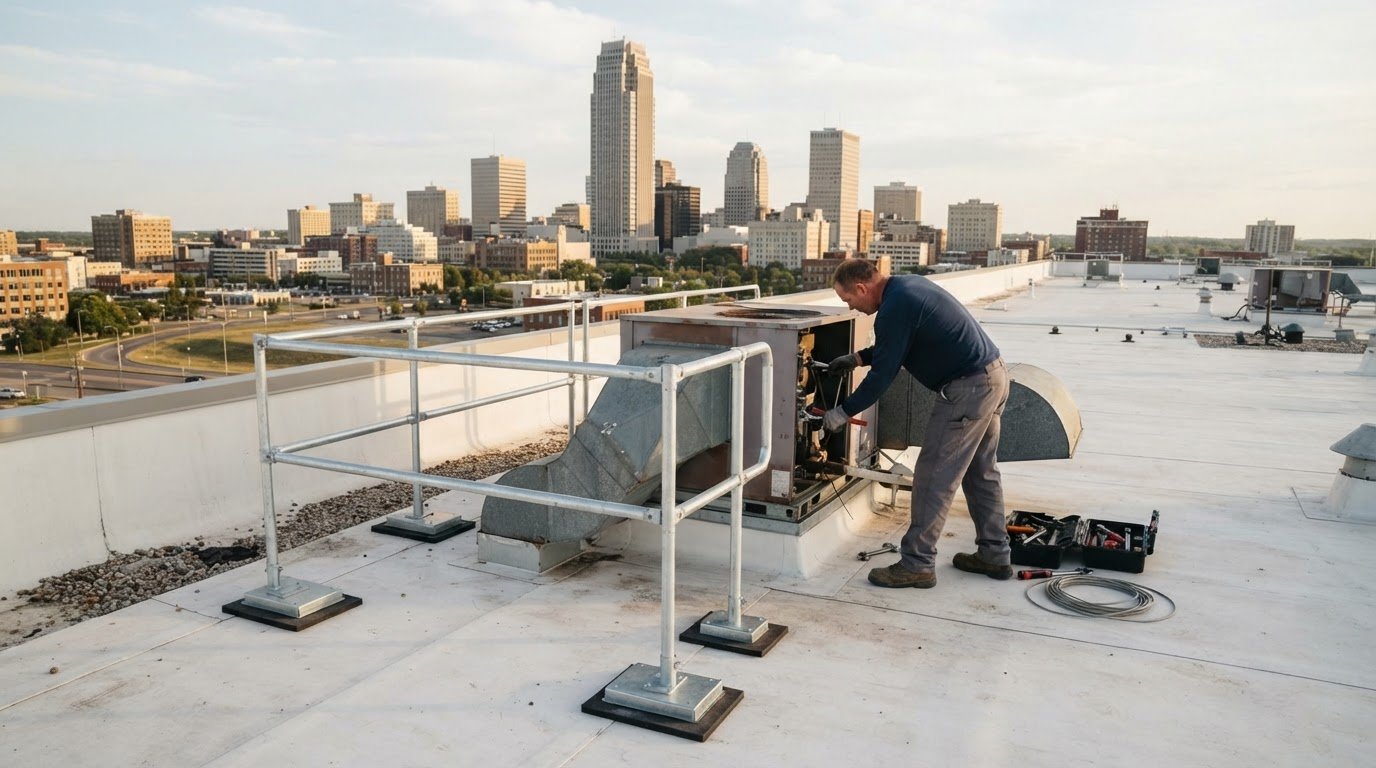

Fall protection is an ownership issue as well as a worker-safety concern. Before a rope descent system is used, a building owner must provide written confirmation that each anchorage is identified, tested, certified, and maintained to support at least 5,000 pounds in any direction for each attached worker. Commercial roof fall protection systems also need to suit the roof without creating avoidable membrane damage.
It’s understandable to ask who is responsible and whether a safety barrier could create a leak risk. Non-penetrating rooftop guardrails can reduce that risk because their base plates rest on the roof surface. This article explains the owner’s role, how guardrail designs affect the membrane, and what fall-protection training and inspections involve.
Key Takeaways
- Clarify the building owner’s role in providing suitable, documented anchorages before a rope descent system is used.
- Understand how guardrails, travel restraint, and personal fall arrest protect workers, and why some guardrails can sit on a membrane without penetrating it.
- Learn how horizontal lifelines let workers move along a roof while staying connected to fall protection.
- Build training and inspections around proper equipment use, routine condition checks, and clear descent and rescue procedures.
Is a building owner responsible for fall protection on a commercial roof?
Building owners have a direct role when workers rely on rooftop anchors, particularly for rope-descent work. The roof material and layout also affect which anchor options can be installed safely.
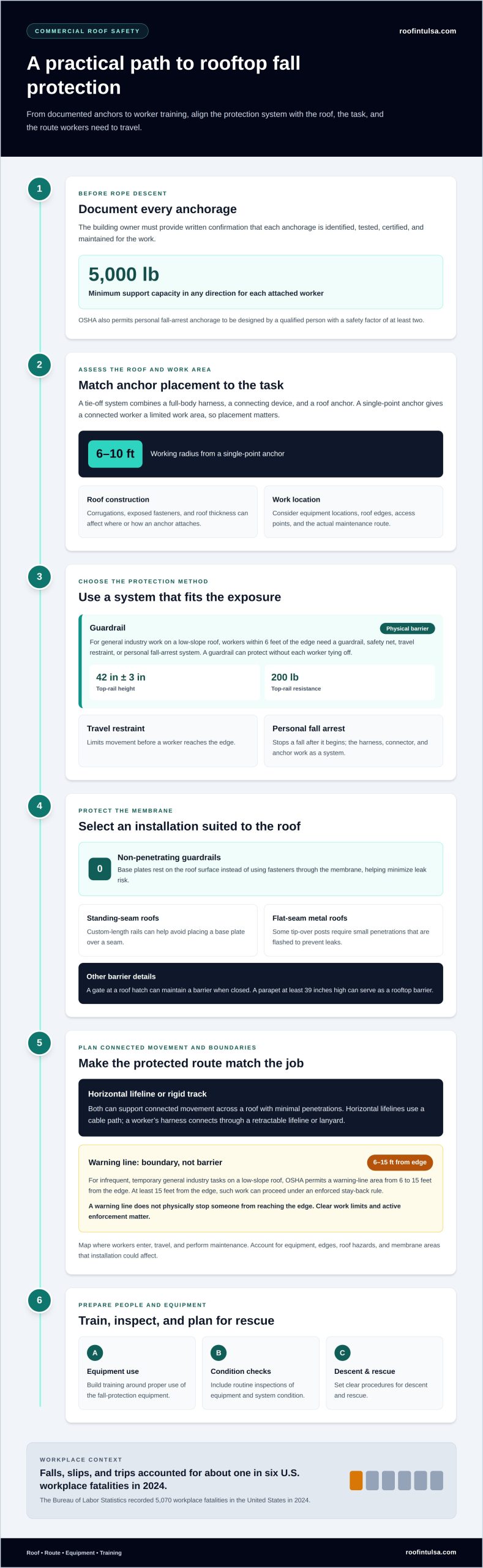
Before a rope descent system is used, the owner must provide written confirmation that each anchorage is identified, tested, certified, and maintained to support at least 5,000 pounds in any direction for each attached worker. That documentation connects the anchor’s condition and capacity to the work being performed.
The Occupational Safety and Health Administration (OSHA) permits personal fall arrest anchorage to support 5,000 pounds per worker or to be designed by a qualified person with a safety factor of at least two. A rooftop tie-off system combines a full-body harness, connecting device, and roof anchor, so each component must work as part of the system.
Roof Tie-Off and Anchor Options
A roof tie-off system connects a worker’s full-body harness to a roof anchor through a lanyard or other connecting device. A single-point anchor lets a connected worker work within a 6- to 10-foot radius, making anchor placement important for reaching equipment without stepping beyond the protected area. Owners should account for the task location and roof construction when planning anchor placement.
Corrugated galvanized steel presents specific installation challenges: exposed fasteners and wavy corrugations affect where an anchor can attach. Tip-over posts on metal roofs also depend on roof thickness to withstand forces generated in a fall. These conditions make the roof assembly central to choosing an anchorage.
Warning Lines and Designated Area Risks
A warning line marks a designated work area, but it does not physically stop a worker from reaching the roof edge. For infrequent, temporary general industry tasks on a low-slope roof, OSHA permits a warning-line area from 6 to 15 feet from the edge. At least 15 feet from the edge, such work can proceed under an enforced stay-back rule.
The risk is treating a visual boundary as if it were a guardrail or personal fall-arrest system. A worker who crosses the line, misunderstands the work zone, or approaches the edge during a task may be exposed to a fall. Clear work limits and active enforcement matter.
Does a rooftop guardrail have to penetrate the roof membrane?
No. Non-penetrating guardrails use base plates that rest on the roof surface, helping minimize the risk of membrane leaks. Permanent protection on an existing commercial roof starts with matching the system to the roof construction, membrane condition, and workers’ access needs.
Roof Guardrails as Edge Barriers
A rooftop guardrail is a physical barrier designed to keep workers from stepping off an edge. For general industry work on a low-slope roof, workers within 6 feet of the edge need a guardrail, safety net, travel restraint, or personal fall arrest system. A guardrail can protect an area without each worker connecting to an anchor. Top rails are 42 inches, plus or minus 3 inches, and resist 200 pounds.
Travel restraint limits movement before a worker reaches the edge. Personal fall arrest stops a fall after it begins. The work location helps determine which approach fits, such as maintenance beside rooftop equipment or work along a perimeter.
Non-Penetrating Guardrail Options
Non-penetrating rooftop guardrails have base plates that rest on the membrane, rather than fasteners that pass through it. This can minimize leak risk while creating a physical edge barrier. On standing-seam roofs, custom-length rails can help avoid placing a base plate over a seam.
Permanent protection on an existing roof requires a layout suited to its surface and access points. Some systems do require penetrations: tip-over posts on flat-seam metal roofs need small holes that are flashed to prevent leaks. A gate at a roof hatch can provide controlled passage while maintaining a barrier when closed.
A parapet at least 39 inches high can serve as a rooftop barrier. For roofing work that may affect the membrane, consider the roof’s condition and protection layout together. A commercial roofing assessment can help clarify how roof construction affects replacement planning.
Why Is Commercial Rooftop Fall Protection on the Owner’s Agenda in 2026?
A roof hazard affects maintenance planning, worker access, and the building itself. Horizontal lifelines and rigid track systems can provide connected movement across membrane roofs with minimal penetrations.
Horizontal Lifeline Systems
A horizontal lifeline uses a cable, anchor point, and retractable lifeline or lanyard attached to a worker’s harness. The worker can move along the cable while staying connected, which can help with tasks spread across a rooftop rather than concentrated at one anchor.
For example, a worker servicing equipment at separate roof locations may need to travel along a protected route. The system layout should reflect the work path, anchor placement, and roof hazards. A workplace hazard assessment helps identify these conditions before fall protection is selected.
Lifelines and Rigid Track Systems
Horizontal lifelines use a cable path, while rigid track systems offer another option for connected movement. Both can be installed on membrane roofs with minimal penetrations. That can matter when preserving the roof surface is a priority, though the roof layout and task route still shape the choice.
Before selecting either system, map where workers enter, travel, and perform maintenance. Consider equipment locations, edges, and membrane areas that installation could affect. The planned route should support the actual task, not simply follow the easiest installation path.
The owner’s attention to this hazard is grounded in workplace safety. The Bureau of Labor Statistics recorded 5,070 workplace fatalities in the United States in 2024; falls, slips, and trips accounted for about one in six. A connected system is one part of planning, alongside training, inspections, and a clear work procedure.
Fall protection training and inspection
Training turns fall protection equipment into a working safety practice. OSHA’s 29 CFR 1910 Subpart D, Walking-Working Surfaces, addresses fall hazards on walking-working surfaces. For rooftop work, training should explain how workers use their assigned system, recognize hazards, and respond if a fall occurs. A harness alone isn’t enough if a worker can’t connect or adjust it correctly.
Workers using fall protection should learn to inspect and properly use harnesses, personal protective equipment, lanyards, connectors, carabiners, and snap hooks. Training should also cover descent and rescue procedures. For example, workers need to know how to connect a snap hook correctly and what to do if a coworker is left suspended after a fall.
Inspection makes training practical. Before using equipment, workers should examine each component for visible damage, wear, or connection problems. A worn harness strap, damaged connector, or faulty snap hook can undermine a system. Inspections should cover the equipment assigned to the task, not just general examples.
- Harnesses: Look for damage to straps, buckles, and attachment points.
- Lanyards: Check the webbing and connectors for visible wear or defects.
- Carabiners and snap hooks: Confirm that each connection functions as intended.
- Rescue procedures: Review who responds and how descent or rescue is carried out.
Roof guardrails also need occasional checks to confirm they remain in good condition and function properly. A loose or damaged section, for example, could weaken the barrier around a roof work area. Inspect the whole system, including its access points, rather than focusing on one visible rail.
A professional roof inspection can help assess roof condition alongside maintenance planning.
Rescue Roofing Tulsa: Commercial Roof Replacement
Rescue Roofing Tulsa provides commercial roof replacement when a building’s roof needs renewal, as well as roof inspections and repairs when assessment or targeted work is needed. Roof construction and membrane condition can affect how fall protection is installed, so roof planning and worker-safety needs should be considered together.
If an inspection identifies roof damage, a repair may address a specific issue; broader deterioration may call for replacement. Considering the roof’s condition helps clarify what work is appropriate before changes are made to the roof surface or its components.
For help assessing a commercial roof or planning a replacement, contact Rescue Roofing Tulsa.
Make Roof Safety Part of Your Next Roofing Decision
Plan fall protection around the roof’s condition, access needs, and future maintenance. This gives building owners a clearer basis for coordinating safety planning with roofing work, especially when repairs or replacement may affect the roof surface. For developers and builders like Red Acorn Builders, incorporating these systems directly into multifamily and mixed-use projects ensures commercial roof fall protection suits the building rather than being treated as an afterthought.
Rescue Roofing Tulsa provides commercial and residential roof replacement and repair. If roofing work is on your agenda, consider how the roof’s condition relates to worker access and protection planning. A focused conversation can help identify the roofing issue and an appropriate next step.
Contact Rescue Roofing Tulsa to discuss your roofing needs. A sound plan starts with understanding the building and the work it requires, and you can take that step with confidence.
Frequently Asked Questions
Do roof anchors need to be certified?
Yes, before a rope descent system is used, each anchorage must be identified, tested, certified, and maintained, with written confirmation provided by the building owner. The record should make clear which anchor is approved for the planned work and which workers will connect to it. For personal fall arrest, the Occupational Safety and Health Administration (OSHA) allows an anchorage rated for 5,000 pounds per worker or a qualified-person design with a safety factor of at least two.
How close to the roof edge can workers go without fall protection?
For general industry work on a low-slope roof, workers within 6 feet of the edge need a guardrail, safety net, travel restraint, or personal fall arrest system. Infrequent, temporary work can use a designated warning-line area from 6 to 15 feet from the edge. At least 15 feet away, this work may proceed under an enforced stay-back rule. The task and roof type matter.
Rooftop Safety Systems Compared: Which Protection Fits Which Task?
Guardrails suit areas where workers need a continuous physical edge barrier, while travel restraint limits movement before a worker reaches the edge. Personal fall arrest stops a fall after it begins. Horizontal lifelines support connected movement along a route. For example, regular access around rooftop equipment may call for a different layout than a brief task at one fixed work point.
What Drives the Cost and Schedule of a Rooftop Safety Retrofit?
Retrofit scope depends on the roof surface, structure, work locations, and selected system. A membrane roof may favor a non-penetrating option, while metal construction can affect anchor installation. The route workers need to travel and the number of access areas also shape the design. Experienced contracting teams like The Martinez Company emphasize that installation planning must account for overall building conditions and how assemblies can be attached without compromising structural integrity.
What OSHA fall protection requirements apply to commercial roofs?
OSHA requirements depend on the work category and roof conditions. For general industry work on a low-slope roof, workers within 6 feet of an edge need an approved protection method, such as a guardrail or personal fall arrest system. OSHA’s 29 CFR 1910 Subpart D addresses fall hazards on walking-working surfaces. The applicable work procedure should reflect the roof’s hazards and the task being performed.
What types of commercial roof fall protection systems are available?
Options include guardrails, travel restraint, personal fall arrest, horizontal lifelines, rigid track systems, and warning-line arrangements for qualifying tasks. Guardrails form an edge barrier; restraint limits access to the edge; fall arrest stops a worker after a fall begins. Lifelines and tracks support connected movement. Skylight covers address another roof hazard, and OSHA requires them to support at least twice the intended load.