



What if a roof report flags problems without showing which ones need attention now? A commercial roof condition assessment report should do more than list visible defects. It should connect documented evidence to the roof’s condition, explain what was and wasn’t assessed, and show why each recommendation matters. It’s reasonable to ask whether a finding calls for routine maintenance, a targeted repair, or a larger investment.
This guide explains what a useful report should cover and how to read its findings without assuming every deficiency means replacement is necessary. You’ll learn to review the assessment’s scope and limitations, weigh the evidence behind recommendations, and prioritize follow-up based on roof condition and your property’s needs.
We’ll also look at how to turn findings into practical maintenance and capital-planning decisions, including when further evaluation may help clarify the next step. For commercial properties in Tulsa and surrounding communities, a roofing professional familiar with commercial roofs can help put documented conditions in context. Whether the findings point toward monitoring, repair, or replacement, understanding the report helps you make a more informed decision.
Key Takeaways
- A commercial roof condition assessment report documents observed conditions and recommended next steps; it doesn’t automatically mean the roof needs replacement.
- Use the report’s scope, dated photos, and location details to understand what was assessed and where findings were observed.
- Separate urgent concerns from planned maintenance and monitoring by weighing the evidence, possible consequences, and recommended timing.
- Compare reports by reviewing their scope, limitations, supporting evidence, priorities, and actionable recommendations.
- Use documented findings to guide practical inspection, repair, or replacement discussions for your Tulsa-area commercial property.
What a Commercial Roof Condition Assessment Report Tells a Property Owner
A commercial roof condition assessment report is a documented snapshot of observed roof conditions and recommended next steps.
Its purpose is to help owners make informed decisions, not to automatically prescribe roof replacement. Findings can support routine maintenance planning, help prioritize repairs, or inform longer-term capital planning. For example, a report may document a localized concern that needs follow-up without concluding that the entire roof is beyond repair. Consider any recommendation alongside its supporting evidence, the assessment’s scope, and the property’s operational needs.
A condition assessment is more than a quick visual check, which may identify an obvious issue without documenting the broader roof condition or explaining what to do next. It also isn’t necessarily a specialized engineering evaluation. An engineering review may be appropriate for questions that require analysis beyond a general condition assessment. The Property Condition Assessments (PCAs) framework provides broader context: these assessments document property conditions and can inform repair and capital-planning decisions.
What is the difference between an assessment and an inspection report?
The terms can overlap, so the title alone doesn’t tell you how comprehensive a report is. Scope and detail may vary with the property, roof system, and reason for the assessment. A report should explain which areas were observed, what the assessment covered, and any access limitations that affected observations. Don’t assume an assessment included testing beyond visual observation; any additional evaluation should be described in the report.
A useful distinction is purpose: an inspection report may record conditions observed during a particular visit, while a condition assessment is typically intended to help the owner understand those observations and consider next steps. In either case, look for clear evidence and stated limits before relying on conclusions.
Who uses a commercial roof condition assessment report?
Building owners, property managers, facilities teams, and asset managers can all use the findings, though they may apply them differently. A facilities team may use documented concerns to organize maintenance. A property manager may need to coordinate repairs around tenant needs and daily operations. Owners and asset managers can use the information to weigh near-term work against future capital plans.
For example, a retail property may need to plan work around business activity, while a condominium’s roof affects shared property decisions. A flat-roof building may also require attention to specific areas documented in the assessment. In Tulsa and surrounding communities, base decisions on the property’s actual condition rather than assumptions. A clear assessment gives everyone involved a shared basis for discussing inspection, repair, or replacement as appropriate.
What a Thorough Commercial Roof Assessment Documents
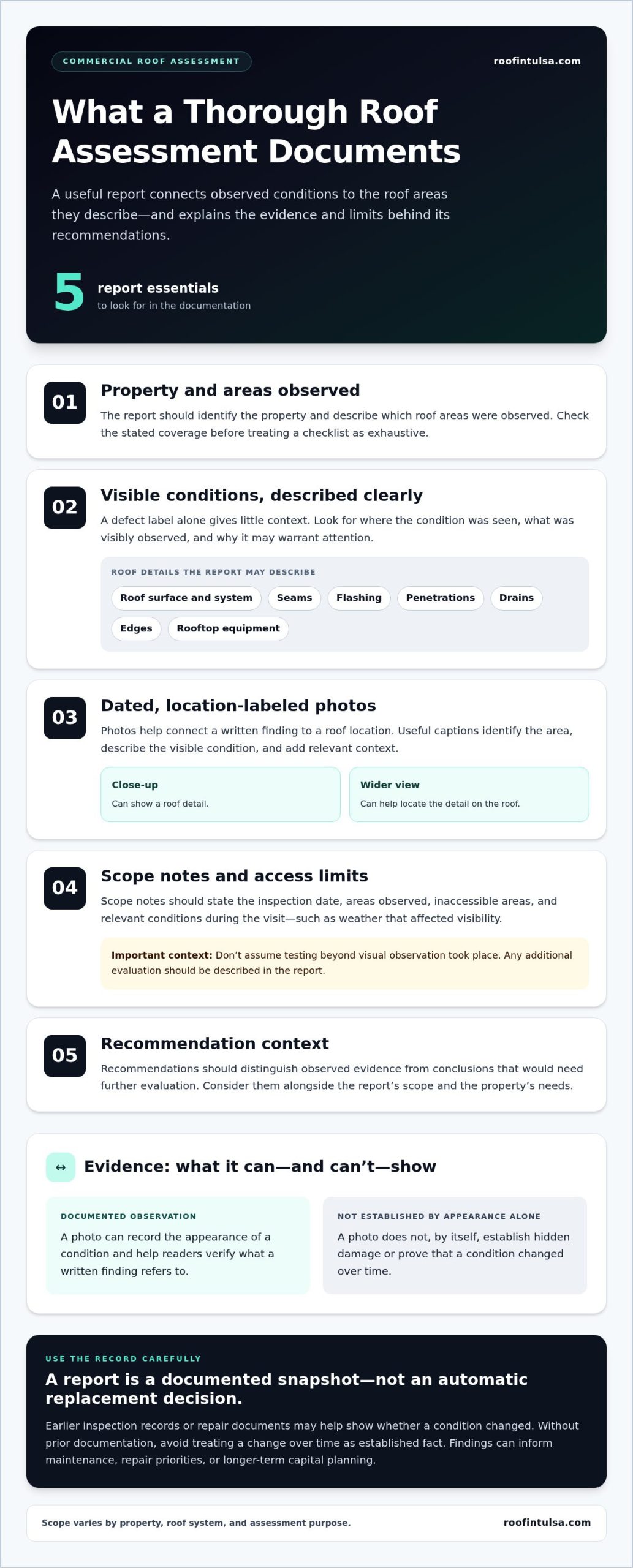
A commercial roof condition assessment report is useful when you can connect its findings to the parts of the roof they describe. Scope varies by property, roof system, and assessment purpose, so read the report’s stated coverage before treating its checklist as exhaustive.
A useful report identifies the property and roof areas observed, describes visible conditions, supports findings with dated and location-labeled photos, notes access limitations, and explains the context for recommendations.
Which roof areas and details should the report describe?
Look for observations about the roof surface and system, seams, flashing, penetrations, drains, edges, and rooftop equipment. The details will differ by material. For example, observations on TPO and EPDM roofs may focus on different visible features, so descriptions should fit the system rather than rely on a generic list.
A defect label alone gives little context. “Seam concern” is less useful than a description of where the seam is, what was visibly observed, and why it may warrant attention. A photo can document appearance, but appearance alone doesn’t establish hidden damage. Recommendations should distinguish observed evidence from conclusions that would require further evaluation.
How do photographs, scope notes, and history improve the report?
Photos help you verify what a written finding refers to. A clear caption should identify the roof area or location, describe the visible condition, and add relevant context. A close-up may show a detail, while a wider view can help readers locate it on the roof. Dated images also make later comparisons more useful.
Scope notes should state the inspection date, areas observed, inaccessible areas, and relevant conditions during the visit, such as weather that affected visibility. Earlier inspection records or repair documents may help show whether a condition changed. Without prior documentation, avoid treating a change over time as established fact.
For Tulsa-area properties, use property-specific evidence rather than assuming local weather caused a roof condition. Relevant documentation might include visible conditions observed during the assessment and available property records. The GSA’s Facilities Standards (PBS-P100) applies to federal public buildings, so it can offer context for facility standards but should not be treated as a requirement for every private commercial roof.
- Property and roof-system details
- Areas observed and access limitations
- Component-specific descriptions of visible conditions
- Dated photos with location labels and useful captions
- Inspection date, relevant conditions, and recommendations tied to evidence
If you’re reviewing a commercial roof in Tulsa or nearby, documented observations can guide a practical commercial roof inspection discussion.
How to Read Findings, Priorities, and Repair Recommendations
A priority label is useful only when the report explains what supports it. Read each recommendation alongside the documented condition, its location, the possible consequence if it worsens, and the suggested timing. A commercial roof condition assessment report should help you understand why an item matters, not just whether it appears on a list.
| Category | How to interpret it | What to consider next |
|---|---|---|
| Immediate attention | A reported condition may call for prompt follow-up because of a potential near-term impact, such as active water entry or a drainage concern. | Clarify the observed evidence, the potential consequence, and the recommended timing. Coordinate with the needs of the building. |
| Planned maintenance | The report identifies a condition that may be addressed through routine or scheduled work, based on the assessment findings. | Consider the recommended action alongside maintenance plans and property operations. |
| Monitoring | The condition is documented for observation, rather than treated as proof that immediate repair or replacement is necessary. | Look for guidance on what to watch and when follow-up may be appropriate. |
These categories are practical reading aids, not universal definitions. Follow the report’s own priority terms and explanations. Recommendations are strongest when they connect specific evidence, the possible consequence, a clear priority, and a proportionate action with a stated timeframe.
How can owners distinguish urgent issues from routine maintenance?
Active water entry or a drainage concern may warrant timely follow-up, particularly if it affects occupied space or building operations. Separate what the assessor observed from what remains uncertain. A stain documents visible interior evidence, but it doesn’t by itself establish the source or full extent of a roof issue. Use the report’s findings, the property’s needs, and a qualified assessment to determine urgency rather than treating a label as a complete diagnosis.
Operational context matters, too. A concern affecting tenant areas, equipment, or business activity may require a different response plan than a maintenance item with no immediate operational impact. Coordinate the building’s needs with the documented evidence.
When should a report recommend repair, monitoring, or further evaluation?
A repair recommendation may fit a localized, documented deficiency when the evidence supports addressing that area. Monitoring can be reasonable when a condition needs observation and the report avoids unsupported certainty about how it will develop. Further evaluation may be appropriate if access was limited or the available evidence doesn’t support a firm conclusion.
A report records conditions observed at a point in time; it does not guarantee how long a roof will remain serviceable. Nor does every deficiency mean replacement is necessary. A targeted repair may be appropriate for some findings. Weigh broader work against the report’s evidence, scope, and property-specific needs.
How to Compare Assessment Reports and Turn Findings into a Plan
A useful commercial roof condition assessment report should help you move from observations to practical decisions. Before comparing reports, account for differences in property size, roof-system complexity, and access. A larger or more complex roof may require a broader scope, while limited access can leave some areas unobserved. A longer report isn’t automatically more useful if its evidence and next steps aren’t clear.
What questions help evaluate a report’s usefulness?
Review each report in the same order. This makes gaps easier to spot, even when the assessments have different formats.
- Scope: Does it state the inspection date, areas included, and purpose?
- Evidence: Are observations supported by clear descriptions or photos tied to specific roof locations?
- Limitations: Does it identify areas that weren’t accessible or other factors that limited conclusions?
- Priorities: Can you tell which findings need timely attention, planned work, or continued observation?
- Action: Are next steps understandable and connected to the findings?
Also consider what decision the assessment was meant to support. A one-time condition assessment can provide a snapshot for a repair decision or capital review. Recurring inspections can help maintain an ongoing record. Neither purpose is inherently better; the right fit depends on the property’s needs. For a broader overview of commercial roof considerations, see this commercial roofing guide.
How can owners use reports for maintenance and capital planning?
Turn recommendations into a simple action record: note the finding, assign a responsible person, set a follow-up date based on the report, and save related photos, repair records, and later inspection notes. Add routine tasks to a maintenance calendar. Track repair items for planning, and use larger or unresolved concerns to inform a capital review.
Repeat documentation can help reveal changes when reports cover reasonably comparable areas and use a similar scope. If inspection coverage differs, a condition may appear new simply because it wasn’t observed previously. Use the report’s limitations to keep comparisons grounded. A roof maintenance guide can offer general upkeep context, though examples written for homeowners may not apply directly to commercial properties.
For help turning commercial roof findings into inspection or repair next steps, discuss your commercial roofing needs with Rescue Roofing Tulsa.
Commercial Roof Assessments in Tulsa: Choosing a Practical Next Step
A report is most useful when it leads to a decision that fits the building, not a one-size-fits-all schedule. Tulsa-area owners can use documented findings to decide whether a commercial roof inspection, a targeted repair discussion, or a broader replacement review is the sensible next step. Consider the condition described, the report’s limitations, and how the issue could affect tenants, staff, customers, or daily operations.
When should a Tulsa commercial property schedule an assessment?
Consider an assessment when planning maintenance, noticing a visible change, or revisiting a recurring roof concern. If a property has experienced a weather event, use its specific observations and records to determine whether follow-up is appropriate rather than assuming damage occurred. There’s no single inspection interval that fits every building. Roof type, prior findings, access, and operational needs all matter. A timely assessment can also establish a documented condition record for future decisions.
Keep the context with the findings: note the date, affected area, any known changes, and relevant repair history. That record can help property teams distinguish a newly observed concern from a condition that was already documented, when comparable records are available.
What can Rescue Roofing Tulsa help owners do next?
Rescue Roofing Tulsa serves commercial properties in Tulsa and surrounding communities, including retail properties, condominiums, and flat-roof buildings. The company provides commercial roof inspections, repairs, and replacements. The right next step depends on what the assessment documents. A localized finding may lead to a repair discussion, while broader condition concerns may call for considering replacement. An inspection can help owners understand the roof’s observed condition and consider appropriate next steps without assuming a particular outcome.
Before discussing next steps, gather the assessment, relevant photos, prior repair records, and notes about business or tenant needs. This keeps the conversation focused on the roof evidence and the property’s priorities. For additional context, read the Tulsa commercial roofing guide.
If you’re ready to discuss your property’s documented findings, schedule a commercial roof inspection discussion with Rescue Roofing Tulsa. Start with the concern you observed, where it appears, and what the report recommends.
Turn Roof Findings into a Clear Next Step
A commercial roof condition assessment report is most valuable when its observations lead to practical, property-specific decisions. Review the scope and evidence, note any limitations, and use the stated priorities to distinguish timely follow-up from maintenance or monitoring. A reported deficiency doesn’t automatically mean the roof needs replacement.
Keep the building’s needs in view, too. A retail property, condominium, or flat-roof building may have different operational priorities, and those should inform discussions about inspection, repair, or replacement. Rescue Roofing Tulsa serves commercial properties in Tulsa and surrounding areas with these roofing services.
If you’re weighing a report’s findings or planning a closer look at your roof, discuss a commercial roof inspection with Rescue Roofing Tulsa. A clear understanding of the roof’s documented condition can help you move forward with a plan that fits your property.
Frequently Asked Questions
What is included in a commercial roof condition assessment report?
A useful commercial roof condition assessment report generally identifies the property and roof system, explains the assessment scope, and documents observed conditions with locations and photographs. It should also state access limitations, separate observations from assumptions, and organize recommendations into understandable next steps. Contents vary by property, access, roof system, and assessment purpose. Read the stated scope carefully so you know what the report covers and what it doesn’t establish.
How is a roof condition assessment different from a roof inspection?
The terms can overlap, so the scope matters more than the label. A basic roof inspection may record visible conditions, while a condition assessment may organize observations to support maintenance or capital planning. A specialized engineering evaluation can have a different purpose and scope. Review which areas were examined, what methods were used, and what limitations were stated before deciding whether the report answers the question you need resolved.
How often should a commercial roof be assessed?
There isn’t one assessment interval that fits every commercial property. Roof-system age, observed condition, maintenance history, access, weather exposure, and ownership needs can all affect timing. A documented assessment can establish a useful baseline and help guide future reviews. Use its recommendations alongside a property-specific maintenance plan. If conditions change or a concern recurs, those details may help determine whether follow-up is appropriate sooner.
Does a commercial roof condition assessment report include repair costs?
Not necessarily; cost details depend on the report’s purpose and scope. An assessment may describe recommended work without including a project estimate or a complete repair specification. First understand the documented condition, its priority, and the recommended next step. If repair planning is needed, use those findings as the basis for a separate discussion of the property and the work involved.
Does a roof assessment report mean the commercial roof needs replacement?
No. A report documents observed conditions and may recommend maintenance, repair, monitoring, further evaluation, or replacement, depending on the evidence. A listed deficiency doesn’t automatically mean the whole roof has failed. Review the reasoning behind each recommendation, its timing, and any assessment limitations before making a capital decision. A localized condition may call for a targeted response rather than replacement of the entire roof.
Can a roof condition assessment find hidden moisture?
It can only address hidden moisture if the assessment scope includes methods suited to investigating it. Not every report includes specialized testing, so review the methods used and the conclusions the evidence supports. A visual observation alone doesn’t prove concealed moisture or establish its extent. If hidden moisture would affect a repair or replacement decision, the next evaluation should focus on resolving that specific uncertainty.
Who should review a commercial roof condition assessment report?
The property owner or asset manager should review the report with the facilities or property-management team, who can add context about building use, maintenance history, and operational priorities. A roofing professional can explain observed conditions and practical follow-up options. Rescue Roofing Tulsa provides commercial roof inspections, repairs, and replacements for properties in Tulsa and surrounding areas. Questions requiring specialized engineering conclusions call for expertise suited to that evaluation’s scope.