


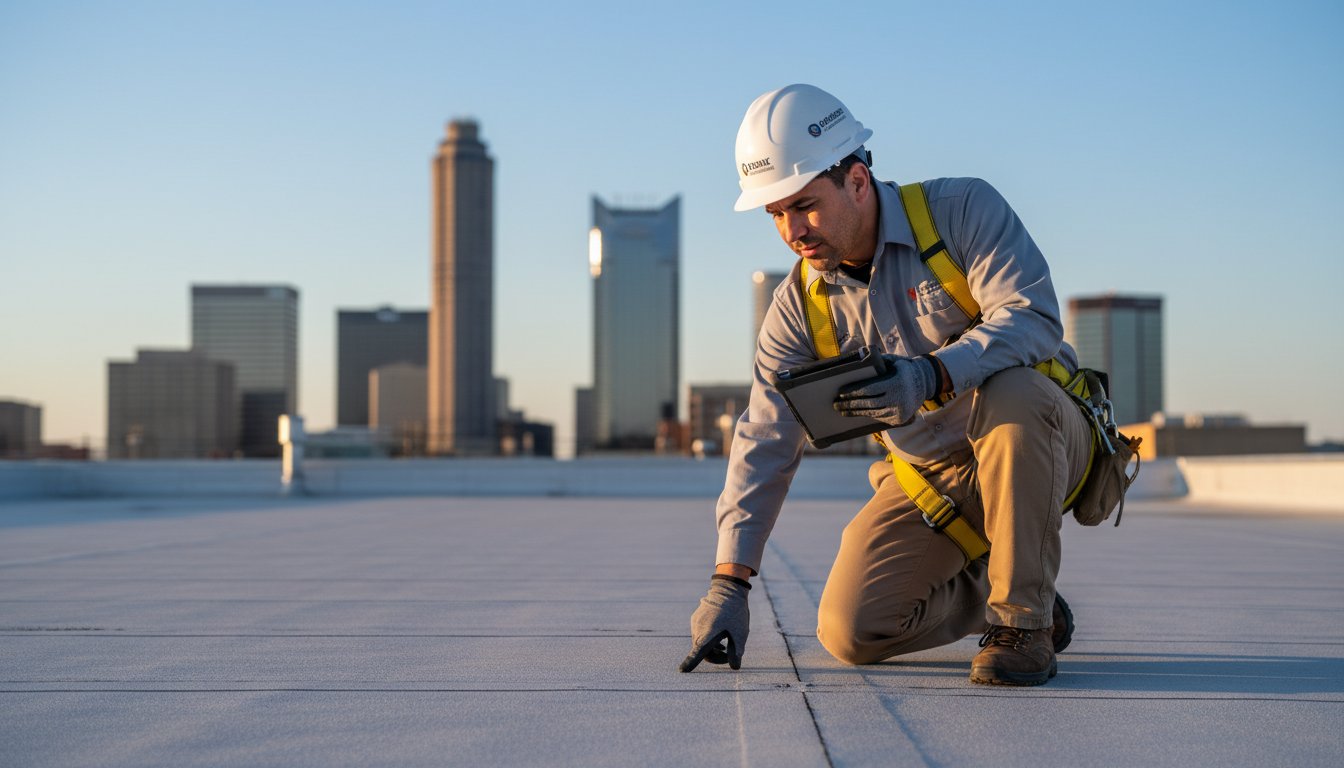

Last April, a Tulsa business owner arrived at his warehouse after a midnight thunderstorm to find water dripping directly onto his inventory. He thought his roof was fine, but a single clogged scupper had turned his flat roof into a swimming pool. This is exactly why having a proactive commercial flat roof inspection checklist is essential for every property manager in Green Country. It’s the difference between a simple maintenance task and a devastating emergency that halts your business operations.
We understand that managing a commercial property in Oklahoma means checking the weather app with a constant sense of anxiety. You shouldn’t have to wonder if the next round of hail or our 100-degree summer days will result in a complex insurance claim or a complete shutdown of your building. It’s frustrating to deal with unpredictable costs when you’re just trying to keep your business running smoothly and efficiently.
This 2026 guide provides a clear path to lower long-term maintenance costs and total peace of mind. We’ll show you exactly what to look for, from membrane seams to drainage systems, so you can catch damage before it becomes a crisis. You’ll gain a printable list of items to check that ensures your roof is ready for the next storm season, keeping your investment safe and your daily work uninterrupted.
Key Takeaways
- Save your budget by transitioning from emergency repairs to a proactive maintenance plan designed for Tulsa’s unique freeze-thaw cycles.
- Follow our step-by-step commercial flat roof inspection checklist to spot hidden interior damage and exterior perimeter issues that others often miss.
- Gain the local expertise needed to distinguish between standard aging and severe hail impact or wind scouring to keep your building protected.
- Build a “hassle-free” insurance claim foundation by learning which documentation and photo logs are essential for proving storm damage.
- Learn how to identify “Level 5” roofing emergencies and when to bring in a trusted Tulsa professional for advanced diagnostic tools.
Why Regular Flat Roof Inspections are Vital in Tulsa
Owning a business in Green Country means dealing with some of the most volatile weather in the United States. A Flat roof system provides excellent space efficiency and cost-effectiveness for our local architecture, but it requires a proactive approach to remain watertight. Relying on reactive maintenance is a gamble that usually ends in expensive interior damage and disrupted operations. By implementing a consistent commercial flat roof inspection checklist, you shift from crisis management to predictable asset protection.
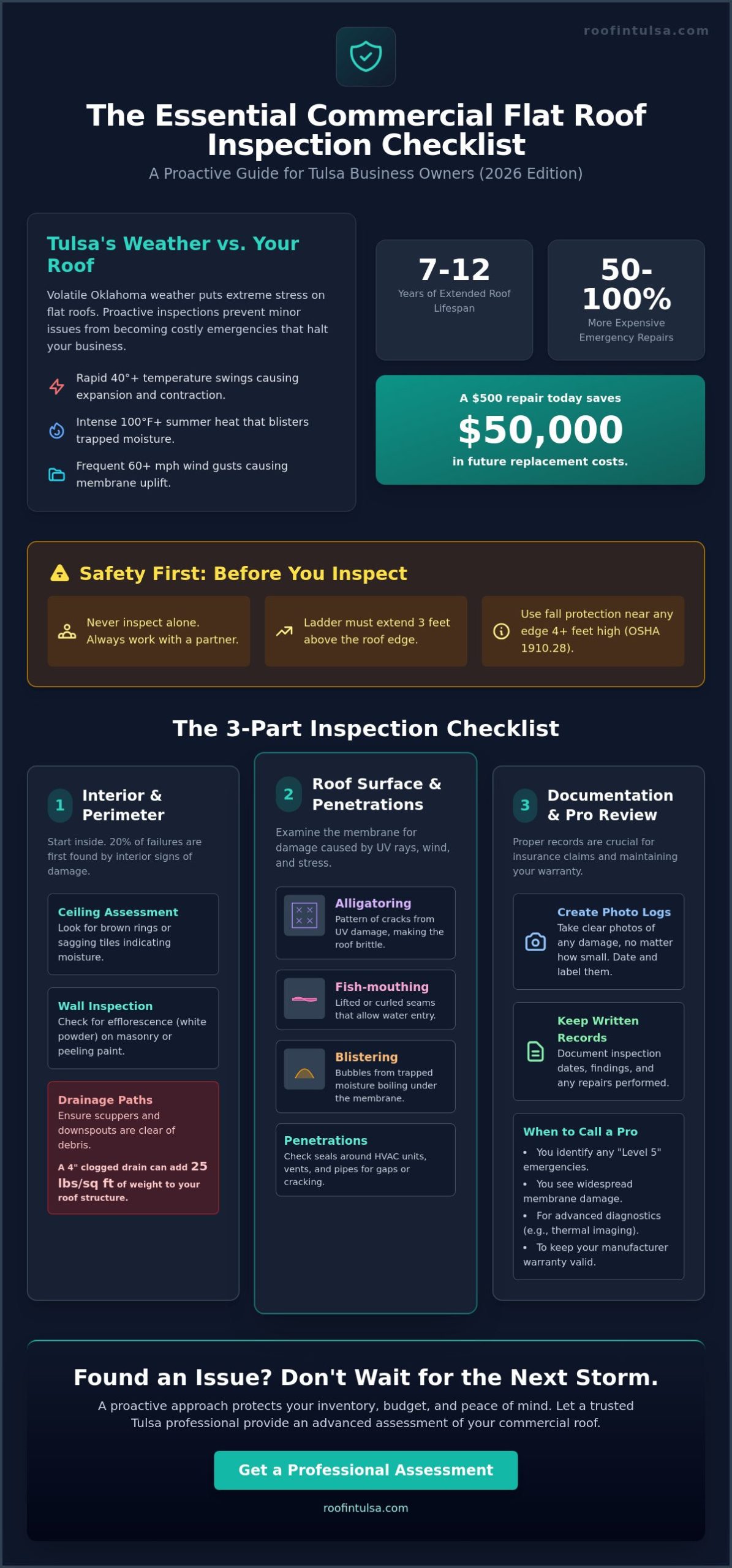
Tulsa’s climate is notoriously hard on roofing materials. We frequently experience temperature swings of 40 degrees or more within a single 24-hour period. These rapid changes cause membranes to expand and contract, putting immense pressure on the seams of TPO, EPDM, and PVC systems. Without bi-annual checks in the Spring and Fall, these microscopic stresses turn into major leaks. Most manufacturers require documented professional inspections at least twice a year to keep your warranty valid. If you don’t have these logs, you might find your warranty claim denied when you need it most.
Extending Your Roof’s Lifespan
Small membrane tears are almost impossible to see from the ground, but they’re the primary cause of insulation board saturation. Once water gets under the membrane, it stays there. In Tulsa, summer heat often stays above 100°F for weeks, causing that trapped moisture to boil and blister the roof surface. Routine checks help us identify these issues before they compromise the structural deck. This level of care is essential for any commercial roofing strategy, as it can delay a full replacement by 7 to 12 years.
Budgeting for Commercial Roof Repairs
Surprises are great for birthdays, but they’re terrible for business budgets. Using a commercial flat roof inspection checklist allows you to build a 3-year or 5-year capital expenditure plan based on actual data. You’ll know exactly when your HVAC curbs need resealing or when a restorative coating is necessary. This prevents the need for emergency after-hours repairs, which often carry rates 50% to 100% higher than scheduled maintenance. A $500 repair caught during a routine check today saves $50,000 in full replacement costs five years down the road.
The 3-Part Commercial Flat Roof Inspection Checklist
Safety is the first step before you begin any physical assessment. OSHA standard 1910.28 requires fall protection for anyone working near an unprotected edge 4 feet or more above a lower level. Don’t step onto the roof without a partner and high-traction footwear. Ensure your ladder extends at least 3 feet past the roof edge for a secure transition. Once you’re safely on top, you can begin the formal commercial flat roof inspection checklist to identify vulnerabilities before they become expensive emergencies.
Interior and Perimeter Checks
The search for leaks often starts inside the building. Roughly 20% of flat roof failures are first identified by discolored ceiling tiles or a persistent musty odor in top-floor units. These signs indicate that water has already bypassed the membrane and is saturating the insulation. Look for “weeping” masonry or peeling paint on the interior walls near the roofline. This often points to failing counter-flashing where the roof meets the parapet wall.
- Ceiling Assessment: Look for brown rings or sagging tiles that indicate active moisture.
- Wall Inspection: Check for efflorescence (white salty powder) on brickwork, which suggests water is traveling through the wall.
- Drainage Path: Walk the perimeter to ensure scuppers and downspouts are free of debris. A single clogged 4-inch drain can cause 5 inches of ponding water to accumulate, adding nearly 25 pounds of weight per square foot to your structure.
Surface and Penetration Inspection
Tulsa’s climate puts extreme stress on roofing materials. With wind gusts frequently reaching 60 mph, the membrane can experience “uplift” that weakens the seams. Inspect the surface for “alligatoring,” a pattern of cracks in bitumen or coatings that resembles reptile skin. This is a sign that UV exposure has sucked the oils out of the material, making it brittle and prone to shattering during a hail event. If you notice “fish-mouthing,” where the edge of a seam lifts up like a gasping fish, it’s time for immediate repair.
Most leaks don’t happen in the middle of the roof; they happen at the “penetrations.” Inspect HVAC curbs, vent pipes, and pitch pockets. Cracked or shrinking caulk around a pipe boot is responsible for nearly 40% of localized leaks in commercial buildings. If you’re unsure about the integrity of your seals, consulting with Tulsa’s most trusted roofing team can provide the professional clarity you need to protect your investment.
- Membrane Integrity: Search for blisters or bubbles, which indicate trapped moisture between the layers.
- Flashings and Curbs: Ensure metal flashings are tightly secured and haven’t pulled away from the wall or equipment.
- Fastener Check: Look for “fastener back-out,” where screws start to poke through the membrane from underneath.
Following this commercial flat roof inspection checklist twice a year, typically in the spring and fall, helps you catch minor issues before they lead to a full roof replacement. Maintaining a detailed log of these findings is essential for insurance claims and warranty validation.
Identifying Tulsa-Specific Storm & Hail Damage
Your commercial flat roof inspection checklist must account for the unique intensity of Oklahoma weather. While standard wear happens over decades, a single storm like the ones seen in May 2024 can cause immediate, hidden failures. You need to distinguish between general aging and acute storm damage to ensure insurance claims are filed within the typical 12 month window. Our team at T-Town Roofing sees these issues daily and understands how to spot the difference.
Normal wear usually appears as uniform fading or minor surface cracking across the entire roof. In contrast, storm damage is localized and aggressive. During your walk-through, look for “scouring” near the roof edges. This happens when high winds whip the membrane, causing protective granules to scrub off. You might also find ponding water after one of Tulsa’s heavy 4 inch spring downpours. If water remains 48 hours after a storm, your drainage system is likely compromised or the insulation beneath the membrane has compressed.
Debris impact is another major concern for local property owners. Wind-blown objects or fallen limbs from nearby oak trees create punctures that aren’t visible from the ground. Even a small tear in a TPO membrane can lead to significant interior damage during the next rain cycle. When you use a professional commercial flat roof inspection checklist, you can identify these issues before they turn into a full-scale emergency.
Recognizing Hail Impact on Flat Roofs
Hail damage on flat surfaces is often subtle and easy to miss. On EPDM or TPO roofs, look for “bruising.” These are soft spots where the hail impact fractured the internal reinforcement or the underlying insulation board. For modified bitumen roofs, check for fractured glass fibers that appear as small, circular cracks in the asphalt. Micro-fractures from hail are often invisible to the untrained eye, yet they allow moisture to seep into the system, leading to premature failure within 2 to 3 years.
Wind and Debris Assessment
High winds frequently target the perimeter of your building. Inspect the “coping” metal and edge flashing for any signs of displacement, loose fasteners, or gaps. You should also check rooftop HVAC units to ensure panels haven’t been shaken loose or shifted by gusts. Wind uplift occurs when the air pressure under the roofing membrane is higher than the air pressure above it, causing the roof cover to pull away from the substrate. This pressure differential can lead to total roof failure if the edge components aren’t secure. We’re here to help you evaluate these critical points to keep your building dry and secure.
Documenting Your Findings for Insurance Claims
A detailed record is your strongest asset when a storm hits Green Country. Your commercial flat roof inspection checklist serves as the foundation, but the documentation you build around it determines how fast your claim gets approved. A pre-storm photo log acts as a baseline. It shows the insurer exactly what the roof looked like before 70 mph winds or two inch hail arrived. Without this, adjusters might argue that damage was pre-existing wear and tear. Use a grease pencil or chalk to circle areas of concern. Never use sharp tools or spray paint that could degrade the TPO or EPDM membrane. Clear documentation leads directly to professional insurance claim assistance, which can reduce your processing time by several weeks.
Creating a Photographic Evidence Trail
High-quality photos are the backbone of any successful claim. You need to capture every issue from two perspectives. First, take a wide-angle context shot to show where the problem is located on the roof. Second, take a close-up detail shot to highlight the specific damage. Place a common object like a quarter or a tape measure next to hail dents or cracks to provide a sense of scale. This prevents the insurance company from downplaying the severity of the impact. Store these files in a cloud-based folder. This makes it easy to share the entire history with your tulsa roofing contractor during a consultation. Digital timestamps on these photos provide indisputable proof of when the damage occurred.
The Role of Professional Documentation
Adjusters look for a paper trail that proves you’ve been a responsible building owner. Consistently tracking the history of roof maintenance shows the insurer you’ve performed due diligence. A 2023 industry report noted that property owners with documented maintenance logs receive claim payouts up to 25% faster than those without records. While your own checklist is a great start, an adjuster values a contractor’s report more highly because it’s considered an expert third-party assessment. We help by translating technical inspection notes into claim-ready data. This includes identifying specific failure points that a non-expert might miss, such as compromised flashing or hidden moisture beneath the membrane. We ensure your documentation meets the strict 2026 standards required by major commercial insurers.
Don’t let a lack of paperwork stall your recovery. If you’ve found damage during your inspection, contact us today for expert insurance claim assistance and get your business back under a secure roof.
When to Call a Professional Tulsa Commercial Roofer
While using a commercial flat roof inspection checklist helps you stay ahead of routine maintenance, some findings require an immediate expert response. A visual check is a great first step, but it has limits. You can see a tear in the membrane, but you can’t see the moisture trapped in the insulation layers beneath it. Professional roofers use specialized tools like infrared moisture scans to find hidden damage before it compromises your building’s structural safety. These scans detect thermal differences that indicate trapped water, preventing small leaks from turning into total roof failures.
Emergency Indicators
Some roof issues are “Level 5” emergencies that put your inventory and employees at risk. You should call for professional help immediately if you encounter these red flags during your walk-through:
- Significant Ponding: Water that remains on the roof surface 48 hours after a rainstorm indicates a major drainage failure. This adds thousands of pounds of unnecessary stress to your building.
- Electrical Hazards: Active leaks occurring near electrical panels, server rooms, or heavy machinery.
- Structural Compromise: Visible sagging in the roof deck or large sections of the membrane that have detached from the substrate or perimeter.
- Widespread Failure: Finding active drips in more than three separate areas of the building simultaneously after a single storm event.
Relying solely on a visual check can be dangerous. Trapped moisture leads to mold growth and deck rot that stays hidden until a collapse occurs. Our team uses thermal imaging to detect temperature variations in the roof assembly. This data allows us to target specific wet areas for repair instead of recommending a full replacement when it isn’t necessary. It’s a data-driven approach that saves Tulsa property owners thousands of dollars in unnecessary construction costs.
The Rescue Roofing Advantage
We pride ourselves on being a dependable partner for the Tulsa business community. Our team provides a 24/7 emergency response because we know that leaks don’t follow a 9-to-5 schedule. As a GAF Master Elite certified contractor, we belong to the top 2% of roofers nationwide. This certification ensures that every roof repair in Tulsa we perform meets rigorous quality standards and qualifies for the best warranties in the industry.
We’re here to help you move from a DIY commercial flat roof inspection checklist to a professional solution. Our goal is to provide a hassle-free experience that gives you total peace of mind. We handle the technical details and the heavy lifting so you can focus on running your business without worrying about the next storm. We’ve served the local community for years and understand the specific challenges our Oklahoma climate presents to flat roofing systems.
Don’t let a small leak become a major capital expense. Contact Rescue Roofing Tulsa today to schedule your free professional assessment and estimate. We’ll review your checklist findings and provide an honest, expert plan to protect your property for years to come.
Protect Your Business Assets with Proactive Roof Care
Staying ahead of roof deterioration starts with a proactive mindset. By implementing a consistent commercial flat roof inspection checklist, you’re doing more than just looking for leaks; you’re protecting your bottom line. Tulsa property owners face unique challenges from intense UV exposure and severe hailstorms. Catching small issues like pooling water or membrane cracks today prevents the massive repair bills often seen after the 2026 Oklahoma storm season. Proper documentation ensures your insurance claims remain hassle-free if disaster strikes.
We’re here to help you navigate these challenges with confidence. As a GAF Master Elite Certified contractor, Rescue Roofing Tulsa provides the expertise required to maintain your building’s integrity. Every project we complete comes with a 10-year workmanship warranty, giving you long-term peace of mind. If you encounter an urgent issue, our team is available for 24/7 emergency repair services to keep your operations running smoothly. Don’t wait for a ceiling leak to tell you there’s a problem.
Schedule Your Free Professional Commercial Roof Inspection with Rescue Roofing Tulsa
Your roof is your building’s first line of defense. Taking these small steps now ensures your business stays safe and dry for years to come.
Frequently Asked Questions
How often should a commercial flat roof be inspected in Tulsa?
You should schedule a professional inspection at least twice a year, ideally during the spring and fall. In the Tulsa climate, temperature swings of 40 degrees in a single day are common. These rapid shifts cause materials to expand and contract, which can stress your roof seams. This biannual schedule ensures you catch small issues before they become expensive repairs.
Can I perform a commercial roof inspection myself?
You can perform a basic visual walk-through to look for debris, but a professional commercial flat roof inspection checklist requires specialized training and safety equipment. Walking on a flat surface can be dangerous without proper fall protection. Our team identifies hidden moisture and membrane thinning that the untrained eye often misses. Professional documentation also helps protect your 10-year workmanship warranty.
What are the most common causes of flat roof leaks in Oklahoma?
UV degradation and ponding water are the primary causes of leaks in Oklahoma. Tulsa sees an average of 227 sunny days per year, which eventually dries out roof membranes and makes them brittle. When water sits for more than 48 hours, it creates ponding that adds weight and stresses the underlying structure. High winds from spring storms also lift flashing away from the edges.
How much does a professional commercial roof inspection cost?
Professional inspection costs typically depend on the total square footage of your building and the complexity of the roof system. According to national industry benchmarks, commercial inspections often range from $0.05 to $0.10 per square foot. We provide detailed estimates tailored to your specific facility. This ensures you only pay for the expertise required for your particular roof type and size.
What should I do if I find hail damage during my inspection?
Contact a local roofing expert immediately if you spot dents in your flashing or bruised membranes. Tulsa recorded 14 major hail events in 2023 alone, and even small impacts can compromise your system. Prompt action prevents water from seeping into the insulation layer. We help you document the damage with photos and measurements to ensure your property remains protected and dry.
Does a flat roof inspection help with my insurance claim?
A professional inspection provides the essential documentation needed for a successful insurance claim. We create a detailed report that includes high-resolution photos and specific measurements of the damage. This evidence makes the process hassle-free by giving your adjuster clear facts. Having a GAF Master Elite Certified contractor on-site during the adjuster’s visit ensures no damage is overlooked or undervalued.
How long does a typical commercial flat roof last in the Tulsa climate?
A well-maintained flat roof in Tulsa typically lasts between 15 and 25 years depending on the material used. TPO and EPDM systems are durable, but Oklahoma’s extreme 100-degree summers can shorten their lifespan if maintenance is neglected. Regular upkeep can extend the life of your roof by 5 to 7 years. This proactive approach saves you from the high cost of a premature replacement.
What is the best time of year to schedule a roof inspection?
Early spring and late fall are the best times to go through your commercial flat roof inspection checklist with a professional. Spring inspections identify damage caused by winter freeze-thaw cycles before heavy April rains begin. Fall visits ensure your roof is ready for the weight of potential snow and ice. Scheduling during these months allows for any necessary repairs to be completed in moderate temperatures.