



What if your roof’s “expiration date” has more to do with Oklahoma’s intense storm cycles and limestone-eating bacteria than the actual age of your shingles? Most homeowners expect their roof to last decades, yet the signs you need a new roof in Tulsa often appear much sooner than expected. If you’ve spotted dark streaks or felt anxious after our recent spring hail events, you’re not alone. It’s difficult to know when a few missing shingles point to a deeper, more expensive problem.
This guide helps you identify these local warning signs before hidden damage turns into a major interior leak. We’ll show you how to distinguish between cosmetic issues like moss and structural threats like granule loss, especially with the new 2026 Oklahoma roofing regulations now in effect. You’ll gain the clarity needed to navigate insurance concerns and the confidence to decide if a targeted repair or a full replacement is the right choice for your home. Let’s look at exactly what your roof is trying to tell you.
Key Takeaways
- Spot visible warning signs like curling edges and “sand” in your gutters that indicate your shingles are losing their protective layer.
- Identify the difference between simple dirt and limestone-eating bacteria that can structurally weaken your asphalt shingles.
- Recognize the specific signs you need a new roof Tulsa weather causes, including subtle hail bruising and wind-lifted shingles.
- Protect your home’s interior by learning how to trace ceiling stains and attic moisture back to roof deck failures.
- Understand why a professional inspection is the only way to catch hidden storm damage before it leads to a costly emergency.
Visible Exterior Warning Signs: What Your Shingles Are Telling You
Your roof is the first line of defense against Oklahoma’s unpredictable weather. While it’s easy to ignore the shingles overhead, they often provide clear visual warnings long before water reaches your ceiling. Identifying these early indicators can save you from the stress of emergency repairs. A proactive approach allows you to address minor issues before they escalate into structural problems.
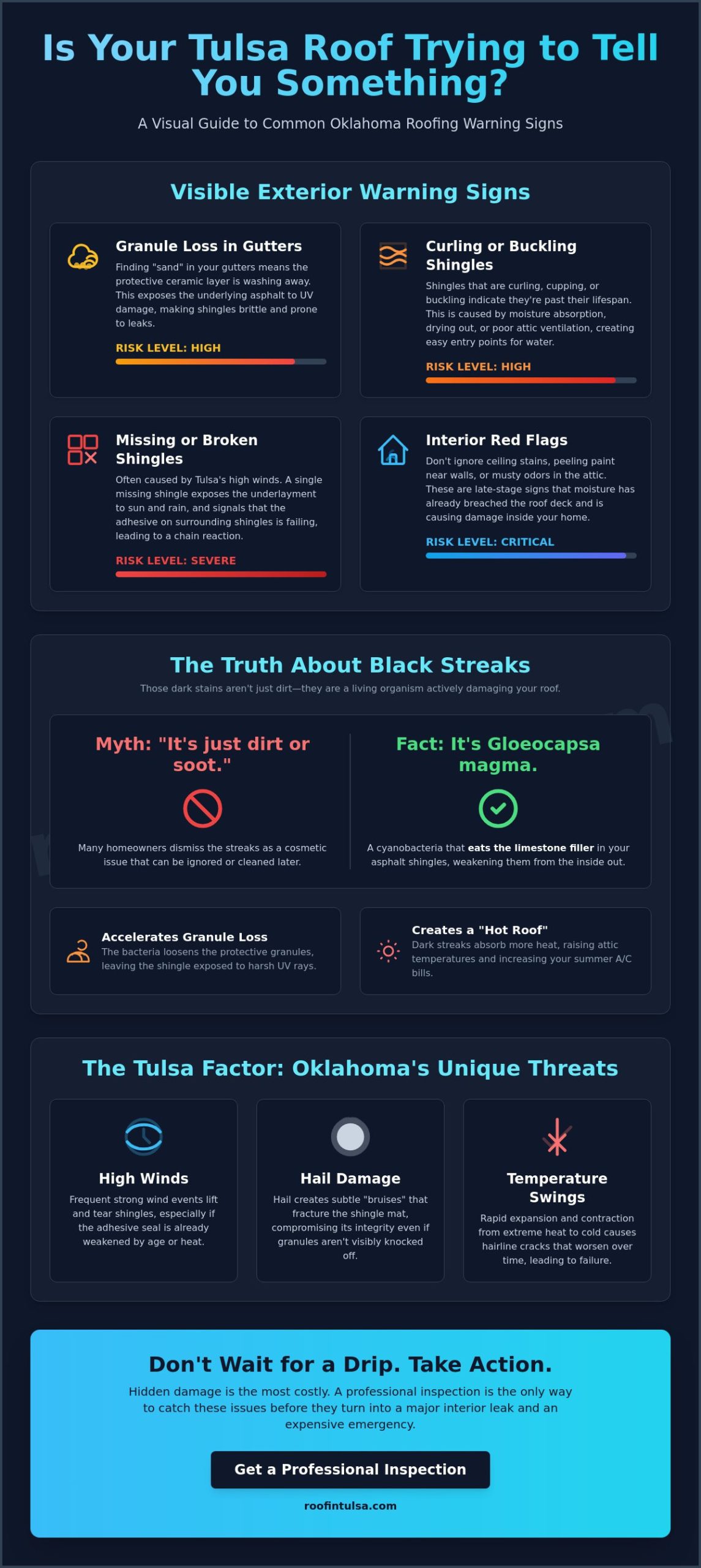
When you see a missing shingle, it’s rarely an isolated incident. Each asphalt shingle relies on a specialized adhesive strip to stay bonded to the one below it. Once that seal fails, the wind can easily lift and tear the surrounding pieces. Tulsa County has already seen three significant wind events and a tornado this year; these forces are often enough to strip aging shingles from a home. Tulsa homeowners also deal with extreme temperature swings. These shifts cause shingles to expand and contract rapidly. This leads to hairline cracks that eventually compromise the entire structure. A single missing shingle might seem like a small cosmetic issue. However, it exposes the delicate underlayment to direct sunlight and rain. In our region, one missing piece often signals that the rest of the roof’s adhesive is becoming brittle.
The Danger of Granule Loss in Gutters
Have you noticed what looks like coarse, dark sand at the base of your downspouts? These are ceramic granules. They aren’t just for color. They protect the underlying asphalt from UV degradation. In Tulsa, heavy spring storms often wash away these granules, leaving the shingle “bald” and brittle. This accelerated wear is one of the most reliable signs you need a new roof in Tulsa. Without this protection, the sun bakes the asphalt, making it prone to leaks. Additionally, local bacteria often feed on the limestone filler in modern shingles. This “limestone diet” loosens the granules and leaves the roof vulnerable to the elements. Finding heavy sediment in your gutters is a primary indicator that your roof’s lifespan is nearing its end.
Shingle Physical Deformities
If your shingles appear to be changing shape, they’ve likely reached the end of their functional life. You’ll often see “cupping,” where the edges turn upward, or “clawing,” where the middle of the shingle bulges while the edges stay flat. Both patterns suggest that the material is drying out or suffering from poor attic ventilation. When you perform a check, please stay safe. Use a pair of binoculars from the sidewalk rather than climbing a ladder.
Look for these specific changes from the ground:
- Curled edges: Shingles that look like they are peeling away from the roof deck.
- Buckling: Straight-line humps that often run vertically up the roof slope.
- Broken tabs: Shingles that have snapped due to debris or thermal stress.
If these deformities are visible from the street, the damage is already significant. These physical changes are clear signs you need a new roof in Tulsa before the next major storm hits. Catching these deformities early helps you plan for a replacement on your own timeline rather than during a rainy-day emergency.
The Truth About Black Streaks: Is It Just Ugly or Is It Damage?
Many Tulsa residents see dark, vertical streaks on their roofs and assume it’s just soot or dirt. However, these marks are actually a hardy cyanobacteria called Gloeocapsa magma. It thrives in the high humidity of our “Green Country” environment. This isn’t just an aesthetic concern. These black streaks are a living organism eating your roof’s limestone filler. As the bacteria consumes the limestone, it weakens the shingle’s structure. This process is one of the more subtle signs you need a new roof in Tulsa, as it happens slowly over several years. If you notice these streaks spreading, your shingles are likely losing their ability to protect your home.
Beyond structural damage, these dark stains create a “hot roof” effect. The dark pigmentation absorbs more solar heat. This raises the temperature in your attic significantly. You might notice your air conditioner running longer during our humid July afternoons. This extra heat further dries out the asphalt mat, making shingles brittle and prone to cracking. It’s helpful to understand that while we often focus on Hail and Wind Damage, biological growth is a constant, quiet threat to your home’s efficiency. Understanding these signs you need a new roof in Tulsa helps you avoid the shock of a sudden, major leak.
Biological Growth and Shingle Integrity
This bacteria does more than just change the color of your roof. It actively loosens the bond between the protective granules and the asphalt mat. When this bond fails, the granules wash away. This leaves the roof vulnerable to UV rays. You should distinguish between standard “algae” and more destructive growth like moss or lichen. While algae is primarily a food-source issue, moss and lichen actually root into the shingle. They hold moisture against the surface. If you see thick, green clumps, the damage is likely deep and structural.
Why North-Facing Slopes Fail First
Tulsa neighborhoods with heavy tree cover are particularly at risk. North-facing slopes stay shaded and damp for longer periods. This creates a perfect breeding ground for bacteria and moss. If the shingle mat is thinning in these shaded areas, it’s often a sign that the biological growth has already compromised the roof. Consistent roof maintenance can prevent these organisms from taking hold. However, once the shingles become brittle and thin, replacement is usually the safest path. If you’re unsure if your streaks are surface-level or structural, a professional Tulsa roof assessment can provide the honest answers you need to protect your investment.
The Tulsa Factor: Identifying Hail and Wind Damage
Living in Tulsa means accepting that our roofs face a unique set of atmospheric challenges. As of May 2026, Tulsa County has already experienced two days of severe hail and three significant wind events. These aren’t just statistics. They represent real stress on your home’s exterior. While the previous sections covered biological growth and visible wear, storm damage is often much more sudden. Understanding the specific signs you need a new roof in Tulsa after a storm can help you navigate the insurance process with confidence.
Many homeowners confuse biological black streaks with hail damage. This is a critical distinction for insurance claims. While algae streaks are vertical and follow the flow of water, hail hits are random. They often look like dark thumbprints where the granules have been driven into the asphalt mat. If you see these marks, the structural integrity of the shingle is likely compromised. Storm damage also frequently targets transition points. Flashing around chimneys and valleys often pulls away during high winds. This creates an immediate entry point for water that isn’t always visible from the street.
Spotting Hail Bruising
Hail damage doesn’t always result in a hole. Instead, it often creates a “bruise.” If you were to touch the shingle, it would feel soft and indented, much like a bruised apple. These hits fracture the fiberglass mat underneath. Once this mat is broken, it’s only a matter of time before the next Oklahoma downpour finds its way into your home. If you only notice a few isolated hits, a targeted roof repair in Tulsa might be enough to restore your protection. However, widespread bruising across multiple slopes usually signals a larger issue that requires a more comprehensive solution.
Creased Shingles from High Tulsa Winds
High winds do more than just blow shingles off. Often, the wind “lifts” the shingle just enough to break the manufacturer’s sealant bond. Once this bond is broken, the shingle flaps in the wind. This creates a distinct horizontal crease line across the top of the shingle. You might not see missing pieces from the ground, but the shingle is no longer waterproof. Because our peak hail season in April and May often brings these high-velocity winds, this type of “hidden” damage is common. When a large percentage of your roof has failed sealant bonds, it becomes one of the primary signs you need a new roof in Tulsa. In these cases, a full roof replacement in Tulsa is often the only way to ensure your home remains safe during the next storm cycle.
Interior Red Flags: Signs of Roof Failure Inside Your Home
Sometimes the most telling signs you need a new roof in Tulsa aren’t on your shingles at all. They’re hidden in your attic or showing up as subtle marks on your bedroom ceiling. While exterior damage is often caused by sudden storms, interior red flags usually signal long-term structural issues. By the time you see a water stain, the leak has likely been active for months. Catching these problems early can prevent costly repairs to your drywall, insulation, and electrical systems.
Tracing a leak path is rarely straightforward. Water often enters through a small crack in the flashing and travels several feet along a rafter before dripping onto your ceiling. If you notice a sagging roof deck while in your attic, this is a serious warning. It indicates that moisture has saturated the wood, leading to rot and a loss of structural integrity. You can also perform a simple “daylight test.” If you turn off the attic lights during a sunny afternoon and see light peeking through the roof boards, you have a direct path for water and pests to enter your home. These openings are clear signs you need a new roof in Tulsa before the next seasonal downpour occurs.
Attic Ventilation and Heat Stress
Our 100-degree Tulsa summers don’t just affect your comfort; they bake your roof from the inside out. If your attic doesn’t have proper ventilation, the trapped heat can reach 150 degrees or more. This extreme temperature “cooks” your shingles, causing the underside to become charred and brittle. You should check your insulation after a heavy rain. If it feels damp or looks matted, your roof’s underlayment has likely failed. A healthy roof system requires a constant flow of air to prevent this type of thermal degradation.
The “Ghost” Leak: Mold and Mildew
Persistent humidity in your attic is often a sign of a failing roof system. You might notice a musty smell in your upper hallways or see dark spots forming on the attic rafters. This isn’t just an air quality issue; it’s a sign that your roof deck is no longer keeping moisture out. Interior mold is often the final symptom of a complete roof system failure. If you detect these odors or see fuzzy growth on your insulation, the moisture levels have been high for too long. If you’re concerned about hidden moisture, a professional Tulsa roof inspection can identify the source of the humidity before it compromises your family’s health.
Taking Action: Why a Professional Tulsa Roof Inspection is Essential
While walking your property with binoculars is a smart first step, a ground-level view has significant limitations. You might spot missing shingles or dark streaks, but you cannot assess the structural integrity of the sealants or the condition of the underlayment from the sidewalk. A professional evaluation is the only way to confirm the subtle signs you need a new roof in Tulsa. Our team at Rescue Roofing Tulsa specializes in identifying hidden damage that often hides in plain sight. We look for micro-fractures in the asphalt mat located directly adjacent to biological growth and check for compromised seals that only a hands-on inspection can reveal.
In Oklahoma, “waiting and seeing” is often the most expensive strategy a homeowner can take. A small leak that goes unnoticed during a dry spell can quickly turn into a structural emergency during a spring thunderstorm. By the time the damage is obvious to an untrained eye, the cost of remediation has likely doubled. We believe in providing the insurance claim assistance you need to navigate these complex situations. Our goal is to ensure you have a clear, documented path forward before the next severe weather event arrives. This proactive approach saves you money and protects your home’s long-term value.
Maintenance vs. Insurance Claims
It’s vital to understand the difference between routine maintenance and storm-related loss. For example, the black algae streaks discussed earlier are typically considered a maintenance issue. However, these streaks often mask underlying hail hits that are eligible for insurance coverage. Our local experts are trained to distinguish between simple age-related wear and the functional damage caused by Tulsa’s high winds and hail. We provide honest, transparent assessments so you know exactly where your roof stands. We won’t recommend a full replacement if a targeted repair will solve the problem. Trust is our cornerstone, and we treat every roof as if it were over our own family’s heads.
Your Next Steps with Rescue Roofing
Protecting your home starts with a thorough, no-obligation professional inspection. We don’t just look at the shingles; we examine the flashing, gutters, and ventilation systems to ensure your entire roof is functioning as a unit. If we find storm damage, we handle the heavy lifting of documentation for your insurance provider. This removes the administrative burden from your shoulders and ensures your claim is based on accurate, professional data. Don’t leave your home’s safety to chance. Identifying the signs you need a new roof in Tulsa early is the best way to avoid interior damage. Schedule your free inspection with Rescue Roofing Tulsa to protect your home today. We are here to serve as your trusted neighbor and expert guide through every step of the process.
Protect Your Home Before the Next Oklahoma Storm
Understanding the signs you need a new roof in Tulsa is the best way to prevent a minor issue from becoming a major financial burden. From identifying the bacteria eating away at your shingle’s limestone to tracing hidden water stains in your attic, you now have the tools to evaluate your home’s health. Remember that Oklahoma weather moves fast. What looks like a small cosmetic streak today could be a structural vulnerability that fails during the next high-wind event. Taking proactive steps now ensures your family stays safe and dry all year long.
As a locally owned and operated business, we are deeply invested in the safety of our Tulsa neighbors. We serve as A+ rated insurance claim specialists to help you navigate the complexities of storm damage recovery with confidence. If you’re facing an urgent situation after a storm, we provide 24/7 emergency repair availability to secure your property immediately. Don’t wait for a heavy downpour to test your roof’s integrity. Get your free roof inspection from the local experts at Rescue Roofing Tulsa! We look forward to providing the honest, dependable guidance your home deserves.
Frequently Asked Questions
Do black streaks on my roof mean I need a new replacement?
Black streaks don’t always mean you need a total replacement. These marks are caused by cyanobacteria that feed on the limestone in your shingles. While the streaks look like dirt, they gradually weaken the shingle’s structure over time. If your shingles are still flexible and the seal is intact, a professional cleaning might suffice. However, if the growth is accompanied by thinning mats or granule loss, it’s one of the common signs you need a new roof in Tulsa.
How can I tell the difference between hail damage and roof algae?
Hail damage appears as random, circular indentations that feel soft to the touch, similar to a bruised fruit. In contrast, roof algae or bacteria form long, dark vertical streaks that follow the path of rainwater. Hail hits actually fracture the fiberglass mat inside the shingle, which is a structural failure. Algae is primarily a surface issue until it begins to loosen the protective granules. A professional can help you distinguish these marks during an inspection.
Will my homeowners insurance pay for a new roof if it has black streaks?
Standard homeowners insurance typically doesn’t cover black streaks because they are classified as a maintenance issue rather than sudden storm damage. However, many Tulsa roofs with streaks also have hidden hail bruising from recent spring storms. If our inspectors find legitimate impact damage beneath the biological growth, the replacement may be covered. We recommend a professional assessment to determine if your specific situation qualifies for a claim.
How long does a typical shingle roof last in the Tulsa climate?
A standard asphalt shingle roof in Tulsa generally lasts between 15 and 22 years. Our local climate, with its high humidity and frequent severe weather, can significantly shorten this lifespan compared to other regions. Intense UV exposure and rapid temperature swings cause shingles to become brittle faster. Regular inspections after major weather events help you track your roof’s condition and plan for a replacement before leaks occur.
Can I just power wash the dark stains off my shingles myself?
What are the most common signs of roof failure after a Tulsa wind storm?
The most common signs of wind failure include missing shingle tabs and horizontal crease lines across the top of the shingles. Even if shingles aren’t missing, high winds can “lift” them and break the adhesive seal. This leaves your home vulnerable to rain even if the roof looks okay from the ground. Lifted flashing around chimneys or valleys is another frequent indicator of wind-related damage that requires professional attention.
Does a small leak always mean I need a total roof replacement?
A small leak doesn’t always require a total replacement if the rest of the roof system is in good condition. If the leak is caused by a single damaged shingle or a small section of failing flashing, a targeted repair is often the best solution. However, if the leak is a result of widespread granule loss or brittle shingles, it’s one of the definite signs you need a new roof in Tulsa to prevent future damage. We always look for the most cost-effective solution first.
Why do the black streaks only appear on the north side of my house?
Black streaks appear most often on the north side of your home because it receives the least amount of direct sunlight. This lack of sun allows moisture from rain and dew to linger much longer than it does on southern slopes. These damp, shaded conditions create the perfect environment for Gloeocapsa magma bacteria to thrive. Heavy tree cover can also contribute to this problem by providing extra shade and dropping organic debris on the shingles.