



Last Updated: November 23, 2026
Quick Summary
Choosing a commercial roof coating contractor means verifying four things before you sign: proof of a real roof assessment, current licensing and insurance, a coating system matched to your existing roof type, and a written proposal that names every exclusion. Price comes last, because a cheap bid on the wrong system costs more than a fair bid on the right one.
- A bid delivered before any roof access is a guess, so end the conversation if a contractor quotes from the parking lot.
- Ask for a license, an insurance certificate naming you as certificate holder, and at least three comparable low-slope projects.
- A real inspection covers roof condition, moisture, substrate compatibility, and surface preparation needs.
- Score bids with price weighted at only 15%, after scope, assessment, experience, and warranty.
- Require written unit rates for likely extras so change orders have a known price before work starts.
Table of Contents
- How do you choose a commercial roof coating contractor?
- Evaluating Experience, Licensing, and Insurance
- Commercial Roof Coating Inspection: What a Real Assessment Covers
- Matching the Coating System to Your Existing Roof Type
- Commercial Roof Coating Contractor Questions to Ask Before Signing
- Commercial Roof Coating Contractor Selection Cost: Comparing Bids and Exclusions
- Commercial Roof Coating Warranty: What the Paperwork Actually Covers
- Frequently Asked Questions
How do you choose a commercial roof coating contractor?
Choosing a commercial roof coating contractor means verifying four things before you sign: proof of a real roof assessment, current licensing and insurance, a coating system matched to your existing roof type, and a written proposal that names every exclusion. Price comes last. A cheap bid on the wrong system costs more than a fair bid on the right one.
The North American roof coatings market is projected to reach about $0.48 billion in 2026, according to Roofing Contractor’s market report. That growth brings more contractors into the category, and not all of them belong on your building.
Below, we’ll show you how to screen a contractor, what to ask, and how to read a bid so the numbers actually compare.
Start with a roof assessment, not a sales pitch
If a contractor quotes your roof from the parking lot, end the conversation. A coating decision depends on roof condition, and roof condition cannot be judged from the ground.
A proper assessment takes time. Someone walks the roof, checks the membrane or seams, looks for wet insulation, and photographs what they find.
Watch out: a bid delivered before any roof access is a guess. If the contractor later “discovers” problems, you pay for the difference.
Evaluating Experience, Licensing, and Insurance
Ask for three documents before you discuss products: license, insurance certificate, and a list of comparable commercial projects. A residential roofer who has never touched a modified bitumen or single-ply membrane roof is learning on your building.
The U.S. roofing contractors industry had 113,000 businesses with a 4.2% compound annual growth rate from 2021 to 2026, per IBISWorld’s roofing contractors analysis. Volume of businesses does not equal depth of commercial experience.
What to collect and check:
- License: current and in the company’s legal name
- Insurance: general liability plus workers’ compensation, with you named as certificate holder
- Commercial project list: at least three low-slope roofs similar in size and type to yours
- References: past clients you can actually call
For a deeper walkthrough of what to verify, see our guide on what to look for in a commercial roofer in Tulsa, which covers licensing, insurance, and materials.
Commercial Roof Coating Inspection: What a Real Assessment Covers
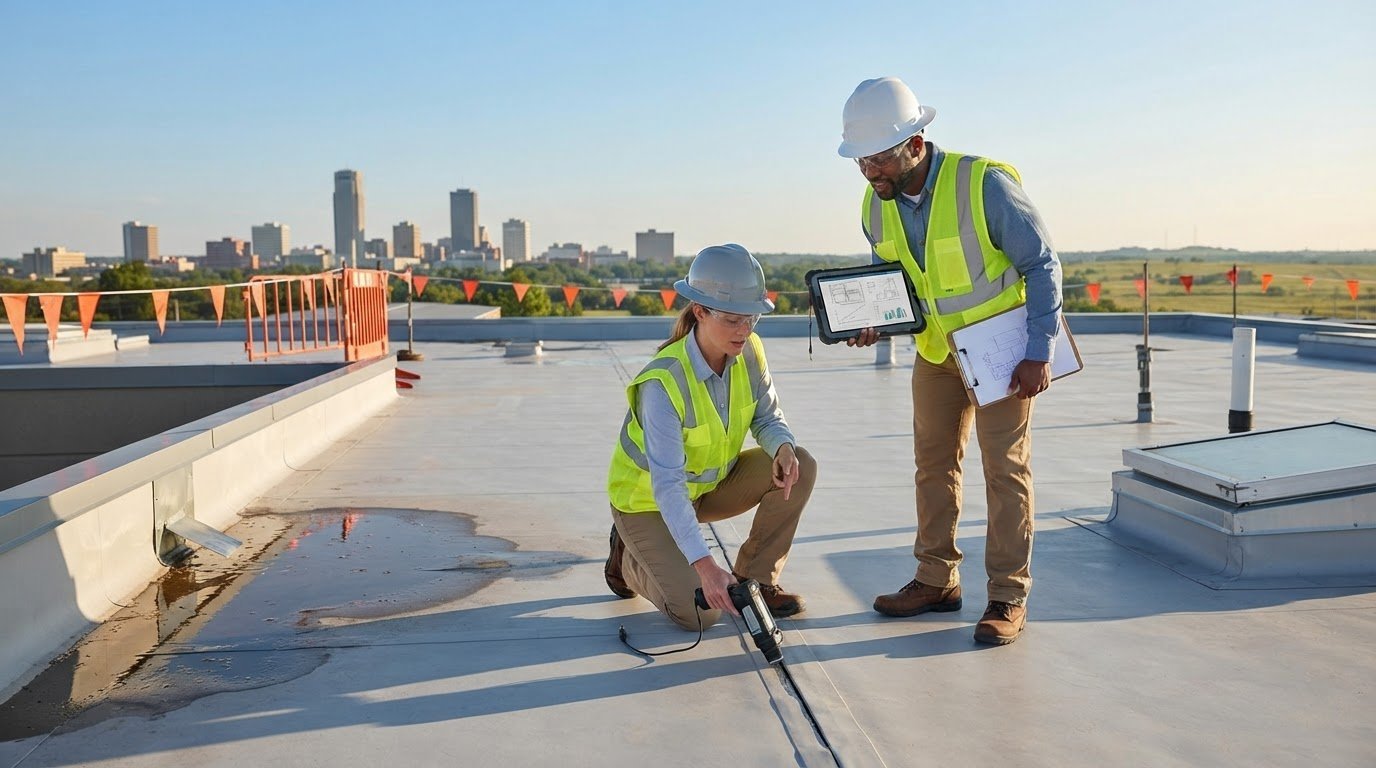
A real commercial roof coating inspection covers four things: roof condition, moisture, substrate compatibility, and surface preparation needs. If any of those is skipped, the coating suitability question is unanswered. The difference between a contractor who can coat your roof and one who should is usually visible in how they inspect it, not in how they quote it.
The four inspection layers, in order
1. Roof condition and substrate identification. The inspector should name what is actually on the roof: built-up roofing, modified bitumen, EPDM, TPO, PVC, or metal, and the approximate age and number of plies or membrane thickness.
2. Moisture survey. Visual inspection alone misses wet insulation, the most common reason a coating blisters or delaminates within a few years.
3. Seam, flashing, and penetration review. On single-ply and modified bitumen roofs, seams and flashings are where water enters first.
4. Drainage and ponding. Ponding water is a coating killer and a common warranty void condition.
What the written assessment should contain
Ask for a document, not a verbal summary. A usable assessment includes:
- Roof plan or sketch with test locations marked
- Moisture readings by location and method used
- Photo log keyed to the roof plan
- Substrate identification and coating compatibility note
That last item matters. A contractor who documents limits is more credible than one who claims the roof is fully understood from a single walk.
Adhesion and compatibility checks
Before committing to a coating system on an aged or questionable substrate, a competent contractor will run a test patch or adhesion test in a small area and check bond after cure.
Watch out: an assessment that produces a bid number but no moisture data, no photo log, and no substrate identification is a sales call, not an inspection.
To see what a professional inspection actually involves, review this outline of a commercial roof inspection so you can judge whether a contractor’s walk-through was real.
Matching the Coating System to Your Existing Roof Type
Coating performance starts with substrate compatibility.
Match the coating to what is actually under it:
- Built-up roofing: acrylic or asphalt-based systems, depending on surface condition
- Modified bitumen: coatings rated for granulated or smooth cap sheets
- Single-ply membrane: products approved by the membrane maker, since some coatings attack the sheet
- Metal roofing: flexible coatings that move with thermal expansion
Manufacturer training matters here. A contractor certified by the coating maker can tell you which products are approved for your roof type and can register the material warranty when that applies.
If you are weighing whether a reflective system fits your building at all, this breakdown of reflective roof coatings for retail centers covers the trade-offs before you commit.
Commercial Roof Coating Contractor Questions to Ask Before Signing
Ask these commercial roof coating contractor questions in the same order every time, and write down the answers. Consistent answers across three bids tell you more than any single quote.
The core list:
- Who performs the roof assessment, and will I get it in writing?
- What coating system are you proposing, and why is it approved for my roof type?
- What surface preparation is included: power washing, patching, primer?
- What is excluded from this price?
- Which manufacturer warranty applies, and who registers it?
- What labor warranty do you provide, and for how long?
- How many crews, and who is the on-site supervisor?
- What is the project schedule, and how do you protect my operations?
- How do you handle change orders if hidden damage appears?
- Can I see photos of a completed project of the same roof type?
A contractor who answers all ten without hedging is worth a second visit. One who dodges questions four, five, and nine is telling you something.
Commercial Roof Coating Contractor Selection Cost: Comparing Bids and Exclusions
Comparing coating bids on the bottom-line number alone is the most expensive mistake building owners make. The lowest bid is usually the one with the most exclusions, and exclusions become change orders. Stop comparing prices and start comparing scopes on a like-for-like basis, then score the proposals against a consistent framework.
Normalize the scope before you compare dollars
Two bids are only comparable if they cover the same work. Build a one-page scope matrix and require every contractor to price against it, or map their proposal into it yourself. The categories that most often hide differences:
| Bid Element | What to Check | Red Flag |
|---|---|---|
| Surface prep | Wash, patch, prime listed separately with methods | “Prep included” with no detail |
| Coating material | Product name, manufacturer, coverage rate, number of coats, dry-film thickness target | Generic “elastomeric coating” |
| Roof repairs | Wet insulation, deck repair, flashing, seam treatment priced as line items | Silent on repairs |
| Ponding and drainage | Corrective work identified or explicitly excluded | No mention |
| Warranty | Material and labor terms stated, registration responsibility named | Verbal promise only |
| Schedule | Start date, duration, phasing, crew size | “TBD” |
| Change orders | Written unit rates for extra prep, repair, or coating | No process stated |
| Closeout | As-built photos, thickness readings, warranty documents | Nothing promised |
A bid that is 20% lower usually differs in one of three places: less surface preparation, fewer coats or lower coverage rate, or more exclusions. Find which one before you reward the number.
Score the proposals, don’t just read them
A weighted scorecard forces the comparison into the open and reduces the pull of a low price. A workable weighting for a commercial coating project:
- Scope completeness and clarity, 25%. Does the proposal name products, prep methods, and exclusions?
- Assessment quality, 20%. Was there a real inspection with moisture data and photos?
- Experience on your roof type, 20%. Comparable low-slope projects, references you can call.
- Warranty terms and registration, 15%. Material and labor terms, transferability, who files.
Score each bid 1 to 5 per category, multiply by the weight, and total. A bid that wins on price but scores low on scope completeness is telling you where the change orders will come from.
The exclusions that turn a low bid into a high one
Read every proposal for what is not included. The common ones:
- Wet insulation removal and replacement
- Deck repair or replacement
- Flashing and penetration rebuilds
- Ponding-water correction or drain work
Ask each contractor to state a unit rate for the most likely extras, so a change order has a known price before work starts.
Commercial roofing demand totaled 83.2 million squares in 2024 and is projected to reach 85.2 million squares in 2029, per Freedonia Group’s US commercial roofing data. Slow, steady demand means contractors should have capacity. A bid with a suspiciously short schedule deserves a question about crew size.
Watch out: a proposal that quotes a total but not a coverage rate, coat count, or dry-film thickness target cannot be compared to another bid, and it cannot be verified after installation.
For cost and lifespan context to weigh a coating against other options, this comparison of commercial roof restoration versus replacement helps you frame the numbers.
Commercial Roof Coating Warranty: What the Paperwork Actually Covers
A commercial roof coating warranty is only as good as its exclusions.
Check these clauses:
- Term: material and labor may run different lengths
- Transferability: does it survive a building sale?
- Void conditions: ponding water, foot traffic, unapproved repairs
- Registration: who files it, and do you get a copy?
A labor warranty from a contractor who disappears is worth nothing. That is why the manufacturer registration matters as much as the contractor’s promise.
Coating a commercial roof is a long-term decision, and the contractor you pick matters more than the product label.
Get started with Rescue Roofing and get a written assessment of your roof before you sign anything.
Frequently Asked Questions
How can you tell if a commercial roof is ready for coating?
A commercial roof coating inspection should confirm the existing roof type, check for saturated insulation, active leaks, and failed seams before anyone quotes a coating. Moisture testing and core samples matter because coating over wet insulation traps the problem and shortens service life. Ask the contractor to document the roof condition in writing and to state plainly which repairs must happen before the coating system goes down.
What should a commercial roof coating proposal include?
A written proposal should name the coating material and manufacturer, list surface preparation steps, itemize repairs and exclusions, and spell out the warranty term and what voids it. It should also state who handles permits and safety, the project schedule, and payment terms. Bids that quote one lump sum with no material specification are hard to compare and easy to inflate later.
How long does a commercial roof coating last?
Service life depends on the coating type, the substrate, surface preparation, and ongoing roof maintenance. Acrylic, silicone, and urethane coatings behave differently on metal, modified bitumen, built-up roofing, and single-ply membrane, so the manufacturer’s stated term for your specific system is the number to plan around. A commercial roof coating warranty is only as good as the inspection and prep behind it.
How much does commercial roof coating cost?
Pricing depends on roof size, existing roof condition, coating system selected, and how much repair work is needed first. Because those variables swing widely, ask each contractor for a line-item bid that separates prep, repairs, material, and labor. Comparing those lines, not just the bottom number, shows which proposal carries hidden exclusions. Request a current quote based on an actual inspection of your roof.
