



Your roof claim may be reduced by depreciation, but your policy determines whether that amount can be recovered. Actual cash value (ACV) subtracts depreciation and your deductible from the covered loss. Replacement cost value (RCV) may pay recoverable depreciation after you complete and document repairs or replacement. Understanding what ACV vs. RCV in roofing insurance means helps explain why the initial payment may not be the final one.
It’s understandable to expect insurance to cover a roof replacement and feel uncertain when the first payment falls short. The difference between ACV and RCV can affect what you receive, what you may pay out of pocket, and whether a later payment is available. This article explains how depreciation and deductibles affect claim payouts, what recoverable depreciation means, and how policy terms determine whether a replacement is prorated.
Key Takeaways
- Learn why a roof claim can be prorated and how the amount you spend on replacement can affect additional payment.
- Understand what needs to happen before withheld depreciation may be paid, and how exclusions and deductibles shape the claim.
- Compare how ACV and RCV can produce different out-of-pocket costs for the same roof damage.
- See how a roof inspection, repair, or replacement can help move forward after storm damage.
Do Insurance Companies Prorate Roof Replacements?
Yes. A policy can limit payment through depreciation or an age-based roof provision. The declarations page and policy wording show which coverage applies to a claim.
Checking Roof Coverage Declarations
The declarations page summarizes your coverage, limits, deductibles, and any roof-specific terms. Read it with the policy wording, since the summary may not explain every condition. Check whether roof losses are covered on an ACV or RCV basis and whether an endorsement changes that coverage.
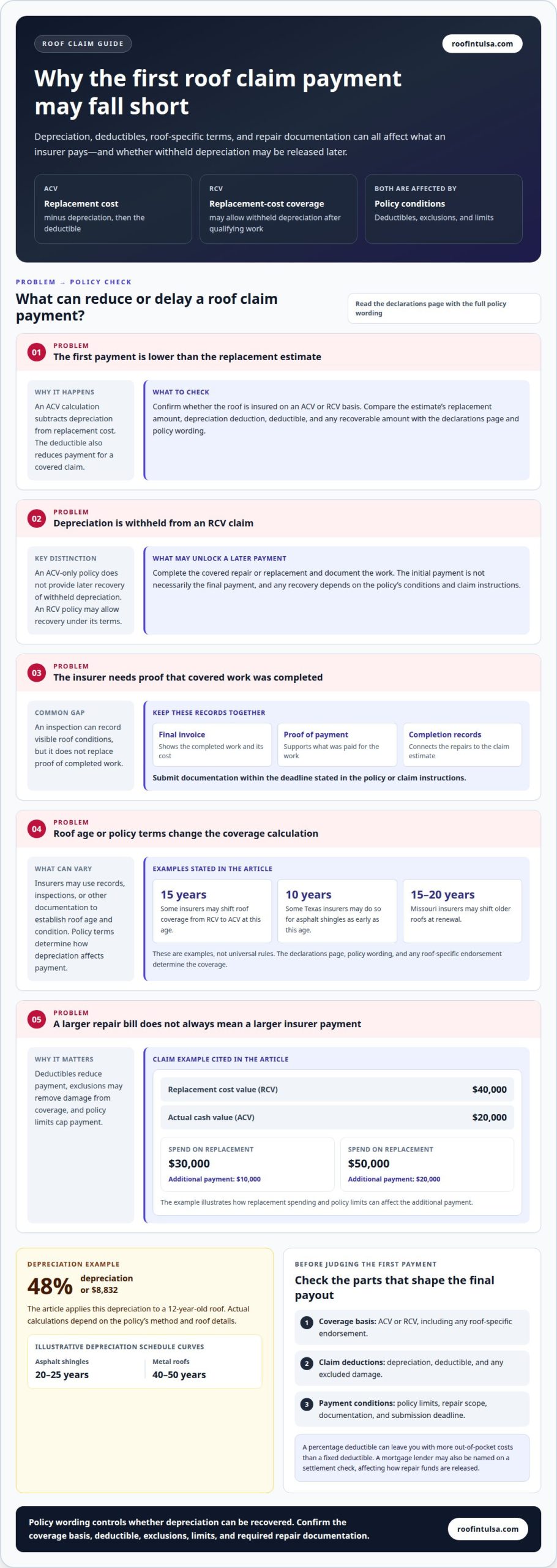
Roof age can affect the coverage available at renewal. Insurers may use records, inspections, or other documentation to establish age and condition. Some insurers may shift coverage from RCV to ACV when a roof reaches 15 years; some Texas insurers may do so for asphalt shingles as early as 10 years. Missouri insurers may shift roofs over 15 to 20 years old at renewal.
A mortgage can also affect claim payments. Depending on the loan and policy, the lender may be named on a settlement check, which can affect how repair funds are released even after the insurer calculates the covered loss.
State Laws and Claim Calculations
State insurance laws shape policy requirements and claim handling, but their effect depends on the state and the policy. ACV pays replacement cost minus depreciation, while an RCV policy may allow depreciation recovery under its terms.
The example applies 48% depreciation, or $8,832, to a 12-year-old roof.
Actual payment also depends on the deductible, covered damage, and repair or replacement costs. According to the U.S. District Court for the District of Minnesota, a roof with a $40,000 RCV and $20,000 ACV yields $10,000 in additional payment after spending $30,000 on replacement, while spending $50,000 still yields only $20,000 in additional payment. That example shows why a higher replacement bill does not automatically raise the insurer’s payment beyond the policy limit.
What is recoverable depreciation on my roof claim?
Recoverable depreciation is the amount withheld from an initial RCV payment that may be released after you complete and document covered repairs. An ACV-only policy doesn’t provide that later recovery.
Depreciation Schedules and Policy Terms
A depreciation schedule estimates how age and condition reduce a roof’s value; policy terms determine how that estimate affects payment. Asphalt-shingle schedules may use a 20-to-25-year curve, while metal-roof schedules may use a 40-to-50-year curve. Actual calculations depend on the policy’s method and roof details.
Exclusions can remove certain damage from coverage, while the deductible reduces payment for a covered claim. A percentage deductible can leave you with more out-of-pocket costs than a fixed deductible.
Recovering Depreciation with Documentation
Documentation links completed work to the insurer’s estimate and supports a request for withheld depreciation. Keep the final invoice, proof of payment, and completion records together. Submit them within the deadline stated in your policy or claim instructions.
An inspection can document the roof’s visible condition, while an endorsement can change how a policy treats roof losses. Neither replaces the required proof of completed work. A roof inspection can record conditions before repairs, giving you a clear account of the roof’s state.
ACV Settlement Risks
An ACV settlement can leave you with higher out-of-pocket costs because depreciation isn’t paid later.
Deductible buyback products may reduce a deductible under their terms, but they don’t restore depreciation withheld under an ACV policy. Before accepting a settlement, review the policy limit, deductible, exclusions, and repair scope.
Deductibles and policy limits both shape ACV and RCV payments: the deductible reduces the covered amount, and the limit caps payment. An inspection and complete claim documentation help clarify the roof’s condition and the work included in the estimate.
Example comparing ACV and RCV payouts
The NAIC illustrates the difference with two families that have identical roof damage. The contrast comes from depreciation and how each policy calculates payment, showing why the same repair scope can produce different payouts. Replacement cost value reflects the covered cost to replace damaged property. Actual cash value subtracts depreciation before the deductible is applied.
Under the ACV example, the Johnson family has $10,000 in depreciation. The resulting payout is $4,000. The $10,000 gap between the examples comes from depreciation, not different damage or deductibles.
For homeowners, this comparison makes the initial out-of-pocket difference clear. The Johnson family receives $4,000, leaving more of the repair cost to fund. An RCV policy may release withheld depreciation after replacement work is completed and documented. That later payment follows the policy’s conditions and does not make the first payment equal to the full replacement cost.
The examples don’t mean every insurer uses identical terms or claim calculations. Your deductible, limits, exclusions, and roof-specific provisions affect the final payout. Don’t assume “default” means RCV: the declarations page and policy wording control the coverage. Compare the estimate’s replacement amount, depreciation deduction, deductible, and any recoverable amount. These figures show whether the initial claim payment matches the applicable policy calculation.
RCV and ACV describe different ways an insurer values covered roof damage, affecting how much replacement work contributes to the final claim payment. To understand what ACV vs. RCV in roofing insurance means, compare how each policy values covered damage.
How ACV and RCV Differ
ACV is the covered repair or replacement cost minus depreciation; RCV is based on replacement cost without that age-related deduction. Both are subject to the deductible, exclusions, and policy limits. This distinction matters because depreciation can reduce ACV, while an RCV policy may allow withheld depreciation after you document replacement work. RCV doesn’t mean every roof expense is automatically reimbursed.
Roof Replacement Costs Under Each Valuation
With ACV, depreciation and the deductible reduce covered roof replacement costs. With RCV, the insurer calculates the covered replacement cost, then applies the deductible and policy terms. The United States District Court for the Eastern District of Louisiana described a policy capped at the least of the building limit, the replacement cost of the damaged part, or the amount actually spent on repairs or replacement. An estimate above the covered scope doesn’t automatically increase payment.
Roof materials and age can also affect ACV calculations. For example, a 12-year-old metal roof is described with roughly 24% depreciation, compared with 48% for a shingle roof. That difference shows why similar roof ages don’t always produce similar ACV valuations. The policy’s depreciation method and covered damage determine how those figures apply.
For homeowners asking what is ACV vs RCV in roofing insurance, the practical answer also depends on the policy limit, deductible, and roof condition. Compare the premium with the potential out-of-pocket share before choosing coverage. A roof replacement assessment can help connect documented roof damage with the work scope.
Rescue Roofing Tulsa: Residential Roof Replacement
Rescue Roofing Tulsa provides residential roof replacement when roof damage or condition calls for a full replacement. An insurance estimate outlines covered work, while a roofing assessment helps clarify the roof’s condition and the work involved. Your policy determines claim payment; replacement work and claim approval are separate decisions.
If the damage appears limited, roof repair may address the affected area instead. A roof inspection can document visible conditions and help determine whether repair or replacement is appropriate. This information gives you a clearer basis for discussing the roof scope alongside your claim estimate.
For roof damage or help deciding whether to replace the roof, contact Rescue Roofing Tulsa to discuss your next step.
Take the Next Step With Confidence
Connect your claim paperwork with the roof’s actual condition and the work it needs. Understanding what ACV versus RCV means in roofing insurance can help you discuss the estimate, but it doesn’t determine whether the damage calls for repair or replacement. That decision depends on the roof’s condition and the documented scope of work.
Rescue Roofing Tulsa provides residential and commercial roof replacement, along with roof repair. If you’re weighing repair against replacement after damage, a roofing assessment can clarify the work involved. Your insurer determines coverage under your policy, while the roofing scope describes the work needed on your property.
Share your roofing concerns with Rescue Roofing Tulsa and discuss a practical next step. A clear picture of the roof can make it easier to move forward with confidence.
Frequently Asked Questions
Is an RCV policy always better than ACV?
No. RCV can provide more claim funding when you complete covered replacement work, but it may not suit every homeowner’s budget or policy needs. Compare the deductible, coverage limits, roof-specific terms, and your ability to pay repair costs upfront. If you don’t replace the roof, recoverable depreciation may not be released. The right fit depends on how your policy handles likely claim situations.
What’s the Difference Between ACV and RCV?
ACV accounts for depreciation when valuing covered roof damage; RCV is based on the replacement cost of the covered damaged part. This difference affects how the claim is funded, not whether storm damage is covered. An estimate can identify the work and replacement materials, while the policy determines whether depreciation reduces the insurer’s valuation.
Do I always get recoverable depreciation, or only with some policies?
Recoverable depreciation is available only if the policy allows it, typically under RCV coverage and subject to its requirements. An ACV-only policy doesn’t provide a later depreciation payment. For an RCV claim, the insurer may withhold depreciation initially and release it after you document completed work. The policy wording determines what documentation is accepted and which conditions apply.
How does my roof’s age affect a storm damage payout?
Roof age can influence depreciation and affect whether the policy provides RCV or ACV coverage. Insurers may assess age using records or inspection findings, and material and condition can also affect valuation. As a result, two roofs with similar storm damage can receive different claim calculations. A declarations page or renewal endorsement may show whether age-related terms affect the roof’s coverage.
If I have an RCV policy and don’t repair the roof, what happens?
If you don’t complete the covered repair or replacement, you generally won’t meet the condition for receiving withheld depreciation. After applicable deductions, the claim may remain limited to the initial payment calculated under the policy. Read the settlement terms before deciding to leave damage unrepaired. The insurer’s estimate and policy wording explain which portion is payable without completed work.
What Is the Actual Cash Value of a 20-Year-Old Roof?
There isn’t one ACV amount for every 20-year-old roof. The calculation depends on replacement cost, the roof’s material and condition, and the depreciation method. That illustration isn’t a universal valuation; the policy’s calculation and deductible affect the claim payment.