


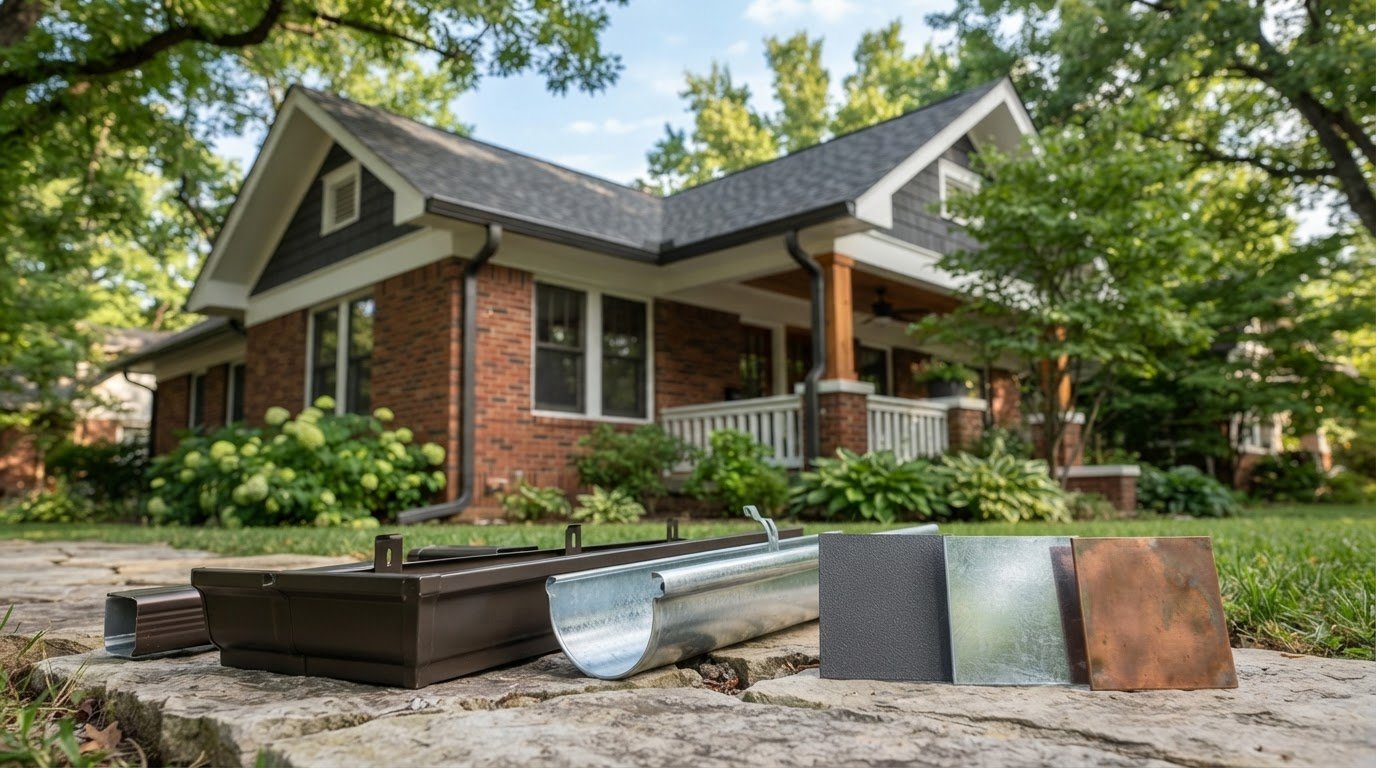

The most practical gutter isn’t always the right fit for your home’s architecture. Knowing how to choose a gutter style for my home starts with matching the shape and material to the roofline, water flow, and the building’s character. K-style gutters suit many homes, while half-round profiles can complement historic properties; roof size and rainfall also help determine whether a standard 5-inch or 6-inch width is appropriate.
It’s easy to focus on material first, but gutter profile matters too, especially on homes with historic details or complex rooflines. Vinyl, aluminum, galvanized steel, zinc, and copper each differ in appearance and durability. Seamless and sectional gutters also differ in how their joints are formed.
This guide compares common gutter profiles and materials, explains what to consider for older homes and challenging rooflines, and offers a practical way to narrow your options. Balance architectural fit, drainage needs, and the look you want for your home.
Key Takeaways
- Compare gutter profiles by how they fit your roofline, move water, and complement your home’s architecture.
- Weigh each material’s durability and appearance against the conditions your gutters need to handle.
- Consider how seamless and sectional construction affects joints, installation, and the way the system fits your home.
- For historic homes or complex rooflines, let architectural details and the layout of roof edges guide your shortlist.
What seamless gutter shape is best?
Compare water capacity, fit along the roof edge, appearance, and installation method. If you’re wondering “how to choose a gutter style for my home,” these criteria will help you narrow the options.
K-Style Gutters
A K-style gutter has a flat back that can be nailed directly to the fascia, plus a flat bottom and shaped front. Its profile offers greater water capacity than the other shapes discussed here. At the same width, K-style gutters can handle more than twice the water volume of half-round gutters. Common widths are 5 inches and 6 inches, with 6-inch models suited to heavier rainfall.
Half-Round Gutters
Half-round gutters have a curved, U-shaped channel that gives round gutters a traditional aesthetic. Their sides don’t sit flush against the fascia, so brackets typically support them. They usually measure 6 inches in diameter, and the smooth interior helps reduce clog risk. Compared with K-style gutters of the same width, half-round models handle less water, but their open shape can make cleaning more direct.
Box Gutters
Box gutters have a high back that tucks under roof shingles, creating a built-in appearance along the roof edge. That placement means installation usually happens during construction or roof repair. Gutters sized 6 inches and larger are usually box-style. Unlike a K-style gutter nailed to the fascia, a box profile is integrated with the roof edge, so its installation depends on that connection.
Fascia Gutters
Fascia gutters are custom-built from a continuous piece of aluminum and fitted to the home’s dimensions. Their tall profile can create a clean, integrated look at the roof edge without a separate fascia board behind the gutter. Compared with sectional gutters, a continuous run has fewer joints where leaks can develop. This tailored fit can be useful when the roof edge calls for a specific profile.
| Profile | Fit and form | Key distinction |
|---|---|---|
| K-style | Flat back; fascia-mounted | Higher water capacity |
| Half-round | U-shaped; bracket-mounted | Smooth interior |
| Box | High back; under shingles | Roof-edge integration |
| Fascia | Custom continuous aluminum | Made to fit dimensions |
Gutter guards need to match the gutter’s opening and shape. They can help reduce debris buildup, but they don’t increase water capacity. Choose a guard that covers the channel without obstructing water flow.
Water spilling over the edge, persistent pooling, or recurring overflow can point to a clog, poor fit, or inadequate capacity. Before choosing a larger or different profile, consider the roof area, pitch, and local rainfall.
To choose a gutter style for your home, match the profile to the roof edge and runoff, then consider appearance and ease of cleaning. For complex drainage issues or tailored water management, specialists offering roof plumbing services NSW can help determine the ideal profile and downspout configuration.
Vinyl, aluminum, steel, zinc, and copper materials
Material affects durability, appearance, and maintenance. Compare materials for their expected service life and cost, and consider how each will suit your home’s architecture.
Vinyl Gutters
Vinyl gutters are lightweight, generally easy to install, and often chosen for their lower initial material cost. They typically last 10 to 20 years, while heat and cold can cause expansion and contraction. For K-style gutters, aluminum or copper is generally preferred over vinyl because vinyl moves more with temperature changes. Consider vinyl when affordability matters more than a longer service life.
Aluminum Gutters
Aluminum is lightweight, rust-resistant, and easy to install, making it a practical option for many homes. Aluminum gutters typically last 20 to 30 years. Standard-gauge seamless material is 0.027 inches thick; heavy-gauge material is 0.032 inches or thicker. Gauge affects the material’s thickness, so compare it alongside the expected durability and the roofline’s demands.
Steel Gutters
Galvanized steel gutters typically last 20 to 30 years and are strong and durable. They can withstand heavy snow and ice without damage, which distinguishes them from lighter materials. Steel’s strength makes it worth considering where harsh winter conditions matter. For robust metal installations, suppliers like LitCore provide high-quality roofing and rainwater drainage products engineered to handle demanding weather. Compare its finish and upkeep needs with aluminum before choosing a material for a K-style profile or another design.
Zinc typically lasts 50 to 80 years or more, while copper typically lasts 50 to 100 years. Both offer a distinctive appearance for historic homes; copper develops a patina over time. Their longer service lives come with higher material costs than vinyl, aluminum, and galvanized steel.
Material prices vary by the case and are given after a quote request; system length, material, gauge, and roof complexity affect the total. Match the material to your priorities, then consider how the gutter profile will look against the roof and fascia.
For a material choice that involves replacing roof-edge components, explore gutter installation as part of planning the project.

Pros and Cons of Gutter Styles: Which Type is Right For You?
Seamless and sectional gutters differ in how they join along the roof edge. That construction affects installation, leak points, and debris cleanup.
Seamless Gutters
Seamless gutters are formed from one continuous piece cut to fit the home. With fewer joints than sectional gutters, they have fewer places where leaks can develop. They’re fitted to the roof edge rather than assembled from short pieces. Color options include white, brown, black, and custom colors. Clear debris regularly and keep water flowing toward each downspout.
Sectional Gutters
Sectional gutters consist of separate lengths joined along the eaves. Their pieces can be simpler to install as a DIY project than seamless gutters, but every seam is a potential leak point. Weather, debris, and the condition of the joints affect how well they hold up. Check seams and corners while cleaning, especially where sections meet near a downspout.
For heavy rain, a 6-inch gutter is typically recommended for larger roofs, steep pitches, or intense rainfall. Gutter width and the roof’s water flow matter more than seamless construction alone. For snow and ice, steel gutters are strong and durable, and can withstand heavy snow and ice without damage.
The installation method depends on the construction: sectional pieces are joined along the roof edge, while seamless gutters are formed as one continuous run to fit the home. Both need regular debris removal from the channel and downspouts so water can drain freely. After severe weather, check for loose sections, separated joints, and overflow.
Choose seamless gutters if fewer joints and a fitted installation are priorities. Sectional gutters may be easier to install, but their seams need attention during routine cleaning. With either style, match the gutter’s width to the roof’s water load and keep the channel and downspouts clear.
Choosing gutter styles for historic homes and complex rooflines
Historic details and roof geometry both influence gutter choice. Start by considering the home’s original appearance, roof edges, and the paths runoff takes to each downspout. If you’re deciding how to choose a gutter style for your home, traditional details or unusual roof shapes may narrow your options.
For historic properties, local zoning requirements may affect the profile. Some ordinances may require half-round gutters, whose curved shape can suit traditional architecture. Half-round gutters were the gutter of choice for most homeowners through the 1950s. Before choosing, consider how the gutter will look beside original trim, eaves, and other exterior details.
Complex rooflines need careful attention to runoff. Dormers, intersecting slopes, and short eaves can concentrate water in particular areas. Trace the roof edges, note where valleys direct runoff, and plan how each gutter run will reach a downspout. A continuous run can reduce joints along a long edge, but corners and changes in direction still need careful fitting.
- Historic facade: Compare curved profiles with the home’s trim and architectural details.
- Multiple roof slopes: Map roof edges and valleys to follow runoff through the gutter system.
- Heavy rainfall: Weigh roof size, pitch, and local rainfall when planning width and downspout placement.
Material also affects the finished look. Copper develops a patina, while galvanized steel has a different finish; both can change how gutters look against older siding and trim. An affordable material still needs to suit the architecture and carry runoff effectively. To choose a gutter style for your home, balance its character with the roof geometry and drainage needs.
Before selecting a system, sketch the roof edges, corners, valleys, and downspouts. Include any loose gutters or roof-edge damage in the plan. Plan a gutter installation around the home’s architectural details and water flow.
Rescue Roofing Tulsa: Residential Roof Replacement
Rescue Roofing Tulsa installs gutters alongside residential roof replacements, helping the gutter system fit the roof edge and direct runoff effectively. Gutter installation can also address worn or poorly fitted gutters when the roof is staying in place. A roof inspection can identify concerns at the roof edge, and roof repair can address damage where gutters attach.
Share details about your roofline, existing gutter problems, and the look you want. This gives the team useful context to discuss gutter installation and how the work can meet your home’s needs.
For help planning gutter installation or related roof work, visit Rescue Roofing Tulsa.
Make Gutter Planning Part of Your Next Roof Decision
Gutter choice affects more than your home’s appearance. Consider it as part of your next roof-edge project, especially if existing gutters are damaged or roofing work is planned. Knowing how to choose a gutter style for your home gives you a practical starting point for discussing appearance, runoff, and roofline requirements.
Rescue Roofing Tulsa offers gutter installation, residential and commercial roof replacement, and roof repair. Coordinating gutter work with related roofing can keep the focus on how the roof edge and drainage work together. If you’re planning an update or addressing damage, contact the team to discuss your priorities and the areas that need attention.
Contact Rescue Roofing Tulsa for gutter advice and take the next step toward a well-planned roof and gutter project.
Frequently Asked Questions
What Are the Different Gutter Materials?
Common residential gutter materials include vinyl, aluminum, galvanized steel, zinc, and copper. The right choice depends on your home’s setting, preferred appearance, and how long you want the system to last before replacement. For a traditional finish, you might compare copper or zinc; for a lightweight option, consider aluminum. Choose a material that complements the gutter profile.
What Types of Gutters Are There?
Compare gutters by both profile and construction. K-style, half-round, box, and fascia describe the gutter’s shape; seamless and sectional describe how its runs are made and joined. For example, a K-style gutter can be made as one continuous run or assembled from sections. Decide on each separately, then match the combination to the roof edge, drainage needs, and the home’s appearance.
Do local ordinances affect gutter style on historic homes?
Local zoning requirements may affect gutter choices for historic properties, including which profiles are allowed or required. Some ordinances may call for half-round gutters to preserve a home’s historic character. Before planning a replacement, find out whether local historic rules apply and consider how the profile will look with the original trim, eaves, and other exterior details.
What are the main residential gutter styles and profiles?
Common profiles include K-style, half-round, box, fascia, and European-style gutters. K-style and half-round gutters are common on visible roof edges; box gutters integrate with the roof edge, while fascia gutters are made to fit the home’s dimensions. European-style gutters have outward-turning beads and use half-round hangers. Compare the profile as well as how it attaches.
Which gutter style works best with different roof types and home architecture?
Match the gutter to the roof edge and the home’s architectural details. A traditional facade may look more cohesive with a curved profile, while a straightforward fascia edge may suit K-style gutters. Roof valleys, dormers, and intersecting slopes need attention because they direct runoff into specific areas. On a historic property, local requirements and original exterior details should guide your choice.
What gutter materials are available, and how do their durability and maintenance compare?
Vinyl, aluminum, galvanized steel, zinc, and copper are common gutter materials. Their durability and maintenance needs vary, so consider how each suits your climate, preferred appearance, and maintenance routine. Keep gutters clear of leaves and debris, and check for damage or poor drainage after severe weather. Regular maintenance helps protect the gutter system and roof edge.