




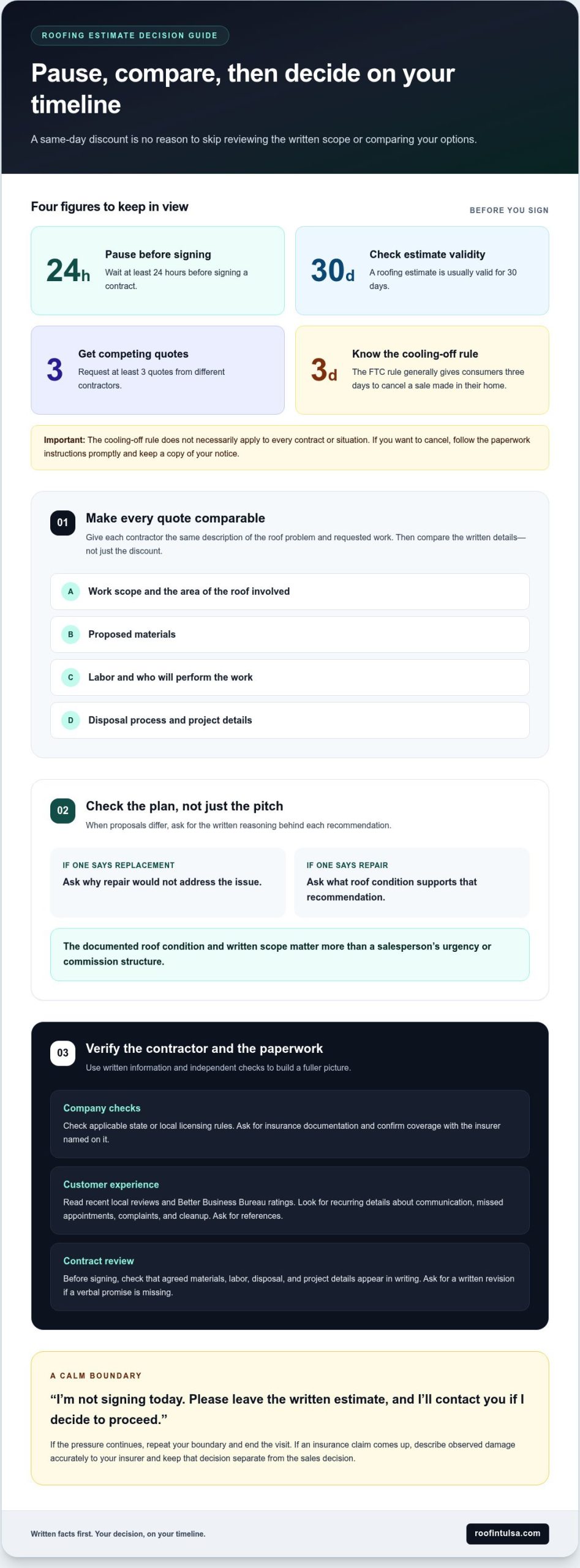
A roofing offer that demands an immediate yes deserves a pause. To handle a pushy roofing salesman, step back, review the written estimate, and wait at least 24 hours before signing a contract. A roofing estimate is usually valid for 30 days, so a same-day discount isn’t a reason to skip comparing your options.
It’s understandable to feel pressured when someone says prices are rising, materials are scarce, or a deal expires today, especially when you’re worried about your roof. You can take time to decide. This article explains why some salespeople create urgency, how to compare estimates and assess discounts, and how to use local reviews when evaluating a roofer. You’ll also learn how to respond calmly, recognize warning signs, and keep control of the decision.
Key Takeaways
- Recognize urgency tactics, such as claims of scarce materials or expiring offers, and give yourself room to decide.
- Compare written estimates by looking at the work scope, materials, labor, and disposal details, not just the discount.
- Understand how commission-based incentives can influence a sales pitch, and remember you can decline if you feel pressured.
- Read local customer reviews and Better Business Bureau ratings to get a fuller picture of a roofing company.
- Use references and project details to judge whether a roofer’s proposal fits your needs before signing.
1. Why Are Roofing Salespeople So Darned Pushy?
Some home-improvement salespeople use urgency to get a decision before you can compare options. They may claim materials are scarce, prices are about to rise, or a discount disappears today. Pressure can also begin with compliments about your home that lead into suggestions for extra work. These tactics don’t prove a contractor is unreliable, but they are reasons to pause, read carefully, and decide on your own timeline.
A roofing estimate is usually valid for 30 days, so a same-day offer shouldn’t replace a careful review. Before signing, look for a written, line-item scope that explains materials, labor, and disposal. Ask who will perform the work, when the project can start, and how updates will be shared. A contractor who can’t explain the crew, timeline, or written terms leaves you without basic information for comparing workmanship and communication.
The FTC Cooling-Off Rule generally gives consumers three days to cancel a sale made in their home. If you want to cancel a roofing contract signed at home, act promptly, follow the cancellation instructions in the paperwork, and keep a copy of your notice. The rule generally applies to home sales, but don’t assume every contract or situation qualifies.
State and local rules for roofing contractors and door-to-door sales vary by jurisdiction. Before choosing a contractor, check the licensing rules and home-solicitation protections that apply where your property is located. For license and insurance checks, use the relevant state or local licensing office and ask the contractor for insurance documentation. Contact the insurer named on the document to confirm coverage. You can also request references and ask past customers about communication, cleanup, and completed work.
Use reviews as another check, not a substitute for a written scope. Read recent local reviews and Better Business Bureau ratings, then look for recurring details: missed appointments, unresolved complaints, clear explanations, or clean project sites. Ask how changes are documented and who answers questions during the job. One review is one person’s account; a consistent pattern offers more context.
If a salesperson pressures you to file an insurance claim, don’t agree just to keep the sale moving. Record the damage you observed, contact your insurer directly, and describe the facts accurately. You can politely end the conversation by saying, “I’m not signing today. Please leave the written estimate, and I’ll contact you if I decide to proceed.” That gives you space to compare proposals without an argument.
2. Commission-only incentives and high-pressure sales
Some large roofing companies use a 100% commission structure, so a salesperson receives no paycheck unless a customer signs a contract. That incentive can make a quick close valuable to the salesperson, but it doesn’t prove the roof needs the proposed work. Learning how to handle a pushy roofing salesman means separating the sales pitch from the evidence about your roof. Ask for the specific inspection findings behind the recommendation, and take time to consider them.
Notice whether the discussion focuses on the roof’s condition or repeatedly turns toward signing. For example, a salesperson might stress an expiring offer but give little detail about the materials or scope. Bring the conversation back to the work: ask what problem it addresses, what the written estimate includes, and how the recommendation follows from the inspection. Clear explanations help you assess the proposal rather than the salesperson’s urgency.
Compare the recommended work with the roof’s condition as described in writing. If a salesperson proposes replacement, ask why repair wouldn’t address the issue. Request the explanation in the estimate, along with the materials and work involved. This makes it easier to review the recommendation later or compare it with another proposal. A salesperson’s commission structure doesn’t determine whether repair or replacement suits your roof; the documented condition and scope matter.
If the conversation feels rushed, respond directly: “I’m reviewing the written proposal before I decide.” If the pressure continues, repeat your boundary and end the visit. You don’t need to debate how the salesperson is paid or explain why you’re declining. A practical way to handle a pushy roofing salesman is to state your decision calmly and keep the conversation focused on written facts.
Before signing, compare the paperwork with what you discussed. Check that the promised materials, labor, disposal, and agreed project details appear in the contract. If a verbal promise is missing, ask for a written revision before agreeing. For example, don’t rely on a spoken assurance about cleanup if the contract leaves responsibility unclear. The document should reflect the work and expectations you’re accepting.
If the pitch turns to an insurance claim, keep the sales decision separate from the claim decision. Describe observed damage accurately to your insurer, and don’t treat a salesperson’s assurance as an insurer’s coverage decision. Insurance claim assistance can help you understand the claim process while you consider the proposed roofing work independently.
3. Getting information and comparing options
Build your decision from written information, not a salesperson’s verbal summary. Request at least 3 quotes from different contractors before making a final decision. Give each contractor the same description of the roof problem and requested work. That makes the proposals easier to compare. If one contractor recommends replacement and another suggests repair, ask each to explain the roof condition behind that recommendation. A useful comparison starts with what the roof needs, not which salesperson presented first.
Read each estimate line by line. Check whether it identifies the work area, proposed materials, labor, and disposal process. Note what each contractor says will happen before, during, and after the work. If an estimate uses broad terms such as “replace roof,” ask for the specific scope in writing. A clear description helps you see whether two quotes cover the same job or differ in important ways.
Make a simple comparison sheet with one column for each contractor. Record the proposed repair or replacement, materials, work included, project timeline, and written terms. Mark missing details instead of assuming they match another estimate. For example, one proposal may describe removing existing roofing, while another may not explain how the old material will be handled. Ask for clarification in writing so you can compare like with like.
Assess a discount by comparing the complete written proposal with other quotes, not by focusing on the claimed savings. A large discount may follow an inflated stated price, leaving you effectively paying full price. Ask what changed in the scope or materials to explain the difference. If the offer depends on signing before you’ve compared the documents, take time to review the terms rather than treating the discount as proof of value.
A recommendation to replace the roof should explain why repair wouldn’t address the problem. A contractor may recommend repair rather than full replacement when replacement isn’t necessary. Ask what damage was observed, where it appears, and how the proposed work addresses it. Compare the explanation with the written scope. If one estimate identifies a specific repair and another calls for replacement, ask both contractors to explain their reasoning based on the same roof condition.
Before deciding, review your notes and resolve differences that affect the work. Confirm that revisions appear in the written proposal, not only in a call or conversation. Consider the scope, materials, disposal, timeline, and communication plan together. Choose the option whose explanation and documentation fit the roof’s needs, rather than assuming the lowest quote or largest discount is automatically best. If proposals remain difficult to compare, ask each contractor to explain the differences plainly before you commit.
4. Today-only discounts and artificial scarcity
A “today only” roofing discount creates pressure by making delay feel costly. A salesperson may say a price expires tonight, materials are nearly gone, or a crew has one opening left. Evaluate each claim separately from the written proposal. Ask what changes tomorrow and request the reason in writing. If the answer is only urgency, you still need time to assess the work, materials, and terms.
Real material price changes can happen, but a deadline should have a clear explanation. Roofing material price increases from manufacturers occurred in early 2026 and were announced in advance. That example differs from a surprise verbal deadline during a sales visit. Ask which material is affected, when the change takes effect, and whether the written estimate reflects it. Then compare the timing with the proposal’s stated terms.
Discounts can also distort comparisons. A large discount may be applied to an inflated stated price, leaving you effectively paying full price. Compare the final written total and scope with other estimates, not the crossed-out figure or claimed savings. For example, a lower offer may exclude disposal or use different materials. A discount is useful for comparison only when the included work is clear.
Treat scarcity claims with the same care. “We have one crew slot left” doesn’t explain who will do the work or when it will begin. Ask for the proposed start date, project timeline, and crew details in writing. If those details are missing, the deadline doesn’t give you the information needed to judge the offer. A genuine scheduling constraint can be explained plainly without demanding an immediate signature.
Roofing markets can shift. The market was highly variable in 2021, and that history can make broad claims about future costs sound plausible. But a past period doesn’t prove that a current offer expires today. Ask the salesperson to distinguish a manufacturer’s announced change from a company’s promotional deadline. Keep each explanation with the estimate, so you can compare the same terms later.
Before accepting any time-limited deal, pause: save the written offer, compare its scope with other proposals, and note the expiration terms. Then decide whether the claimed savings still matter alongside the materials, labor, and disposal details. If the offer disappears before you can review it, you can decline and continue comparing. A sound roofing decision should rest on the documented work and terms, not the countdown alone.
Base your decision on what the estimate describes, not the urgency of a same-day offer. Take time to compare roofing estimates rather than accepting a same-day discount under pressure. That pause keeps your focus on the proposed work and the differences between estimates, not just a reduced figure presented as temporary. If a discount requires an immediate answer, treat the deadline as a reason to review the offer carefully, not as a substitute for comparison. Decide only after you’ve had time to weigh the estimates and determine which documented proposal reflects the work being offered.
5. Checking local reviews and references
Research the planned work before choosing a contractor, then read online reviews from customers in your community. Local accounts can reveal whether a company communicates clearly, keeps appointments, and cleans up after roofing work. Look for specific descriptions, such as how the crew handled a schedule change or explained an unexpected issue. General praise can be encouraging, but detailed examples provide more useful context for comparing proposals.
Check customer reviews and the Better Business Bureau (BBB) profile. Treat the BBB rating and individual reviews as separate pieces of information. Read complaint details and company responses rather than relying on a rating alone. A response explaining how an issue was addressed adds context; a recurring pattern of similar concerns deserves closer attention. Compare that pattern with reviews on other platforms before drawing a conclusion.
Pay attention to dates and project relevance. A review about a roof replacement may help you assess a replacement proposal, while a comment about a different service may say less about that particular work. Recent local feedback can offer a clearer picture of current communication and project practices. Note recurring themes, such as unclear timelines, difficulty reaching the office, careful cleanup, or helpful explanations. One unusually positive or negative account shouldn’t outweigh a consistent pattern.
Ask the contractor for references from customers whose projects resemble yours. Roof repair and full replacement have different scopes, so ask for a reference that matches the work you’re considering. When speaking with a past customer, ask whether the written scope matched the completed work, how updates were handled, and whether the crew left the property tidy. These practical questions turn “Were you satisfied?” into details you can compare.
Use what you learn to follow up on specific points in the estimate. If reviews mention schedule changes, ask how project updates are communicated. If a reference describes a scope change, ask how revisions are recorded. Compare the answers with the written proposal and note whether each contractor responds directly. Reviews and references can’t show every detail of your project, but they can help you assess how a company treats customers and handles questions.
Keep your notes together: review themes, BBB profile details, reference comments, and estimate questions. That record can help you make a considered choice instead of reacting to a confident pitch. If you’d like to discuss your roof concerns at your own pace, get in touch about your roofing questions.
That record can help you make a more informed choice before buying the contractor’s service, after researching the planned work and checking the company’s online reviews.
Rescue Roofing Tulsa: Residential Roof Replacement
Rescue Roofing Tulsa can help you move from comparing proposals to understanding what your roof needs. If a contractor recommends replacement, a roof inspection can clarify the roof’s condition and the proposed next step. When the findings point to repair, roof repair may address the problem without a full replacement. If your roof needs replacing, Rescue Roofing Tulsa provides residential roof replacement.
Bring your questions and estimate details to the conversation. Understanding your roof’s condition and the work under consideration can help you decide without rushing. Contact Rescue Roofing Tulsa to discuss your roofing concerns.
Make Your Next Roofing Decision on Your Terms
Roofing decisions affect your home long after a sales conversation ends. Knowing how to handle a pushy roofing salesman can give you room to focus on what matters: the work your roof actually needs. Keep your notes, estimates, and questions together so you can review them with a clear head. You don’t have to decide simply because someone is waiting for an answer.
As you move forward, focus on your roof’s condition and the work that addresses it. Rescue Roofing Tulsa offers residential roof replacement, commercial roof replacement, and roof repair. Whether you’re considering repair or replacement, a calm conversation about your roofing concerns can help you identify a practical next step.
Contact Rescue Roofing Tulsa to discuss your roofing needs. Take the time you need, and move forward with confidence.
Frequently Asked Questions
Why Are Roofing Salespeople So Darned Pushy?
Some roofing salespeople have incentives to secure signed contracts, including commission-only arrangements where payment depends on a sale. That can encourage urgency, but it doesn’t establish whether the proposed work is appropriate. Handling a pushy roofing salesman starts with separating the pitch from the evidence: ask what roof condition supports the recommendation and what written details explain the proposed work. A clear answer should address your roof, not just the deadline.
What questions should I ask a roofing contractor before signing a contract?
Ask who will manage the project, how changes will be documented, and who will answer questions once work begins. Request the proposed start date and an explanation of how the crew will protect and clean the property. If the contractor recommends replacement, ask why repair isn’t suitable. Then compare the answers with the written contract. For example, if cleanup was discussed verbally, check that responsibility is in the document before signing.
What are common roofing sales scams and high-pressure tactics?
Watch for claims that insurance will cover all roofing work, requests to misrepresent damage, or promises tied to an immediate signature. A yard-sign offer can also raise concerns if it’s presented as a way to cover an insurance deductible. Don’t agree to inaccurate claim details or payments that disguise deductible coverage. Write down what was offered, keep copies of the paperwork, and describe roof damage truthfully to your insurer.
Should I sign a roofing contract the same day a salesman visits?
No. Take time to read the contract and compare its scope with your other information. The guidance in this article recommends waiting at least 24 hours before signing, and estimates are usually valid for 30 days. For an eligible sale made in your home, the FTC Cooling-Off Rule generally provides three days to cancel. That rule has limits, so read the cancellation terms and act promptly if you need to cancel.