


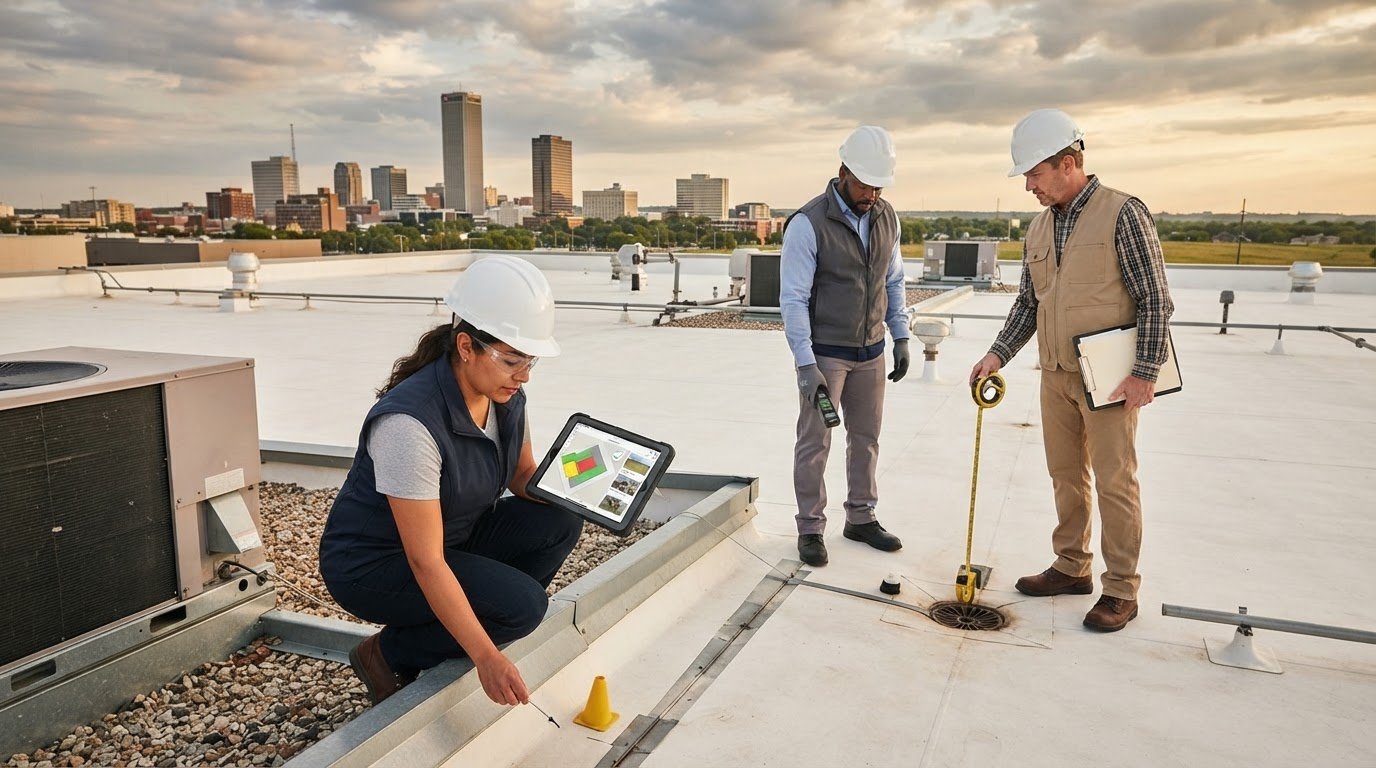

What good is a commercial roof inspection report if it lists defects but doesn’t show where they are or what to do next? This commercial roof inspection report sample shows how clear locations, supporting evidence, and practical recommendations can make findings easier to understand. Roofing terms can be unfamiliar, so a report should explain what was observed and what follow-up may be useful.
The sample is illustrative, not a record of an actual inspection or property. Use it to understand common report sections, how evidence can support a finding, and how observations can inform repair or maintenance planning.
This guide explains how to read roof-system details, locations, photos, and recommendations, including the difference between an item that needs follow-up and one to monitor. You’ll also learn what records to keep so future inspections, repairs, and planning are easier to manage.
Key Takeaways
- A useful report ties each observation to a specific roof area, supporting evidence, and a practical follow-up.
- Use this commercial roof inspection report sample to see how report entries can explain conditions and support useful questions.
- Compare each recommendation with its supporting details to distinguish prompt follow-up from monitoring.
- For a Tulsa property, base planning on findings for that building and inspection date rather than assuming storm damage.
- Keep inspection notes and follow-up records together to support future maintenance and repair planning.
What Is a Commercial Roof Inspection Report?
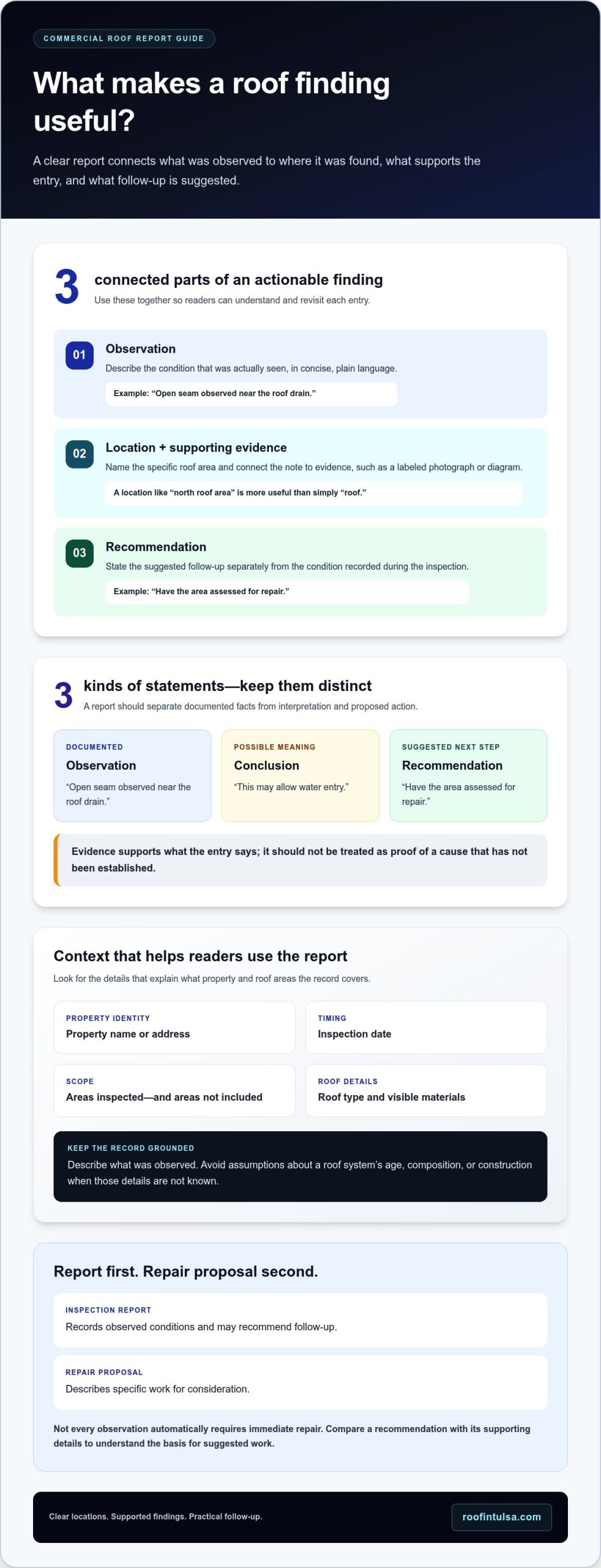
A commercial roof inspection report is a dated record of roof conditions observed during an inspection, the evidence supporting those observations, and recommended follow-up. A commercial roof inspection report sample can show how these elements work together. The purpose is straightforward: help readers understand what was seen, where it was seen, and what may need attention.
A clear report separates facts from interpretation. “Open seam observed near the roof drain” describes an observation. “This may allow water entry” is a possible conclusion. “Have the area assessed for repair” is a recommendation. Keeping these statements distinct helps owners and facility managers understand what is documented and what is proposed, rather than treating every note as a confirmed cause or a repair decision.
An inspection report is also different from a repair proposal. The report records conditions and may recommend follow-up; a proposal describes specific work for consideration. Review the findings first to understand the basis for suggested work and to organize questions, maintenance records, or next steps. Not every observation automatically requires immediate repair.
Who uses a commercial roof inspection report?
Owners can use the record to understand a building’s condition and plan maintenance. Facility managers can track observations, share information with colleagues, and coordinate follow-up. Other building decision-makers may refer to the same details when reviewing priorities or discussing a repair plan. Clear location labels, such as “north roof area” or “above the loading bay,” help everyone connect a written entry to the right part of the building.
That detail matters when a property has several roof areas. A general note like “check the membrane” can be hard to act on. A location and plain-language description make the entry easier to discuss and revisit later.
How does a commercial report differ from a basic roof checklist?
A checklist can show which items were reviewed, but it may provide little context about what the inspector observed. A report explains relevant conditions and may include supporting evidence, such as notes or photographs. It can identify where an observation was made and describe recommended follow-up, making the information more useful for planning than a checked box alone.
Commercial buildings can have distinct roof areas, transitions, drains, or equipment zones that benefit from separate descriptions. For example, “south roof area” is more useful than “roof” when readers need to locate an entry. A well-organized record doesn’t need complicated language. It should give readers enough context to understand each observation and decide what information or follow-up they need.
- Observation: What condition was seen?
- Location and evidence: Where was it, and what supports the entry?
- Recommendation: What follow-up is suggested?
These elements give owners and facility teams a practical starting point. The report documents the condition; the people responsible for the building can use that information to coordinate appropriate next steps. For commercial properties across the Midwest, specialized contractors such as Buckeye Roofing & Restoration can help facility managers evaluate these reports and implement recommended solutions.
What Should a Commercial Roof Inspection Report Sample Include?
A useful commercial roof inspection report sample is organized around the questions a building decision-maker needs answered: What property and roof area were reviewed? What condition was observed? What evidence supports the entry? What follow-up is recommended? Formats vary, but clear sections make findings easier to interpret and use.
An actionable report links each finding to a specific roof location and supporting evidence. That connection helps a reader find the area being discussed, understand the observation, and distinguish it from a recommendation about what to do next.
Property details and roof-system description
Start with identifying details that give the record context. These may include the property name or address, inspection date, inspected areas, and report author. The date shows when the condition was observed, while the inspected-area list clarifies the report’s scope. It also helps prevent readers from assuming an area was reviewed when it wasn’t included in the record.
A roof-system description can name the roof type and visible materials, along with relevant details that were actually observed. Avoid filling gaps with assumptions about a system’s age, composition, or construction. If a report refers to a particular roof area, use a recognizable label such as “east section near the loading area,” rather than simply “roof.” A location label lets someone follow up without guessing where to look.
Findings, photographs, and recommendations
For each entry, look for a precise location, a concise description of the observed condition, and related evidence. A dated photograph or labeled diagram can connect the written note to the roof area. Evidence should support what the entry says, not be treated as proof of a cause that hasn’t been established. If the report includes several images, labels or captions make it easier to match each one to the relevant finding.
Recommendations should be distinct from observations. “Loose material visible at the edge of the east roof section” describes what was recorded. “Evaluate the area for appropriate repair” suggests a next step. That separation helps readers understand which statements describe the inspection and which call for further action.
Plain-language explanations can make technical terms easier to follow:
- Flashing: Material used to seal joints and transitions, such as where a roof meets a wall.
- Drainage: How water moves toward and through roof drains or outlets.
- Roof deck: The structural surface beneath the roof covering.
- Membrane: A continuous roof covering used on some low-slope systems.
As you review a report, connect each term to the location and evidence provided, then read the recommendation separately. Rescue Roofing Tulsa provides commercial roof inspections in Tulsa to help property owners understand observed roof conditions.
How to Read a Commercial Roof Inspection Report Sample
A report is most useful when you can trace a finding from its wording to its location, evidence, and suggested follow-up. The commercial roof inspection report sample below is fictional and uses generic language. Its entries illustrate how findings can be written without describing conditions at a real property.
Illustrative sample entry: observation, location, and evidence
Read an observation as a description of what was visible at the time of inspection, not as a diagnosis of its cause. A location label and matching photo reference help readers understand where the note applies and what was documented. The wording below is illustrative. It doesn’t include a real inspection date, measurement, severity rating, or repair outcome.
| Report entry | What it communicates | A reasonable reader question |
|---|---|---|
| Illustrative only: Water staining observed near a roof penetration. Location: roof area near a penetration. Supporting evidence: photo reference associated with this entry. | The entry records visible staining in a general area and points to supporting visual evidence. It doesn’t establish why the staining appeared or confirm that the penetration caused it. | Does the referenced photo show the same location, and was any related interior area observed or documented? |
| Illustrative only: Further evaluation recommended for the noted area. | This calls for additional assessment. It doesn’t identify a confirmed cause, specific repair, or outcome. | What further evaluation is being suggested, and what question is it intended to answer? |
Water staining can be a visible symptom, but the phrase alone doesn’t prove that water entered through the nearby penetration. Treat a stated cause as confirmed only when the report documents evidence supporting that conclusion. If the wording is uncertain, keep the distinction clear: what was seen is an observation; why it happened may need further evaluation.
Priorities and recommendations: what the wording means
“Monitor” generally means record the condition and watch for change, while “further evaluation” means the report recommends additional assessment to understand it. Neither phrase alone sets a universal urgency level. Consider the report’s stated rationale, location, evidence, and any timing it provides. Don’t infer a priority that the documented findings don’t support.
If an entry feels unclear, use focused questions to understand it:
- Which roof area does this finding refer to?
- What visible evidence supports the observation?
- Does the wording describe a condition, a suspected cause, or a confirmed conclusion?
- What does the recommendation involve, and what remains unknown?
A commercial roof inspection report describes conditions recorded at the time of inspection. It doesn’t predict how the roof will perform in the future. Keeping the observation, evidence, and recommendation separate helps you discuss next steps without treating a possibility as a diagnosis.
How to Use Inspection Findings for Commercial Roof Planning in Tulsa
A report becomes more useful when its findings lead to a simple, documented follow-up plan. For Tulsa properties, keep the record tied to the specific building and inspection date. Don’t assume an observation was caused by a storm or that a condition exists across the whole roof unless the report documents that.
Use this sequence to move from findings to practical planning:
- Review the summary. Note the overall observations and recommendations, while keeping the report’s stated scope in mind. A summary is a starting point, not a substitute for the details behind each entry.
- Locate the evidence. Match each finding to its roof area, photo, or diagram. Check that labels make sense for the building and that you’re comparing the same areas when reviewing older records.
- Clarify the recommendation. Separate the observed condition from a suspected cause or proposed action. If the report recommends monitoring or further evaluation, identify what that means in the context of the documented finding.
- Record agreed follow-up. Note the action, who will coordinate it, and any related documentation to retain. Avoid adding a deadline or urgency that the report itself doesn’t support.
Base follow-up planning on documented findings and the context of the specific property. This keeps decisions grounded in what was observed rather than assumptions about weather, roof-wide conditions, or a generalized commercial roof inspection report sample.
Turn findings into a documented follow-up plan
Group report entries by roof area, then record the stated next action for each. This makes it easier to see which items call for monitoring, additional evaluation, or another clearly described step. Note who is coordinating follow-up and save related records together. For broader commercial roofing context in Tulsa, the guide Commercial Roofing in Tulsa: A Complete Guide for Business Owners may also help frame planning discussions.
A follow-up record can be brief. Include the original finding, its location, the supporting evidence reference, and any decision made. If new information becomes available, add it as a dated note rather than changing the original inspection entry. This preserves the distinction between what was observed then and what was decided later.
Keep a useful commercial roof history
Store dated reports and clearly labeled photos together, organized by property and inspection date. Later, readers can compare records for the same roof area and see whether a documented condition appears unchanged or different. Inspection history can also inform routine maintenance discussions. A related resource, Roof Maintenance: A Homeowner’s Guide to Protecting Your Tulsa Home, covers maintenance in a residential context.
Rescue Roofing Tulsa offers free, no-obligation roof inspections and quotes for commercial property owners in Tulsa. To discuss your building’s observed roof condition, request a commercial roof inspection.
Request a Commercial Roof Inspection in Tulsa
A sample report can show how findings are documented, but it can’t tell you the current condition of your building. A professional Roof Inspection can help clarify what is observed on a commercial roof and provide a basis for discussing possible next steps. The inspection focuses on the property and areas assessed, rather than assuming that a condition in an example applies to your roof.
Rescue Roofing Tulsa serves commercial property owners in Tulsa, Oklahoma, and provides free, no-obligation roof inspections and quotes. The inspection gives you an opportunity to understand observed conditions and consider appropriate follow-up. Findings depend on the property and what is observed during the inspection.
What to have ready for an inspection conversation
A little context can make it easier to explain what you’d like assessed. Identify the property and, if known, the roof area or concern you want to discuss. You can also gather existing inspection notes or photographs. These records may provide context, but they don’t replace an assessment of the roof’s current condition.
- Property details: Have the building’s location ready so the conversation relates to the right property.
- Area of interest: Note a roof section or feature you want assessed, if you can identify it.
- Existing records: Organize previous notes or photos, keeping their dates and locations clear.
You don’t need to know roofing terminology to get started. Describing what you’ve noticed or sharing an entry from a previous commercial roof inspection report sample can help frame the conversation. If the location or cause isn’t clear, say so. Separating an observation from a suspected explanation helps avoid treating an assumption as a confirmed condition.
A straightforward next step with Rescue Roofing Tulsa
Rescue Roofing Tulsa is locally owned and provides Roof Inspections for commercial properties in Tulsa. A free, no-obligation inspection and quote can help you understand what’s observed and consider potential next steps. The findings will depend on the property and what is observed during the inspection.
To discuss your commercial roof, request a roof inspection in Tulsa. Bring any questions or existing roof records you’d like to use as context. Start with the building and the areas you’d like assessed, then use the findings to consider how to proceed.
Make Your Next Roof Decision With Confidence
A report is most valuable when it becomes part of a clear record for the people responsible for the building. Keep notes connected to the inspection date and location, and add future decisions or follow-up as they happen. That way, the next conversation can start with useful context instead of guesswork. The commercial roof inspection report sample in this guide is a reference, not a substitute for understanding the condition of your own property.
Rescue Roofing Tulsa is a locally owned roofing contractor serving commercial property owners in Tulsa. Roof Inspection is one of its services, and free, no-obligation roof inspections and quotes are available. You don’t need to know every roofing term before you begin. Bring your questions and identify the areas you’d like assessed.
Request a free, no-obligation Roof Inspection and quote to discuss your commercial property and plan your next step with clearer information.
Frequently Asked Questions
What does a commercial roof inspection report include?
A commercial roof inspection report typically includes property and inspection details, a description of the roof system and areas reviewed, documented observations, and supporting evidence such as photos. A commercial roof inspection report sample can help you recognize these components, though formats vary. Check whether entries identify the relevant roof area and distinguish what was directly observed from interpretation or suggested follow-up.
How do I read a commercial roof inspection report?
Start by checking that the property and inspection date match the building and visit you’re reviewing. Then look at each finding alongside its location and any related photo or diagram. If a note uses an unfamiliar term, identify the entry and ask for a plain-language explanation of what it describes. Keep the written observation separate from conclusions or suggested actions until their basis is clear.
What is the difference between a roof inspection report and a roof estimate?
An inspection report records observed roof conditions and may identify possible follow-up. An estimate describes proposed work, its scope, and its price. They serve different purposes: a report entry isn’t automatically an approved repair plan, and a recommendation doesn’t by itself define all work needed. When reviewing both documents, compare the proposed work with the report findings it addresses, and note any scope that isn’t clearly connected.
Are commercial roof inspection reports different from residential reports?
The core purpose is similar: document observations and communicate roof condition. A commercial building may have several roof sections or different system details, so entries organized by area can clarify which finding applies where. A small residential roof may be simpler to describe, but building complexity varies. There’s no single format that applies to every commercial or residential inspection.
Can photos be included in a commercial roof inspection report?
Yes, photos can accompany written findings and help readers recognize the visible condition being described. A useful image reference identifies the photo and connects it to a specific report entry, rather than leaving readers to guess which note it supports. Images have limits: a photograph may show a stain or surface condition, but it can’t necessarily establish what caused it or what lies beneath the visible area.
How often should a commercial roof be inspected?
There isn’t one inspection interval that fits every commercial roof. Timing can depend on the building, roof condition, maintenance history, and circumstances affecting the property. Review prior inspection records and any property-specific follow-up recommendations when planning. If those records are missing, outdated, or no longer answer your questions about current conditions, a new inspection can provide an updated basis for planning.
Can a commercial roof inspection report confirm the cause of a leak?
Not by itself in every case. A report may document visible signs, such as interior staining, and describe where they were observed. That information can guide further evaluation, but a stain near a roof feature doesn’t automatically prove that feature caused the leak. Look for wording that distinguishes confirmed findings from suspected explanations, and ask what additional assessment may be needed to determine the cause; building leak repair specialists such as waffen.com.sg illustrate how moisture intrusion issues are systematically identified and resolved.