




What if the largest number on your roof insurance claim summary isn’t the amount you’ll receive? Learning how to read a roof insurance claim summary can help you make sense of the totals, deductions, and repair items without treating the estimate as a promise of payment or approval to begin work. It’s understandable to feel unsure when insurance terms don’t match the damage you can see.
This guide explains common figures such as replacement cost, actual cash value, depreciation, and your deductible. You’ll learn how to check the listed roof work against documented conditions, note possible differences in scope, and prepare focused questions for your insurer. The summary records the insurer’s estimate, so comparing it with the roof’s condition can help you identify details that may need clarification.
If something doesn’t line up, you don’t have to guess. A roof inspection can document visible conditions for discussion with your insurer. Rescue Roofing Tulsa offers roofing assessments and insurance claim assistance, but coverage decisions belong to the insurer. The aim is to understand the document and choose a careful next step.
Key Takeaways
- Review the estimate, payment figures, and individual roof work items in order to understand what the claim summary shows.
- Check how replacement cost value, actual cash value, depreciation, and your deductible affect the figures, using your claim documents and policy for context.
- Compare listed materials, quantities, roof sections, and related work with inspection findings, then note specific differences to ask about.
- Keep the claim summary, policy documents, dated photos, inspection findings, and insurer correspondence together for reference when seeking clarification.
- A roofing inspection and claim assistance can help clarify the documented roof scope, while coverage and payment decisions remain with the insurer.
What Is a Roof Insurance Claim Summary, and What Does It Tell You?
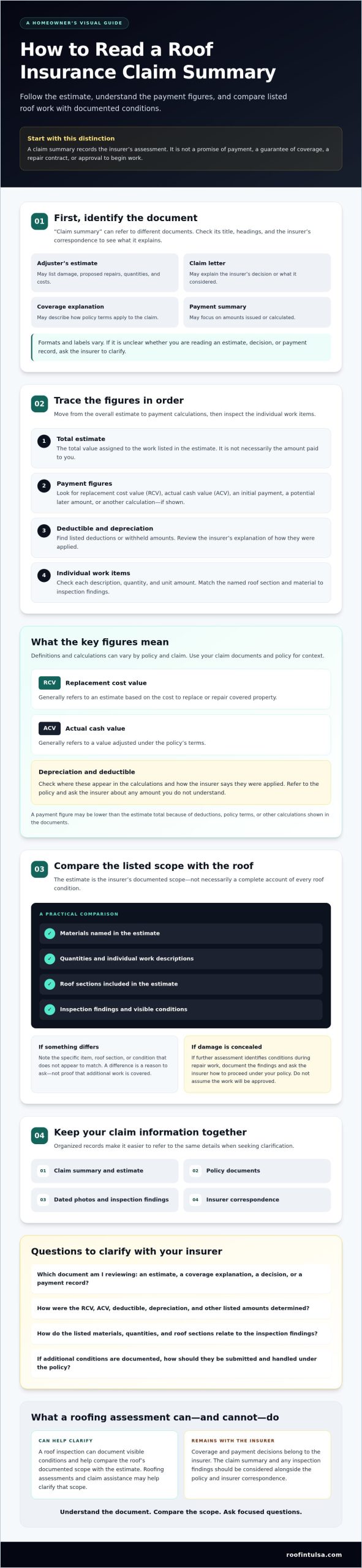
Insurance terms can feel like a lot to take in, but it helps to review the document one section at a time. A roof insurance claim summary is an insurer’s document outlining its assessment of reported damage, proposed work, and related payment calculations. Its format and terminology can vary by insurer, policy, and claim.
Think of it as a record of what the insurer has documented for the claim, not a complete account of every condition on the roof. It may list repairs or materials included in an estimate and show how the insurer arrived at a payment figure. It is not a repair contract, a guarantee of coverage, or confirmation that every roof issue has been identified. Your policy and the insurer’s correspondence provide important context. For a general explanation of how property coverage may be structured, see these property insurance basics.
Which documents might be called a claim summary?
The phrase may refer to different documents in a claim file. An adjuster’s estimate often lists damage, proposed repairs, quantities, and costs. A claim letter may explain the insurer’s decision or describe what it considered. A coverage explanation may discuss how policy terms apply, while a payment summary may focus on amounts issued or calculated.
These documents may arrive together or separately, and their labels aren’t standardized. Check the document title, headings, and insurer correspondence to identify what you’re reviewing. If it’s unclear whether a page is an estimate, decision, or payment record, ask the insurer to clarify. Identifying the document is a practical first step in learning how to read a roof insurance claim summary.
Why the summary may not answer every roofing question
An insurer’s estimate records the damage and work included in its assessment. It is not the same as a complete roofing inspection. For example, a summary might list work on one roof slope while an inspection documents visible conditions on other sections. That difference is a reason to compare the records and ask questions, not proof that additional work is covered.
Some conditions may not be visible until repair work begins. If further assessment identifies concealed damage, document the findings and ask the insurer how to proceed under your policy. Don’t assume the summary includes every condition or that newly identified work will be approved. For more background on insurance and roof protection, see Tulsa Roofing: The Complete Homeowner’s Guide to Protection, Repair, and Insurance. Understanding what each document says can help you raise focused questions without confusing an estimate with a coverage decision.
How to Read the Main Roof Claim Figures and Line Items
Once you’ve identified the document, trace the figures from the overall estimate to the individual work details. This makes it easier to connect the insurer’s documented scope with the amounts shown. For more context on what a detailed estimate may include, read United Policyholders’ guide to understanding the scope of loss.
- 1. Find the total estimate. This is the total value assigned to the work listed in the estimate. It is not necessarily the amount paid to you.
- 2. Locate the payment figures. Look for terms such as replacement cost value (RCV) and actual cash value (ACV), if they appear. Note whether the document shows an initial payment, a potential later amount, or another calculation.
- 3. Check the deductible and depreciation. Find any deductions or withheld amounts, then review the insurer’s explanation of how they were applied.
- 4. Review each work item. Check the description, quantity, and unit amount for each listed item. Compare the roof section and material named in the estimate with the area and work described in inspection findings.
What do replacement cost and actual cash value mean?
RCV generally refers to an estimate based on the cost to replace or repair covered property, while ACV refers to a value adjusted under the policy’s terms. The precise method and definitions can vary, so check your policy and ask the insurer how each figure was determined for your claim. A payment figure may be lower than the estimate total because of deductions, policy terms, or other calculations shown in the documents.
How do deductible and depreciation affect the figures?
A deductible is an amount the policy may require you to pay toward a covered loss. Find where it appears and ask how it applies to this claim. Depreciation is an adjustment that may reflect age or condition, depending on the policy and estimate. If the document lists “recoverable depreciation,” don’t assume it will automatically be paid later. Ask the insurer whether it applies, what documentation is needed, and whether any timing conditions apply.
The estimate total shows the calculated value of the listed work. The deductible and any depreciation may affect payment figures, but the policy and claim documents determine how. If the figures or roof items are difficult to interpret, an inspection can help document roof conditions for discussion with the insurer. Learn about roof inspection and claim assistance from Rescue Roofing Tulsa. A roofing professional can help clarify the physical scope, but coverage decisions remain with the insurer.
How to Compare the Claim Summary With Your Roof Damage
A claim summary and a roof inspection describe the roof from different perspectives. The summary lists what the insurer assessed and included in its estimate. Inspection notes and photos can help you compare that scope with visible conditions. As you learn how to read a roof insurance claim summary, focus on details you can check rather than treating a difference as a verdict.
Which roof estimate details should you check?
Review the roof sections or slopes named in the document, the materials and quantities listed, and the work proposed for each area. Compare those details with dated inspection photos and observations from a qualified roofing professional. For example, if the estimate names one slope, ask whether that matches the documented location of the observed damage. Don’t climb onto the roof to check it yourself. A professional inspection can assess roof conditions more safely.
For a broader look at evaluating roof condition, see Signs You Need a New Roof in Oklahoma: The Ultimate Homeowner Checklist. Use it as general context, not as a substitute for an inspection or a review of your claim documents.
| Document item | Roof area or component to compare | Question to ask |
|---|---|---|
| Roof slope or section | Named slope or roof plane | Does the estimate identify the area where the damage was observed? |
| Material and work description | Shingles, flashing, or another listed component | Does the description match the material and proposed work documented during inspection? |
| Quantity or measurement | Listed area or number of items | How was this quantity measured, and can it be compared with the inspection findings? |
| Related work | Associated roof components | Is this work included, or should I ask whether it was assessed? |
What if the roofer’s estimate and insurer summary differ?
A contractor’s estimate may describe different materials, quantities, or work than the insurer’s summary. That difference alone doesn’t prove the insurer’s decision is wrong or establish that additional work is covered. Treat it as a prompt to compare the line items and ask for clarification.
Mark the specific items that don’t match. Then ask the insurer how to submit relevant photos, inspection notes, or other supporting documents, and whether it needs anything else to review the difference. Keep your question focused: identify the roof area, the estimate item, and the inspection finding behind your concern.
A difference in scope is a reason to ask for clarification, not proof of a coverage outcome. A careful comparison can help you discuss the documented roof condition clearly while leaving coverage decisions to the insurer.
What to Do If a Roof Claim Summary Is Unclear or Incomplete
If a figure or repair item doesn’t make sense, pause and organize your documents before contacting the insurer. You don’t need to resolve every question at once. A clear record of the issue, supporting information, and the insurer’s response can make follow-up easier.
Use this checklist to get started:
- Save the claim documents. Keep the summary, policy documents, dated photos, inspection findings, and insurer correspondence together. Save updated estimates or explanations as well.
- Mark the unclear details. Note the page, line item, roof area, figure, or term that needs clarification. Write down what you expected to see and what the document shows.
- Prepare focused questions. Ask what information supports the listed scope or calculation, and how to submit relevant photos, inspection notes, or other documents for review.
- Ask about process and timing. Confirm how the insurer handles questions or additional documents and whether any deadlines apply to your claim. Check the policy and claim correspondence rather than assuming one timeline applies to every claim.
- Keep a contact record. Note the date of each conversation, the name or department you spoke with, the response, and any requested follow-up. Keep copies of documents you send.
These steps turn a general concern into specific questions. They’re also useful if you’re learning how to read a roof insurance claim summary and need to revisit a figure or scope item later.
How to prepare clear questions for your insurer
Be specific. Instead of asking why the estimate seems low, point to the page and item you’re asking about. For example: “Can you explain how the quantity for this roof section was determined?” or “How should I submit inspection photos that show this area?” Ask the insurer to explain its process and any applicable timing in writing when possible. Keep the response with your claim records.
When a roofing inspection may help clarify the scope
A roof inspection can document observable conditions, identify affected areas, and give you information to discuss with the insurer. It can clarify the physical condition of the roof, but it doesn’t determine coverage or guarantee that additional work will be approved. Those decisions depend on the insurer’s review and your policy. For general repair context, see A Homeowner’s Guide to Roof Repair: Fixing Leaks, Damage, and More.
If a professional assessment would help you understand the roof’s condition, ask Rescue Roofing Tulsa about a roof inspection. The team offers roofing insight and insurance claim assistance; the insurer remains responsible for coverage decisions.
How Rescue Roofing Tulsa Can Help You Understand the Roofing Scope
After reviewing the claim summary, a roofing assessment can help answer a different question: what conditions are visible on the roof, and what work might address them? For homeowners in Tulsa and surrounding areas, Rescue Roofing Tulsa offers roof inspections, repairs, replacements, and insurance claim assistance. These services can help you understand the roof’s condition and compare observed damage with the work described in your documents.
That distinction matters. A contractor can provide roofing perspective, but coverage questions need to be reviewed with the insurer in light of the claim summary and policy. Knowing how to read a roof insurance claim summary is useful; an assessment can add information about the physical scope without deciding what the policy covers.
What a roofing contractor can and cannot clarify
During an inspection, a roofing professional can discuss observable conditions, materials, and work noted on the roof. If a summary lists work on one section, for example, an inspection may help you understand what conditions are visible there and whether other areas should be documented for discussion. Those findings can help you prepare clearer questions for the insurer.
A roofing contractor can’t promise claim approval, dictate how policy language should be interpreted, or guarantee a payment amount. Direct questions about coverage, deductibles, claim status, and policy requirements to your insurer. Roofing expertise can explain the roof, but the insurer makes the claim decision.
Choosing a sensible next step in Tulsa
Before asking for a conversation, gather the claim summary, related insurer letters, policy documents, dated photos, and existing inspection notes. Mark the specific roof area or estimate item you want to discuss. Then consider what information you need:
- A roof condition assessment: If you need a clearer record of visible conditions to compare with the summary.
- A repair discussion: If you’re trying to understand possible work for a specific damaged area.
- A replacement evaluation: If the documented scope raises questions about whether repair or replacement may be appropriate. For broader background, see Roof Replacement Tulsa: The Ultimate Homeowner’s Guide.
Rescue Roofing Tulsa provides roofing services and insurance claim assistance, while the insurer remains responsible for coverage decisions. If you’re ready to discuss the roof’s condition or the work listed in your documents, contact Rescue Roofing Tulsa about your roof claim questions. Bring the documents and questions you’ve gathered so you can discuss the next step with a clearer picture.
Take the Next Step With a Clearer Claim Picture
Understanding how to read a roof insurance claim summary starts with separating the estimate, payment calculations, and listed roofing work. Check the figures and line items against documented roof conditions, then note questions rather than assuming a difference means coverage is owed. Keep claim documents and inspection records together so you can refer to specific details when contacting your insurer.
A roof inspection can add information about visible conditions and the work that may be needed. Rescue Roofing Tulsa serves Tulsa and surrounding areas with roof inspections, repairs, replacements, and insurance claim assistance. The team can help you understand roof conditions and scope, while your insurer makes coverage decisions.
Have questions about what’s listed or what your roof may need? Contact Rescue Roofing Tulsa to discuss your roof inspection and claim questions. Take it one step at a time. Clear records and focused questions can help you decide what to do next.
Frequently Asked Questions
What is a roof insurance claim summary?
A roof insurance claim summary is a document that may outline the insurer’s assessment of reported roof damage, work included in its estimate, and related payment calculations. Its name and layout can differ between insurers. Review it alongside your policy and claim correspondence to understand what it describes. The summary alone doesn’t guarantee that every roof condition or repair cost is covered.
What do RCV and ACV mean on a roof insurance claim?
RCV commonly means replacement cost value, and ACV commonly means actual cash value. The exact calculation and how either figure applies depend on your policy and claim documents. If the estimate total differs from the amount shown as payable, check the insurer’s explanation and ask how it calculated each figure. Don’t assume the same term or calculation applies under every policy.
Is depreciation on a roof insurance claim recoverable?
Sometimes a claim document identifies depreciation that may be recoverable, but whether it applies depends on your policy, claim decision, and insurer requirements. Don’t assume a withheld amount will automatically be paid later. Ask your insurer whether depreciation is recoverable in your case, what documentation it needs, and whether your policy or claim correspondence describes timing requirements or other conditions.
What should I do if the roof estimate does not match the damage?
Mark the specific roof areas or estimate line items that don’t appear to match the documented damage. Gather relevant photos, inspection notes, and insurer correspondence, then ask how to submit supporting information or request clarification. A roofing inspection may help document observable conditions. A difference between a contractor’s estimate and the insurer’s summary is a reason to ask questions, not proof that additional work is covered.
Can a roofing contractor explain my insurance claim summary?
A roofing contractor can discuss visible roof conditions, explain roofing terms, and compare observed work with estimate line items. For example, an inspection may help clarify which roof sections show observable damage. A contractor doesn’t decide coverage or replace the insurer’s explanation of policy terms. Ask your insurer coverage questions, and consider a roof inspection if you’re unsure what physical work the roof may need.
Does a roof insurance claim summary mean my roof replacement is approved?
Not necessarily. A summary may show an estimate or describe part of the insurer’s decision, but its meaning depends on the document and your policy. Read the full correspondence and ask the insurer whether replacement work is covered, what conditions apply, and whether it needs more information. Clarify these points before scheduling repairs or replacement, rather than treating an estimate as approval to proceed.
What documents should I keep when reviewing a roof claim?
Keep the claim summary, relevant policy documents, insurer letters or emails, dated photographs, inspection notes, and records of conversations. Organize questions by document page or estimate line so you can refer to them clearly when following up. Save copies of anything you send and note responses or requested next steps. Before sharing records, protect personal information and ask the insurer which documents it needs.