


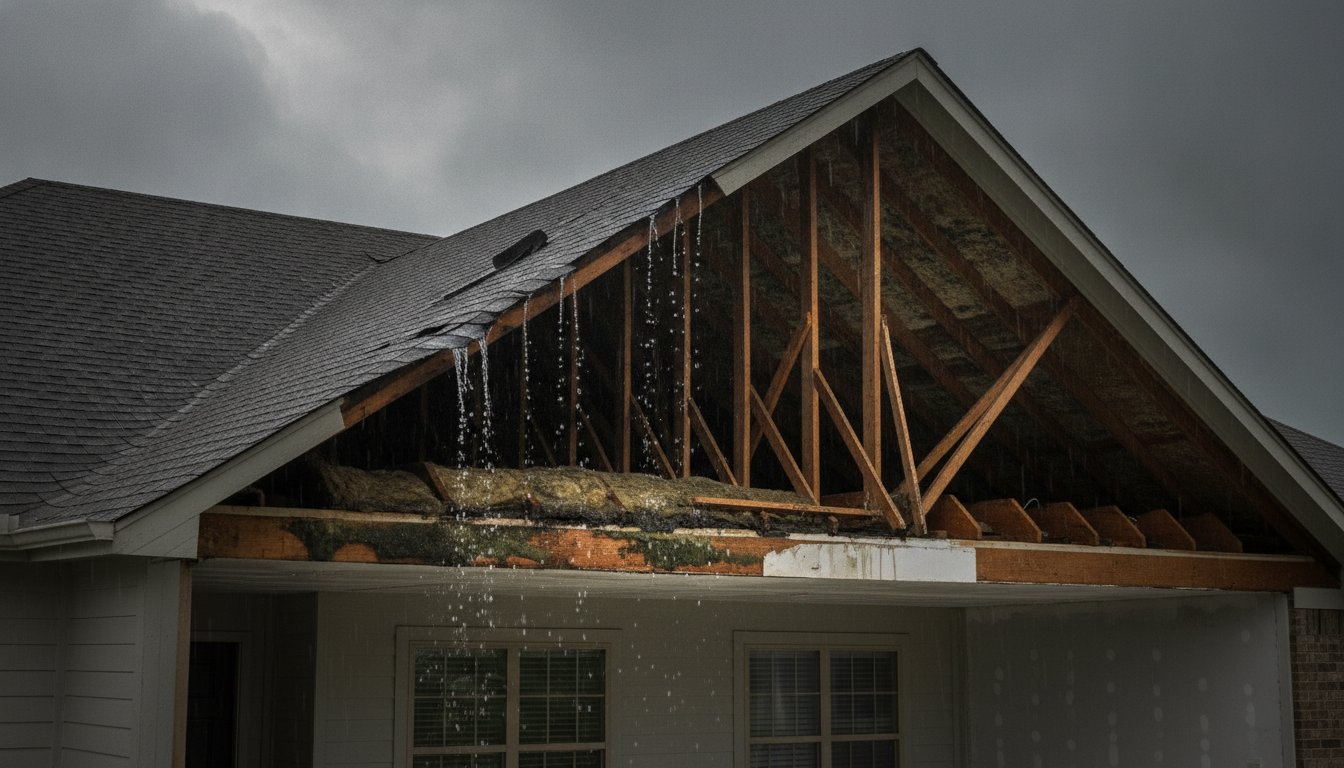

If you could see the water slowly weakening the rafters behind your ceiling right now, would you still wait another month to address those missing shingles? We understand that the thought of a full roof replacement feels overwhelming, especially when you’re already stressed by recent Tulsa storms. It’s natural to hope a small leak can wait, but understanding what happens if you don’t replace a damaged roof is the first step in protecting your biggest investment. You want to save money and avoid a headache; unfortunately, silence from your attic doesn’t always mean your home is safe.
In this article, we’ll reveal the escalating risks and financial consequences of delaying a replacement, helping you stop a minor leak before it becomes a major catastrophe. You’ll learn the specific timeline of roof failure and how procrastination can actually lead to your insurance company denying future claims due to neglect. We’ll also guide you through avoiding secondary repair bills for mold or structural rot. By the end, you’ll have a clear path toward finding a dependable local contractor who treats your home like their own. Protecting your family starts with a sturdy roof, and we’re here to help you navigate the process with confidence.
Key Takeaways
- Learn how water infiltration becomes a health hazard within just 48 hours as toxic mold begins to colonize damp drywall and insulation.
- Discover what happens if you don’t replace a damaged roof regarding your finances, specifically how procrastination leads to restoration bills that far exceed a standard replacement.
- Understand the “duty to mitigate” clause in your insurance policy and why delaying a storm damage report can result in a complete claim denial.
- See how constant moisture transforms your home’s structural decking from solid support into a soft, sponge-like material that compromises your family’s safety.
- Learn how a professional inspection from a local Tulsa expert can simplify the insurance process and stop damage before it spreads to your home’s interior.
The Silent Progression of Water Infiltration and Mold Growth
A leaking roof is rarely a static problem. It is a progressive failure that gains momentum with every Oklahoma rain cycle. Many homeowners assume that if they don’t see a brown spot on their living room ceiling, the damage is contained. Unfortunately, by the time water marks appear on your drywall, the internal components of your home have likely been saturated for weeks. Understanding what happens if you don’t replace a damaged roof begins with recognizing that water always follows the path of least resistance. It trickles down rafters, soaks into structural beams, and pools in areas where it can trigger the destructive processes of water damage that compromise your home’s safety.
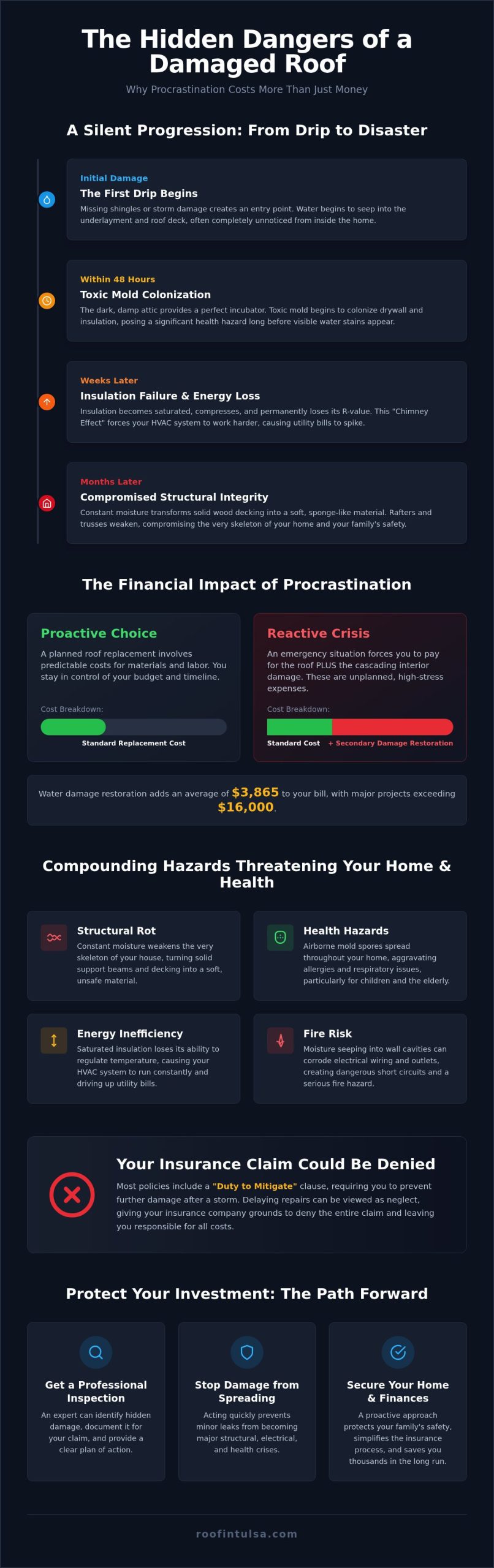
The most urgent threat is the 48 hour window. This is the remarkably short amount of time it takes for toxic mold to begin colonizing damp drywall and wood. Because our attics are often dark and poorly ventilated, they provide the perfect incubator for fungal growth. For families in Tulsa, this isn’t just a property issue; it’s a health concern. Mold spores can aggravate respiratory issues and allergies, making the air inside your home less safe for children and the elderly long before you ever see a physical leak.
Attic Insulation and Energy Efficiency Loss
Your roof and your attic insulation work together as a system to regulate your home’s temperature. When a roof fails, your insulation is often the first casualty. Most fiberglass or cellulose insulation relies on air pockets to maintain its R-value, which is its resistance to heat flow. Once these materials get wet, they compress and lose their insulating properties permanently. Even after the insulation dries, it rarely returns to its original effectiveness. This leads to the “Chimney Effect,” where expensive heated or cooled air escapes through the top of your home. Some industry professionals report that a compromised roof can cause your HVAC system to work significantly harder, leading to higher monthly utility bills and premature equipment failure.
The Rapid Spread of Black Mold in Oklahoma Climate
Tulsa’s high humidity levels act as a catalyst for rapid fungal growth. In our region, a small moisture entry point can quickly lead to a widespread mold infestation that requires professional remediation. Surface cleaning with bleach isn’t enough; mold often eats into the wood fibers of your trusses and decking, weakening the very skeleton of your house. The national average for water damage restoration is $3,865, with some major projects reaching $16,000. These costs are entirely separate from the price of the roof replacement itself. By acting early, you prevent these secondary restoration bills from piling up.
Financial Consequences: The High Cost of Procrastination
Procrastination is often viewed as a way to save money in the short term. However, when it comes to your home’s exterior, delaying action is actually a form of compounding debt. A planned roof replacement allows you to budget, compare materials, and choose the best timing for your family. In contrast, what happens if you don’t replace a damaged roof is that you eventually face an “emergency premium.” When a roof finally fails during a severe Tulsa storm, you’re no longer just paying for shingles; you’re paying for emergency tarping, accelerated labor rates, and the immediate stress of a housing crisis.
The financial gap between a standard replacement and a full-scale restoration is significant. A standard project focuses on the roof itself. A restoration project, however, must address the roof plus the interior havoc water has caused. National averages for water damage restoration sit at approximately $3,865, with complex cases reaching $16,000. These are costs you can entirely avoid by addressing the primary issue before it breaches your home’s interior envelope.
Secondary Damage Repair Costs
Water doesn’t stop at the attic floor. It travels behind walls and under floorboards, leading to expensive repairs that go far beyond roofing. Saturated drywall must be cut out and replaced to prevent the health risks of mold exposure, which can lead to even more costly professional remediation. If you have hardwood floors, even a slow, unnoticed drip can cause warping and cupping that requires total floor replacement. Perhaps most dangerous is the impact on your electrical system. Moisture in wall cavities can corrode wiring and lead to short circuits, creating a fire hazard that puts your entire investment at risk.
Home Value and Marketability in Tulsa
In the Tulsa real estate market, a roof’s condition is often the “make or break” factor for a sale. Most buyer’s agents will request a professional inspection at the first sign of shingle wear. If the roof is failing, many lenders will refuse to underwrite a mortgage, effectively killing the deal before it starts. You’ll likely be forced to drop your asking price by much more than the cost of a new roof just to attract a cash buyer. Conversely, a new roof offers a strong return on investment. It provides the “curb appeal” and peace of mind that allows you to command a top-market price. If you’re concerned about the current state of your shingles, scheduling a professional roof inspection is the best way to protect your home’s equity.
Compromised Structural Integrity and Safety Hazards
Your roof is more than just a waterproof lid; it’s a critical structural system. The decking, or sheathing, acts as the skeleton that supports the weight of the entire roofing system. When you ignore damage, you aren’t just letting in water. You’re allowing a destructive force to slowly dissolve the mechanical strength of your home. A roof is designed to shed water quickly, but once that barrier is breached, the materials underneath are not built to stay wet. Understanding what happens if you don’t replace a damaged roof is vital because the damage eventually moves from the shingles to the very bones of your house.
Constant moisture turns solid plywood or OSB into a soft, sponge-like material. This isn’t just a metaphor. The wood fibers actually expand, delaminate, and lose their ability to hold nails or support weight. A “heavy” wet roof, weighed down by saturated insulation and waterlogged wood, becomes a ticking time bomb. In extreme cases, the added weight of a heavy Tulsa rain can cause a weakened ceiling to collapse entirely, putting everyone inside at immediate risk.
Roof Decking and Rafter Rot
Professional roofers often identify “soft spots” simply by walking on a failing roof. These are areas where the wood has rotted so thoroughly it can no longer support a person’s weight. If the rot spreads from the decking to the rafters or trusses, the repair costs skyrocket. Replacing a few sheets of plywood is a standard part of many replacements. However, replacing the main load-bearing rafters requires complex structural work. This rot can eventually migrate down to the load-bearing walls, causing your home’s frame to shift, windows to stick, and walls to crack. It’s much simpler to replace a roof than it is to rebuild the frame of your home.
Fire Hazards from Electrical Short Circuits
It sounds counterintuitive that water causes fires, but it’s a common reality in attic spaces. Water often follows electrical conduit lines directly into junction boxes or recessed light fixtures. These fires are particularly dangerous because they start in the attic, far away from smoke detectors and bedrooms. They can burn through the roof structure for a long time before anyone inside notices the smell of smoke. When water infiltrates attic junction boxes, the combination of moisture and live wiring creates a high-probability environment for a fatal electrical fire. This is one reason why we treat emergency repairs with such urgency; we aren’t just stopping a leak, we’re preventing a potential fire.
Insurance Claim Denials and Liability Issues
Your homeowners insurance policy is a legal contract that includes specific responsibilities for you as a property owner. One of the most critical elements of this agreement is the “Duty to Mitigate” clause. This clause requires you to take reasonable, timely steps to prevent further damage once a problem is discovered. If you’re aware of missing shingles after a Tulsa hailstorm but wait several months to call a professional, the insurance company may argue that the resulting interior damage was preventable. Understanding what happens if you don’t replace a damaged roof is essential because your inaction can give the insurer a legal basis to deny your claim entirely.
Insurance adjusters are highly trained to distinguish between “sudden and accidental” damage, like a limb falling during a storm, and “long-term neglect.” If an inspection reveals that water has been seeping through a compromised valley for over six months, they’ll likely classify the resulting rot as a maintenance issue. Since standard insurance policies don’t cover general wear and tear or lack of maintenance, you could be left footing the entire bill for both the roof and the structural repairs. In 2026, we’ve seen insurance companies become even more rigorous in their scrutiny of roof age and condition during the renewal process.
The Danger of the ‘Neglect’ Clause
Insurance providers often review maintenance records and previous claim history when evaluating a new request. If you’ve been advised to replace your roof in the past and chose to wait, that procrastination becomes a documented liability. While storm damage is a covered peril, the damage caused by ignoring that storm is often excluded under the neglect clause. To better understand how to navigate these complexities and stay protected, we recommend reading Tulsa Roofing: The Complete Homeowner’s Guide for detailed insights on protection and insurance.
Liability and Homeowner Safety
Beyond the financial risk of a denied claim, a failing roof creates significant personal liability concerns. If a loose shingle or a piece of rotted fascia falls and injures a visitor, neighbor, or pedestrian, you may be held legally responsible for the medical costs. In some cases, insurance providers might even cancel your policy if they determine the roof’s condition makes the property an unacceptable risk. A professional, documented inspection serves as your best legal defense, proving that you’ve been proactive in maintaining a safe environment. If you’re worried about recent storm damage, our team can provide expert insurance claim assistance to ensure your home remains protected and your policy stays in good standing.
Taking Action: How to Stop the Damage Today
Understanding what happens if you don’t replace a damaged roof is the first step toward protecting your home. The second step is ending the cycle of procrastination. While the risks of structural rot and insurance denial are real, they are also entirely preventable. You don’t have to navigate this process alone. Taking action today doesn’t necessarily mean an immediate, massive bill. It starts with professional mitigation. If your roof has active leaks, we can provide temporary tarping to stop the water intrusion immediately. This buys you the time needed to plan a permanent solution without worrying about the next afternoon thunderstorm.
In 2026, many homeowners are concerned about the rising costs of construction materials. We address this by offering flexible financing options that make a necessary replacement affordable for Tulsa families. We also specialize in removing the administrative burden of the project. Our team handles the heavy lifting of insurance claim assistance, ensuring that you receive the full coverage you’re entitled to under your policy. By documenting the damage thoroughly and meeting with adjusters on your behalf, we bridge the gap between a stressful property issue and a restored, safe home.
The Rescue Roofing Tulsa Process
Our approach is designed to be simple and transparent. It begins with a comprehensive, no-obligation roof inspection where we assess the shingles, decking, and attic ventilation. Once the damage is identified, we move to the documentation phase. We provide your insurance provider with the detailed evidence they need to process your claim according to current Oklahoma regulations. Finally, our professional crews handle the installation. We use high-quality, wind-resistant materials that are specifically chosen to withstand the unique weather patterns of the Green Country region.
Why Local Expertise Matters in Oklahoma
Tulsa has specific building codes and permit requirements that national contractors often overlook. Because we live and work in this community, we understand the importance of adhering to these standards to protect your home’s resale value. We also know that Oklahoma wind is a different beast entirely. We select materials and installation techniques designed for high-wind resistance, ensuring your new roof stays put when the sirens go off. Don’t wait for the next storm to test your home’s integrity. Schedule your free inspection with Rescue Roofing Tulsa today and gain the peace of mind that comes with a secure home.
Secure Your Home and Your Peace of Mind
A damaged roof is a challenge that doesn’t resolve itself; it only grows more complex and expensive over time. From the rapid colonization of mold to the risk of structural failure, the consequences of waiting can jeopardize both your finances and your family’s safety. Now that you understand what happens if you don’t replace a damaged roof, you can take the necessary steps to stop the cycle of decay. Addressing minor leaks now prevents the heavy burden of insurance denials and massive restoration bills later.
As your neighbors in Tulsa, we’re here to guide you through every step of the process. We specialize in insurance claim assistance to ensure you receive the support you deserve. Whether you need 24/7 emergency repair services after a storm or a thorough assessment of your home’s skeleton, our local expertise is at your disposal. Don’t let a small problem become a catastrophe. Protect your home and family; contact Rescue Roofing Tulsa for a free inspection today. We’re committed to keeping our community safe, one sturdy roof at a time.
Frequently Asked Questions
How long can you leave a damaged roof before it leaks?
A damaged roof can begin leaking during the very next rain cycle, even if the damage seems minor. Missing or cracked shingles leave the underlying components vulnerable to wind-driven rain immediately. Once the protective underlayment is exposed to UV rays and moisture, it degrades rapidly. We recommend a professional inspection immediately after a storm to identify silent damage before the first drop ever enters your living space or attic.
Will my insurance cover a roof that I didn’t repair right away?
Insurance coverage for delayed repairs is often limited or denied entirely due to neglect clauses. Most policies include a duty to mitigate, which requires you to act quickly once damage is discovered. If you knew about a leak but didn’t act, the insurer may refuse to pay for interior damage. Our team specializes in insurance claim assistance to help you document the timeline and prove the damage was caused by a sudden storm.
Can a damaged roof cause a house fire?
Yes, water intrusion from a failing roof is a serious fire hazard. When leaks follow internal rafters or conduit lines, moisture can enter junction boxes and recessed lighting fixtures. This leads to electrical shorts that can spark attic fires. These fires are particularly dangerous because they often go unnoticed until they’ve spread through the roof structure. This is a primary reason why we offer 24/7 emergency repair services.
Does a small leak always mean I need a full roof replacement?
Not necessarily. A single, isolated leak might be solved with a targeted roof repair if the rest of the system is in good condition. However, multiple leaks or widespread shingle degradation often indicate that the roof has reached the end of its functional life. We provide honest assessments to determine if a repair is a safe, long-term solution or just a temporary bandage on a much larger structural problem.
How much does secondary water damage add to the cost of a new roof?
Secondary water damage can often double the total cost of your home restoration project. While a standard replacement focuses on the exterior shingles, water damage requires interior work like replacing saturated insulation and cutting out moldy drywall. In some cases, these interior repairs can cost nearly as much as the roof itself. Early intervention is the most financially responsible choice for homeowners who want to avoid massive secondary repair bills.
What are the first signs that roof damage is becoming structural?
Look for soft spots or a bouncy feeling when walking on the roof surface. Inside your home, signs include doors that suddenly stick in their frames or new cracks in the drywall near the ceiling. These indicate that moisture has compromised the load-bearing rafters or the roof decking. Understanding what happens if you don’t replace a damaged roof is crucial here; structural rot can eventually migrate from your attic down to your home’s load-bearing walls.
Can I sell my Tulsa home with a damaged roof?
Selling a Tulsa home with a damaged roof is extremely difficult because most lenders will refuse to underwrite the mortgage. Buyers’ agents will typically flag shingle wear or water stains during the initial walkthrough, leading to failed inspections. This often forces sellers to accept low cash offers or drop their asking price significantly. A new roof provides a high return on investment by protecting your home’s equity and ensuring the sale proceeds without delays.
How does Oklahoma’s humidity affect a leaking roof?
Tulsa’s high humidity levels act as a catalyst for mold and wood rot. In drier climates, moisture might evaporate before causing major issues. In Oklahoma, damp attic spaces stay wet, allowing fungal spores to colonize surfaces within 24 to 48 hours. This accelerated decay is one reason why knowing what happens if you don’t replace a damaged roof in our region is so important. It’s about maintaining a healthy indoor environment for your family.