

Table of Contents
- How Aerial Roof Quotes Work
- Aerial Roof Measurement Accuracy: What the Data Shows
- Roofing Estimate Discrepancies: Why Quotes Don’t Always Match Reality
- Aerial vs. Manual Roof Measurement: Which Method Wins
- Best Aerial Roof Measurement Companies and What They Deliver
- Critical Factors That Affect Measurement Precision
- Post-Measurement Verification: Protecting Your Insurance Claim and Budget
- Conclusion
Last Updated: August 13, 2026
How Aerial Roof Quotes Work
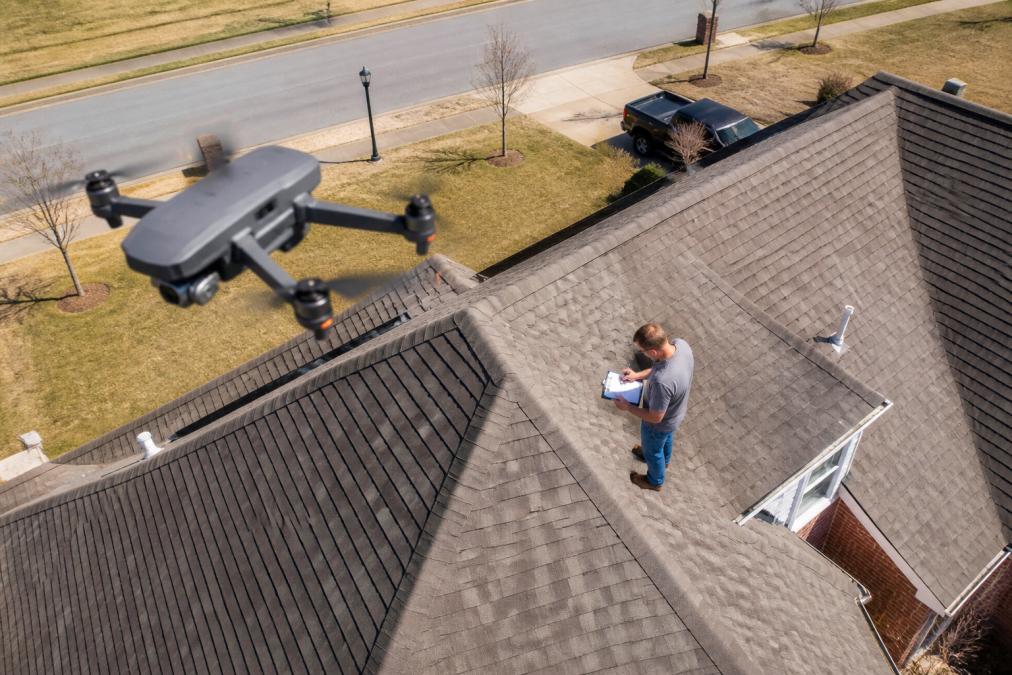
Aerial roof quotes rely on high-resolution satellite imagery and drone photography to generate estimates without requiring a contractor to physically climb onto your roof. The process combines photogrammetry, a technique that calculates precise measurements from overlapping images, with AI-powered software that interprets roof geometry, identifies materials, and estimates labor requirements. At Rescue Roofing, we’ve integrated aerial measurement technology into our quote process to provide fast, initial estimates while maintaining the accuracy verification step that protects homeowners and contractors alike.
The workflow typically starts with accessing high-resolution property imagery through satellite databases or by deploying a drone over the property. Specialized software analyzes the images to identify roof planes, calculate pitch angles, measure linear dimensions along eaves and ridges, and estimate square footage. The system uses ground sampling distance, the physical area represented by each pixel, to ensure geometric accuracy. AI algorithms then cross-reference this data against material databases, local building codes, and labor cost databases to generate a preliminary bid.
What makes this approach attractive is speed. Traditional manual measurement requires a site inspection, which can take days to schedule. Aerial quotes can be generated within hours. For homeowners seeking quick estimates after storm damage or for contractors managing high-volume inquiries, this efficiency is genuinely valuable. However, the speed comes with trade-offs that matter significantly when your roof is involved.
The accuracy of aerial measurements depends heavily on image resolution, cloud cover, roof complexity, and the quality of the underlying software. A simple, square roof with standard asphalt shingles is far easier to measure accurately from above than a complex structure with multiple valleys, dormers, and architectural features. The software must distinguish between actual roof edges and shadows, identify material transitions, and account for eave overhangs, all from a two-dimensional image.
Aerial Roof Measurement Accuracy: What the Data Shows
The central question homeowners and contractors ask is straightforward: how accurate are these aerial roof quotes truly? The honest answer is that accuracy varies significantly based on roof complexity and the quality of the measurement system being used. Many contractors report that aerial estimates fall within 5-15% of final measurements after a site inspection, though some systems perform better and others worse depending on their technology maturity.
Industry practitioners generally find that aerial quotes work best for straightforward residential roofs with minimal complexity. A simple gable roof with one or two planes, clear edges, and standard materials tends to produce estimates that align closely with manual measurements. The problems emerge when roofs feature multiple valleys, dormers, skylights, steep pitches, or unusual architectural features. Each additional complexity variable introduces potential measurement error.
One critical limitation is that aerial imagery cannot detect hidden damage, deterioration, or structural issues beneath the visible surface. A roof might appear intact from above but have significant water damage, rotted decking, or failing underlayment that only becomes apparent during a physical inspection. This gap between what aerial quotes can assess and what actually affects project scope and cost is where most discrepancies occur.
The ground sampling distance of satellite imagery also matters considerably. Standard satellite imagery typically provides 30-50 centimeter resolution, meaning each pixel represents a 30-50 cm area on the ground. For a roof, this resolution can obscure fine details that affect accuracy. Higher-resolution imagery or drone-based photography can achieve centimeter-level precision, but not all aerial quote services use this grade of imaging.
Roofing Estimate Discrepancies: Why Quotes Don’t Always Match Reality
The gap between aerial quotes and final project costs frustrates both homeowners and contractors. Understanding why these discrepancies occur is essential for setting realistic expectations and protecting your insurance claim.
Aerial quotes cannot account for roof complexity variables that only become apparent during a physical inspection. Hidden damage, water stains in the attic, soft spots in decking, compromised flashing, changes project scope dramatically. What looked like a straightforward roof replacement from above might require structural repairs, additional underlayment, or ventilation improvements once the contractor is on-site. These discoveries don’t represent contractor dishonesty; they represent the genuine limitations of remote estimation.
Material estimation errors also create discrepancies. Aerial software calculates roof area based on visible plane dimensions, but it cannot precisely measure eave overhangs, calculate waste factors for complex cutting lists, or account for architectural details that require additional materials. A roof with multiple valleys and dormers generates significantly more waste than a simple rectangular roof of similar total area. The cutting list complexity directly affects material costs.
Labor estimation is another source of variance. Aerial quotes apply standard labor rates based on roof area and pitch, but they cannot factor in site-specific challenges: difficult roof access, narrow neighboring properties that complicate equipment placement, or weather-related complications. A roof that’s straightforward to measure from above might be genuinely difficult to work on due to its location or surrounding structures.
Insurance claim validity depends partly on quote accuracy. If your aerial quote significantly underestimates damage or project scope, your insurance settlement might not cover the actual work required. Conversely, if an aerial quote inflates the estimate, your claim might face scrutiny from the insurance adjuster. The discrepancy between initial aerial assessment and final site inspection findings can create friction in the claims process if not managed carefully.
Aerial vs. Manual Roof Measurement: Which Method Wins
This comparison isn’t about choosing one method as universally superior. Instead, it’s about understanding when each approach delivers genuine value and where each falls short.
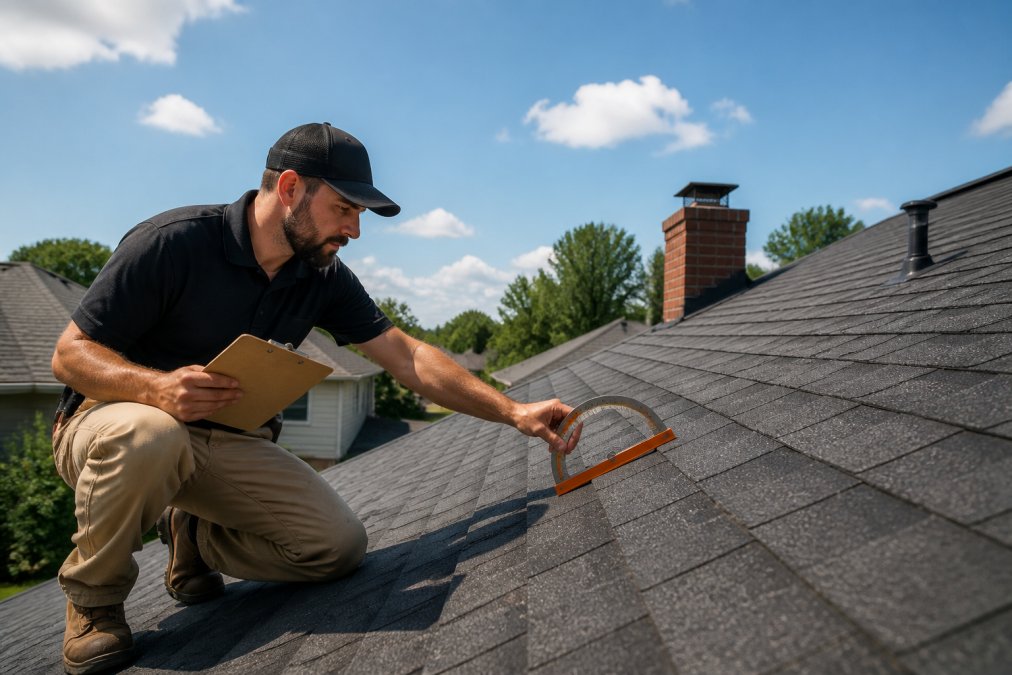
Manual measurement, a contractor physically inspecting the roof with measuring tapes, levels, and direct observation, provides irreplaceable information. A contractor on the roof can identify material condition, detect hidden damage, assess structural integrity, and account for site-specific challenges that no aerial image can reveal. Manual measurement also captures details like flashing condition, ventilation adequacy, and underlying decking quality. The result is a quote grounded in actual physical reality rather than algorithmic interpretation.
The drawback of manual measurement is time. Scheduling requires coordination, and the inspection itself takes hours. For homeowners needing a quick estimate or contractors managing high-volume inquiries, this delay is a genuine constraint.
Aerial measurement excels at speed and initial filtering. For straightforward roofs, aerial quotes provide reasonably accurate estimates within hours. For contractors, aerial quotes allow rapid triage: identifying which inquiries warrant a site visit and which can be handled remotely. For homeowners, an aerial quote provides a baseline expectation before committing to a full inspection.
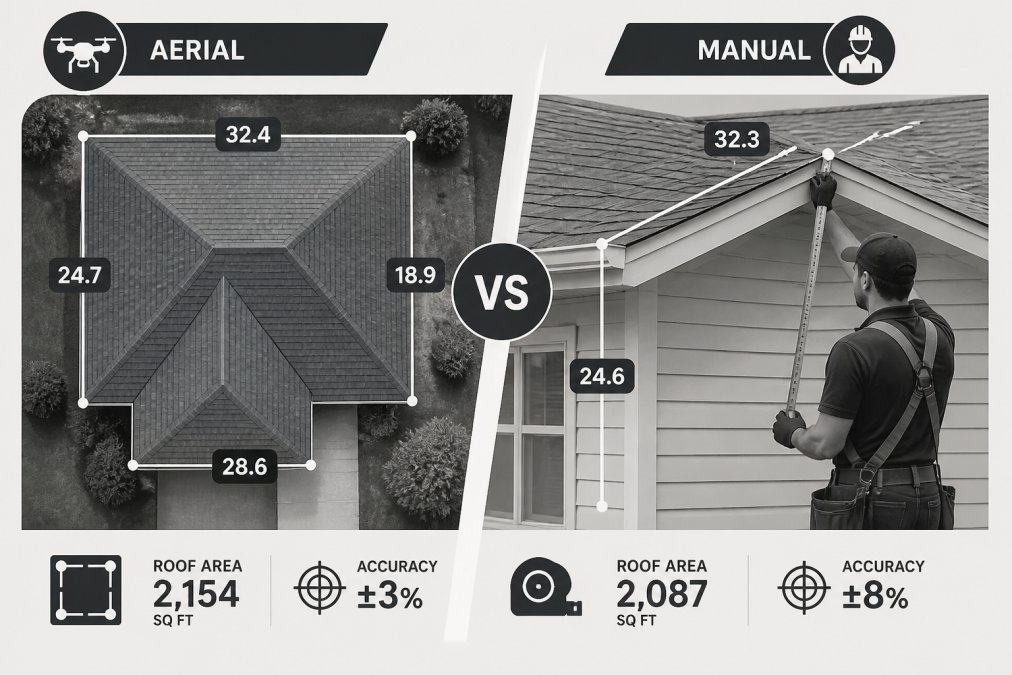
The most effective approach combines both methods. An initial aerial quote establishes a baseline estimate and confirms general project feasibility. A follow-up manual inspection, whether comprehensive or focused on specific areas, captures the details that affect final accuracy. This two-step process leverages the speed of aerial assessment while maintaining the accuracy and completeness of manual measurement.
For insurance claims specifically, this hybrid approach provides protection. The aerial quote establishes the initial damage assessment, while the manual inspection documents the actual scope, protecting both the homeowner’s claim and the contractor’s liability.
Request an aerial quote first to establish timeline expectations and general scope. Then schedule a manual inspection before finalizing your budget or insurance claim. The combination gives you both speed and accuracy.
Best Aerial Roof Measurement Companies and What They Deliver
Several companies have built platforms around aerial roof measurement, each with different technology approaches and accuracy profiles. Understanding what differentiates them helps you evaluate whether their methodology matches your needs.
Roofing software providers like Dronedeploy, Hover, and Measure have invested in AI-powered roof analysis. These platforms typically integrate with drone imagery or satellite data, apply machine learning models trained on thousands of roof inspections, and generate automated measurements. Their accuracy varies based on roof complexity and image quality. Hover, for example, claims accuracy within 5-10% for most residential roofs, but their own documentation acknowledges that complex roofs and obstructed imagery reduce precision.
Insurance companies and large roofing contractors have developed proprietary aerial measurement systems. These tend to be more conservative in their accuracy claims and often incorporate manual verification steps before finalizing estimates. The trade-off is that they’re typically not available to individual homeowners, they’re used internally by the companies that own them.
At Rescue Roofing, we use aerial assessment as a preliminary step in our quote process, but we always follow with a detailed site inspection before finalizing estimates. This approach gives homeowners the speed of initial assessment without sacrificing the accuracy that protects their claim and budget.
When evaluating any aerial roof measurement company, ask specific questions: What image resolution do they use? How do they handle complex roof geometries? Do they perform manual verification? What’s their documented accuracy rate for roofs similar to yours? Companies that are transparent about limitations and verification processes tend to deliver more reliable results than those that claim universal accuracy.
Critical Factors That Affect Measurement Precision
Several variables determine whether aerial roof quotes will be reasonably accurate or significantly off.
Roof complexity is the primary driver. Simple gable or hip roofs with minimal dormers and valleys are measured accurately by aerial systems. Each additional architectural feature, skylights, complex valleys, roof penetrations, unusual pitch variations, introduces measurement difficulty. A roof with seven different planes and four dormers is inherently harder to measure from above than a simple rectangular roof.
Image resolution and quality directly affect precision. Satellite imagery at 30-50 centimeter ground sampling distance cannot capture fine details that drone photography at 2-5 centimeter resolution can. Cloud cover, shadows, and time of day affect image quality. Imagery taken during overcast conditions or at low sun angles introduces shadow distortion that reduces accuracy.
Roof pitch affects measurement accuracy significantly. Steeper roofs present more surface area to the camera angle, making measurements more difficult. Shallow-pitch roofs are easier to measure accurately from directly above. The software must account for perspective distortion as pitch increases.
Material visibility matters for material estimation. Roofs with clear, uniform materials are easier for AI to classify. Roofs with mixed materials, patched sections, or deteriorated areas create classification challenges. The software must distinguish between actual material types and visual artifacts caused by weathering or damage.
Data reliability depends on how current the imagery is. Satellite imagery can be weeks or months old, meaning it might not reflect recent damage or changes. Drone-based imagery is current but requires scheduling. For storm-damaged roofs, current imagery is essential for accurate damage assessment.
Aerial quotes generated from satellite imagery that’s several months old may not reflect recent storm damage or deterioration. Request current imagery or drone-based assessment if your roof has recent damage.
Post-Measurement Verification: Protecting Your Insurance Claim and Budget
This is where many homeowners and contractors make critical mistakes. An aerial quote should never be your final estimate, it should be your starting point for verification.
After receiving an aerial quote, schedule a comprehensive manual inspection before committing to any project or submitting insurance claims. During this inspection, the contractor should physically examine the roof, document material condition, identify hidden damage, and provide a detailed scope of work. This verification step serves multiple purposes: it confirms the aerial estimate’s accuracy, identifies issues the aerial assessment missed, and creates documentation that protects your insurance claim.
For insurance claims specifically, documentation matters enormously. If your initial aerial assessment significantly underestimates damage, your claim might be denied or underfunded. If the aerial assessment inflates the estimate, the insurance adjuster might reduce the settlement. A detailed manual inspection creates the documentation trail that supports claim validity.
When working with contractors, ask whether they include a site inspection as part of their quote process. Contractors who automatically follow aerial quotes with manual verification demonstrate commitment to accuracy. Those who provide final quotes based solely on aerial data are taking shortcuts that could cost you money.
Request that your contractor document the post-measurement verification process: photographs of the roof condition, written notes on material quality, identification of any hidden damage discovered, and explanation of how the final quote differs from the initial aerial estimate. This documentation protects both your insurance claim and your budget expectations.
An aerial quote is preliminary. Always require a manual site inspection and detailed documentation before finalizing your budget or submitting insurance claims. The verification step is where accuracy is actually confirmed.
Conclusion
Are aerial roof quotes truly accurate? The answer depends on what you’re using them for. For quick preliminary estimates on straightforward roofs, aerial quotes deliver reasonable accuracy within hours. For final project budgets, insurance claims, or complex roofs, they’re insufficient without manual verification.
The most reliable approach combines aerial assessment with detailed site inspection. This hybrid method gives you both speed and accuracy while protecting your claim and budget. When you work with Rescue Roofing, we use aerial quotes to establish initial timelines and scope, then follow with comprehensive inspections, detailed documentation, and transparent communication about any discrepancies. This process ensures your final quote reflects actual project requirements and supports your insurance claim with accurate, verified information. CALL Rescue Roofing today to schedule your aerial assessment and verification inspection, and get the accurate quote that protects your property and your investment.
Frequently Asked Questions
How accurate is aerial imagery for roof measurements?
Aerial roof measurement accuracy typically ranges from 95-98% for square footage calculations when using high-resolution satellite imagery and AI-powered tools. However, accuracy depends heavily on image resolution, roof complexity, and the presence of obstructions like trees or shadows. Ground sampling distance affects precision, higher-resolution imagery (under 1 foot per pixel) produces more reliable linear dimensions. For insurance claims and material estimation, this level of accuracy is often sufficient, but contractors frequently conduct on-site verification to catch hidden damage or unusual roof geometry that aerial data cannot detect.
What causes roofing estimate discrepancies between aerial quotes and final invoices?
Estimate discrepancies arise from several sources: hidden structural damage discovered during installation, roof complexity variables (dormers, chimneys, skylights) that aerial imagery underestimates, and material waste calculations that differ from initial cutting lists. Satellite imagery struggles with steep roof slopes and cannot identify soft spots, rot, or water damage beneath the surface. Weather conditions at the time of imaging, seasonal vegetation overhang, and shadows cast by adjacent structures also reduce measurement precision. Post-measurement verification through a physical site inspection catches these variables before work begins, protecting both your budget and insurance claim validity.
Should I trust an aerial roof quote for my insurance claim?
Insurance companies increasingly accept aerial roof measurements for initial claim assessment and material estimation, especially when generated by certified measurement software. However, insurers typically require a physical site inspection by their adjuster before final approval. Aerial quotes provide a solid starting point for your claim documentation and help establish bid precision early, but they do not eliminate the need for on-site verification. If your claim involves storm damage assessment or structural concerns, insurers will expect photographic evidence and detailed measurements from ground level. Using aerial data alongside professional inspection findings strengthens your claim validity.
What is the best way to verify an aerial roof quote before committing to a contractor?
Request a physical site inspection after receiving an aerial estimate. A qualified roofing contractor should measure eave and ridge dimensions, assess roof planes and pitch calculations, and identify any visible damage or complexity variables that aerial imagery missed. Compare the contractor's on-site findings against the aerial data, significant discrepancies (over 5-10% in square footage) warrant investigation. Ask the contractor to explain their measurement methodology and whether they adjusted the aerial estimate based on ground-level observations. This verification step protects your budget, ensures accurate material estimation, and provides documentation that supports insurance claims and warranty coverage.
This article was written using GrandRanker