



The storm has passed, but the worst part might still be ahead of you. A knock at the door from an out-of-state roofer, a confusing call from your insurance adjuster, and a nagging worry about whether that water stain on your ceiling means something serious. If you’re searching for storm damage roof repair in Tulsa, you already know the feeling: the pressure to act fast, the fear of making the wrong call, and the very real possibility of a denied claim.
You’re right to be cautious. That instinct to slow down and get informed before signing anything is exactly what protects you. Oklahoma storms are unpredictable and unforgiving, and the damage they leave behind isn’t always visible from the ground. Hidden leaks, compromised decking, and lifted flashing can quietly turn a minor repair into a full replacement if they go unaddressed.
This guide is here to help you take back control. You’ll learn how to spot damage that’s easy to miss, how Tulsa’s insurance claim process actually works, and why partnering with a local roofing company that knows your neighborhood makes all the difference. By the end, you’ll have a clear, confident path forward.
Key Takeaways
- Storm damage isn’t always visible from the ground — knowing what to look for, like granule loss in gutters and bruised shingles, can prevent a small problem from becoming a costly full replacement.
- Your first call after a Tulsa storm should be to a local roofer, not your insurance company — the right contractor can document damage and advocate for you during the adjuster’s inspection.
- Navigating storm damage roof repair in Tulsa means understanding Oklahoma’s specific building codes, including rules that can require a full replacement rather than a patch depending on how much of your roof is affected.
- The 24 hours after a severe storm are critical — the steps you take (and the photos you capture) in that window can make or break your insurance claim.
- A local Tulsa roofing partner like Rescue Roofing doesn’t just fix your roof — they handle the administrative burden of insurance coordination so you can focus on getting your home back to normal.
How to Identify Storm Damage on Your Tulsa Roof
Oklahoma sits squarely in the heart of Tornado Alley, and Tulsa homeowners know better than most that storms here don’t follow a polite schedule. What many don’t realize is that the damage left behind is rarely as straightforward as a missing shingle or a visible hole. The most costly problems are the ones you can’t see from your driveway.
Signs of Hail vs. High Wind Damage
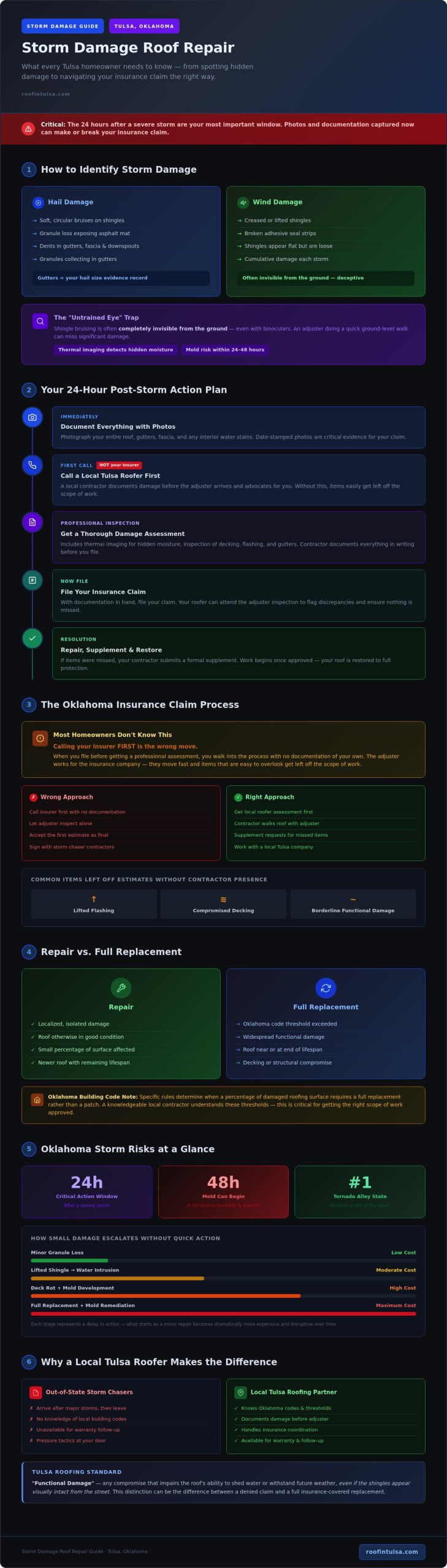
Hail and wind leave very different fingerprints on your roof, and telling them apart matters when it comes to your insurance claim. Hail strikes asphalt shingles with a direct, concentrated impact, creating a soft, circular bruise that breaks down the granule surface. Run your hand across an impacted shingle and you’ll feel a slight depression, almost like pressing a thumb into a ripe peach. That bruising exposes the underlying asphalt mat to UV rays and moisture, and the deterioration starts immediately.
High wind damage looks completely different. Rather than circular impact points, wind creates creased or lifted shingles where the adhesive seal strip has broken. From the ground, those shingles can appear perfectly flat and intact. They’re not. A broken seal allows wind-driven rain to push underneath the shingle on every subsequent storm, making the damage cumulative and invisible until a leak appears inside your home.
Don’t overlook your gutters, fascia, and downspout caps either. These soft metals dent easily and serve as a reliable record of hail size and intensity, evidence that supports your claim even when the shingles themselves are harder to read.
The “Untrained Eye” Trap: Why Ground Inspections Fail
This is where most homeowners make a costly mistake. Shingle bruising is often completely invisible from the ground, even with binoculars. The color and texture of asphalt shingles can mask impact damage until it’s photographed up close or pressed by hand. An adjuster completing a quick visual walk from the ground level may miss a significant portion of the actual damage, which is one reason why having a knowledgeable local contractor on-site during that inspection matters so much.
Experienced roofing professionals also use thermal imaging to detect moisture that has already migrated beneath the surface. Water trapped under shingles or within the decking won’t show up as a stain on your ceiling for weeks, but infrared scanning can identify it early, before it compounds.
In Tulsa roofing standards, functional damage refers to any compromise that impairs the roof’s ability to shed water or withstand future weather, even if the shingles appear visually intact from the street.
That distinction matters enormously for anyone pursuing storm damage roof repair in Tulsa. Oklahoma’s humidity doesn’t wait. A small, undetected moisture intrusion can develop mold growth within 24 to 48 hours in warm conditions, turning a manageable repair into a far more serious remediation project. Acting quickly, and getting the right eyes on your roof, is the single most effective thing you can do after a storm passes.
Navigating the Oklahoma Insurance Claim Process
Here’s something most storm-damaged homeowners don’t know: the order in which you make your calls matters enormously. Most people instinctively reach for their insurance company’s number first. That’s understandable, but it’s not the smartest first move. Call a trusted local roofer first. Here’s why.
When you file a claim before getting a professional assessment, you’re walking into a process with no documentation of your own. The adjuster your carrier sends works for the insurance company. Their job is to assess damage accurately, but they’re also working quickly, often covering multiple properties in a single day. Without an experienced contractor present to point out functional damage, lifted flashing, and compromised decking, items that are easy to overlook get left off the scope of work. Once that initial estimate is submitted, getting additional items added requires a formal supplement request, which takes time and persistence.
A local roofer who understands storm damage roof repair in Tulsa can document everything before the adjuster arrives, walk the roof alongside them, and flag discrepancies in real time.
The 5-Step Insurance Claim Lifecycle
Understanding how a claim moves from storm to settlement removes a lot of the anxiety. The process follows a predictable path:
- Step 1: Professional damage assessment and documentation. Before you call your carrier, have a qualified local contractor inspect your roof and document every impact point, lifted shingle, and compromised component with photos and written notes. This becomes your evidence file.
- Step 2: Filing the claim with your carrier. With documentation in hand, you file your claim. Your contractor can help you describe the damage accurately so nothing significant is omitted from the initial report.
- Step 3: The adjuster meeting. This is the most critical step. Make sure your roofer is on-site. An experienced contractor can walk the roof with the adjuster, identify items the adjuster may have missed, and ensure the written scope reflects the actual damage.
- Step 4: Reviewing the scope and filing supplements. The adjuster’s initial estimate is rarely the final word. A supplement is a formal request to add items the original scope missed, such as code-required upgrades, additional labor, or materials that were overlooked. This is where having a contractor who knows the supplement process pays off significantly.
- Step 5: Finalizing the repair and depreciation release. Many policies pay out in two stages. You receive the Actual Cash Value (ACV) upfront, which reflects your roof’s depreciated worth. Once repairs are complete, you submit proof and your carrier releases the remaining Replacement Cost Value (RCV), covering the full cost of restoring your roof to its pre-storm condition.
Removing the Administrative Burden
The difference between ACV and RCV is one of the most misunderstood parts of the entire process. Actual Cash Value accounts for age and wear, so an older roof might receive a payout that falls well short of what replacement actually costs. Replacement Cost Value makes you whole. Knowing which type of policy you hold, and how to trigger that full payout, is something a knowledgeable roofing partner can walk you through before you sign anything.
Rescue Roofing acts as your advocate throughout the entire process, from the initial inspection to the adjuster meeting to supplement negotiations. Rather than leaving you to interpret a dense insurance estimate on your own, they translate it, identify gaps, and push back where the scope falls short. For a broader look at how Tulsa homeowners can protect their investment before and after a storm, Tulsa Roofing: The Complete Homeowner’s Guide covers the full picture in detail.
Common reasons claims get denied in Oklahoma include late filing, lack of documentation, and damage attributed to pre-existing wear rather than the storm event. All three of these are preventable. Acting quickly, documenting thoroughly, and having a local contractor who can speak credibly to the storm’s impact on your specific property are the three things that most consistently protect a claim from denial.
Roof Repair vs. Full Replacement: Making the Right Call
This is the question that keeps Tulsa homeowners up at night after a storm. Repair or replace? The honest answer depends on three things: the extent of the damage, the age of your existing roof, and the math behind your insurance policy. Get this decision wrong in either direction and you either overpay for a replacement you didn’t need, or you patch a roof that quietly fails you in the next storm season.
Oklahoma’s building codes add a layer of complexity that most homeowners don’t anticipate. The 25% Rule is one of the most consequential thresholds in residential roofing. If storm damage affects 25% or more of a single roof facet, local code in many Oklahoma jurisdictions requires that the entire facet be replaced rather than patched. This isn’t a contractor upselling you. It’s a compliance requirement. A targeted repair on a heavily impacted facet may not pass inspection, which means your insurer could be on the hook for more than the initial estimate suggested.
Insurance companies also track what’s known as “multiple hits” on a single roof section. If your roof has been repaired repeatedly in the same area across multiple claims, carriers may classify the damage as a maintenance issue rather than a storm event, which creates grounds for denial. A full replacement, properly documented as storm-related, often results in a cleaner claim outcome than a patchwork repair history.
When a Targeted Repair Is Sufficient
Not every storm calls for a full replacement. Isolated wind damage affecting only a few shingles, minor flashing failures around a chimney or skylight, or a gutter separation that caused a localized leak are all scenarios where a well-executed repair is the right call. The key word is isolated. When the damage is confined, the surrounding materials are structurally sound, and the roof is relatively young, a targeted repair protects your home without unnecessary cost. For a deeper look at what that process involves, A Homeowner’s Guide to Roof Repair walks through the specifics in detail.
The Case for Full Roof Replacement
Widespread hail damage tells a different story. When impact points are distributed across multiple facets, the entire shingle mat is compromised, not just the visible bruise points. Granule loss accelerates UV degradation across the whole surface, and a partial repair leaves the untouched sections aging at an uneven rate. For a roof already approaching the end of its service life, a storm event is often the most financially sensible moment to replace it entirely. Your deductible is a fixed cost regardless of scope, so if the repair estimate approaches a significant portion of replacement cost, full replacement frequently delivers better long-term value.
For homeowners concerned about out-of-pocket costs, financing options for deductibles or material upgrades are worth asking about directly. Choosing a higher-grade shingle or adding impact-resistant materials during a replacement can also reduce future premiums, a conversation worth having with both your contractor and your insurance agent before the work begins.
Navigating this decision alone is difficult. Having a trusted partner in storm damage roof repair in Tulsa means getting a straight answer based on your specific roof, not a one-size-fits-all recommendation.
Immediate Steps to Take After a Severe Tulsa Storm
The storm is over. The instinct to walk outside and assess the damage is completely natural. But before you do anything else, stop and look up. Downed power lines are the most immediate danger after a severe Oklahoma storm, and they’re not always easy to spot in low light or debris-covered yards. If you see a line on the ground, stay inside and call 911. Don’t assume a line is dead because it isn’t sparking.
Once you’ve confirmed it’s safe to move around outside, the clock starts. The next 24 hours are the most consequential window in your entire recovery process.
Documenting the Damage Correctly
Your phone is your most important tool right now. Start from the ground and work systematically. Take wide “macro” shots of each roof facet to establish overall context, then move in for close “micro” shots of individual shingles, gutters, and flashing. You’re looking for the circular bruising and granule displacement that hail leaves behind, as well as lifted or creased shingles from wind. Natural light is your ally here, so don’t wait until the next morning if there’s still daylight available.
Don’t stop at the roof. Photograph your fences, mailbox, window screens, and any outdoor AC equipment. Collateral damage on soft metals and painted surfaces serves as independent, physical evidence of hail size and intensity, proof that can corroborate your roofing claim when the adjuster questions the extent of the event.
Record the date and time of your photos, and cross-reference them with the hail size reported by local Tulsa weather services for your specific zip code. Storm reports are timestamped and publicly available, and they create a verifiable record that ties your damage to a specific weather event rather than general wear.
Emergency Tarping and Temporary Fixes
If the storm left an obvious breach, a missing section of shingles, or a tree impact, temporary protection isn’t optional. Most homeowners insurance policies include a duty-to-mitigate clause, meaning you’re required to take reasonable steps to prevent further interior damage after a loss. Failing to do so can give a carrier grounds to reduce your claim payout.
Emergency tarping and temporary repairs are typically covered as part of your claim, not as an out-of-pocket expense. Rescue Roofing offers 24/7 emergency response for exactly this scenario, getting a protective barrier in place before the next round of Oklahoma weather arrives. For a full breakdown of what to do in the hours immediately after a storm, Emergency Roof Repair: What to Do After a Storm covers the process step by step.
Avoiding Storm Chasers
After a significant hail event, out-of-state roofing crews arrive in Tulsa within days. They’re easy to spot: unmarked trucks, door-to-door solicitation, and pressure to sign a contract before your insurance adjuster has even been scheduled. These “storm chasers” typically disappear once payment clears, leaving you with no local recourse if the work fails.
Red flags to watch for include requests to sign an Assignment of Benefits (AOB) form, offers to waive your deductible (which is insurance fraud in Oklahoma), and contractors who can’t provide a local address or references. For anyone navigating storm damage roof repair in Tulsa, working with a contractor who has a permanent local presence, like Rescue Roofing at 7310 E 71st St, means accountability doesn’t end when the last nail is driven.
If someone knocks on your door before you’ve had a chance to make a single call, that’s your first red flag. Contact a trusted local Tulsa roofer first and protect yourself before signing anything.
Why Rescue Roofing is Tulsa’s Choice for Storm Recovery
Choosing the right contractor after a storm isn’t just about who can fix your roof fastest. It’s about who will still be here six months from now if something goes wrong. That distinction separates a local roofing specialist from the out-of-state crews that flood Tulsa after every major weather event and disappear just as quickly.
Local Expertise You Can Trust
Rescue Roofing operates out of a permanent Tulsa location at 7310 E 71st St. That address matters more than it might seem. It means there’s a real, physical place to call, visit, or hold accountable long after your repair is complete. Oklahoma’s building codes, insurance requirements, and roofing conditions are specific to this region, and a contractor with genuine local roots understands those nuances in a way that a traveling crew simply doesn’t. For a deeper look at what sets a committed local partner apart from the alternatives, Your Trusted Local Tulsa Roofing Contractor covers exactly that.
Being roofing-focused also matters. Some Tulsa contractors split their attention between roofing and unrelated services. Rescue Roofing’s work is dedicated entirely to residential and commercial roofing, which means every process, every material decision, and every insurance interaction is built around one discipline done well.
That specialization shows up most clearly in the insurance claim process. Rescue Roofing handles adjuster coordination directly, walking the roof alongside your carrier’s representative, identifying items that get missed in a quick visual pass, and filing supplement requests when the initial scope falls short. For anyone navigating storm damage roof repair in Tulsa, that kind of hands-on advocacy removes the most stressful part of the entire recovery.
The commitment to quality materials and transparent communication runs through every job. You’ll know what’s being installed, why it was selected, and what the warranty covers before work begins. No surprises on the invoice. No vague answers about what happened on your roof.
- Permanent local presence with a verifiable Tulsa address and long-term community accountability
- Dedicated roofing specialists focused entirely on residential and commercial roofing, not split across unrelated trades
- Full insurance claim assistance from initial documentation through adjuster meetings and supplement negotiations
- Transparent communication on materials, scope, and warranties before any work begins
Start Your Recovery Today
You don’t need to have everything figured out before you make the call. That’s what the inspection is for. Rescue Roofing offers free, no-obligation storm damage inspections, and scheduling is straightforward by phone or through roofintulsa.com. One conversation is all it takes to get a clear picture of what your roof actually needs.
Your home protected your family through the storm. Getting it back to that standard, quickly and correctly, is exactly what Rescue Roofing is here to do.
Your Roof, Your Home, Your Next Step
Oklahoma storms don’t give you much warning, but you do get to choose how you respond after one passes. The most important things to remember: document everything before you call your insurer, get a local contractor on-site during the adjuster inspection, and don’t let anyone pressure you into signing before you’re ready.
For anyone navigating storm damage roof repair in Tulsa, the difference between a smooth recovery and a denied claim often comes down to who’s in your corner from the start. A contractor who handles adjuster coordination, files supplements, and stays accountable long after the job is done isn’t a luxury. It’s the practical choice.
Rescue Roofing is locally owned, available 24/7 for emergencies, and specializes in insurance claim assistance so you don’t have to figure it out alone. One call is all it takes to get a clear picture of where things stand.
Get your free storm damage inspection from Rescue Roofing Tulsa today and take the first step toward getting your home back to exactly where it needs to be.
Frequently Asked Questions About Storm Damage Roof Repair in Tulsa
How long do I have to file a storm damage claim in Oklahoma?
Oklahoma law generally requires homeowners to file a claim within one year of the date of loss, but your individual policy may set a shorter window. Don’t rely on the statutory maximum. Read your declarations page carefully, and if you’re unsure, call your carrier directly to confirm the deadline. Waiting too long is one of the most common reasons claims get denied, and it’s entirely preventable.
One practical note: filing quickly doesn’t mean filing unprepared. You can notify your carrier of the loss to preserve your timeline while still getting a professional inspection done before the adjuster arrives.
Will my insurance company cancel my policy if I file a roof claim?
Filing a single weather-related claim rarely triggers a cancellation. Oklahoma carriers understand that hail and wind are regional realities, not signs of negligence. Where homeowners run into trouble is with multiple claims filed in a short period, which can affect your renewal terms or premium. A storm damage claim tied to a documented weather event is generally treated differently than repeated claims for maintenance-related issues.
If you’re concerned, ask your agent directly before filing. That conversation costs nothing and gives you a clearer picture of your specific policy’s history and risk profile.
Can I just repair the shingles that were blown off by the wind?
Sometimes, yes. If the damage is genuinely isolated to a handful of shingles and the surrounding materials are structurally sound, a targeted repair is a legitimate option. The problem is that wind damage is rarely as contained as it looks from the ground. Lifted shingles often break their adhesive seal strips without fully detaching, leaving sections that appear intact but are no longer weatherproof.
A professional inspection will tell you whether a repair is sufficient or whether Oklahoma’s 25% rule applies to your situation, which could require a full facet replacement regardless of what you’d prefer to spend.
What is the difference between a roofing estimate and an insurance scope?
A roofing estimate is a contractor’s calculation of what repairs or replacement will cost based on their assessment of the damage. An insurance scope is the carrier’s written document outlining what they’ve agreed to pay for, line item by line item. These two documents frequently don’t match, and the gap between them is where homeowners lose money if they’re not paying attention.
When the scope is lower than the estimate, a supplement request is the formal process for closing that gap. This is one area where having an experienced local partner handling storm damage roof repair in Tulsa matters most, because supplement negotiations require specific documentation and industry knowledge to be effective.
Do I have to pay my deductible upfront for storm damage repairs?
Your deductible is your financial responsibility under the policy, and it’s typically due when work begins rather than before the claim is processed. What you should never do is work with a contractor who offers to waive or absorb your deductible. That arrangement is considered insurance fraud in Oklahoma and can expose you to serious legal liability, regardless of how the offer is framed.
If your deductible creates a financial hardship, ask your contractor directly about available payment options. What you’re looking for is a transparent conversation, not a workaround that puts your claim or your legal standing at risk.
How do I know if a roofer is a “storm chaser” or a local company?
Ask for a physical local address and verify it. A legitimate Tulsa roofing company has a real office you can visit and a phone number that connects to someone who’ll still be reachable after the job is done. Storm chasers typically operate out of temporary locations, can’t provide local references, and pressure you to sign quickly before you’ve had time to do any research.
Other red flags include requests to sign an Assignment of Benefits form, offers to handle “everything” before you’ve even filed a claim, and contracts that don’t clearly spell out materials, warranties, or project timelines. If something feels rushed, trust that instinct.
What happens if the insurance adjuster misses some of the damage?
The adjuster’s initial estimate isn’t the final word. If your contractor identifies damage that wasn’t included in the original scope, a supplement request can be filed to add those items. This process requires documentation, including photos, written notes, and sometimes a second inspection, which is exactly why having your roofer present during the adjuster’s visit makes such a practical difference.
Supplements are a normal, expected part of the claims process. Rescue Roofing handles adjuster coordination and supplement negotiations directly, so you’re not left trying to argue line items with your carrier on your own.
How long does a typical storm damage roof repair take in Tulsa?
A straightforward repair on isolated wind or hail damage can often be completed in a single day once materials are on hand. A full roof replacement on a standard residential home typically takes one to three days depending on the size, pitch, and complexity of the roof. The longer part of the timeline is usually the claim process itself, not the physical work.
Weather, material availability, and adjuster scheduling all affect the overall timeline. Your contractor should be able to give you a realistic project window after the inspection is complete, so you’re not left guessing about when your home will be fully protected again.