



What if the “quick fix” you hired to stop a ceiling drip actually voids your insurance coverage and costs you thousands in the long run? It’s natural to feel anxious when a storm leaves your Tulsa home vulnerable, and the urge to hire the first contractor who knocks on your door is strong. However, this haste often leads to common mistakes homeowners make with roof repairs, such as overlooking the new 2026 Residential Roofing Endorsement requirements or failing to document hidden water damage within the 24 month claim window. These errors don’t just cause stress; they can significantly impact your property value and your peace of mind.
We know you want to protect your investment and ensure your family stays safe and dry. You deserve a smooth, professional experience that leaves you with a leak-free home and a valid warranty. This guide will teach you how to avoid expensive blunders and navigate the latest Oklahoma roofing regulations with confidence. We will explain the 25% rule for code compliance, detail how to maximize the Fortified Roof Grant, and provide a clear roadmap for a successful insurance claim experience that stands the test of time.
Key Takeaways
- Learn why delaying minor fixes leads to rapid decking rot and why hardware store sealants are often a temporary mask for deeper issues.
- Discover how to identify “storm chasers” and why the lowest bid can result in the most expensive long-term repair costs.
- Understand the critical link between your roof’s lifespan and its support systems, including gutter drainage and proper attic ventilation.
- Navigate the 2026 Oklahoma insurance landscape by identifying common mistakes homeowners make with roof repairs before filing a claim.
- Gain strategies for maximizing your insurance payout and ensuring your repairs meet the latest Tulsa building codes for lasting protection.
The “Wait and See” Trap: Why Delaying Roof Repairs Is the Costliest Mistake
Many Tulsa residents fall into the trap of “reactive roofing.” This mindset assumes that if you can’t see water dripping from the ceiling, the roof is doing its job. In our local climate, where humidity is high and storms are frequent, this is a dangerous gamble. Waiting for visible evidence is one of the most common mistakes homeowners make with roof repairs. By the time a brown spot appears on your drywall, the internal damage is usually extensive. You are no longer just looking at a shingle fix; you are looking at structural restoration.
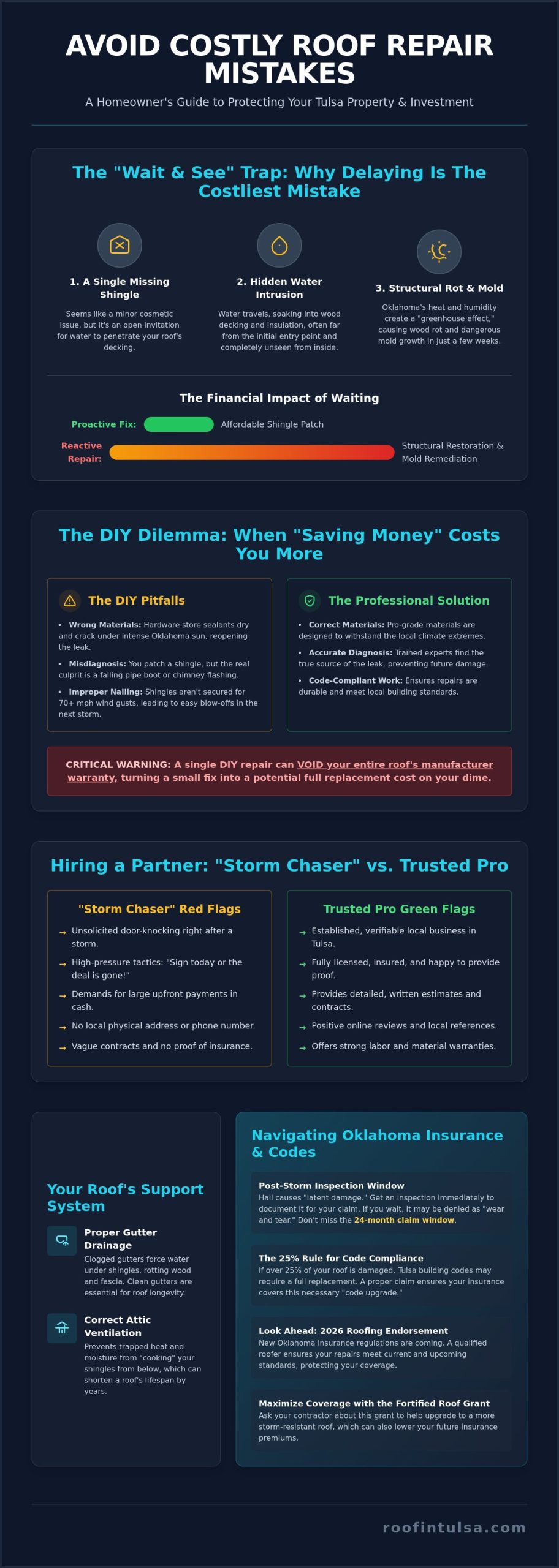
A single missing shingle might seem like a cosmetic issue you can handle eventually. However, that small gap allows water to seep directly onto the wooden decking. In the Oklahoma heat, moisture trapped under shingles creates a greenhouse effect. This can lead to wood rot in just a few weeks. Additionally, many families experience “repair fatigue” after a particularly brutal spring storm season. The stress of managing multiple home projects often leads to ignoring minor roof issues. Unfortunately, this neglect is exactly what insurance adjusters look for when denying claims later. If a provider determines that a leak was preventable, they may refuse to cover the resulting interior damage.
Small Leaks vs. Structural Integrity
Water rarely moves in a straight line. It often enters through a small crack, travels along a rafter, and pools in a completely different area of the attic. This makes understanding your roof’s structure vital for every homeowner. A simple shingle patch is affordable; mold remediation and replacing structural beams are not. When moisture sits in your attic, it creates a breeding ground for spores that can impact your family’s health. You can find more tips on spotting these subtle issues in A Homeowner’s Guide to Roof Repair.
Missing the Post-Storm Inspection Window
Waiting for a stain to appear is often six months too late. Oklahoma hail can cause “latent damage.” This refers to bruises on the shingle that aren’t immediately visible but cause the protective granules to shed over time. This process can shorten your roof’s lifespan by a decade. Scheduling an expert roof repair or inspection immediately after a storm ensures you document damage while it’s still fresh. If you wait until next season, your insurance company may argue the damage was caused by normal wear and tear rather than a specific weather event.
The DIY Dilemma: Why Self-Repair Often Leads to Double Costs
It’s tempting to grab a ladder and a tube of sealant when you notice a small leak after a spring storm. In a city like Tulsa, where we value self-reliance, many residents believe a quick Saturday afternoon project can save money. Unfortunately, attempting a “patch job” is one of the most common mistakes homeowners make with roof repairs. Hardware store sealants are often designed for temporary fixes; they aren’t built to withstand the extreme temperature swings of an Oklahoma summer. When these materials dry and crack under the sun, the leak returns, often causing more damage to your attic insulation and drywall than the original drip.
Beyond the materials, the primary issue is misdiagnosis. You might see water dripping and assume a shingle is broken. In reality, the culprit is often failing chimney flashing or a cracked pipe boot. Without professional training, it’s easy to treat the symptom while the actual problem continues to rot your roof deck. Improper nailing is another frequent DIY error. If shingles aren’t secured with the specific pattern required for our 70 mph wind gusts, they can easily peel away during the next thunderstorm. This results in a cycle of repairs that costs far more than doing the job right the first time.
Voiding Your Manufacturer Warranty
Most high-quality roofing materials come with extensive warranties that protect your home for decades. However, these agreements almost always require installation by a certified professional to remain valid. A single $50 DIY fix using the wrong nail type or incompatible shingle weights could potentially invalidate a future warranty claim worth thousands of dollars if the entire system fails. It’s also vital to match material weights and types correctly. Mixing different shingle grades can create uneven wear patterns and compromise the structural integrity of your roof surface.
Safety Risks and Liability Issues
Tulsa neighborhoods like Midtown and Florence Park are known for beautiful, steep-gabled homes. These slopes are notoriously difficult to navigate without professional safety harnesses and toe boards. Ladder accidents remain a leading cause of household injuries, and most standard homeowner insurance policies do not provide liability coverage for self-inflicted injuries during home maintenance. Professional roofing services provide peace of mind because they include specialized insurance and the expertise to work around dangerous power lines or high gables safely. If you are feeling overwhelmed by a recent storm, reaching out for a professional roof inspection is the best way to ensure your home stays protected without risking your safety or your budget.
Hiring the Wrong Partner: Avoiding “Storm Chasers” and Low-Bid Blunders
Following a major hail storm in Green Country, your neighborhood will likely see a surge in door-to-door solicitations. These individuals are often “storm chasers” who travel across state lines to follow severe weather patterns. While they might seem helpful during a crisis, hiring an out-of-state crew is one of the most common mistakes homeowners make with roof repairs. These companies often lack a permanent local presence. This means their “tailgate warranty” effectively expires the moment their trucks leave the Oklahoma border. If your roof begins to leak six months later, you may find their phone number disconnected and no local office to visit for recourse.
Choosing a partner based solely on the lowest estimate is another frequent trap. A significantly lower bid usually indicates that a contractor is cutting corners to maintain their profit margins. They might use inferior underlayment, skip necessary starter shingles, or fail to carry proper workers’ compensation insurance. In Tulsa, community reputation is everything. A local expert who has served our area for years has a vested interest in doing the job right. Their business relies on neighborly referrals and long-term trust, not just one-time storm payouts.
The 5-Step Vetting Process for Tulsa Roofers
To protect your home, you must verify that your contractor has a physical local office, not just a P.O. box or a temporary hotel suite. As of July 1, 2026, Oklahoma law under House Bill 1628 requires roofing contractors to have a specific Residential Roofing Endorsement. Always ask to see this endorsement along with active insurance certificates. It is also wise to read local reviews that specifically mention Tulsa roofing project success. This ensures they understand our specific building codes and weather challenges.
The Hidden Cost of the “Cheap” Quote
Low-bid contractors often suggest “shingle-over” techniques to save time. This involves nailing new shingles over old ones, which simply hides rot rather than fixing it. This practice is highly discouraged by modern building codes because it adds excessive weight and traps heat. While a qualified residential roofing contractor might have a higher upfront cost, their work typically saves you money over 20 years. By using high-quality materials and ensuring proper installation, they prevent the need for premature replacements and costly secondary repairs.
Ignoring the Roof’s Support System: Gutters and Ventilation
Your roof doesn’t exist in a vacuum. It is part of a complex system designed to shed water and manage heat. One of the most common mistakes homeowners make with roof repairs is focusing only on the shingles while ignoring the gutters and ventilation. If your gutters are backed up or your attic can’t breathe, even the most expensive shingles will fail prematurely. In Tulsa, our specific climate of high humidity and sudden temperature swings makes this balance even more critical. When these systems aren’t working together, you aren’t just risking a leak; you are shortening the lifespan of your entire home.
When water can’t flow freely off your roof, it finds the path of least resistance. Often, that path leads right back into your home. During rare Oklahoma winter storms, poor drainage can also lead to ice damming. This happens when snow melts near the warm peak of the roof and refreezes at the cold, clogged gutters. This ice ridge forces liquid water under the shingles, causing hidden damage that you won’t notice until the spring thaw. This is why a professional repair should always include a full assessment of the surrounding drainage components.
Gutter Neglect: The Silent Roof Killer
Clogged gutters do more than just overflow onto your flower beds. They force water to pool against the eave flashing and fascia boards. Over time, this constant moisture leads to wood rot and creates an entry point for pests. Consistent roof maintenance must include a thorough gutter cleaning to ensure the entire system works as intended. Many homeowners find that installing high-quality leaf guards is a wise investment in their roof’s longevity. These guards prevent debris from creating the blockages that lead to expensive structural repairs later on.
Attic Ventilation and Shingle Lifespan
Proper airflow is just as important as water drainage. On a 100-degree Tulsa day, an unventilated attic can easily reach 150°F. This extreme heat literally “cooks” your shingles from the inside out. It causes the asphalt to become brittle and the adhesive strips to fail. A frequent DIY mistake involves adding extra insulation but accidentally covering the soffit vents. This traps hot, moist air in the attic, which accelerates shingle degradation and can even lead to mold growth on the underside of your roof deck. Look for signs of poor ventilation such as shingles that are curling at the edges or excessive granule loss in your downspouts.
If you suspect your roof isn’t breathing correctly, it’s time to act. Don’t let a simple ventilation issue turn into a full replacement. You can schedule a professional roof and gutter inspection today to protect your home’s value and ensure your repair lasts for years.
The Insurance Claim Gap: Failing to Maximize Your Coverage
Filing an insurance claim after an Oklahoma storm is often the most stressful part of the recovery process. You’re dealing with adjusters, paperwork, and strict deadlines while trying to keep your family dry. One of the most common mistakes homeowners make with roof repairs is calling their insurance carrier before having a professional roofer inspect the roof. If you file a claim and the adjuster finds no damage, it still counts as a claim on your record. By having a trusted expert look at your home first, you ensure that a valid claim is filed with all the necessary evidence already in hand.
You should never feel pressured to settle for the first check an adjuster writes. Adjusters often use standardized estimating software that may not reflect the actual labor rates in the Tulsa market or the specific 2026 building code requirements, such as the mandatory Residential Roofing Endorsement. Having your roofer present during the adjuster’s walk-through is a game-changer. It allows for a professional-to-professional conversation where specific damage points can be highlighted and documented immediately. High-resolution photos and storm maps provided by your contractor serve as an objective record that is difficult for insurance companies to ignore.
Why Adjusters Often Miss “Functional Damage”
Insurance companies frequently distinguish between “cosmetic” and “functional” damage. They may argue that hail bruises are merely cosmetic and don’t require a full replacement. However, these impacts compromise the shingle’s integrity and lead to leaks within a few seasons. Professional insurance claim assistance identifies damage an untrained eye misses, such as subtle granule loss or shingle bruising that shortens the roof’s lifespan. Accepting a “partial repair” for these issues is a mistake because it leaves your home vulnerable and may lead to denied claims for future leaks due to “pre-existing neglect.”
Navigating the Administrative Burden
The administrative side of roofing is complex, especially when you’re trying to understand “Actual Cash Value” (ACV) versus “Replacement Cost Value” (RCV). An ACV policy only pays what your roof is worth today after years of wear, while RCV covers the actual cost of a new roof at current 2026 market prices. Rescue Roofing Tulsa handles the heavy lifting of paperwork and carrier communication to ensure you receive the full benefit of your policy. Under current 2026 Oklahoma regulations, insurance companies must acknowledge your claim within 14 days and make a decision within 30 days. To protect your interests, schedule your professional inspection today before you call your insurance company. This ensures you have a local expert on your side to guide you through every step of the process.
Secure Your Tulsa Home for the Long Term
Protecting your property from unpredictable Oklahoma weather requires more than just a quick patch or a low-bid estimate. By understanding the common mistakes homeowners make with roof repairs, you can avoid the financial pitfalls of DIY failures and the stress of dealing with unreliable storm chasers. Remember that a healthy roof relies on a functional support system of gutters and ventilation. Ensuring your insurance claim is documented by a professional before you file can save you thousands in out-of-pocket costs.
Rescue Roofing Tulsa is here to be your trusted local partner. We are locally owned and operated in Tulsa, specializing in Oklahoma storm damage and insurance claims. Whether you need a detailed assessment after a hail event or require our 24/7 emergency repair services, our team provides the reliability you deserve. Get a Free, Honest Roof Inspection from Rescue Roofing Tulsa to ensure your home stays safe, dry, and valuable for years to come. You don’t have to navigate these complex repairs alone; we’re ready to help you protect what matters most.
Frequently Asked Questions
Can I repair my own roof if it is just a few shingles?
You can technically replace shingles yourself, but it’s rarely advisable due to safety risks and warranty requirements. Most manufacturers require certified installation for their product warranties to remain valid. A small DIY error can lead to expensive leaks or wind uplift during the next Oklahoma storm. It’s best to have a professional ensure the shingles are properly integrated into the existing system to maintain your home’s structural integrity.
How do I know if a roofing contractor is a “storm chaser”?
A “storm chaser” typically lacks a permanent local office and often uses out-of-state license plates or temporary addresses like hotel suites. In 2026, every legitimate Oklahoma contractor must hold a Residential Roofing Endorsement. Ask to see this credential along with proof of local business registration and active insurance. If they pressure you for an immediate signature after a storm, they are likely not a permanent part of the Tulsa community.
Is it a mistake to only fix the leaking part of my roof?
Focusing only on the visible leak is one of the common mistakes homeowners make with roof repairs because it ignores latent damage elsewhere. In Oklahoma, if you repair more than 25% of a roof section, current 2026 building codes may require you to bring the entire section up to modern standards. A localized patch might stop a drip today but fail to address the underlying shingle degradation that causes future leaks.
Will my insurance company drop me if I file a roof repair claim in Tulsa?
Oklahoma law generally protects homeowners from being dropped specifically for filing a single weather-related claim, as storms are considered “Acts of God.” However, your premiums could increase if your entire zip code is reclassified as high-risk after a major event. It’s vital to have a professional inspection first to ensure your claim is valid and fully documented, preventing unnecessary “zero-payout” claims from appearing on your insurance history.
Why is attic ventilation considered part of a roof repair?
Proper ventilation is the “lungs” of your roofing system. Without it, heat builds up in the attic and “cooks” your shingles from underneath, causing them to become brittle and fail years early. When we perform a repair, we check that intake and exhaust vents are clear and balanced. This prevents moisture buildup that leads to wood rot and mold, ensuring your new shingles last for their full intended lifespan.
What happens if I ignore a small roof leak for a few months?
Ignoring a small leak allows water to saturate your attic insulation and wooden decking, leading to rapid rot in Tulsa’s humid climate. What starts as a minor shingle fix can quickly turn into a full structural replacement and expensive mold remediation. Furthermore, insurance companies may deny your claim if they determine the damage was worsened by homeowner neglect rather than the initial storm event.
How much does a typical roof repair cost in Tulsa?
Roof repair costs in the Tulsa area vary significantly based on the type of material used, the steepness of your roof, and the extent of the underlying damage. While asphalt shingle patches are different from metal roof repairs, the final price depends on current local labor rates and 2026 building code requirements. We recommend a professional inspection to get an accurate assessment tailored to your home’s specific needs and structural conditions.
Should I get multiple quotes for a roof repair?
Obtaining two or three quotes is a standard practice, but the lowest bid isn’t always the best choice for your home’s safety. Look for consistency in the scope of work and ensure each contractor includes essential items like high-quality underlayment and proper ventilation. Comparing quotes helps you identify “storm chasers” who might be cutting corners on materials or insurance to offer an unrealistically low price that lacks long-term protection.