



What if the biggest threat to your business’s bottom line isn’t the next Tulsa hailstorm, but the material sitting right above your head? Reviewing a commercial roofing systems comparison can feel overwhelming when you’re already dealing with high energy costs and the stress of property maintenance. You likely want a roof that doesn’t just meet the 2018 International Building Code but actually lowers your utility bills. It’s a common goal for local business owners who are tired of the cycle of frequent repairs and complex insurance claims.
This guide provides the clarity you need to choose a system that survives the next Oklahoma storm season. We’ve gathered the most important data for 2026 to help you find a balance between hail resistance and thermal reflectivity. You’ll see how various membranes and metal options stack up against our local climate’s high winds and intense UV exposure. We will walk you through the best choices for a leak-free building so you can focus on running your business with total peace of mind.
Key Takeaways
- Learn the fundamental differences between single-ply membranes and multi-ply systems to determine which structure best protects your commercial property.
- Use our commercial roofing systems comparison to evaluate which materials offer the highest durability against Oklahoma’s frequent hailstorms and high winds.
- Discover the energy-saving benefits of TPO and PVC membranes, which are designed to reflect UV rays and help reduce your monthly cooling costs.
- Identify when your building qualifies for a roof recover versus a full tear-off to maximize your investment while staying within budget.
- Understand how professional insurance claim assistance can simplify the replacement process and ensure your new roof meets all current Tulsa building codes.
Understanding Commercial Roofing Systems: An Overview for Tulsa Owners
Commercial roofing is a specialized field designed for buildings with flat or low-slope surfaces. These systems differ significantly from residential steep-slope roofs because they must manage water drainage and environmental stress without the help of gravity. Having a solid understanding of membrane roofing systems is the first step toward making a smart investment for your property.
When you begin a commercial roofing systems comparison, you will find three primary categories. Single-ply membranes are flexible sheets that are popular for their reflective properties. Multi-ply systems, like built-up roofing or modified bitumen, use redundant layers of asphalt and fabric for added durability. Liquid-applied systems offer a seamless finish that can often be applied over an existing roof to provide a waterproof barrier. Each of these options has distinct advantages depending on your building’s specific needs.
In Tulsa, our roofs face unique challenges that national guides often ignore. We experience 100-degree summers that bake roofing materials under intense UV rays. Within months, those same materials must withstand heavy ice storms and freezing temperatures. This constant stress makes your choice of material vital. It isn’t just about the initial installation cost. You must consider the total “Life Cycle Cost,” which includes maintenance and energy savings over twenty years. A system with a higher upfront price may save you thousands by lasting decades instead of requiring a replacement after just one major storm season.
The Role of the Roof in Building Performance
Your roof choice directly impacts your HVAC efficiency and internal temperature regulation. A reflective “cool roof” keeps your interior cooler, which means your cooling units don’t have to work as hard during an Oklahoma July. You also need to consider structural load-bearing capacity. Heavier systems like traditional tar and gravel require a building frame that can handle the weight without sagging. Thermal shock occurs when rapid temperature changes cause roofing materials to expand or contract so quickly that the structure cracks or degrades.
Key Components Beyond the Membrane
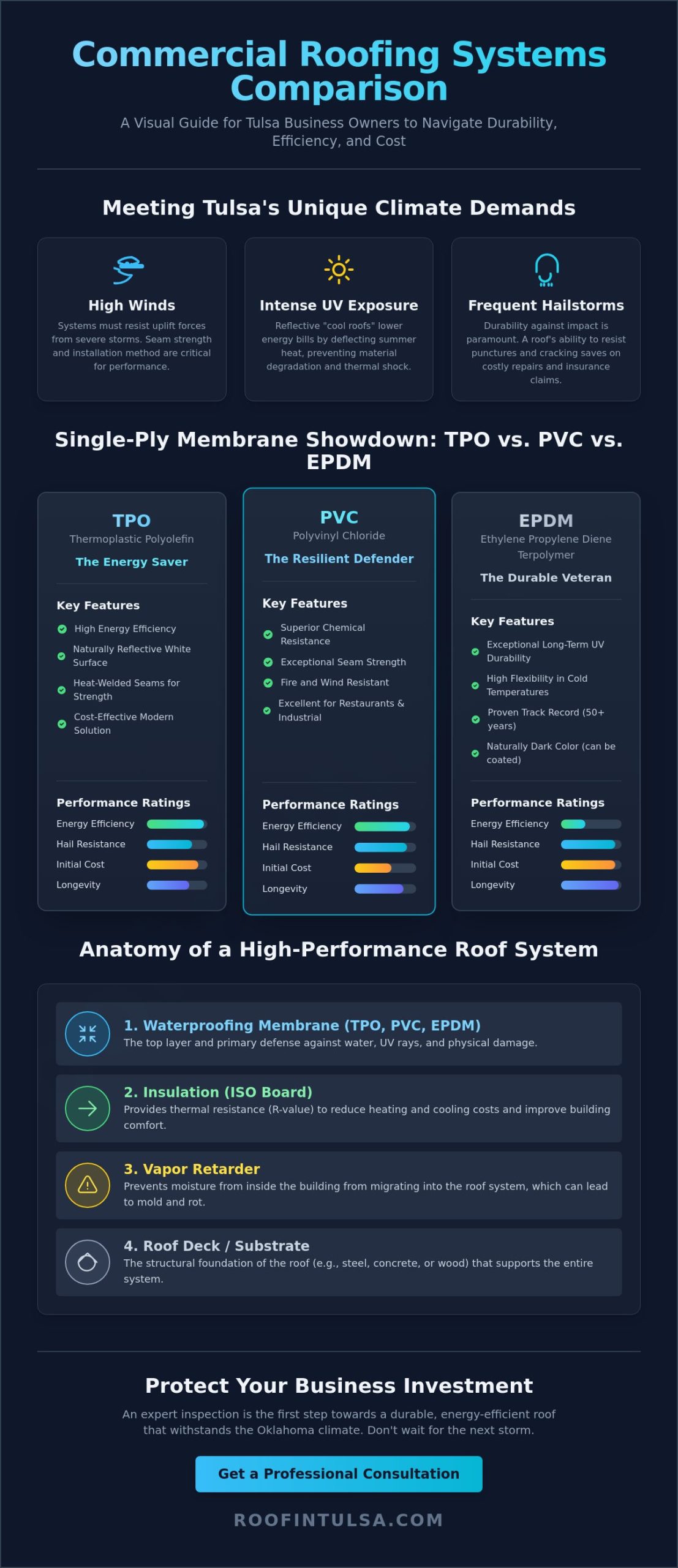
A high-performance system includes more than just the top layer you see. Insulation, often called polyisocyanurate or ISO board, provides the R-value that keeps your utility bills manageable. In our high-humidity seasons, vapor retarders are essential to prevent moisture from getting trapped inside your roof assembly, which can lead to mold. Finally, the quality of the substrate, or the surface the roof sits on, determines your final system warranty. A solid base ensures your commercial roof replacement performs as expected for its entire lifespan.
Single-Ply Membranes: Comparing TPO, PVC, and EPDM
Single-ply membranes have become the modern standard for many Oklahoma facilities. These systems consist of a single layer of synthetic material that provides a waterproof barrier over your building. When conducting a commercial roofing systems comparison, you will likely find yourself choosing between TPO, PVC, or EPDM. Each material offers distinct advantages in durability and performance, especially when facing our local weather patterns.
Thermoplastic Polyolefin (TPO) is currently the leading choice for business owners focused on energy efficiency. Its naturally white, reflective surface helps bounce UV rays away from your building. Polyvinyl Chloride (PVC) is a similar reflective option but is engineered for higher chemical resistance and superior seam strength. Ethylene Propylene Diene Terpolymer (EPDM) is a synthetic rubber membrane known for its long-term UV durability and flexibility. If you’re unsure which membrane fits your building’s structural load, a professional roof inspection can provide the answers you need.
The success of these membranes often depends on the installation method. Fully adhered systems involve gluing the membrane to the substrate, which offers the best resistance against high winds. Mechanically attached systems use specialized fasteners to secure the material, making it a faster option for certain deck types. Ballasted systems use large stones to hold the membrane in place, though these are less common in areas prone to severe storms where flying debris is a concern.
TPO vs. PVC: Which Reflective Roof Wins?
Both TPO and PVC use a heat-welding process to fuse seams together. This creates a monolithic layer that is significantly stronger than taped seams. For restaurants or manufacturing plants with chemical exhaust, PVC is the superior choice because it doesn’t degrade when exposed to oils or greases. However, for most retail and office spaces, TPO is highly effective. In 2026, 80-mil thick TPO membranes are gaining popularity in Tulsa because their added thickness provides better protection against the impact of large hail.
The Longevity of EPDM in Oklahoma
EPDM is often called a “black roof” because of its dark color. While it lacks the reflectivity of TPO, it’s incredibly durable. The material is a synthetic rubber that can last over 20 years with proper care. You must maintain the seams regularly, as they rely on adhesive tape rather than heat welding. EPDM handles thermal expansion during Oklahoma temperature swings by stretching and contracting without losing its structural integrity. This flexibility is a major benefit when our temperatures jump 40 degrees in a single day.
Traditional Multi-Ply Systems: BUR and Modified Bitumen
While many modern facilities opt for the single-ply membranes we discussed previously, traditional multi-ply systems remain a cornerstone of any commercial roofing systems comparison. These systems are built for property owners who prioritize maximum durability and redundancy. Built-Up Roofing (BUR) is the classic “tar and gravel” method that has protected buildings for over a century. It uses multiple layers of bitumen and reinforcing fabric to create a thick, resilient shield over your structure.
Modified Bitumen is the modern evolution of this technology. It takes the proven reliability of asphalt and adds specialized polymers to improve performance and flexibility. You might hear some people ask if asphalt roofing is outdated. The reality is that modern asphalt systems are highly engineered and offer better puncture resistance than many thin single-ply alternatives. For a building owner who needs a roof that can handle frequent foot traffic or heavy equipment maintenance, these multi-ply options are an excellent choice.
The Strength of Redundancy
The primary benefit of these systems is the “safety net” provided by multiple plies. If the top layer is punctured by a heavy tool or sharp storm debris, the layers beneath it continue to provide a waterproof barrier. This redundancy offers immense peace of mind during severe Oklahoma weather. The gravel surfacing on a BUR system also provides excellent UV protection and natural fire resistance. You can find more details on local installation standards and how they apply to your property in our guide to commercial roofing in Tulsa.
SBS vs. APP Modified Bitumen
When choosing a modified bitumen system, you’ll encounter two main types: SBS and APP. SBS (Styrene-Butadiene-Styrene) is often described as “rubberized” asphalt. It has high elasticity, which allows it to stretch and return to its original shape without cracking. This is a significant advantage during the rapid temperature swings we see in the Tulsa metro area.
APP (Atactic Polypropylene) is a “plasticized” asphalt. It generally offers better UV resistance and can withstand higher temperatures before softening. However, in high-wind zones like ours, the superior flexibility and elongation of SBS often makes it the preferred choice for long-term performance. Both systems provide a robust, heavy-duty solution for businesses that need a roof capable of withstanding the elements year after year.
Selection Framework: Choosing the Right System for Your Building
Choosing the right material depends on what happens inside your four walls. A warehouse storing temperature-sensitive goods has different needs than a high-traffic retail center or a quiet office complex. In your commercial roofing systems comparison, you must weigh these operational demands against the physical state of your current structure. If your existing roof is mostly sound, a “recover” might save you the $1.25 to $2.50 per square foot cost of a full tear-off. However, Oklahoma’s “25% Rule” often dictates this choice. If more than a quarter of the roof needs work within a year, local codes may require a full replacement to meet the 2018 International Building Code standards.
You should also evaluate the amount of foot traffic your roof endures. If HVAC maintenance crews or other contractors are on the roof every month, a thin membrane is at a higher risk for punctures. In these cases, a thicker 80-mil TPO or a multi-ply system provides the necessary durability. For businesses aiming for LEED certification or lower utility bills, the “Green” factor is a major priority. Reflective and energy-saving roofs are projected to account for over 60% of new commercial installations by 2026. These systems don’t just help the environment; they keep your cooling costs manageable during our intense summer heat. To see which option fits your specific structure, you can schedule a professional roof inspection with our local team.
The Tulsa Weather Resilience Test
Resilience is the most important factor for any Tulsa business owner. We recommend ranking systems by their hail resistance, specifically looking for UL 2218 Class 4 ratings. This classification means the material has been tested to withstand the impact of large hail without rupturing. Many insurance providers in Oklahoma even offer premium credits for using these high-impact products. You also need to verify wind uplift ratings. Because we are in a region prone to high-wind events, your roof must meet stringent standards like ASTM D7158. Consistent roof maintenance after a major storm is the best way to ensure these ratings hold up over time.
Budgeting for Total Cost of Ownership
It’s easy to focus on the initial price, but the total cost of ownership tells the real story. Metal roofing has a higher upfront cost but can last 40 to 50 years with minimal maintenance. In contrast, a single-ply membrane might have lower installation costs but a shorter 20-year lifespan. You should also look for “No Dollar Limit” (NDL) manufacturer warranties. These warranties provide comprehensive coverage for both labor and materials if the system fails due to manufacturing defects. When you factor in the energy savings from a cool roof, a slightly more expensive system often pays for itself within a few years through reduced utility bills.
The Rescue Roofing Advantage: Local Expertise and Insurance Support
National roofing chains often lack the deep understanding of Tulsa’s specific building codes and weather patterns. Our team at Rescue Roofing Tulsa brings a neighborly perspective to every project, ensuring your facility meets the 2018 International Building Code standards adopted by the City of Tulsa. We don’t just see a building; we see a local business that needs to stay operational through every season. Because we live and work in the same community, we’re familiar with the high-wind standards and the “25% Rule” that can complicate a simple repair. Choosing a partner who understands these regional nuances is just as important as your final commercial roofing systems comparison.
Our commitment to quality is backed by professional certifications from leading manufacturers like GAF. These credentials aren’t just badges; they’re your assurance that we use high-quality materials and adhere to rigorous installation standards. We prioritize reliability and dependability in everything we do. Whether you’re dealing with the aftermath of a hailstorm or planning a proactive upgrade, we act as a trusted advisor to help you navigate the technical and administrative hurdles of property maintenance.
Navigating Commercial Storm Damage Claims
Oklahoma adjusters have specific requirements for documenting storm damage, and missing a single detail can lead to a denied claim. We provide expert insurance claim assistance to help you navigate this complex process with confidence. Having a contractor present during the adjuster meeting is vital. We ensure all damage to the membrane, flashing, and substrate is identified and documented correctly from the start. Our documentation process typically includes:
- Comprehensive photo evidence of hail impact and wind uplift.
- Detailed measurements of affected roof sections to satisfy the “25% Rule” requirements.
- Core samples to verify the existing roof’s composition and insulation thickness.
- A professional estimate that aligns with current Tulsa material and labor costs.
We also understand that business downtime is not an option. Our crews coordinate closely with your facility managers to minimize noise and disruptions. We stage materials strategically and work in phases to ensure your daily operations continue smoothly while we secure your building’s future.
Your Next Steps for a Secure Facility
Every building has a unique structural load and drainage pattern. Before you commit to a specific material, a professional commercial roofing inspection is the most important step you can take. This evaluation identifies underlying issues like moisture in the insulation or compromised decking that a surface-level look might miss. We’ll provide a customized comparison estimate that shows you exactly how different systems will perform on your specific property over the next 20 years.
Contact Rescue Roofing Tulsa for a comprehensive commercial roof evaluation. Let us help you find the most durable, cost-effective solution to protect your business for the 2026 storm season and beyond.
Secure Your Business with a Roof Built for Oklahoma
Choosing the right protection for your facility involves more than just picking a material; it’s about matching your building’s specific needs to the realities of Tulsa’s weather. You’ve seen how reflective TPO membranes can lower cooling costs and why multi-ply systems offer the redundancy needed for high-traffic areas. This commercial roofing systems comparison highlights that the best choice balances upfront costs with long-term resilience against hail and wind. Making an informed decision now prevents expensive repairs after the next major storm season.
As a locally owned and operated business in Tulsa, we understand the stress that follows a severe weather event. We’re here to provide expert insurance claim assistance and 24/7 emergency repair services to keep your operations running smoothly. You don’t have to navigate complex building codes or adjuster meetings alone. Our team is committed to helping you find a solution that fits your budget and protects your livelihood. Protect your business with a free commercial roof evaluation from Rescue Roofing Tulsa today. We look forward to helping you build a safer, more efficient future for your property.
Frequently Asked Questions
What is the most durable commercial roofing system for Tulsa weather?
The most durable commercial roofing systems for Tulsa are typically metal or thick 80-mil TPO membranes. Metal systems offer the longest lifespan and the best resistance to high winds. Thick TPO membranes provide excellent puncture resistance against the large hail common in our region. This commercial roofing systems comparison shows that choosing a material with a UL 2218 Class 4 rating is the best way to ensure long-term durability.
How long does a typical commercial roof last in Oklahoma?
A typical commercial roof in Oklahoma lasts between 20 and 50 years depending on the material and maintenance. Single-ply membranes like TPO or PVC generally last 20 to 25 years. Traditional multi-ply asphalt systems often reach the 20-year mark with proper care. Metal roofing is the longest-lasting option, frequently protecting buildings for 40 to 50 years. Frequent temperature swings and storm activity mean regular inspections are vital to reaching these lifespans.
Can I install a new commercial roof over my existing one?
You can often install a new commercial roof over an existing one through a process called a recover, provided the structure is sound. However, the City of Tulsa enforces the “25% Rule” based on 2018 building codes. If more than 25% of your roof is damaged or needs replacement within a 12-month period, you may be required to do a full tear-off. This ensures your entire system meets current safety and insulation standards.
What is the difference between TPO and EPDM for flat roofs?
The main difference between TPO and EPDM is their chemical composition and how they handle solar heat. TPO is a white, reflective thermoplastic that is heat-welded at the seams for superior strength. EPDM is a black synthetic rubber that typically uses adhesive tape for its seams. While EPDM is very flexible and durable, TPO is often preferred in Tulsa because its reflective surface helps lower cooling costs during our hot summers.
How much does hail damage affect commercial roof warranties?
Hail damage can significantly impact your commercial roof warranty by compromising the material’s integrity. Most standard warranties do not cover damage from “acts of God” like major hailstorms. If hail punctures the membrane and you don’t repair it, subsequent leaks might not be covered by the manufacturer. Using Class 4 impact-resistant materials is a smart way to protect your investment and maintain your warranty standing after a storm.
Which commercial roofing system is the most energy-efficient?
TPO and PVC are widely considered the most energy-efficient options for commercial buildings. These are known as “cool roofs” because their bright white surfaces reflect a high percentage of solar radiation. This prevents heat from soaking into your building and reduces the load on your HVAC system. A detailed commercial roofing systems comparison often reveals that the energy savings from these membranes can significantly offset their initial installation costs over time.
How often should a commercial flat roof be inspected in Tulsa?
You should have your commercial flat roof inspected at least twice a year in Tulsa. We recommend scheduling these inspections in the spring and fall to prepare for extreme seasonal changes. It’s also important to request a professional inspection after any major weather event involving hail or winds exceeding 60 mph. Regular checks allow you to catch small punctures or seam issues before they turn into expensive interior water damage.
Does insurance cover commercial roof replacement after a storm?
Most commercial insurance policies in Oklahoma cover roof replacement if the damage is caused by a sudden event like a hailstorm or high winds. It’s vital to have a professional inspection immediately after a storm to document the damage for your provider. We specialize in insurance claim assistance to help you navigate the complex paperwork and ensure your adjuster sees every point of impact. This support helps you get the coverage needed for a high-quality replacement.