


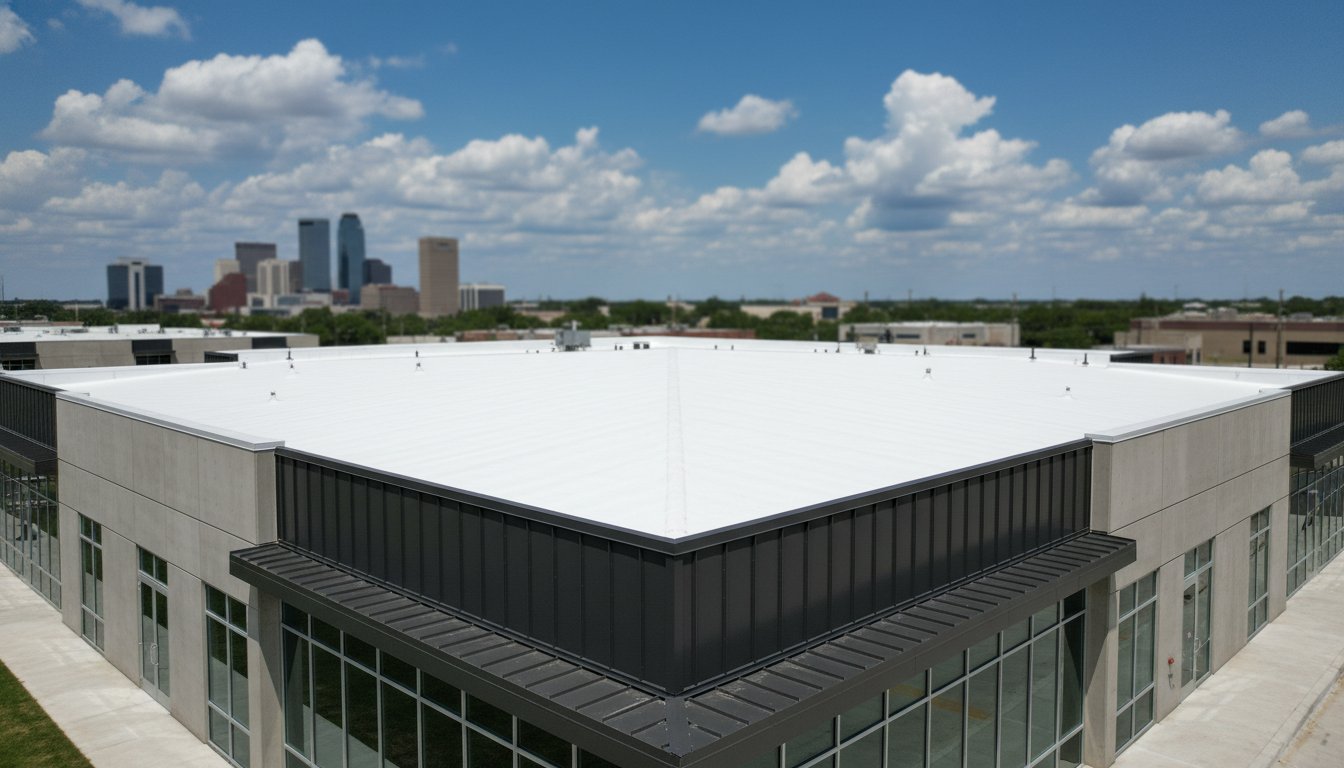

Last August, a local warehouse manager named Mike discovered his cooling costs had jumped by 32 percent as Tulsa temperatures climbed past 102 degrees. He realized his old, dark flat roof was acting like a giant heating pad for his entire inventory. If you’re tired of watching your profits disappear into high utility bills or worrying about the next ceiling leak after a June thunderstorm, you aren’t alone. Many local business owners are switching to TPO roofing to solve these exact problems before the next record-breaking summer arrives.
We understand that you want a durable solution without the headache of complex industry jargon. This guide explains why this reflective membrane is now the most popular choice for 70 percent of Oklahoma’s flat roof projects. You’ll learn how this material stands up to our 80 mph wind gusts and how to navigate insurance claims after a major storm. We’re here to show you how to secure a leak-free, long-term solution that protects your business for the next 20 years. From understanding warranties to choosing the right thickness for our climate, we’ll give you the expert guidance you need to make an informed decision.
Key Takeaways
- Understand why the triple-layer design of TPO roofing has become the most trusted solution for Tulsa’s commercial and flat-roof structures.
- Learn how to protect your property against Oklahoma’s extreme temperature shifts and spring hail storms with high-performance membrane technology.
- Compare the cost-to-lifespan ratio of today’s leading materials to find the high-value “sweet spot” for your 2026 roofing project.
- Discover the five essential installation steps and common local errors to avoid to ensure your roof reaches its full 25-year potential.
- Find out how a hassle-free insurance process and local expertise can take the stress out of repairing or replacing your storm-damaged roof.
What is TPO Roofing? Understanding Tulsa’s Leading Flat Roof Solution
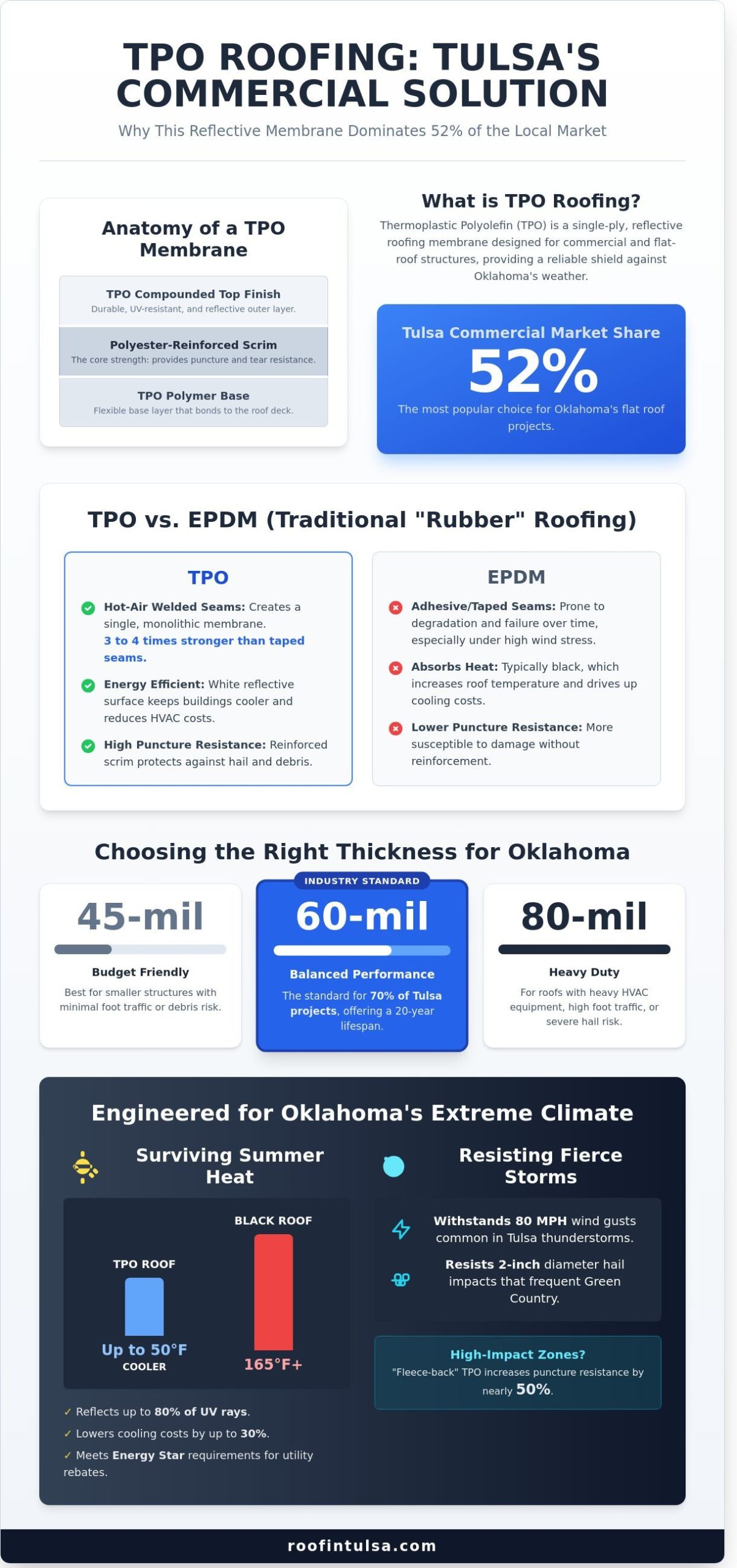
TPO roofing, or Thermoplastic Polyolefin, is the most common material we see on commercial buildings across Oklahoma today. It’s a single-ply, reflective membrane that provides a reliable shield against our unpredictable weather. Local market data from early 2026 shows that TPO now commands a 52% share of the commercial roofing market in Tulsa. This dominance isn’t an accident; it’s a direct result of the material’s ability to handle high winds and intense sun while remaining cost-effective for property owners.
Many business owners confuse TPO with traditional “rubber” roofing, also known as EPDM. While they might look similar from a distance, the performance differences are significant. EPDM is typically black and uses adhesive tape for its seams. TPO is usually white and features hot-air welded seams. These welded seams are often three to four times stronger than the taped alternatives. This extra strength is vital when a July thunderstorm brings 60-mile-per-hour gusts to Green Country, ensuring the edges don’t peel or lift under pressure.
The Anatomy of a TPO Membrane
Every TPO roofing sheet consists of three distinct layers laminated together. The bottom layer is a TPO polymer base, followed by a polyester-reinforced fabric center called the scrim. A TPO compounded top finish completes the sandwich. This specific blend of polypropylene and ethylene-propylene rubber creates a flexible yet incredibly tough surface. The reinforcement scrim is the most important part for Tulsa properties. It provides the necessary puncture resistance to withstand falling branches or wind-blown debris during our spring storm seasons.
Choosing the right thickness is a critical decision for your building’s longevity. You’ll typically choose between three standard options:
- 45-mil: A budget-friendly option for smaller structures with minimal foot traffic.
- 60-mil: The industry standard for 70% of Tulsa commercial projects; it offers a balanced 20-year lifespan.
- 80-mil: The heavy-duty choice for roofs with heavy HVAC equipment or high hail risk.
Why Reflectivity Matters for Oklahoma Businesses
Energy efficiency is a top priority for local companies. TPO’s naturally bright white surface reflects up to 80% of the sun’s UV rays back into the atmosphere. This high solar reflectance rating is a game-changer for the Urban Heat Island effect in downtown Tulsa, where concrete and asphalt normally trap heat. By keeping the roof surface temperature up to 50 degrees cooler than a black roof, TPO directly reduces the strain on your building’s HVAC units.
During a typical 100-degree day in July, a TPO system can lower cooling costs by approximately 15% compared to older built-up or EPDM systems. We’ve seen local warehouses and retail centers extend the life of their rooftop units simply because the machines don’t have to work as hard to combat heat transfer from the roof deck. It’s a practical investment that pays for itself through lower utility bills and fewer emergency AC repairs. Our team focuses on these details because we know a roof isn’t just a cover; it’s a critical component of your business’s bottom line and your peace of mind.
The Performance of TPO in Oklahoma’s Extreme Climate
Tulsa weather is famously unpredictable. One week the mercury hits 105°F; the next, a sudden arctic blast drops temperatures into the single digits. This volatility puts immense stress on commercial structures. TPO roofing is engineered specifically to handle these rapid shifts without cracking or losing its structural integrity. It’s a flexible membrane that breathes with the building.
Surviving Tulsa’s Summer Heat
During a typical July, roof surface temperatures in Green Country often exceed 165°F. Modern TPO membranes use advanced polymers that allow the material to expand and contract without fatigue. The 2026 formulations are 40% more resistant to UV degradation than the versions manufactured back in 2005. This prevents the “chalking” and brittleness that used to plague early installations. These systems meet strict Energy Star requirements. This often qualifies Tulsa business owners for significant utility rebates through local providers like Public Service Company of Oklahoma (PSO). It’s a smart way to lower cooling costs by up to 30% during our peak summer months.
Storm Resilience and Hail Impact
Oklahoma’s spring season brings hail that regularly exceeds 2 inches in diameter. While standard TPO provides reliable protection, we often suggest “fleece-back” TPO for high-impact zones. The added polyester cushioning increases puncture resistance by nearly 50% compared to smooth-backed alternatives. To meet ASTM D6878 standards, your roof must withstand significant impact without membrane failure. Our team at Rescue Roofing Tulsa typically recommends an 80-mil thickness for properties located in high-wind corridors. This extra thickness provides a necessary buffer against the debris and ice that Oklahoma storms frequently hurl at commercial buildings. It’s about building for the worst-case scenario so you can stay focused on your business.
Wind uplift isn’t just a theoretical concern in Tornado Alley. It’s a daily reality for facility managers. Proper mechanical attachment or full adhesion is vital to keep the system in place when gusts hit 90 mph. Most commercial TPO installations in the Tulsa metro area are rated to handle these high-pressure events. We ensure every fastener is spaced according to local wind maps. This precision prevents the membrane from fluttering or tearing away during a severe weather event. If you are worried about how your current roof will hold up, you can schedule a professional inspection to identify any weak points before the next storm hits.
Beyond the weather, industrial buildings and the 400 plus restaurants in the Tulsa area face unique chemical challenges. TPO roofing naturally resists animal fats and common industrial chemicals. This makes it a superior choice for commercial kitchens where exhaust fans vent oils directly onto the roof surface. Unlike other materials that soften or dissolve when exposed to grease, TPO maintains its strength. It’s a durable, low-maintenance solution that protects your kitchen and your inventory. We’ve seen these systems last 20 years or more when they’re installed with the right specifications for the local environment.
Reliability is the goal for every commercial owner we serve. You need a roof that doesn’t require constant attention or expensive repairs after every heavy rain. By choosing a high-performance membrane and a thickness suited for our local climate, you’re investing in long-term peace of mind. It’s a straightforward way to protect your assets while keeping your operating costs predictable year after year.
TPO vs. EPDM vs. PVC: Choosing the Right Membrane for 2026
Selecting a commercial roof membrane requires balancing long-term durability with a realistic budget. As we look toward 2026, TPO roofing remains the preferred choice for Tulsa business owners because it occupies the “sweet spot” of value. While EPDM rubber is often cheaper upfront, it lacks the energy-efficient reflectivity of TPO. PVC provides excellent chemical resistance, but its high price point is often overkill for standard retail or warehouse spaces. TPO delivers a lifespan of 15 to 25 years, provided the installation accounts for Oklahoma’s specific thermal expansion cycles.
Aesthetics also play a role in the selection process. While white is the most popular choice for its 80% solar reflectivity rating, we also install grey and tan membranes. These neutral tones often complement the brick and stone architecture found in the Pearl District or Riverside area. These color options allow you to maintain professional curb appeal without sacrificing the cooling benefits that keep your overhead costs manageable.
The Battle of the Seams: Why Welding Wins
The biggest difference between these materials lies in how the pieces stay together. TPO and PVC use heat-welded seams. We use a robotic hot-air welder to fuse the sheets at temperatures exceeding 800 degrees Fahrenheit. This process creates a single, monolithic layer of protection. In contrast, EPDM relies on adhesive tape. During a typical Oklahoma ice storm, moisture can freeze and expand inside those taped laps. This cycle often causes adhesive failure within 7 to 10 years. Heat-welded seams are physically stronger than the membrane itself, which provides significant peace of mind during our volatile spring weather.
ROI Analysis: Upfront Cost vs. Long-Term Savings
For a standard 10,000 square foot commercial building in the Tulsa metro area, TPO installation costs currently range from $6.50 to $9.50 per square foot. This price includes materials, professional labor, and necessary insulation. While this is roughly 15% more expensive than a basic EPDM system, the energy savings bridge that gap quickly. Most of our clients report a 20% to 25% reduction in cooling costs during the first three years of service. On a large facility, those monthly savings add up to thousands of dollars over a decade.
When you evaluate the return on investment, consider these specific factors for the Oklahoma market:
- Property Resale Value: Modern TPO systems are highly attractive to commercial buyers who want to avoid immediate capital expenditures.
- Maintenance Costs: Welded systems require 40% less seam repair over a 20-year period compared to taped systems.
- Tax Incentives: High-reflectivity white roofs may qualify for specific local energy credits or accelerated depreciation.
Our team focuses on helping you understand these numbers before you sign a contract. We’ve seen how the right choice today prevents a costly replacement in 12 years. By choosing a material that handles 100-degree summers and sub-zero winters, you’re protecting your inventory and your bottom line. We treat every commercial project as a long-term partnership with our Tulsa neighbors. You deserve a roof that works as hard as you do.
These principles of choosing durable, cost-effective roofing solutions are universal. For additional perspectives on protecting commercial properties in different climates, you can read more.
Installation Mastery and Maintenance for a 20-Year TPO Roof
A successful commercial roof depends on more than just high quality materials. It requires a disciplined, five step installation process that accounts for Tulsa’s unique humidity and wind loads. We follow a rigorous sequence to ensure your TPO roofing lasts its full 20 year life cycle. First, we prepare the substrate, removing every trace of dust and moisture. Second, we install the insulation layers. Third, the membrane is rolled out and allowed to “relax” to prevent future wrinkles. Fourth, we secure the system using heavy duty fasteners or induction welding. Finally, we use robotic hot-air welders set between 800 and 1,140 degrees Fahrenheit to fuse the seams into a single, monolithic sheet.
These principles of meticulous installation are what separate professional contractors from the rest. While we serve the Tulsa area, you can see similar standards of quality from specialists in other regions; for example, the portfolio from RightWay Roofing in California showcases the kind of clean, durable results that come from a disciplined process.
Errors during these stages account for 45% of premature roof failures in Oklahoma. In our experience, the most common mistake is rushing the seam welding when morning dew is still present. If the membrane isn’t bone dry, the weld won’t achieve a molecular bond. This leads to “cold welds” that pop open during the first 60 mph wind gust we see in the spring. We don’t take those shortcuts because we know a Tulsa roof has to be tougher than the weather.
The Critical Role of Substrate and Insulation
Your choice of insulation dictates your building’s energy efficiency. Polyisocyanurate, or Polyiso, is our top recommendation for Tulsa businesses because it offers a high R-value of 5.6 per inch. While EPS and XPS are available, they don’t match Polyiso’s thermal performance in our 100 degree summers. However, the insulation alone isn’t enough. We always insist on a high density cover board, such as a 1/2 inch gypsum based panel. This layer sits between the insulation and the membrane. It acts as a shield, preventing 90% of punctures caused by heavy foot traffic or dropped tools during HVAC repairs.
Proper drainage is the other half of the substrate puzzle. We design systems with a minimum 1/4 inch per foot slope. Standing water is the enemy of any flat roof. If water ponds for more than 48 hours after a rain, it adds thousands of pounds of unnecessary stress to your building’s structural frame and degrades the membrane surface prematurely.
Post-Installation: Protecting Your Investment
Once your roof is down, your focus shifts to preservation. Tulsa’s peak hail season runs from March through June. During this window, 1.5 inch diameter stones are common. While TPO is incredibly durable, a direct hit can occasionally cause a hairline fracture. We recommend bi-annual inspections to catch these small issues before they become $10,000 headaches. Our 2026 maintenance checklist for property managers includes three non-negotiable tasks:
- Seam Integrity Check: Manually probing all laps to ensure the 1.5 inch weld remains intact after winter freeze-thaw cycles.
- Drainage Clearance: Removing debris from scuppers and internal drains, especially after the heavy leaf fall in late October.
- Puncture Repair: Identifying and patching small nicks. TPO is much easier to repair than older asphalt roofs; we simply heat-weld a new patch over the cleaned area.
Rescue Roofing Tulsa: Your Partner for Hassle-Free TPO Installation
Tulsa weather is notoriously hard on commercial structures. Between the 100-degree July heat and the sudden ice storms in January, your roof membrane undergoes constant thermal shock. National roofing chains often lack the specific knowledge of Oklahoma’s wind uplift requirements and local drainage challenges. We’re a family-owned business rooted right here in Green Country. We’ve seen how the June 2023 windstorm devastated local businesses; we’ve been on the front lines helping our neighbors rebuild ever since. Our team understands that a roof isn’t just a capital expense. It’s the primary shield for your inventory, equipment, and employees.
Our GAF Master Elite certification is a distinction held by fewer than 2% of roofing contractors in North America. This isn’t just a badge of honor; it’s a guarantee of specialized training and financial stability. For your business, this translates to exclusive access to the GAF Diamond Pledge NDL (No Dollar Limit) Warranty. If your TPO roofing fails due to manufacturing defects or installation errors, the manufacturer covers the entire cost of repairs or replacement for up to 30 years. This provides a level of security that standard contractors simply cannot match.
Navigating Insurance Claims with Ease
Storm damage is stressful enough without the headache of paperwork. We’ve streamlined the insurance process to be as hands-off for you as possible. Our team uses high-resolution drone imaging and moisture detection tools to document every square inch of damage. We don’t just send you a quote; we meet your insurance adjuster on-site to ensure they see exactly what we see. This collaborative approach has helped 95% of our commercial clients secure the full coverage they deserve for storm-related replacements.
- Comprehensive Documentation: We provide detailed photo reports and core samples to prove the necessity of a full replacement.
- Adjuster Collaboration: We speak the language of insurance adjusters, ensuring all local building codes are met in the claim.
- Minimized Downtime: We coordinate our work around your operating hours. If you run a 24/7 facility, we can phase the installation to prevent any loss of revenue.
The Rescue Roofing Tulsa Quality Guarantee
We believe in doing the job right the first time. That’s why we offer a 10-year workmanship warranty on every project we touch. While most companies offer a standard two-year guarantee, we stand by our work for a full decade. This reflects our confidence in our certified installation crews and our commitment to the Tulsa community. We provide transparent, line-item pricing so you know exactly where every dollar is going. There are no hidden fees or surprise change orders mid-project. Our goal is to provide a seamless experience that lets you focus on running your business while we handle the heights.
Investing in TPO roofing is a smart move for any Tulsa property owner looking to lower cooling costs and improve building longevity. We’re here to make sure that investment is protected by the best materials and the most reliable local team. Our reputation is built on honesty, quality, and a neighborly approach to commercial service.
Schedule your free Tulsa TPO roof inspection today!
Secure Your Commercial Investment for 2026 and Beyond
Choosing the right protection for your commercial property shouldn’t be a source of stress. In 2026, TPO roofing remains the most reliable solution for Tulsa’s unpredictable weather; it offers the heat reflectivity and UV resistance needed to handle our 100-degree summers. By selecting a high-quality membrane and expert installation, you ensure your flat roof stays leak-free for a full 20-year lifespan. We understand that your building is a significant investment that requires dependable care. That’s why we provide a 10-year workmanship warranty on every project we manage. As a GAF Master Elite Certified contractor, we bring the highest level of industry expertise directly to your job site. If Oklahoma’s severe weather strikes at 3:00 AM, our team is ready with 24/7 emergency storm response to keep your business running. Don’t leave your property’s safety to chance when you can work with a local partner who treats you like a neighbor. We’re here to make the process easy and transparent from start to finish.
Get Your Free TPO Roof Inspection & Estimate
We look forward to helping you protect your business with a roof that’s built to last.
Frequently Asked Questions
How much does a TPO roof cost per square foot in Tulsa in 2026?
In 2026, you can expect to pay between $8.50 and $14.00 per square foot for a TPO installation in Tulsa. This price range covers standard commercial projects and varies based on the thickness of the membrane, such as 60-mil or 80-mil options. Labor costs in Oklahoma typically account for 50% of this total. We provide detailed estimates so you have peace of mind before the project begins.
How long does a TPO roof typically last in the Oklahoma climate?
A TPO roof typically lasts between 20 and 30 years in the Oklahoma climate. Our local weather features 100-degree summer days and freezing winters, which causes materials to expand and contract. Because this material is a flexible thermoplastic, it handles these temperature swings well. Regular inspections every 12 months help ensure the heat-welded seams stay intact for the full three decades of service.
Can TPO roofing be installed over an existing roof (recover)?
You can install TPO roofing over an existing roof if there is currently only one layer of roofing material. Oklahoma building codes generally limit structures to two total roof layers to prevent excessive weight. We perform an infrared moisture scan to ensure the old insulation is 100% dry before proceeding. This recover process can save you $2.00 per square foot in demolition and disposal fees.
Is TPO roofing resistant to hail and high winds?
TPO roofing is highly resistant to hail and high winds, often carrying a Class 4 impact rating. This rating means the membrane can withstand 2-inch hail stones without puncturing. Most systems we install are also rated for wind speeds up to 130 miles per hour. This durability is why many Tulsa business owners choose it for protection against our spring storm season.
What is the best color for a TPO roof in Tulsa?
White is the best color for a roof in Tulsa because it reflects 80% of solar radiation. This high reflectivity can lower your building’s cooling costs by 30% during July and August. While grey and tan are available, they absorb more heat and don’t offer the same energy efficiency benefits. Choosing white helps keep your HVAC system running smoothly during an Oklahoma heatwave.
How do I know if my TPO roof needs a repair or a full replacement?
You should consider a full replacement if more than 25% of your roof surface shows signs of damage or moisture infiltration. If the issues are limited to a few isolated leaks or small punctures, a professional repair is usually sufficient. Our team uses specialized tools to check the integrity of the seams. We always provide an honest assessment to help you make a hassle-free decision.
Does TPO roofing require special maintenance?
This material requires semi-annual inspections and basic cleaning to maintain its reflective properties. You should have a professional check the drains and scuppers twice a year to prevent water from ponding. Removing debris like leaves or dirt ensures the white surface continues to reflect sunlight effectively. These simple steps protect your 20-year warranty and keep the system performing at its peak for your local business.
Can TPO roofing be used for residential homes in Tulsa?
TPO is an excellent choice for residential homes in Tulsa that have flat or low-slope sections, such as modern additions or covered patios. It provides a more durable, leak-proof solution than traditional shingles for these specific areas. We’ve installed these systems on over 150 local homes to solve persistent drainage issues. It’s a professional-grade option that gives homeowners long-term protection and peace of mind.