



What if a roof leak appears after installation, and it’s unclear whether the roofing contractor or shingle manufacturer is responsible? If you’re wondering what is a workmanship warranty in roofing, the key distinction is that this coverage generally addresses installation errors, while a manufacturer’s warranty generally applies to defects in roofing materials. They protect against different problems, and neither should be assumed to cover every leak.
Before work begins, it helps to understand what a warranty promises, who reviews a covered concern, and what steps you must follow to make a claim. Exclusions, maintenance requirements, and claim procedures can all affect coverage.
This guide explains the purpose and limits of roofing workmanship coverage, compares it with material warranties, and outlines the written terms to review and keep. Look for the covered work, warranty period, exclusions, maintenance requirements, transfer rules, and claim process. Knowing where to find these details can help you plan a roof replacement or repair and keep the records you may need later.
Key Takeaways
- Learn what is a workmanship warranty in roofing and how it addresses specified installation-related problems.
- See how a contractor’s workmanship coverage differs from a manufacturer’s material warranty.
- Compare warranty scope, duration, exclusions, maintenance duties, and claim instructions instead of relying on the stated term alone.
- Know how to document a possible issue safely and follow the written claim process.
- Use clear written expectations to make more informed decisions about roofing replacement, installation, or repairs.
What Is a Workmanship Warranty in Roofing?
A leak or visible defect after a roofing project can leave a homeowner wondering who should address it. If you’re asking what is a workmanship warranty in roofing, it’s written coverage for specified problems related to how a roof was installed. In plain terms, a workmanship warranty addresses installation quality, while material performance is generally covered under a separate manufacturer’s warranty.
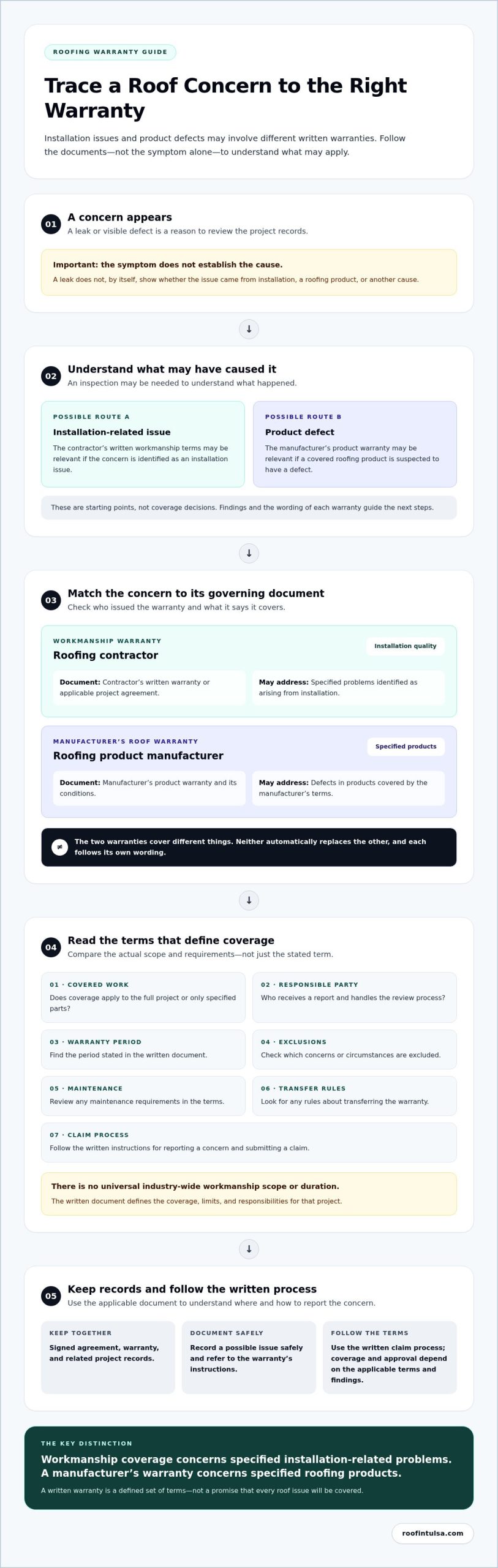
The word “specified” matters. There is no universal industry-wide scope or duration for workmanship warranties. One agreement may describe particular installation issues and how to report them; another may set different limits and responsibilities. The written document defines the coverage for that project.
What does a roofing workmanship warranty generally address?
Depending on the agreement, workmanship coverage may apply to identified installation errors. For example, if water enters near a roof feature and an inspection finds that the cause may be an installation issue, the warranty terms can explain whether and how the concern should be reviewed. This example does not establish automatic coverage or guarantee claim approval. The cause, covered work, exclusions, and claim requirements all matter.
Roof systems include multiple components, and product warranties have their own conditions. For general background on roof components and roofing materials and warranties, see Wikipedia’s overview of roofs. It can provide basic context, but it does not replace the written warranty for your project.
Why does workmanship coverage matter to homeowners?
A written warranty gives you a starting point if a concern appears after the work is complete. It can identify who reviews a reported installation issue and explain how to submit it. That does not settle every claim in advance, but it replaces guesswork with a defined process.
Verbal assurances can be reassuring, but they are harder to refer back to later. Keep the warranty with your roofing contract and project records so you can find the applicable terms when needed. For a planned roof replacement, review the paperwork alongside the project scope to understand what work is included and what the written coverage says about it.
- Identify the covered work. Check whether the warranty applies to the full project or only specified parts.
- Find the responsible party. Note who receives a report and handles the review process.
- Keep the documents accessible. Save the signed agreement, warranty, and related project records together.
These basics make it easier to discuss expectations before work begins and know where to look if a problem surfaces later. A workmanship warranty is not a promise that every roof issue will be covered. It is a written set of terms that defines responsibility for particular installation-related concerns.
Workmanship Warranty vs. Manufacturer’s Roof Warranty
A roof problem may involve how the system was installed, a product defect, or another cause. To identify which warranty may be relevant, start by checking who issued it and what its written terms cover. A workmanship warranty concerns installation; a manufacturer’s warranty concerns specified roofing products. Neither automatically replaces the other.
| Comparison | Workmanship warranty | Manufacturer’s roof warranty |
|---|---|---|
| Provider | The roofing contractor, when workmanship terms are provided in writing. | The manufacturer of specified roofing products. |
| General purpose | Sets out the contractor’s coverage, if any, for specified installation-related issues. | Sets out the manufacturer’s coverage for specified products. |
| Possible covered issue | A problem that the written terms identify as arising from installation. | A defect in a covered product, as defined by the manufacturer’s terms. |
| Governing document | The contractor’s written warranty or applicable project agreement. | The manufacturer’s product warranty and its conditions. |
The exact protections, exclusions, and claim procedures depend on each document. A leak, for instance, does not reveal whether installation or a product caused the problem. Both warranty documents may be useful when an issue involves multiple roof components, but each applies according to its own wording.
Who provides each type of roofing warranty?
The roofing contractor sets out workmanship terms when they are provided in writing. The manufacturer sets the product-specific terms for its materials. Keep both documents with your contract and project records. For each one, identify the responsible party, the covered work or products, and the instructions for reporting a concern. The federal Warranty of Construction describes warranty terms in a government-contract context; it is not a substitute for the documents governing a homeowner’s roofing project.
Can one warranty cover a problem the other does not?
Potentially. If an issue appears related to installation, the contractor’s written terms may be relevant. If a product defect is suspected, the manufacturer’s terms may matter. These are starting points, not coverage decisions. Symptoms alone cannot establish the cause, and an inspection may be needed to understand what happened. The applicable warranty wording and findings guide the next steps.
Keep both documents together so you can follow the right instructions without assuming who is responsible before the cause is understood. If you’re planning a roof replacement or addressing an existing concern, clear project expectations make those discussions more straightforward. Explore roof replacement and repair planning as part of preparing for roofing work.
How to Compare Roofing Workmanship Warranty Terms
A warranty’s stated term is only one part of its value. To compare workmanship coverage, check which work it applies to, what conditions may limit it, and how a concern must be reported. A longer term does not automatically mean broader protection if the covered work is narrow or the claim requirements are difficult to meet. The practical question behind what is a workmanship warranty in roofing is not just how long it lasts, but what the written terms actually promise.
Keep workmanship coverage separate from a manufacturer’s product warranty, homeowners insurance, and expectations about how long a roof should last. Each serves a different purpose. A roof’s expected service life is not a warranty promise, and insurance has its own policy terms. The National Roof Certification and Inspection Association’s guide to understanding workmanship warranties offers additional background on how workmanship coverage differs from material coverage.
Which details should homeowners find in the written warranty?
Read the warranty alongside the roofing contract. Confirm when coverage starts, the stated term, which work is included, and who receives a claim. Then review exclusions, required maintenance, conditions that could affect coverage, and the steps for reporting a concern. Note any deadlines or required supporting records, and store the warranty with your project documents.
- Coverage scope: Identify the specific installation work included and any parts of the project left out.
- Time period: Find the start date and stated term. Do not infer either from a conversation or from a separate product warranty.
- Conditions and exclusions: Check maintenance duties and circumstances the document says may limit coverage.
- Claim instructions: Find how to report a concern, whom to notify, and what information or records are required.
What limitations can affect a workmanship warranty?
Written exclusions vary. A warranty may explain how it treats later alterations, neglected maintenance, or damage from causes outside the installation work. These are examples to look for, not rules that apply to every agreement. If someone modifies the roof or a new issue appears, the cause may need to be assessed before anyone can determine which terms are relevant.
That distinction can matter in Tulsa, where a storm may cause damage separate from an installation concern. A leak after severe weather does not, by itself, show what caused it or which coverage might apply. Record what you observe and when, then follow the instructions in the relevant written documents. Do not assume a workmanship warranty covers every roof problem, or that a suspected limitation automatically settles a claim.
A careful comparison gives you a clearer view of the written scope and the steps to take if a concern arises. Keep the documents together and use them to guide discussions about roof replacement or repair before work begins.
What to Do If You Notice Roofing Workmanship Issues
Finding a leak or noticing a roofing defect can be stressful, but a steady response helps you preserve useful information and follow the right process. A symptom alone does not establish whether installation work caused the problem or whether a warranty applies. Start with safety, document what you can see, and follow the instructions in your written warranty.
How should you document a roofing concern?
Keep the signed contract, warranty, invoices, project details, and messages about the work together. These records can help you describe what was installed and understand which reporting steps apply. Do not climb onto the roof to investigate or make changes that could damage it or create a safety risk.
- Make the area safe. If water is entering, protect people and belongings from interior hazards. Avoid touching wet electrical fixtures or entering areas that may be unsafe.
- Record what you observe. Take photos from the ground or indoors when it is safe. Note the date you first noticed the issue, where it appears, and any visible interior effects, such as a ceiling stain or dripping water.
- Add relevant context. Record the timing of recent weather and any temporary steps taken to protect the interior. Keep notes factual, and do not attempt a roof repair before reviewing the warranty instructions.
- Follow the written reporting process. Use the contact method specified in the warranty and provide the requested records or details. Keep a copy of what you send and note when you reported the concern.
- Arrange an appropriate inspection. A qualified roof inspection may help identify the source of the concern. Findings can inform next steps, but the written warranty and its claim process still govern any coverage decision.
If you’re dealing with a leak or other roof concern, the Tulsa roof repair guide offers context on addressing repair needs. Understanding what is a workmanship warranty in roofing can help you know which document to consult, but it will not determine the cause of a specific problem.
How can maintenance and project records support clear communication?
Records created over time can help show what work was completed and what condition you observed before or after it. Keep inspection notes, maintenance dates, receipts, and photos with your project paperwork. This information may help explain the roof’s history during an inspection, but it does not guarantee coverage or decide a claim outcome. For routine upkeep ideas, see the Tulsa roof maintenance guide.
Rescue Roofing Tulsa provides roof repair and inspection services for property owners in Tulsa and surrounding areas. Explore roof repair and inspection services if you need help addressing a roofing concern.
Choose a Roofing Project With Clear Expectations
A roofing project is easier to plan when the work and its written terms are clear before installation or repairs begin. Review the project scope, understand which materials and roof areas are included, and read any workmanship warranty from start to finish. Pay close attention to its limits and claim instructions. Clear documents help everyone discuss the same work and set realistic expectations.
This preparation is useful whether you’re considering a replacement, a new installation, or a repair. Knowing which roof areas the project covers, for example, can help you understand how the written warranty relates to the work performed. It also helps distinguish workmanship terms from a product warranty and from expectations about how long a roof may last.
What should a homeowner understand before roofing work begins?
Before work starts, make sure the project scope, materials, responsibilities, and written warranty terms are understandable. Resolve unclear language before relying on an assumption. Keep the signed contract, warranty, and project records together so you can easily find the scope and applicable documents later.
- Scope: Identify the work areas and tasks included in the project.
- Materials: Note the products or material descriptions included in the written project documents.
- Responsibilities: Understand who is responsible for the work and who receives a warranty concern.
- Warranty terms: Find the coverage limits, conditions, and instructions for making a claim.
Questions about how the work, materials, and warranty documents fit together are worth addressing during planning. The central question of what is a workmanship warranty in roofing comes down to the written coverage for specified installation-related issues, not a blanket promise about every possible roof problem.
For a broader look at planning a replacement, the Tulsa roof replacement guide can help you consider the project as a whole. Use it alongside your contract and warranty documents, since the written terms for your project define its scope and responsibilities.
How can Rescue Roofing Tulsa help with your roofing project?
Rescue Roofing Tulsa serves residential and commercial property owners in Tulsa and surrounding areas with roof replacements, installations, repairs, and inspections. Understanding your project helps support practical conversations about the work your roof needs and the records you should keep. Warranty terms remain specific to the written documents for the project.
If you’re planning roofing work or need to address a roof concern, explore Rescue Roofing Tulsa’s roofing services. Start by considering the project scope and the written expectations, so you can plan the work with a clear understanding of what is involved.
Move Forward With a Clear Roofing Plan
Understanding what is a workmanship warranty in roofing can help you approach your next project with better questions and clearer expectations. Keep project documents organized, take time to understand the written terms, and make decisions based on your roof’s needs rather than assumptions about coverage.
A thoughtful conversation about your roof’s condition and the work it may need can make planning more manageable. Whether you’re considering a replacement, installation, repair, or inspection, Rescue Roofing Tulsa serves homeowners in Tulsa and surrounding areas with local roofing services.
Explore Rescue Roofing Tulsa’s roofing services to discuss your roof replacement, repair, or inspection needs and plan your next step.
Frequently Asked Questions
Is a workmanship warranty the same as a roof warranty?
No. “Roof warranty” is a broad phrase that may refer to contractor workmanship coverage, a manufacturer’s product warranty, or both. Check the document’s title and details rather than relying on a general label. A packet, for example, might include one document for the contractor’s installation terms and another for the shingles. Each has its own responsible party and claim instructions, so keep them together but review them separately.
What does a workmanship warranty cover on a roof?
A workmanship warranty covers the installation-related issues specifically described in its written terms. The scope might identify certain work performed during a replacement or repair, but it does not automatically extend to every roof component or future problem. A concern near a repaired section, for example, may prompt a review of the work description and warranty language. The document, not the symptom alone, establishes what may qualify for consideration.
How long does a roofing workmanship warranty last?
There is no single duration that applies to every roofing workmanship warranty. The written agreement should state the term and when it begins, such as at completion or another defined project milestone. Do not assume the clock starts on the day you notice a problem, or that a product warranty has the same timeline. Save a dated copy of the completed contract and warranty so you can check the applicable period later.
Can a workmanship warranty cover a roof leak?
It can if the written terms address the installation-related cause of the leak and the claim meets the agreement’s conditions. A ceiling stain or dripping water identifies a concern, but not its source. Water may travel from the point where it enters, so the visible indoor location may not match the roof area involved. Record what you observe and arrange an appropriate inspection before drawing conclusions about coverage.
What happens if a roofing contractor’s workmanship warranty claim is denied?
Start by reading the written explanation and comparing it with the warranty’s coverage, exclusions, and claim requirements. Check whether the decision identifies a specific term or missing document. If the instructions allow it, provide relevant records or ask for clarification in writing. Keep copies of all correspondence and inspection findings. If the disagreement remains unresolved, consider getting independent advice about your options, since outcomes depend on the agreement and circumstances.
Does a workmanship warranty transfer to a new homeowner?
It may transfer, but transferability depends on the warranty’s written terms. Some documents may set conditions, deadlines, or steps for notifying the responsible party after a sale; others may restrict transfer. If you’re buying a home, request the original warranty and any transfer records when reviewing the roof’s history. Do not rely on a seller’s verbal assurance that coverage continues, because the document determines whether it can be assigned.
Can storm damage affect a roofing workmanship warranty?
Storm damage may create a separate roof concern, but it does not automatically prove that workmanship coverage has ended or that it applies. A roof can experience storm-related damage and have an unrelated installation issue, so the cause matters. Keep the date of the weather event, photos taken safely, and any inspection findings. Review the warranty’s language about outside damage, and keep insurance questions separate from the contractor’s workmanship terms.
What documents should I keep for a roofing warranty?
Keep the signed contract, workmanship warranty, manufacturer product warranty, invoices, project scope, and records showing which materials or areas were included. Save inspection reports, maintenance notes, dated photos, and messages about later concerns or repairs, too. Store digital copies in a labeled folder and keep originals somewhere secure. If you sell the home, these records can help explain the roof’s work history and show which warranty documents may need review.