



After a severe Tulsa storm, the last thing you want to face is a complicated and stressful battle with your insurance company. The worry about the high cost of a new roof, the fear of a denied claim, and the confusion over what to do next can feel overwhelming. As your local, trusted neighbors, we understand the anxiety that comes with protecting your home and family, and we believe you shouldn’t have to navigate this process alone.
Successfully getting insurance to pay for wind damage to your roof is entirely possible when you have a clear, straightforward plan. This guide is designed to give you that plan and restore your peace of mind. We will walk you through the entire process step-by-step, from the moment you first suspect damage to the final approval of your claim. You’ll learn exactly how to properly document the evidence, file your claim correctly, and communicate effectively with your adjuster. Our goal is to empower you with the knowledge to ensure your roof is repaired or replaced with the full coverage you deserve, making the entire experience as hassle-free as possible.
Key Takeaways
- Understand what your standard Oklahoma homeowner’s policy typically covers for wind damage *before* you call your agent.
- Learn the critical first steps to take within 48 hours of a storm to ensure your safety and protect your claim from the start.
- Proper documentation is the secret to successfully getting insurance to pay for wind damage to roof; we’ll show you what you need.
- Navigate the claims process with confidence by learning how to avoid the common mistakes that lead to denied or underpaid claims.
First, Understand Your Policy: What Wind Damage Insurance Typically Covers in Oklahoma
After a severe Oklahoma storm, the first question on every homeowner’s mind is, “Am I covered?” The process of getting insurance to pay for wind damage to roof repairs can feel overwhelming, but it starts with one crucial step: understanding your policy. The good news is that most standard homeowner’s policies (often called HO-3) are designed to protect you from this exact situation. This type of property insurance typically covers damage from “named perils,” and wind is almost always on that list.
So, what does that coverage look like in practice? It generally includes:
- Direct Wind Damage: This covers shingles that have been creased, lifted, or blown off completely by high-speed gusts.
- Structural Damage: If the wind is severe enough to damage the underlying roof deck or trusses, your policy should cover these structural repairs.
- Resulting Water Intrusion: Damage caused by rain entering your home through the wind-damaged roof is typically covered, including repairs to ceilings and drywall.
However, it’s just as important to know what isn’t covered. Insurers will likely deny claims for damage resulting from general wear and tear, lack of maintenance, or pre-existing issues that were present before the storm. Your policy is there for sudden, accidental events, not gradual decline.
Wind vs. Other Perils: Is It Covered?
Wind damage is distinct from other types of storm damage. It’s characterized by lifted or creased shingles and missing tabs. This is different from hail damage, which leaves dents and pockmarks. In Oklahoma, many policies have a separate, often higher, deductible for hail. The good news is that if a windstorm knocks a tree or large branch onto your roof, that damage is also typically covered under the wind peril.
Actual Cash Value (ACV) vs. Replacement Cost Value (RCV)
Understanding these two terms is critical, as they dramatically impact your claim payout. Knowing which one is in your policy is the key to setting realistic expectations.
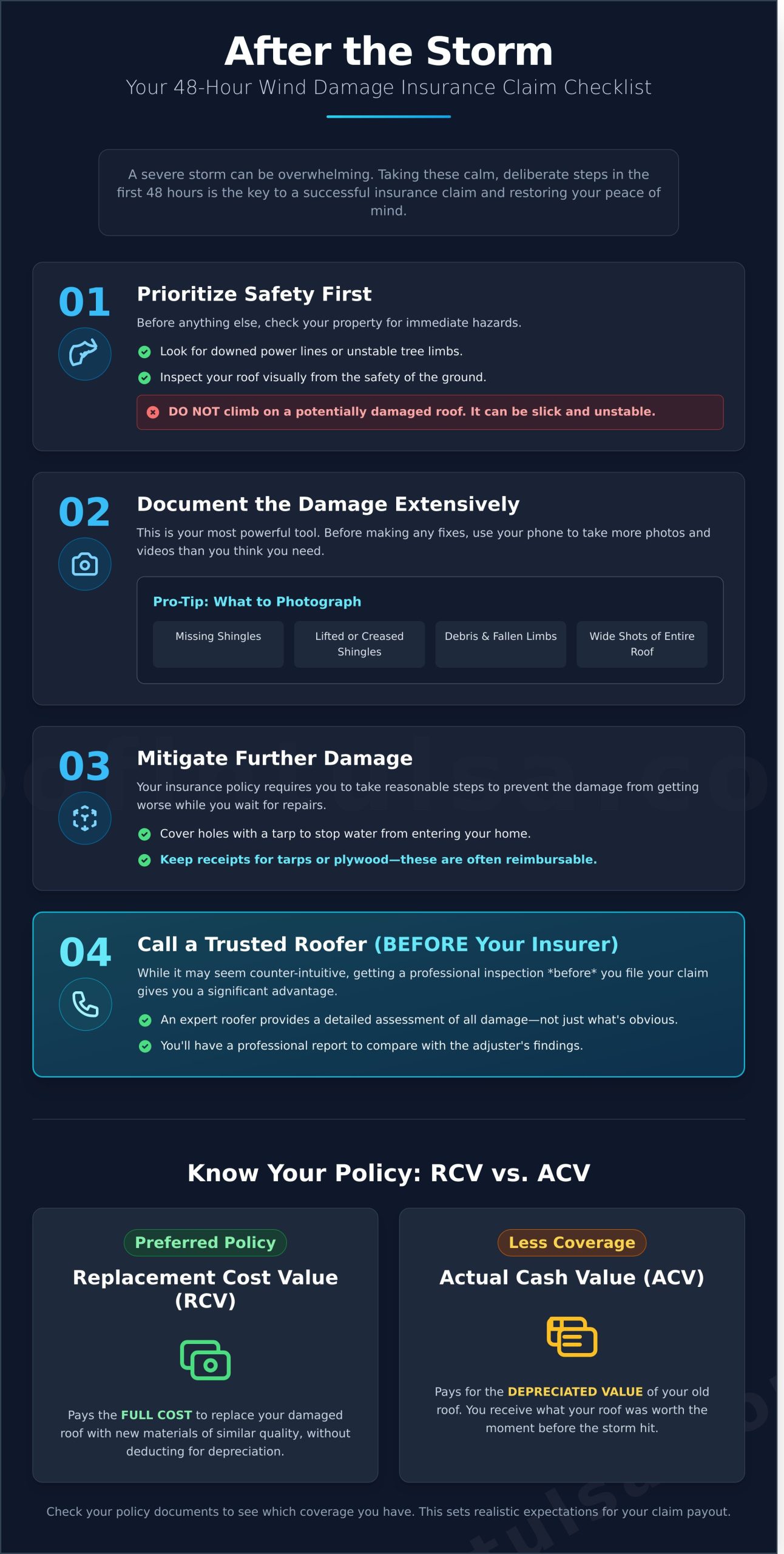
- Actual Cash Value (ACV): This policy pays for the depreciated value of your old roof. Think of it like the “used” value-you receive what your roof was worth the moment before the storm hit.
- Replacement Cost Value (RCV): This is the preferred policy. It pays the full cost to replace your damaged roof with new materials of similar quality, without deducting for depreciation.
Reviewing your policy documents now will give you the peace of mind and knowledge you need before you ever have to make a call to your insurance agent.
Your First 48 Hours: An Actionable Checklist After the Storm
The moments after a severe Tulsa storm can be stressful. Your roof has taken a hit, and you’re worried about what comes next. Don’t panic. Taking calm, deliberate steps in the first 48 hours is the key to a successful insurance claim and gives you the best chance of getting insurance to pay for wind damage to roof. We’re here to help guide you through it.
Follow this simple checklist for immediate peace of mind:
- Prioritize Safety First. Before anything else, check your property for immediate hazards like downed power lines or unstable tree limbs. Perform a visual inspection of your roof from the safety of the ground. Do not climb on a potentially damaged roof. It can be slick and unstable.
- Document the Damage Extensively. This is your most important step. Before moving a single shingle or making any temporary fixes, take photos and videos of all the damage.
- Mitigate Further Damage. Your insurance policy requires you to prevent the damage from getting worse. This means making temporary repairs, like covering a hole with a tarp, to stop water from entering your home.
- Call a Trusted Roofer. Get a professional inspection from an honest, local roofing company *before* you call your insurance company.
Documenting Everything: Your Most Powerful Tool
Your camera is your best friend right now. Take more photos than you think you need from every possible angle. Capture close-ups of lifted or missing shingles, creased areas, and any debris. Then, take wider shots to show the full scope of the storm’s impact on your property. Remember to keep receipts for any tarps, plywood, or other materials you buy for temporary repairs, as these are often reimbursable.
Why You Should Call a Roofer Before Your Insurer
While it may seem logical to call your insurance agent first, contacting a trusted local roofer provides a significant advantage. A professional inspection gives you a detailed, expert assessment of all damage-not just what’s obvious. This documentation strengthens your claim and prepares you for the adjuster’s visit. It ensures you understand the full scope of necessary repairs, putting you in control of the conversation and making the entire process much less stressful. If you have an active leak, see our guide on what to do for Emergency Roof Repair.
Navigating the Claim: From Filing to Getting Your Check
Filing an insurance claim can feel overwhelming, but we’re here to make the process as smooth and hassle-free as possible. With a clear understanding of the steps, you can confidently manage your claim and secure the funds needed for a quality roof replacement. The key to successfully getting insurance to pay for wind damage to roof is a well-documented and professionally managed claim.
Once you’ve had a professional inspection, the formal process begins. Here’s what to do:
- File Your Claim Promptly: Contact your insurance provider via phone or their online portal. Have your policy number and the date of the storm ready.
- Provide Initial Details: Briefly describe the wind damage based on your inspection report and photos.
- Get a Claim Number: Your insurer will assign a claim number and an adjuster to your case. Keep this number handy for all future communication.
Working with the Insurance Adjuster
The insurance adjuster’s job is to assess the damage and estimate repair costs on behalf of the insurance company. While they are professionals, their goal is to protect the insurer’s interests. This is why having your trusted local roofer present is so important. We represent your interests, meeting the adjuster on-site to point out every detail of the damage and ensure their report is accurate and complete. Never sign any documents on the spot without a thorough review.
Understanding the Insurance Paperwork
After the inspection, you’ll receive a “scope of work” detailing the approved repairs and costs. We will carefully review this document with you to confirm it covers everything needed for a durable, long-lasting restoration. The payment process typically involves two checks. The first is for the Actual Cash Value (ACV) of your roof. The second check, for the Recoverable Depreciation, is sent after we complete the work. Be aware that the first check is often co-payable to your mortgage company, a standard procedure we can help you navigate.
Common Roadblocks: Why Wind Damage Claims Get Denied or Underpaid
Filing an insurance claim can feel overwhelming, and the fear of denial is a major source of stress for homeowners. At Rescue Roofing Tulsa, we understand these concerns and aim to provide peace of mind by helping you understand the process. Successfully getting insurance to pay for wind damage to roof systems often means anticipating and preparing for common hurdles. Knowing what to expect is the first step toward a fair outcome.
Here are the most frequent reasons claims are denied or underpaid:
- Insufficient Documentation: A lack of clear “before” and “after” photos or a detailed, professional damage report can sink a claim before it starts.
- The “Wear and Tear” Argument: The insurer may argue the damage is due to the roof’s age or poor maintenance, not a specific storm event.
- A Lowball Repair Estimate: The insurance adjuster’s initial offer may only cover a small patch, not what’s truly needed to protect your home.
- Hiring a “Storm Chaser”: Out-of-town contractors may perform shoddy work and disappear, leaving you with a denied claim and a leaky roof.
The ‘Old Roof’ Defense and How to Counter It
One of the most common tactics is to blame the roof’s age. An insurer might state that the shingles were already brittle or worn. The best counter-argument is a professional assessment. A detailed inspection from a reputable local roofing company can provide evidence that the damage is recent and directly caused by wind uplift or storm debris, not gradual decline. Having records of past maintenance also demonstrates your commitment to keeping the roof in good condition.
Partial Repair vs. Full Replacement: The Big Fight
It’s cheaper for an insurance company to pay for a few new shingles than an entire roof. That’s why many initial offers only cover a patch job. However, a reputable local roofer knows this isn’t always the right solution. They can argue that a partial repair would result in mismatched materials that hurt your home’s value or that replacing only some shingles compromises the integrity of the entire roof system. In some cases, Oklahoma building codes may even require a full replacement to ensure uniformity and safety.
How Rescue Roofing Tulsa Makes Your Claim Hassle-Free
Understanding the insurance claim process is one thing, but navigating it alone after a storm is another. The paperwork, deadlines, and negotiations can be overwhelming when you’re already stressed about your home. That’s where we come in. At Rescue Roofing Tulsa, we transform this confusing process into a straightforward, managed experience, ensuring you get the full compensation you deserve without the headache.
Our entire approach is designed to advocate for you, the homeowner. We handle the details so you can focus on your family. Here’s how our proven process works:
- Free, No-Obligation Inspection: Our process begins with a comprehensive inspection of your entire roofing system. We meticulously document all wind-related damage with detailed notes and high-resolution photos, creating the solid evidence needed for a successful claim.
- On-Site Adjuster Meeting: We meet your insurance adjuster on-site at your property. Our trained expert will walk the roof with them, pointing out every detail of the damage to ensure nothing is overlooked. This single step can be the difference between a partial repair and a fully approved roof replacement.
- Insurance Scope Review: After the adjuster completes their report, we review it line-by-line with you. We verify that the scope of work is fair, accurate, and complete. This is a critical step for getting insurance to pay for wind damage to your roof without cutting corners.
- High-Quality Restoration: Once your claim is approved, our GAF Master Elite Certified team performs the necessary repairs or replacement using only the best materials, restoring your home’s safety and value.
Your Local Tulsa Advocate
We’re not just a roofing company; we’re your neighbors. We live here, we work here, and we understand Oklahoma storms and the local insurance landscape. Our reputation in the Tulsa community is built on trust and integrity. We manage the confusing paperwork and difficult phone calls, acting as your dedicated advocate to minimize your stress from start to finish. Learn more about our professional Tulsa Roof Replacement process.
Get Started with a Free Inspection
You don’t have to face the insurance company alone. An overlooked detail can lead to a denied claim or an unfair settlement that doesn’t cover all the damage. Let our experts provide the clarity and support you need. A free, professional inspection is the first step toward the peace of mind you deserve. We’re here to help.
Schedule Your Free Storm Damage Inspection Today!
Your Partner for a Stress-Free Wind Damage Claim
When a Tulsa storm hits, knowing your policy and acting quickly are your first lines of defense. While documenting damage and understanding the process are crucial, the challenge of getting insurance to pay for wind damage to roof can feel overwhelming. You don’t have to navigate this complicated path alone; having a trusted expert on your side makes all the difference.
At Rescue Roofing Tulsa, we are specialists in insurance claims assistance. As your local, trusted Tulsa roofing contractor, we provide more than just repairs-we provide peace of mind. Our team will be there every step of the way, and we will even meet with your adjuster to ensure your claim is handled fairly and accurately from the start. Don’t let a damaged roof and a difficult claim add to your stress.
Take the first step toward a hassle-free solution. Get a Free, No-Hassle Storm Damage Inspection today and let our team restore your roof and your confidence.
Frequently Asked Questions About Roof Wind Damage Claims
How long do I have to file a roof claim after wind damage in Oklahoma?
Most insurance policies require that you file a claim within one year of the storm date. However, it is always best to act quickly to prevent any existing damage from getting worse. Filing promptly makes it easier to connect the damage directly to the specific wind event. We always recommend you check your policy for the exact deadline, but don’t wait to schedule a professional inspection to assess the damage and get the process started.
Will my insurance premiums go up if I file a wind damage claim?
In Oklahoma, state law prohibits insurance companies from raising your individual rates for filing a single weather-related claim, as it’s considered an “Act of God.” While widespread storms in an area can lead to general rate increases for everyone, you will not be penalized for using the coverage you pay for. Filing a legitimate claim to protect your home is your right as a policyholder and will not single you out for a rate hike.
What if the insurance estimate is lower than my roofer’s quote?
This is a very common situation and part of the standard process. The initial insurance adjuster’s estimate often overlooks specific line items or uses generic pricing. A professional roofer provides a more detailed quote based on the true scope of work and local material costs. We then submit our findings to your insurer as a “supplement” to negotiate a fair and accurate settlement that covers the full cost of a quality, lasting repair.
Can an insurance company deny my claim because my roof is old?
An insurer cannot deny a valid claim for storm damage just because a roof is old. If a covered peril like wind caused the damage, it should be covered. They might, however, argue the damage is due to wear and tear. This is why a thorough, professional inspection is vital. We document all evidence of specific wind uplift and damage, providing the proof needed for getting insurance to pay for wind damage to your roof, regardless of its age.
Do I need to get multiple quotes for my insurance company?
No, you are not required to get multiple bids for your insurance company. As the homeowner, you have the right to choose any qualified and reputable contractor you trust to work on your home. Your only responsibility is to select a professional whose estimate is fair and reasonable for the required work. From there, we can work directly with your insurance company to ensure the project is approved and fully funded for a quality installation.
What is the difference between wind and hail damage coverage on my policy?
In most standard homeowner’s policies, wind and hail damage are grouped together under the same “windstorm” coverage. They are typically not separate. The most important thing to check is your deductible. Many policies in Oklahoma have a specific-and often higher-percentage-based deductible for wind and hail claims. Reviewing your policy’s declaration page will clarify your exact out-of-pocket cost for a storm-related claim, giving you peace of mind.
How can I spot a ‘storm chaser’ roofing scam?
Be cautious of anyone using high-pressure sales tactics, asking for a large down payment upfront, or offering to cover your deductible (which is insurance fraud). Other red flags include out-of-state license plates and a lack of a permanent local office or verifiable local references. Always choose a licensed, insured, and established local roofer with deep roots in the Tulsa community. A trusted contractor will prioritize your best interests, not a quick sale.
What happens if more damage is found after the repair work starts?
Discovering hidden damage is a normal part of the roofing process and is handled with a supplemental claim. Once we remove the old shingles, we might find problems like soft or rotted decking that weren’t visible initially. When this occurs, we stop work, document the new damage with photos, and submit a supplement to your insurance company for approval. We ensure everything is properly covered before we continue with the repair.