



Table of Contents
- What Affects Commercial Roof Repair Costs
- Commercial Roof Repair Cost Per Square Foot
- Commercial Roof Leak Repair Cost Breakdown
- Commercial Roofing Repair vs Replacement: Making the Right Choice
- How to Get an Accurate Commercial Roof Repair Estimate
- Insurance and Hidden Costs You Should Know About
- Conclusion
Last Updated: August 6, 2026
What Affects Commercial Roof Repair Costs
Commercial roof repair costs depend on structural factors, material choices, labor complexity, and regional market conditions that can swing estimates by thousands of dollars.
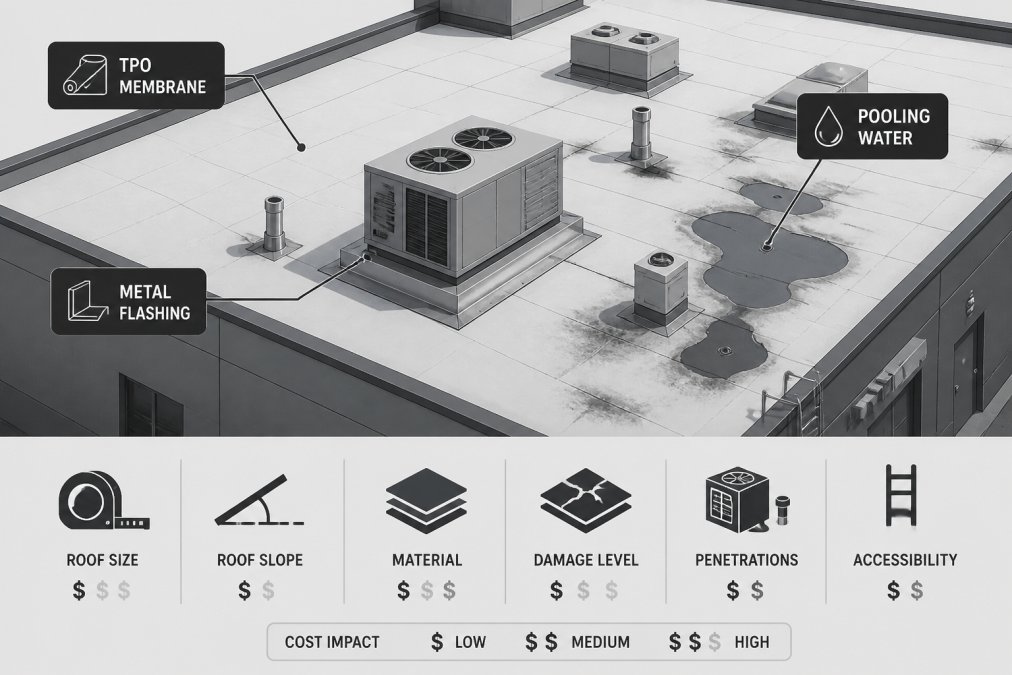
The most significant variables are roofing system type, damage extent, and building accessibility. A single-ply membrane repair on a low-slope roof with easy access costs far less than addressing structural damage to the roof deck or replacing insulation beneath a built-up roofing system. Geographic location matters significantly, labor rates in urban markets run 30-50% higher than rural areas, and regional weather patterns determine how quickly damage spreads.
Material selection heavily influences costs. EPDM tends to be most economical but degrades faster in UV-heavy climates. TPO offers mid-range pricing with better durability. PVC commands premium pricing but delivers superior chemical resistance and longevity. Built-up roofing systems require specialized labor and cost more to repair because the work demands experienced contractors familiar with tar and gravel installation.
Roof pitch and penetrations add complexity. Steeper pitches require additional safety equipment and slower work. Every penetration, HVAC units, skylights, vents, flashing, represents a potential leak point and multiplies labor costs.
Building codes and permit requirements vary by jurisdiction. Some municipalities require licensed contractors for roof work exceeding a certain scope.
Request an aerial inspection before accepting any estimate. Contractors using drone technology can document damage patterns and identify hidden issues like damaged insulation or compromised roof deck that would otherwise surprise you mid-project and inflate costs.
Commercial Roof Repair Cost Per Square Foot
Commercial roof repair cost per square foot varies dramatically based on repair type and roofing system.
Localized repairs typically run lower per-square-foot costs than full-system restoration. A simple patch over a small puncture in a TPO membrane might cost between $3 and $8 per square foot. If damage extends across multiple areas or the underlying roof deck needs attention, costs climb to $10-$20 per square foot.
Full membrane replacement runs $8-$15 per square foot depending on region, material choice, and deck condition. If the roof deck requires reinforcement or replacement, add $5-$10 per square foot. Built-up roofing replacement typically costs $12-$18 per square foot because installation demands multiple layers and curing time between applications.
Per-square-foot pricing also reflects building profile. A warehouse with minimal penetrations costs less per square foot than a medical office with numerous HVAC units and skylights. Restricted access, working around tenants, or navigating tight urban sites adds labor hours and drives pricing upward.
Regional labor rates create significant variation. Tulsa-area contractors typically charge $40-$60 per labor hour, while coastal metropolitan areas run $80-$120 per hour.
Compare per-square-foot estimates only when scope is identical. Different contractors may recommend different repair strategies. Ensure you’re comparing apples to apples.
Commercial Roof Leak Repair Cost Breakdown
Understanding where your money goes reveals legitimate costs versus potential padding.
The leak detection phase costs $300-$800 depending on roof size and damage visibility. If the leak source is obvious, detection is quick. If water travels laterally beneath the membrane before surfacing elsewhere, finding the actual entry point requires systematic investigation. Rescue Roofing uses aerial technology to map damage patterns before crews set foot on the roof, reducing detection time and unnecessary exploration.
Material costs typically represent 30-40% of your repair bill. A patch kit for single-ply membrane costs $50-$150. Replacement flashing runs $100-$300 per unit. Damaged insulation replacement costs $2-$5 per square foot. New membrane material ranges from $1-$3 per square foot.
Labor comprises 50-60% of typical repair costs. A two-person crew working 8 hours on a straightforward patch costs $640-$960 in labor (at $40-$60 per hour in Tulsa). Complex repairs involving roof deck work or multiple penetration sealing stretch labor to 20-40 hours, pushing costs to $800-$2,400. Emergency repairs outside standard business hours command 1.5x to 2x labor rates.
Equipment and logistics add 10-15% to your bill. Safety equipment, scaffolding, tarping, and debris removal are legitimate costs. Rescue Roofing’s 24-hour availability means emergency repairs don’t automatically trigger premium pricing.
Insurance deductibles and claim coordination represent hidden costs many property managers overlook. Your deductible, typically $500-$2,500, comes directly from your pocket. If the repair qualifies for insurance coverage, the claim process takes 2-4 weeks, during which temporary repairs may be necessary.
Watch for “scope creep” during repairs. Contractors sometimes discover additional damage once they begin work, compromised roof deck, deteriorated insulation, or failed secondary drains. Establish clear protocols upfront: get written approval before proceeding with work beyond the original estimate, and request itemized documentation of any change orders.
Commercial Roofing Repair vs Replacement: Making the Right Choice
The decision between repair and replacement hinges on roof age, damage extent, and long-term cost implications.
A roof under 10 years old with localized damage almost always favors repair. A 15-year-old roof with multiple leak sites and visible membrane degradation tilts toward replacement. Repairing a roof approaching end-of-life creates recurring repairs that ultimately cost more than replacement.
The "50% rule" provides practical guidance: if repair costs exceed 50% of replacement cost, replacement usually makes financial sense. Spending $15,000 on repairs to a roof that would cost $25,000 to replace might seem prudent until the same roof leaks again 18 months later, requiring another $8,000 repair.
Structural integrity determines whether repair is viable. If the roof deck shows soft spots, rot, or significant water damage, surface repairs won’t solve the underlying problem. The deck must be addressed through localized replacement or full deck restoration.
Building codes sometimes mandate replacement when repairs trigger inspections. If your roof hasn’t been updated in 20+ years and local codes have changed, bringing the system into compliance might require replacement rather than repair.
Energy efficiency ROI deserves consideration. Replacing with modern TPO or PVC membranes, especially reflective systems, reduces cooling costs by 10-20% in Tulsa’s climate. Over a 20-year roof lifecycle, energy savings can offset 15-25% of replacement cost.
Warranty coverage differs dramatically. A repair typically carries a 1-5 year warranty on the patched area. Full replacement includes 10-20 year material warranties plus labor warranties. Rescue Roofing provides transparent warranty terms upfront.
Repair is best for roofs under 15 years old with isolated damage affecting less than 20% of the roof area. Replacement makes sense for roofs over 15 years old, systems with multiple concurrent issues, or buildings where energy efficiency upgrades justify the investment.
How to Get an Accurate Commercial Roof Repair Estimate
Getting an accurate estimate requires knowing what to ask for and how to evaluate contractor responses.
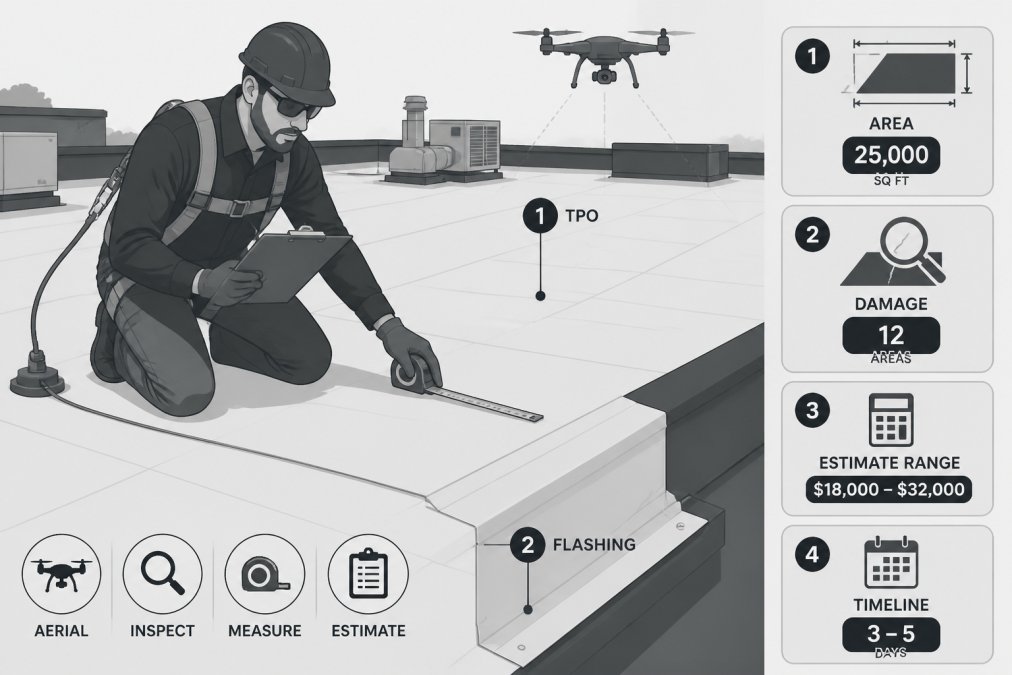
Start by requesting an aerial inspection. Modern drone technology captures high-resolution imagery showing damage patterns, membrane condition, flashing integrity, and drainage issues without requiring crew time on the roof. This costs $200-$500 but provides detailed documentation for accurate estimates. Rescue Roofing includes aerial quotes as standard practice.
Provide contractors with complete building information: roof size, roofing system type, age of current system, previous repair history, and known leak locations.
Request itemized estimates breaking costs into material, labor, equipment, and permits. A line-item breakdown reveals where each dollar goes and makes comparison between contractors meaningful.
Ask specifically about scope limitations. Does the estimate include roof deck inspection? Does it cover temporary tarping if weather delays work? Are permits included or quoted separately? What happens if contractors discover additional damage during work?
Clarify warranty terms before accepting an estimate. What does the contractor guarantee? For how long? Does warranty coverage include labor, materials, or both?
Request references from similar projects completed in the past 12 months. Call property managers who had comparable work done and ask about communication, timeline adherence, and post-project support.
Verify licensing and insurance. Ask for proof of general liability insurance, workers’ compensation coverage, and roofing license. Licensed contractors in Oklahoma must maintain current certifications.
Compare at least three estimates before deciding. Estimates varying wildly from the average should trigger questions.
Request a timeline with specific start and completion dates. Vague timelines like “3-5 weeks” create scheduling uncertainty. Professional contractors provide detailed project schedules showing inspection, material ordering, weather buffers, and actual work phases.
Insurance and Hidden Costs You Should Know About
Insurance coverage and hidden costs often surprise property managers who focus solely on contractor estimates.
Commercial property insurance typically covers roof damage from covered perils, wind, hail, lightning, fire, but excludes damage from poor maintenance or normal wear. If your roof is 20+ years old and fails during a storm, insurers might deny claims arguing the failure resulted from age-related deterioration rather than storm damage.
Deductibles represent your first financial responsibility. Commercial deductibles range from $500 to $5,000 depending on your policy. Your deductible applies per claim.
Claim approval timelines create hidden costs. Insurance adjusters typically take 2-4 weeks to inspect damage and issue payment. During this period, temporary repairs might be necessary to prevent further water damage. Tarping, interior water extraction, and temporary drainage solutions cost $500-$2,000 but prevent catastrophic secondary damage.
Code compliance upgrades frequently accompany insurance-covered repairs. If your roof doesn’t meet current building codes, insurers might require upgrades as a condition of coverage. New wind resistance standards, updated fire ratings, or improved drainage requirements might necessitate more expensive materials or installation methods.
Permit and inspection fees vary by municipality. Tulsa-area permits for roof work typically cost $100-$400 depending on project scope.
Environmental disposal fees apply when removing old roofing materials. Disposal costs typically run $0.50-$2.00 per square foot. A 10,000-square-foot roof replacement generates 5-10 tons of waste material, with disposal costs reaching $500-$2,000.
Financing costs matter for larger projects. If you finance a replacement through contractor payment plans or bank loans, interest adds 5-15% to total project cost.
Operational disruption costs are real but often overlooked. If your roof repair prevents customer access or requires operational shutdown, lost revenue represents a hidden cost. Scheduling repairs during slower periods or planning phased work to maintain partial operations reduces this impact.
Don’t assume your insurance covers all roof damage. Review your policy’s specific language around maintenance responsibility, age limitations, and covered perils. Many policies require documented maintenance records. Maintain detailed records of all roof work, inspections, and maintenance performed.
Getting an accurate commercial roof repair cost estimate requires understanding what drives pricing and asking the right questions. The factors affecting your bill, roofing system type, damage extent, labor rates, and regional conditions, create significant variation between projects and contractors.
Rescue Roofing simplifies this process through accurate aerial inspections, transparent itemized estimates, and direct insurance claim coordination. Our team in Tulsa and surrounding areas provides detailed commercial roof repair cost estimates that account for your specific building conditions and local market factors.
Get a detailed estimate today. Call Rescue Roofing for a free aerial inspection and transparent pricing on your commercial roof repair needs.
Comparison Table: Repair vs. Replacement Decision Framework
| Factor | Repair Makes Sense | Replacement Makes Sense |
|---|---|---|
| Roof Age | Under 12 years | Over 15 years |
| Damage Extent | Less than 20% of roof area | More than 30% of roof area |
| Structural Condition | Roof deck intact, no soft spots | Roof deck shows deterioration or rot |
| Leak History | First or second incident | Multiple recurring leaks in past 3 years |
| Estimated Cost | Under 50% of replacement cost | Over 50% of replacement cost |
| Energy Efficiency Need | Not a priority | Building needs cooling cost reduction |
| Warranty Preference | Short-term coverage acceptable | Long-term warranty important |
| Operational Impact | Can tolerate 1-3 days downtime | Can accommodate 5-10 day project |
Comparison Table: Roofing Material Cost and Durability Profile
| Material | Typical Lifespan | Repair Difficulty | Relative Cost Per Square Foot | Best For |
|---|---|---|---|---|
| EPDM | 15-20 years | Easy | Lower | Budget-conscious projects, low-slope roofs |
| TPO | 15-20 years | Moderate | Mid-range | Most commercial applications, energy efficiency |
| PVC | 20-30 years | Moderate | Higher | Chemical exposure environments, premium durability |
| Built-up | 15-25 years | Difficult | Mid-range | Traditional systems, multi-layer protection |
Key Takeaways
- Roofing system type, damage extent, and local labor rates are the primary drivers of commercial roof repair costs, with variation of 50-100% between projects.
- Per-square-foot pricing provides useful comparison only when repair scope is identical; different contractors may recommend different repair strategies.
- The 50% rule helps determine repair vs. replacement: if repairs exceed 50% of replacement cost, replacement usually delivers better long-term value.
- Aerial inspections eliminate estimate surprises by identifying hidden damage and complexity before contractors begin work.
- Insurance coordination, permits, and disposal fees represent 15-25% of total project cost but are frequently overlooked in initial budgeting.
- Warranty terms and operational disruption costs should factor into your repair vs. replacement decision alongside pure material and labor pricing.
Frequently Asked Questions
How much does a commercial roof repair cost per square foot?
Commercial roof repair costs vary based on the roofing system type, damage severity, and location. Single-ply membranes like TPO and EPDM typically cost less to repair than built-up roofing or PVC systems. Factors including roof pitch, accessibility, and the extent of structural damage to the roof deck significantly impact pricing. Contact a local contractor for an accurate commercial roof repair cost estimate specific to your property.
Is it better to repair or replace a commercial roof?
The repair versus replacement decision depends on your roof's age, condition, and remaining lifecycle. If your roof is over 20 years old or has extensive damage across multiple areas, replacement often provides better long-term value. Minor leaks, isolated penetrations, or damage to flashing typically warrant repair. A professional inspection can reveal whether underlying structural issues exist that make replacement the more cost-effective choice.
Does insurance cover commercial roof repairs?
Many commercial property insurance policies cover roof repairs resulting from sudden damage like storms or hail. Coverage typically excludes wear and tear or maintenance-related issues. Your policy may include a deductible, and some insurers require specific building code compliance. Filing a claim involves documenting damage, getting contractor estimates, and communicating with your adjuster. Professional assistance with the claims process ensures you understand your coverage and maximize your benefit.
What hidden costs should I expect during a commercial roof repair?
Hidden costs can include permit fees required by local building codes, disposal fees for old roofing materials, structural repairs to the roof deck if damage is more extensive than initially visible, and extended labor if weather delays the project. Some roofing systems require specialized installation that increases labor complexity. Aerial inspections help identify these issues upfront, but always ask your contractor about potential additional costs before work begins.
[EXTERNAL_LINK: Oklahoma Construction Industries Board licensing requirements | construction.ok.gov]
[EXTERNAL_LINK: National Roofing Contractors Association maintenance guidelines | nrca.net]
[EXTERNAL_LINK: ASTM International roofing system standards | astm.org]
This article was written using GrandRanker