




Last spring, a homeowner in Midtown Tulsa faced a sudden $18,000 roof replacement after a severe storm, only to spend hours wondering if any of that cost could be recovered at tax time. It’s a common frustration for many of our neighbors who want to protect their homes without draining their savings. You might be asking, can I deduct a new roof on my taxes 2026? The answer isn’t a simple yes or no, but understanding the difference between a simple repair and a capital improvement is the first step toward peace of mind. We know how confusing IRS jargon feels when you’re just trying to keep your family safe and your finances secure.
As your trusted local experts, we’ve gathered the latest information to help you maximize your benefits. You’ll discover the specific IRS rules for 2026 regarding roof deductions, including how the Energy Efficient Home Improvement Credit under Section 25C could provide up to $1,200 in annual credits for specific materials. We will also explain how a new roof affects your cost basis when you sell your home and what happens when storm damage enters the equation. This guide provides the clarity you need to make informed decisions for your Tulsa home and your wallet.
Key Takeaways
- Learn the direct answer to “can I deduct a new roof on my taxes 2026” and why the IRS classifies a replacement as a capital improvement rather than a standard repair.
- Discover how landlords and home-based business owners can lower their tax burden through depreciation and specific home office deductions.
- Understand the criteria for deducting roof damage following federally declared disasters and how Oklahoma’s storm season impacts your 2026 filing.
- Get the latest facts on the Energy Efficient Home Improvement Credit to see which roofing materials still qualify for federal tax breaks.
- See how working with a GAF Master Elite contractor provides the professional documentation you need for a hassle-free insurance claim and accurate tax record-keeping.
Is a New Roof Tax Deductible in 2026? The Short Answer
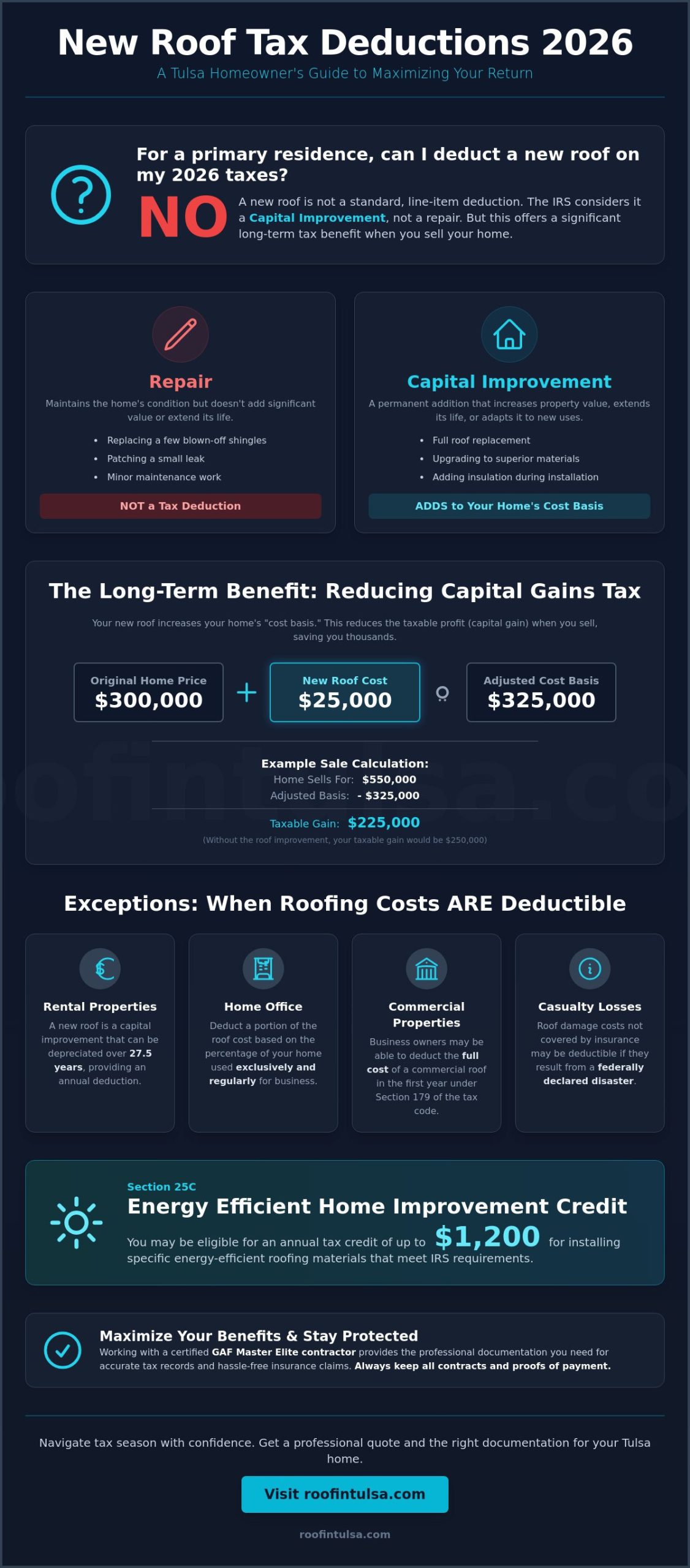
If you are asking, can I deduct a new roof on my taxes 2026, the direct answer for most homeowners is no. For a primary residence, a roof replacement is not a line-item deduction that you can subtract from your gross income like a charitable donation. The IRS generally views a new roof as a personal expense rather than a deductible tax event. However, this doesn’t mean the investment is without tax advantages. It simply means the benefits are realized differently than a standard deduction.
Understanding why you can’t deduct a new roof on your taxes 2026 as a standard deduction helps you plan for the long-term benefits instead. The IRS classifies home expenditures into two categories: repairs and improvements. While 2026 tax rules continue to offer specific credits for energy-efficient upgrades, a basic asphalt shingle roof typically won’t qualify for an immediate write-off. Instead, the government views this project as a capital investment that changes the value of your property over time.
Understanding Capital Improvements vs. Repairs
The distinction between a repair and an improvement is the most important factor in how the IRS treats your roofing costs. A repair is a job that keeps your home in good operating condition but doesn’t add significant value. For example, if a Tulsa windstorm blows off a few shingles and you pay to have them replaced, that’s a repair. It’s a personal maintenance expense, and it’s not deductible or useful for tax purposes.
A full roof replacement is different. This is considered a “Capital Improvement” because it involves a permanent addition that increases the property’s value. When you install a new roofing system, you are adjusting the tax basis of your home. This is a critical financial metric. While you don’t get a check back from the IRS this year, you are effectively building a tax shield for the future. Capital improvements include:
- Replacing the entire roof structure or surface.
- Installing superior materials that extend the roof’s lifespan by 20 years or more.
- Adding attic insulation or specialized radiant barriers during the roofing process.
The Long-Term Tax Benefit: Reducing Capital Gains
The real financial payoff for your 2026 roof replacement often arrives when you sell your Tulsa home. To calculate your profit during a sale, you subtract your “basis” from the final sale price. By keeping your receipts and documentation, you can add the cost of the new roof to your original purchase price. This raises your basis and lowers your taxable capital gain.
For example, if you bought your home for $300,000 and later sell it for $550,000, you might face taxes on a $250,000 gain. However, if you spent $25,000 on a new roof in 2026, your adjusted basis becomes $325,000. This reduces your taxable gain to $225,000. For many families, this protection is vital for keeping more of their hard-earned home equity. It’s important to keep all 2026 roofing contracts and proof of payment in a safe place, as you’ll need them years down the road to prove these improvements to the IRS.
Exceptions: When Roofing Costs ARE Deductible
While a standard roof replacement on your primary residence is usually considered a personal expense, several scenarios allow you to recoup costs. Understanding how these rules apply to your specific situation is key to maximizing your return when you ask, can I deduct a new roof on my taxes 2026? The IRS provides specific pathways for landlords, business owners, and those with dedicated home offices to lower their tax liability through property improvements.
Roofing for Rental and Investment Properties
If you own a rental property in Tulsa, the IRS views a new roof as a capital improvement rather than a simple repair. For residential rentals, you generally depreciate the cost over a 27.5-year schedule. This means you don’t deduct the full amount in one year; instead, you take a portion of the cost as a deduction annually. Minor repairs, like replacing a few shingles after a wind storm, can often be expensed entirely in the year the work is done. For those managing business buildings, commercial roofing tax rules provide even more flexibility. Under Section 179 of the tax code, many business owners can deduct the full cost of a commercial roof replacement in the first year, up to certain limits defined by current tax law.
The Home Office Deduction Requirements
Homeowners who run a business from their residence might qualify for a partial deduction. To meet IRS standards, the space must be used exclusively and regularly for business. You calculate your deduction based on the percentage of your home’s total square footage that your office occupies. If your office takes up 12% of your home, you may be able to deduct 12% of the cost of a new roof. Because these rules are strict, it’s wise to consult a tax professional before claiming these costs on your 2026 filing. You might also explore the IRS Energy Efficient Home Improvement Credit to see if specific materials qualify for additional tax relief through credits rather than just deductions.
Mixed-Use Property Rules for 2026
For properties that serve as both a residence and a place of business, the rules require careful allocation. You must split the roofing costs between the residential and commercial portions of the building based on square footage or another reasonable method. Applying the correct depreciation or expensing method to each section is vital for staying compliant with 2026 tax regulations. If you’re unsure about the current state of your roof or what materials would best suit your property, you can request a professional evaluation to help you plan your next steps. Ensuring you have the right documentation now will make your can I deduct a new roof on my taxes 2026 inquiry much easier to answer when you meet with your accountant.
Casualty Losses and Oklahoma Storm Damage
Living in Tulsa means facing some of the most unpredictable weather in the country. When a tornado or a severe hail storm damages your home, the financial burden can feel overwhelming. You might find yourself asking, can I deduct a new roof on my taxes 2026? The answer often depends on whether the damage qualifies as a casualty loss under specific federal guidelines. This tax path is different from standard home improvements because it focuses on restoring what you lost during a sudden event rather than simply upgrading your property for aesthetic reasons.
What Qualifies as a Deductible Casualty Loss?
The IRS defines a casualty loss as damage, destruction, or loss of property resulting from an event that’s sudden, unexpected, or unusual. In Oklahoma, this typically includes events like the June 2023 windstorms or the frequent spring tornadoes that sweep through the region. It’s important to understand that gradual wear and tear, such as shingles that rot over 20 years or minor leaks from old age, never qualifies for this deduction. To claim a loss, your total qualified casualty losses must exceed 10% of your adjusted gross income (AGI), plus an additional $100 per event. This high threshold means the deduction is usually reserved for major structural replacements following significant disasters.
Navigating the “Federally Declared” Requirement
Since 2018, the IRS has limited casualty loss deductions to damage sustained in a “Federally Declared Disaster.” If you’re wondering can I deduct a new roof on my taxes 2026, you must first verify that Tulsa County was officially designated by the President for federal assistance during that tax year. A localized storm that hits only your street might not qualify, even if the damage is severe. You also can’t deduct any losses that were covered or reimbursed by your insurance policy. Only the out-of-pocket, unreimbursed portion of your repair costs counts toward your potential tax savings.
Gathering the right paperwork is essential for a successful claim. You’ll need timestamped photos of the storm damage, professional repair estimates, and your final insurance settlement letter. Partnering with a reliable team for roof repair in Tulsa provides you with the detailed, professional documentation the IRS requires to substantiate your claim. While you’re researching disaster-related deductions, you should also check if your new materials qualify for the Energy Efficient Home Improvement Credit. This credit can sometimes provide a financial benefit even if your storm damage doesn’t meet the high casualty loss threshold. We focus on making the restoration process as hassle-free as possible so you can regain your peace of mind after a storm.
Energy Efficiency Credits: What Remains in 2026?
Homeowners planning for the upcoming year often ask, can I deduct a new roof on my taxes 2026? While a direct deduction for the total cost of a roof remains unavailable for primary residences, the Energy Efficient Home Improvement Credit (Section 25C) offers a significant financial path forward. This credit, expanded by the Inflation Reduction Act of 2022, stays in effect through 2032. It allows you to claim 30% of the cost of eligible energy-saving materials, providing a direct reduction in the taxes you owe rather than just lowering your taxable income.
Qualifying Materials for Energy Credits
You can’t claim this credit for just any roof. Most standard asphalt shingles don’t qualify because they absorb heat rather than reflecting it. To be eligible for the 2026 tax year, your roofing materials must meet specific Energy Star requirements for solar reflectance. This usually limits the credit to “cool roof” technology, which includes:
- Metal Roofing: These systems naturally reflect solar radiation and often come with pigmented coatings that further reduce heat absorption.
- Pigmented Asphalt Shingles: These are specially engineered with cooling granules to keep your attic temperatures lower during Oklahoma’s intense summers.
- Installation Deadlines: The IRS requires that the roof is fully installed and “placed in service” by December 31, 2026, to qualify for that year’s filing.
State vs. Federal Incentives
In Oklahoma, the financial benefits of a new roof often come from insurance savings rather than just federal tax credits. While the federal government focuses on energy, Oklahoma state law (Title 36 § 928) encourages insurance companies to provide discounts for homeowners who install Impact Resistant (Class 4) shingles. Because our region faces frequent hail and wind, these insurance premium discounts can reach 20% or even 25% annually.
These recurring savings often outweigh the one-time federal credit. When you combine high-performance materials with consistent roof maintenance, you maximize your return on investment by extending the life of your system and keeping your premiums low. It’s a strategy that protects your home while keeping more money in your pocket over the long term. Our team at T-Town Roofing understands how to navigate these local requirements to ensure you get every benefit you’re entitled to.
Ready to see which energy-efficient materials qualify for your home? Contact Tulsa’s most trusted roofer for a free estimate.
Maximizing Your ROI with Rescue Roofing Tulsa
Selecting the right contractor is the most critical step when you ask, can I deduct a new roof on my taxes 2026. At Rescue Roofing Tulsa, we focus on more than just shingles and nails. Our GAF Master Elite certification means your roof is classified as a capital improvement that genuinely extends the life of your home. This distinction is vital for the IRS. While a simple patch might be seen as a maintenance expense, a full replacement using premium materials adds to your cost basis. We provide the high-tier GAF warranty paperwork that serves as physical proof of this added value for years to come.
Storm chasers often flood Oklahoma after a hail event, but they rarely provide the detailed records needed for long-term tax planning. They disappear once the check clears. We are a family-owned, local business invested in the Tulsa community. We stay here to answer questions when you’re filing your 2026 returns. Our team provides a comprehensive digital roof folder for every client. This organized system helps you track your investment without the stress of lost paperwork. Our 10-year workmanship warranty further proves that your roof is a long-term asset rather than a temporary fix.
Our digital roof folders include several key items:
- Before and after high-resolution photos of the installation.
- Itemized contracts showing the full scope of the capital improvement.
- Manufacturer warranty registrations and certification badges.
- Proof of payment and detailed insurance claim summaries.
Professional Documentation for Your Records
Clear communication is our signature. We provide detailed invoicing that separates “improvement” costs from minor “repairs” to help your CPA make accurate determinations. Our tulsa roofing expertise ensures that every document we hand over meets professional standards. If the IRS asks for proof of your home’s increased basis, you’ll have a complete paper trail ready to go. We handle the heavy lifting of insurance claim assistance so your documentation is organized and hassle-free from day one. Contact us to find out how our work fits into your plan if you’re wondering, can I deduct a new roof on my taxes 2026.
Schedule Your 2026 Inspection
You shouldn’t wait until April to think about your roof’s impact on your finances. Assessing your roof’s condition now allows you to plan for a replacement that fits your tax strategy. We offer free, honest inspections to determine if your current damage qualifies as a casualty loss or a necessary capital improvement. This proactive approach gives you peace of mind and protects your biggest investment. Whether you’re dealing with aging shingles or recent storm damage, we’re here to help you navigate the process. Get your free Tulsa roof inspection today! and start building your home’s value with a team you can trust.
Protect Your Home and Your Investment in 2026
While homeowners often ask, can I deduct a new roof on my taxes 2026, the reality depends on specific IRS criteria. Most roof replacements are classified as capital improvements that increase your home’s cost basis, which helps you save on capital gains taxes when you eventually sell. However, the Energy Efficient Home Improvement Credit under Section 25C remains active through December 31, 2032, providing potential tax breaks for specific materials. If Oklahoma’s unpredictable weather caused sudden damage, you may also qualify for casualty loss deductions for costs not covered by insurance providers.
Navigating these financial details shouldn’t be a burden. We provide expert insurance claim assistance to help you manage the complex paperwork after a major storm. As a GAF Master Elite Certified contractor, we ensure your home stays protected with a 10-year workmanship warranty. We’re your local neighbors, and we’re committed to keeping Tulsa homes safe and durable. Let us take the stress out of your next roofing project.
Contact Tulsa’s Most Trusted Roofer for a Free Inspection
You deserve the peace of mind that comes with a quality roof and a team that stands behind their work.
Frequently Asked Questions
Is a new roof considered a tax-deductible home improvement in 2026?
You can’t deduct the full cost of a new roof on your primary residence as a standard personal expense in 2026. The IRS classifies a roof replacement as a capital improvement rather than a medical or operational expense. While you won’t see an immediate 100% deduction on your 2026 tax return, this investment adds value to your property and provides long term tax benefits when you eventually sell.
Can I deduct the cost of a roof repair if I work from home?
You can deduct a portion of roof repair costs if you qualify for the home office deduction under IRS Section 280A. If your home office occupies 15% of your home’s total square footage, you can typically deduct 15% of the repair bill. This applies to localized fixes. For a full replacement, you’ll depreciate that 15% portion over a 39 year period according to current tax laws.
How does a new roof increase the basis of my home?
A new roof increases your home’s cost basis by adding the total price of the installation to your original purchase price. If you bought your Tulsa home for $300,000 and spent $20,000 on a GAF Master Elite roof, your new basis is $320,000. This higher basis is vital because it reduces your taxable capital gains when you sell, potentially saving you from a 15% or 20% tax hit on profits.
What roofing materials qualify for energy tax credits in 2026?
In 2026, certain metal and asphalt roofs with pigmented coatings designed to reduce heat gain qualify for the Energy Efficient Home Improvement Credit. Under Section 25C, homeowners can claim 30% of the material costs, capped at an annual limit of $1,200. You’ll need the manufacturer’s certification statement to prove the materials meet the required standards. It’s a great way to save while upgrading your home’s protection.
Can I claim a new roof on my taxes if it was damaged by a Tulsa storm?
You can only claim a casualty loss for storm damage if the event is a federally declared disaster. Following the Tax Cuts and Jobs Act of 2017, the IRS limited these deductions significantly through the 2025 tax year. If Tulsa is declared a federal disaster area in 2026, you may deduct losses not covered by insurance that exceed 10% of your adjusted gross income. Our team can help you document the damage for your records.
Do I need to keep my roofing receipts for the IRS?
You should keep your roofing receipts and the signed contract for at least 3 years after you sell your property. The IRS requires documentation to verify the adjusted basis of your home during an audit. Since a roof is a major capital improvement, having these records ensures you can prove the investment and lower your capital gains tax. Store digital copies to ensure they remain legible for decades.
What is the difference between a tax deduction and a tax credit for roofing?
A tax deduction reduces the amount of income you’re taxed on, while a tax credit is a dollar-for-dollar reduction in the actual tax you owe. For example, a $1,000 credit reduces your tax bill by exactly $1,000. If you’re asking, “can I deduct a new roof on my taxes 2026,” you’re likely looking for credits like the Energy Efficient Home Improvement Credit rather than a standard deduction.
Can I deduct a roof replacement on a rental property?
You can deduct the cost of a new roof on a rental property, but you must do it through depreciation. The IRS requires residential rental owners to spread the cost over a 27.5 year recovery period using Form 4562. This allows you to claim a consistent percentage of the roof’s value every year. It’s a standard practice that helps Tulsa landlords manage their property’s long term operating costs and maintain their investment.