




Roof financing usually means borrowing to pay for roofing work, with the loan type and terms shaping how the project is funded. Understanding Conrad’s roofing financing options means looking at how roof loans work, what they may cover, and when an FHA Title I loan could apply.
It’s reasonable to want clear answers before committing to a roof project. Financing can make the cost easier to manage, but the right option depends on the work, the loan requirements, and your financial circumstances.
This guide explains roof-loan basics, the types of roofing work financing may cover, and factors that can affect eligibility. It also outlines how FHA Title I loans may apply to roofing projects, so you can compare the options with a clearer understanding of what each involves.
Key Takeaways
- Compare loan eligibility factors, including credit history and repayment capacity, to understand what may shape an application.
- Review fees, down payment terms, and early repayment rules before choosing a financing arrangement.
- Read promotional financing terms closely so you understand how the offer works after its introductory period.
- Consider whether an FHA Title I loan may fit your roofing project and how the loan’s requirements apply.
- Use a roof inspection to clarify whether repair or replacement is the work your home needs before weighing financing options.
What credit score or other eligibility requirements apply?
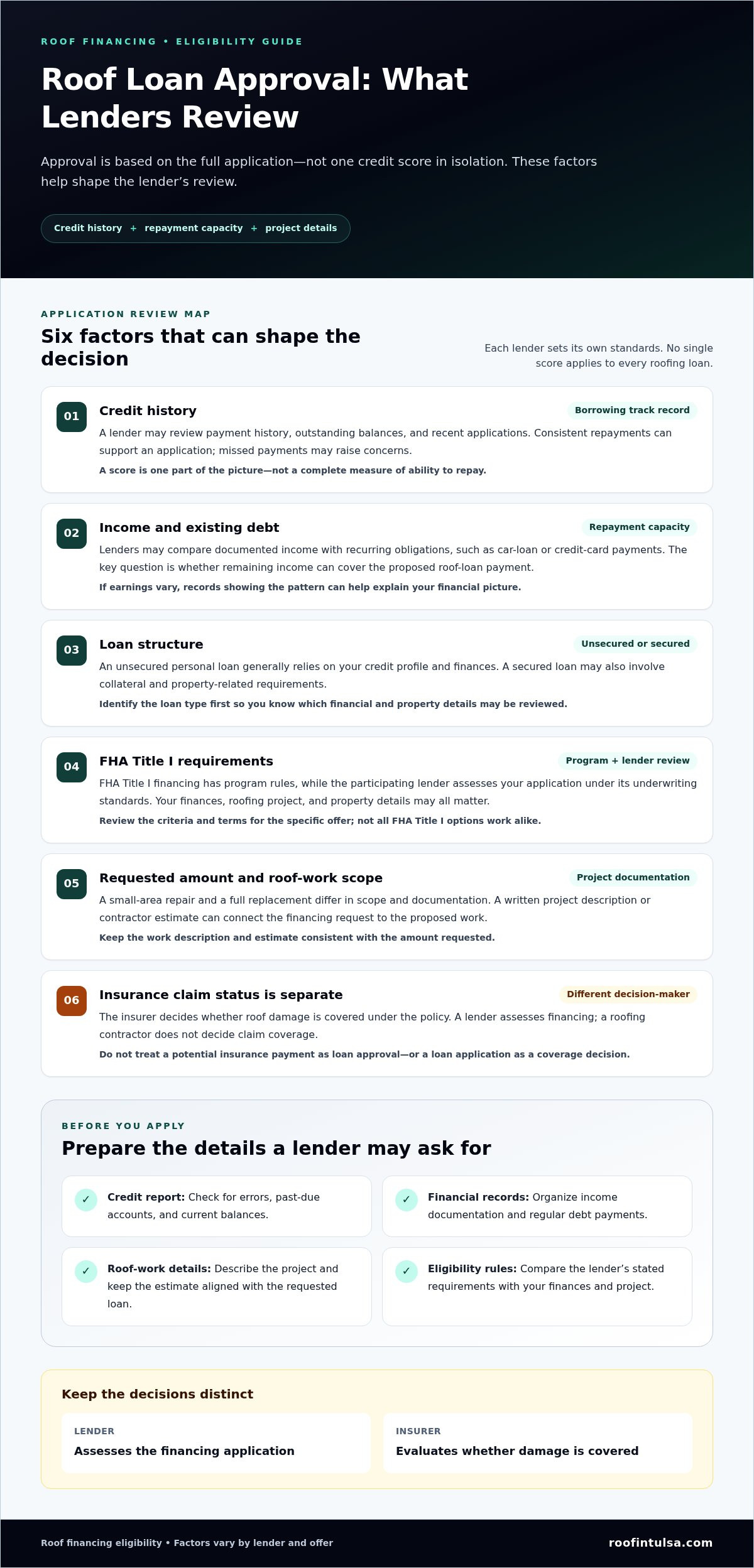
Roof-loan approval usually involves more than a credit score. A lender reviews your credit history, income, existing debts, and requested loan amount. Each lender sets its own approval standards, so no single score applies to every roofing loan. A strong application shows how you’ll manage the new payment alongside your current obligations.
Your credit report shows how you’ve managed borrowing over time. Lenders may consider payment history, outstanding balances, and recent applications. For example, missed payments can raise concerns, while consistent repayments can support an application. Your score is one part of the picture, not a complete measure of your ability to repay.
Income and existing debt help lenders assess your ability to repay. They may compare documented income with recurring obligations, such as car-loan or credit-card payments. If your earnings vary, records showing the pattern can help explain your financial picture. The key question is whether your remaining income can cover the proposed roof-loan payment.
The loan type also affects eligibility. An unsecured personal loan generally relies on your credit profile and finances. A secured loan may also involve collateral and property-related requirements. Before applying, identify the loan structure you’re considering. That makes it easier to understand which financial and property details the lender will review.
For an FHA Title I loan, distinguish the program requirements from the lender’s review. FHA Title I financing has program rules, while the participating lender assesses your application under its underwriting standards. The roof project and property details may matter alongside your finances. Review the eligibility criteria and terms for the specific offer rather than assuming all FHA Title I options work alike.
The roofing work can affect how much you need to borrow. Repairing a small roof area differs in scope and documentation from a full replacement. A written project description or contractor estimate can connect the financing request to the work. Clearly define the proposed work, especially if the project includes separate repairs or upgrades.
Insurance claims involve a separate eligibility decision. The insurer decides whether roof damage is covered under the policy; a roofing contractor does not make that decision. A lender assesses financing, while an insurer evaluates the claim. Don’t treat a potential insurance payment as loan approval or assume a loan application determines claim coverage.
Before applying, gather information that answers the lender’s likely questions:
- Review your credit report for errors, past-due accounts, and current balances.
- Organize income records and a list of regular debt payments.
- Describe the roof work and keep the estimate consistent with the requested loan.
- Compare the lender’s stated eligibility rules with your finances and project.
These steps can help you identify gaps before submitting an application. If your credit file contains an error, address it through the relevant reporting process before relying on the score. If the requested amount seems difficult to repay, compare the project scope with your budget and discuss the financing terms with the lender.
Approval depends on the lender’s assessment of your full application, not one number in isolation. Credit history, income, debt, loan structure, and roofing project details can all influence the decision. Understanding these factors helps you prepare a complete application and compare roof financing choices on their actual terms.
Are there fees, down payments, or prepayment penalties?
Roof-loan costs depend on the financing agreement, not just the advertised interest rate. Review the full offer for lender fees, required upfront funds, repayment terms, and charges for early repayment. These details show how much the financing could cost over the full repayment period. A low introductory rate alone doesn’t explain your total obligation.
Start with the lender’s fee schedule. An offer may include application, origination, documentation, or account-servicing fees. Some fees are added to the balance, while others are due before funding. For example, financing a fee can increase the amount on which interest accrues. Compare the amount available for roofing work with the total balance you would repay.
Ask how each fee is calculated and when it applies. A percentage-based fee can change with the loan amount, while a flat fee stays the same. A late-payment fee may apply if you miss a scheduled payment. Read the agreement to find out what triggers each fee, when it applies, and how it is calculated. Don’t assume an advertised payment includes every possible charge.
A down payment is money you contribute upfront instead of borrowing. Whether one is required depends on the lender, loan structure, and project arrangement. If the lender requires an upfront contribution, clarify when it’s due and how it affects the financed balance. A larger contribution can reduce the principal borrowed, but it also uses funds you might need for other expenses.
Roofing work may involve a deposit or staged payments under the project agreement. Keep those terms separate from the loan terms. A loan may fund the project differently from the contractor’s payment schedule. Before signing, map out when funds become available and when project payments are due. This helps prevent a timing gap between loan disbursement and work-related payments.
Prepayment rules matter if you expect to pay extra or clear the balance early. The agreement should explain whether additional payments reduce the principal, how they’re applied, and whether an early-payoff charge applies. A prepayment penalty can reduce the benefit of paying ahead. If early repayment is part of your plan, compare offers using that scenario, not just the scheduled monthly payment.
Use this review list before accepting an offer:
- Identify every upfront, financed, and ongoing fee.
- Confirm whether a down payment is required and when it’s due.
- Read how extra payments and early payoff are handled.
- Compare the full repayment obligation, not only the stated payment.
- Keep the loan agreement and roofing payment schedule together.
For instance, an offer with no upfront fee could still cost more over time if its interest rate or repayment period differs. Another offer might charge a fee but have terms that better suit your planned payoff. Where possible, compare the same borrowing amount and repayment timeline. That makes the differences easier to see.
For roof financing decisions through Rescue Roofing Tulsa, first clarify the work needed and its payment schedule. A roof inspection can help identify whether a repair or replacement is appropriate before you compare loan terms. Then review the lender’s written disclosures and ask about any fee or payment term you don’t understand.
For Tulsa, Oklahoma comparisons, payment estimates are based on average new-roof costs in local neighborhoods and median home sizes. Keep that basis in mind when reviewing an estimate: it reflects those local inputs, not necessarily the financing terms available for your project. Before deciding whether the estimate applies to your situation, check the written offer for the actual amount financed, required upfront funds, fees, and early-payoff terms.
Use the estimate to guide your questions, not as a substitute for reviewing the agreement. Ask the lender to explain any difference between the estimated and proposed payments, and confirm how fees or an upfront contribution affect the amount you borrow. If you may repay early, check the contract’s prepayment terms too. Comparing the estimate with the written terms can help you assess the offer’s costs and obligations when utilizing conrad’s roofing financing options.
What are the risks and fine print of promotional roofing financing?
A promotional rate can make a roof project seem easier to budget. The written agreement determines what happens after the offer ends. Before accepting, identify the type of promotion, its end date, required payments, and rate afterward. The headline alone doesn’t show your full repayment obligation.
First, distinguish deferred interest from a true introductory rate. With deferred interest, the agreement may require you to pay the promotional balance in full before a deadline. If a balance remains, interest accrued during the promotional period may become due under the stated terms. An introductory-rate offer instead applies its stated rate for a defined period, then switches to the later rate. These structures differ, so read the exact wording.
Next, find the end date and learn how the lender calculates it. The clock might start at account opening, purchase, or another event specified in the agreement. A roof project can have an approval date and a separate funding date. Those dates matter if the promotion period starts before installation or final payment. Record the applicable start and end dates in your budget.
Pay close attention to minimum payments. A required minimum can keep an account current without clearing the promotional balance by the deadline. For example, a homeowner could make every required payment and still owe a large balance when the introductory period ends. Estimate the payoff amount using the agreement’s payment rules, then compare it with what you can afford to pay.
Late or missed payments can have additional consequences. The agreement explains whether a late charge applies, whether the promotional rate can change, and how missed payments affect the account. Don’t assume a missed payment has the same effect with every lender. Find the relevant terms before signing, and set reminders that match the lender’s due dates.
Payment allocation also matters if an account has multiple balances. The lender’s terms explain how payments above the minimum are applied. If promotional and standard-rate balances coexist, the allocation method can affect how quickly each balance falls. Review this section before making extra payments, especially if you’re trying to clear a promotional balance by its deadline.
Use this checklist to examine a roofing-finance promotion:
- Identify whether interest is deferred or reduced during the offer.
- Write down the promotion’s start date and deadline.
- Find the post-promotion rate and the payment calculation method.
- Check late-payment consequences and any account fees.
- Confirm how extra payments are allocated across balances.
- Compare the planned payoff with your monthly budget.
Keep the signed financing agreement with your project paperwork. Match the financed amount to the approved roofing work, then compare each scheduled payment with the promotion deadline. If the estimate, funding, or installation schedule changes, revisit your payoff plan. A calendar reminder well before the deadline gives you time to review the remaining balance and adjust payments.
Promotional financing works best as a written plan, not just an attractive payment claim. Compare the total repayment under the offer with what you’d repay after its introductory period. Review the deadlines, payment allocation, and late-payment terms together. These details show whether the promotion fits your budget and expected repayment schedule.
Roof financing
Roof financing lets homeowners spread project payments over a lender’s repayment schedule. Options may include a personal loan, home equity loan, line of credit, or FHA Title I loan. Each works differently. Compare how funds are approved, delivered, and repaid before choosing financing for roofing work. A useful starting point is to compare available roofing financing options by loan structure and repayment terms.
A personal loan is generally repaid through scheduled payments. The lender reviews your application and sets terms through its underwriting process. A home equity loan or line of credit uses the homeowner’s equity as part of its structure. A loan provides funds under its agreement, while a credit line lets you borrow within an approved limit. These options differ in rates, fees, repayment rules, and collateral.
FHA Title I financing may apply to roofing as a home improvement project. Program requirements and the participating lender’s terms determine how a specific roof project can be financed. Review the loan documents for eligible work, funding arrangements, repayment terms, and property requirements. Don’t assume every Title I offer covers every roofing scope or has identical terms.
Start with the project itself. A roof inspection can help establish whether the work involves a repair or replacement. Then use a written scope of work to define what the financing request covers. For example, a roof-replacement request should correspond to the described replacement work, rather than combining unrelated improvements. A clear scope connects the loan application to the intended project.
Next, compare how the money moves. Determine whether the lender pays the funds to you, the contractor, or another party named in the agreement. Match the funding timing to the project’s payment schedule. If payments are staged, confirm how each one aligns with available loan funds. This practical comparison can help prevent a mismatch between when funds arrive and when project payments are due.
Insurance and financing are separate processes. The insurer decides whether roof damage qualifies for coverage under the policy. A loan application doesn’t determine the claim. If insurance proceeds may contribute to the project, keep the claim and financing records distinct. Build a funding plan around the loan terms and the claim’s actual status, not an assumed payment.
Compare financing options using the same project scope and repayment plan. As you assess various roofing financing options, review these details side by side:
- Loan type and whether the agreement uses collateral.
- How the lender releases or distributes funds.
- Interest, fees, scheduled payments, and total repayment terms.
- Whether extra payments or early payoff change the balance.
- How the loan’s requirements apply to the specific roofing work.
A longer repayment schedule can lower scheduled payments while extending the time you owe. A shorter schedule can require larger payments but may reduce how long the balance remains outstanding. Compare both with your household budget, not just the first payment shown. The agreement’s rate, fees, and payment structure determine the overall financing picture.
To connect the financing decision with the right project scope, request a roof inspection. An inspection can help clarify whether repair or replacement fits the roof’s condition. With that scope in hand, compare loan terms and confirm the financing arrangement covers the work described in the project documents.
Rescue Roofing Tulsa: Residential Roof Replacement
Rescue Roofing Tulsa provides residential roof replacement when a home needs a new roof rather than a repair. If you’re considering financing, a roof inspection can clarify the project scope before you compare loan terms. For localized damage, roof repair may address the problem without a full replacement. The appropriate work depends on the roof’s condition and the area affected.
A clear project description helps align financing with the planned work. Rescue Roofing Tulsa also handles commercial roof replacement, roof repair, and roof inspections. First identify the roofing need, then review financing separately with the lender so the project and repayment terms are clear.
Contact Rescue Roofing Tulsa to discuss your roofing project.
Make the Next Roofing Decision With Confidence
Before choosing financing, make sure the project is clearly defined. A sound decision about Conrad’s roofing financing options starts with knowing whether the roof needs repair or replacement, then matching the financing terms to that work. Keeping the project scope and loan agreement separate helps you understand what the lender is financing and what the roofing work includes.
Rescue Roofing Tulsa offers residential and commercial roof replacement, along with roof repair. If the roof’s condition is uncertain, an inspection can help establish what work to consider. The appropriate next step depends on the property and roofing issue, not on a financing promotion alone.
Bring your project questions to a roofing professional, and review the financing terms directly with the lender. That gives you a clearer basis for deciding what work to proceed with and how to plan for it.
Contact Rescue Roofing Tulsa today to discuss your roofing project and take the next step with greater clarity.