



If a record-breaking hailstorm hits Tulsa tomorrow, will your roofing contractor still be in town when you need a warranty repair two years from now? It’s a heavy question that many local business owners grapple with after a severe weather event. You likely feel the pressure to restore your property quickly, yet the fear of hiring a fly-by-night operation is very real. Knowing exactly what to look for in a commercial roofer, such as a valid Oklahoma commercial endorsement and $1,000,000 in liability insurance, is the best way to replace that anxiety with confidence. It’s about finding a partner who understands that your roof is a long-term investment.
You deserve a durable roof that stands up to Oklahoma’s intense wind and freeze-thaw cycles without the administrative headaches. This guide will help you discover the critical criteria for selecting a commercial roofing partner that protects your investment against Oklahoma’s unique climate challenges. We’ll clear up the confusion between materials like TPO and PVC and simplify the insurance claim process. You’ll also learn how to minimize liability by choosing a safety-conscious contractor who follows rigorous standards. By the end of this article, you’ll have a clear roadmap to a secure, stress-free roofing project.
Key Takeaways
- Understand how Tulsa’s unique climate impacts commercial flat roofs and why specialized systems are necessary for long-term durability.
- Learn exactly what to look for in a commercial roofer, including mandatory Oklahoma state licensing and minimum liability insurance requirements.
- Identify the technical differences between materials like TPO and PVC to ensure your roof handles drainage and ponding water effectively.
- Discover how professional insurance claim assistance can simplify the administrative burden and protect your financial investment after a storm.
- Recognize the value of a local partner who provides 24/7 emergency response to keep your business operational when weather events occur.
Understanding the Stakes: Why Commercial Roofing in Tulsa is Different
Commercial roofing is a high-stakes engineering challenge. It’s far more than just a larger version of a residential project. For Tulsa business owners, the roof is the first line of defense for expensive inventory, heavy machinery, and the safety of your employees. A failure here doesn’t just mean a leak; it can mean a total halt in operations. When you’re evaluating what to look for in a commercial roofer, you aren’t just hiring a vendor for a one-time fix. You’re looking for a long-term partner who understands the local landscape and the financial weight of your facility.
The Tulsa Weather Factor: Hail, Wind, and Heat
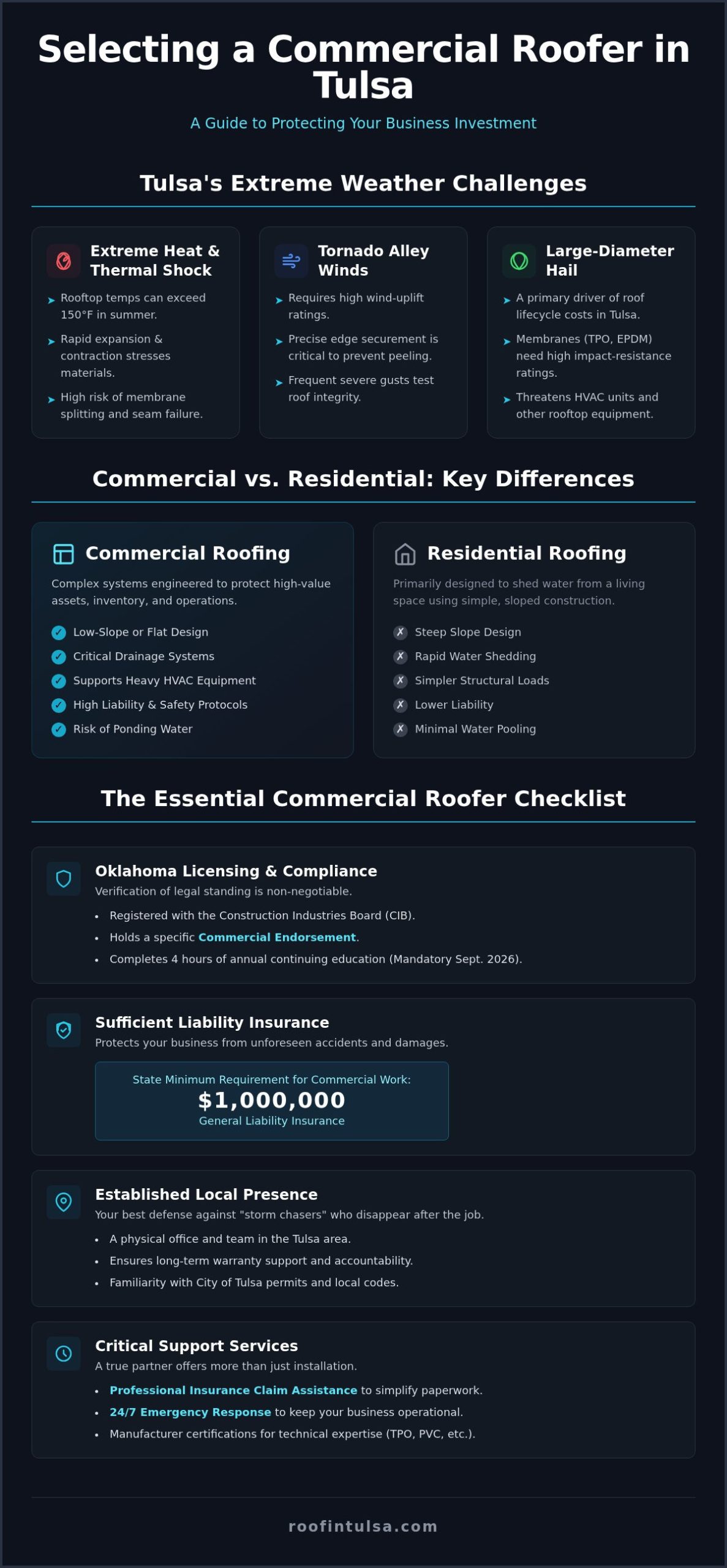
Tulsa sits in the heart of Tornado Alley, which means our commercial buildings face some of the most punishing weather in the country. Extreme temperature fluctuations are a major concern. Oklahoma summers can see rooftop temperatures soar above 150°F, followed by rapid cooling during evening thunderstorms. This constant expansion and contraction, known as thermal shock, puts immense stress on commercial membranes. Over time, this can lead to splitting or seam failure if the material isn’t high quality.
Large-diameter hail is another primary driver of lifecycle costs here. Systems like TPO and EPDM must be specifically rated for impact resistance to survive a typical Tulsa spring. Additionally, high-wind events require precise edge securement and high wind-uplift ratings. Without these local adjustments, a standard flat roof can easily peel away during a severe gust. A local expert knows these risks aren’t theoretical; they’re an annual reality for our community.
Commercial vs. Residential: Scale and Complexity
The structural requirements of a commercial building are vastly different from a house. While residential roofs are designed to shed water quickly via steep slopes, commercial systems are often low-slope or flat. This changes the fundamental roof construction principles that a contractor must apply. Proper drainage is the difference between a roof that lasts 20 years and one that fails in five due to ponding water. Commercial roofs also act as platforms for heavy equipment like HVAC units, which requires specialized knowledge of penetrations and load-bearing capacities.
Scale isn’t the only factor. There is a much higher level of liability involved in commercial work. High-traffic retail sites or busy warehouses require a safety-conscious team that understands how to minimize risks to your customers and staff during construction. Choosing a contractor who prioritizes this level of professionalism is a critical part of what to look for in a commercial roofer. You need a team that respects your operational needs and works to keep your business running safely throughout the project.
Essential Credentials: The Commercial Roofer’s Checklist
Hiring a contractor after a major Oklahoma storm can feel like a gamble. You’re likely balancing the need for speed with the fear of a poor installation. Identifying what to look for in a commercial roofer starts with verifying their legal standing and local reputation. A local physical presence, such as an office right here in Tulsa at 7310 E 71st St, is your first line of defense against “storm chasers” who disappear once the check clears. This local connection ensures you have a neighbor to call if you need support years down the line.
Local Licensing and Oklahoma Compliance
In Oklahoma, commercial roofing isn’t just a trade; it’s a strictly regulated profession. All contractors must be registered with the Construction Industries Board (CIB) and hold a specific commercial endorsement. As of September 2026, these professionals are required to complete four hours of continuing education every year to maintain their credentials. This ensures they stay current on evolving building codes and safety standards that affect your property.
Check that your contractor carries at least $1,000,000 in general liability insurance, which is the state minimum for commercial work. Hiring a team with deep roots in the City of Tulsa permit history guarantees they understand local zoning and code enforcement. This local expertise prevents costly delays and ensures your project meets every municipal requirement from day one. It’s about more than just a roof; it’s about staying compliant with Oklahoma law.
Manufacturer Certifications and Training
Technical skill is best verified through manufacturer certifications. These aren’t just badges of honor; they are requirements for high-level protections like No Dollar Limit (NDL) warranties. When a contractor achieves master-level status with manufacturers like GAF or Elevate, it means they’ve undergone rigorous factory training and regular inspections. This status allows them to offer warranties that the manufacturer themselves will back, even if the contracting company were to close.
If you’re curious about how these systems differ, you can find more details in our guide to Commercial Roofing in Tulsa. These certifications prove the team has the specialized tools and knowledge to handle complex low-slope installations correctly. It shows a commitment to professional growth and a mastery of the specific materials being installed on your building.
Finally, assess their safety record. A reputable company will have clear, written protocols that align with OSHA safety guidelines. This is a non-negotiable factor when deciding what to look for in a commercial roofer, as it protects your business from the massive liability risks associated with rooftop accidents. If you need a partner who prioritizes these standards, reach out to our team today for a professional assessment of your facility.
Evaluating Technical Expertise: Materials and Methods
Technical expertise is more than just knowing how to roll out a membrane. It involves a deep understanding of how different systems interact with your building’s unique structure. When you’re deciding what to look for in a commercial roofer, start by asking about their diagnostic process. A truly professional contractor won’t just guess where a leak is. They use advanced tools like infrared moisture detection to find hidden pockets of water trapped within the insulation. This precision saves you money by preventing the unnecessary replacement of dry, functional materials.
Energy efficiency is another critical technical factor. Proper insulation and a high R-value are essential for keeping your cooling costs manageable during intense Oklahoma summers. A safety-conscious contractor will ensure your system meets current energy codes while also addressing drainage. Tulsa’s heavy spring rains mean that ponding water is a constant threat to flat roofs. Your roofer must have a clear plan for creating proper slopes or installing tapered insulation to ensure water moves toward the drains rather than sitting on your membrane.
Flat Roof Specialists: TPO, PVC, and Beyond
TPO and EPDM are the most common commercial roofing materials used in Oklahoma. TPO is highly popular for its heat-reflective properties, which can significantly lower your energy bills. However, if you own a restaurant or a facility that exhausts chemicals, PVC might be the better choice due to its superior resistance to grease and oils. In some cases, a standing seam metal roof may be the best long-term investment for a Tulsa property due to its extreme durability. For a deeper dive into these options, you can review our checklist for flat roofing contractors.
Maintenance and Restoration Capabilities
A dependable roofing partner looks for ways to extend the life of your existing roof rather than always pushing for a full replacement. Restoration is often a viable path. High-quality commercial roof coatings can seal minor leaks and provide a fresh reflective surface, potentially adding a decade or more to the system’s lifespan. This approach is far less disruptive to your daily operations and much easier on your budget.
Proactive care is the only way to avoid emergency failures. Regular inspections of flashings, seams, and sealants can catch small issues before they become disasters. If you’ve noticed small leaks or signs of wear, addressing them through targeted commercial roof repairs is a smart way to protect your building without the cost of a total overhaul. We focus on these sustainable solutions to help you manage your facility with calm confidence.
The Administrative Side: Insurance, Warranties, and Claims
The physical roof is only half the battle. The other half is the mountain of paperwork that follows a storm. When you’re deciding what to look for in a commercial roofer, you must prioritize contractors who offer professional insurance claim assistance. A roofer who understands the administrative side can be the difference between a fully covered replacement and a massive out-of-pocket expense. You need a partner who provides transparent bidding and detailed documentation that speaks the language of insurance adjusters.
Navigating the Commercial Insurance Claim Process
Documenting storm damage for a commercial claim requires a methodical approach. It starts with a comprehensive inspection that captures high-resolution photos of hail impacts, wind-lifted seams, and compromised flashings. A qualified roofer should be present during the meeting with your insurance adjuster to ensure no damage is overlooked. We specialize in handling this administrative burden for our Tulsa clients, providing the technical data adjusters need to process claims accurately. This collaborative approach removes the stress from your shoulders and keeps your project moving forward without unnecessary delays.
Decoding Commercial Warranties
Warranties are often misunderstood, but they are vital for protecting your long-term budget. The gold standard in our industry is the No Dollar Limit (NDL) warranty. Unlike standard prorated warranties, an NDL warranty covers the full cost of repairs or replacement for a set period, regardless of the rising cost of materials or labor. It’s also important to distinguish between a material warranty, which covers defects in the product, and a workmanship warranty, which covers the installation itself.
A manufacturer’s material warranty is essential, but it won’t help if the leaks are caused by poor sealing around an HVAC unit. That’s where a strong workmanship warranty comes in. Ultimately, a warranty is only as good as the company’s local longevity. If a contractor isn’t around in five years, their “lifetime” guarantee is worthless. You need a local partner with a physical office in Tulsa who will be here to honor their promises. If you’re overwhelmed by the claim process, our team can help you manage the paperwork and restore your property. Contact us for professional insurance claim assistance today.
Making the Final Decision: The Rescue Roofing Advantage
Choosing a commercial roofing partner is a decision that impacts your business for decades. It’s the final step in securing your facility against the unpredictable Oklahoma elements. When you evaluate what to look for in a commercial roofer, the most important trait is a deep, unshakeable commitment to the local community. Rescue Roofing Tulsa isn’t a national chain with a temporary permit. We are your neighbors. Our physical office is right here in town, and our reputation is built on the trust of local business owners who value reliability.
We understand that roofing emergencies don’t wait for standard business hours. That’s why we provide 24/7 emergency response for our commercial clients. If a storm causes a sudden leak at 3:00 AM, you need a team that will answer the phone and arrive quickly to mitigate damage. This level of dependability is a cornerstone of our service. We aim to replace the stress of property maintenance with the calm confidence that comes from professional, local support. You can rest easy knowing a solution is always a phone call away.
Communication and Project Management
Successful commercial projects require more than just technical skill. They require precise coordination and clear communication. We assign a dedicated project manager to every commercial job. This professional serves as your single point of contact, ensuring you’re never left wondering about the status of your roof. Their job is to manage the crew, coordinate with your facility staff, and ensure the project stays on schedule without compromising on safety.
We know your business can’t simply stop because of a construction project. Our teams are trained to ensure minimal disruption to your daily operations. We manage debris, control noise levels, and maintain a clean job site to keep your customers and employees safe. Once the work is complete, we conduct a rigorous final walkthrough. This quality assurance process ensures every flashing, seam, and drain meets our high standards before we consider the job done. It’s our way of proving that we stand behind every square foot of material we install.
Get Started with a Local Tulsa Expert
You deserve a roofing partner who treats your building as if it were their own. We combine industry-standard certifications with the personalized touch of a locally owned business. Our goal is to make the process as simple as possible for you. From the first inspection to the final insurance document, we handle the heavy lifting so you don’t have to. We believe in building relationships, not just roofs.
If you’re ready to protect your investment, the process is straightforward. You can start by getting a commercial roofing quote through our website. We’ll provide a transparent, detailed estimate that outlines exactly what your building needs to stay weather-tight. Don’t wait for the next storm to test your roof’s integrity. Contact Rescue Roofing Tulsa today for your commercial roof inspection.
Protect Your Facility with Tulsa’s Trusted Roofing Partner
Your commercial roof is a major investment that requires more than just a quick fix after a storm. It needs a partner who understands the local climate and the complex legal requirements of the Oklahoma Construction Industries Board. We’ve explored the critical technical details and the administrative hurdles that define what to look for in a commercial roofer. From selecting the right TPO membrane to navigating the intricate insurance claim process, the right choice ensures your business stays operational. It’s about more than just construction; it’s about long-term peace of mind.
As a locally owned and operated business in Tulsa, we are committed to being the neighbor you can count on. We provide expert insurance claim assistance to handle the paperwork for you and offer 24/7 emergency service to protect your inventory when time is of the essence. Don’t leave your property’s safety to chance. Secure Your Business with a Professional Commercial Roof Inspection. We look forward to helping you build a more resilient future for your business.
Frequently Asked Questions
What is the most durable commercial roofing material for Tulsa’s weather?
TPO (Thermoplastic Olefin) is often cited as the most durable and cost-effective option for Tulsa’s climate due to its UV resistance and heat-reflective properties. EPDM is also highly resilient against hail. However, the best material depends on your building’s specific structural needs and budget. A professional assessment can help you decide which membrane offers the longest life for your specific property. We always recommend materials that withstand Oklahoma’s intense freeze-thaw cycles.
How do I know if my commercial roof needs a repair or a full replacement?
A full replacement is usually necessary if more than 25% of the roof surface is damaged or if there are widespread moisture issues in the insulation. Minor leaks, localized punctures, or aging flashings can often be addressed through targeted repairs. If your roof is approaching the end of its 20-year lifespan, a replacement is often more cost-effective than continuous patching. We provide comprehensive inspections to help you make this determination with confidence.
Can a commercial roofer help me with my insurance claim for hail damage?
Yes, professional contractors like Rescue Roofing Tulsa specialize in insurance claim assistance to simplify the administrative process for you. We document every hail impact and wind-lifted seam with high-resolution photos to provide the data adjusters need. Having an expert present during the adjuster’s walkthrough ensures that all damage is accurately identified. This support helps you maximize your coverage while minimizing the stress of managing the paperwork yourself after a major storm hits.
How long does a typical commercial roof replacement take in Tulsa?
Most commercial roof replacements in the Tulsa area take between one and three weeks to complete. The exact timeline depends on the building’s square footage, the complexity of rooftop equipment, and the current weather conditions. We prioritize efficient project management to ensure minimal disruption to your daily business operations. Your dedicated project manager will provide a specific schedule and daily updates until the final walkthrough and quality assurance check are finished.
What is an NDL warranty, and do I need one for my business?
An NDL (No Dollar Limit) warranty is a high-level protection plan that covers the full cost of labor and materials for repairs without a financial cap. This is a critical factor in what to look for in a commercial roofer because it protects you from rising inflation and material costs. While these warranties often require master-level manufacturer certifications, they provide the most robust long-term security for your commercial asset and your bottom line.
How often should I have my commercial roof inspected?
You should have your commercial roof inspected at least twice a year, typically in the spring and fall. Additionally, it’s vital to schedule a professional inspection after any major Oklahoma storm involving high winds or large hail. Regular checkups allow you to catch small issues like clogged drains or minor punctures before they turn into expensive structural failures. Proactive maintenance is the most effective way to extend the lifespan of your roofing system.
Are there energy-efficient commercial roofing options that qualify for tax credits?
Yes, “cool roof” systems like white TPO and PVC membranes are highly energy-efficient and may qualify for federal tax deductions under Section 179D. These materials reflect a high percentage of solar radiation, which significantly lowers your building’s cooling costs during Tulsa’s intense summers. You should consult with a tax professional to see which current incentives apply to your specific building and location. These systems offer both immediate savings and long-term environmental benefits.
What should be included in a commercial roofing maintenance plan?
A comprehensive maintenance plan should include debris removal from drains and gutters, inspection of all flashings, and the resealing of any compromised penetrations. It should also involve documenting the roof’s condition over time to support future insurance claims or warranty requests. Regular maintenance prevents ponding water and seam failures, which are common issues in Oklahoma. Investing in a structured plan is a smart way to protect your building’s interior and avoid expensive premature replacement.