



Table of Contents
- How to Find Reliable Roofers in Tulsa
- Verify Licensing and Insurance: Tulsa Roofing Contractor License Requirements
- Check Better Business Bureau Accreditation and Reviews
- How to Spot a Storm Chasing Roofer and Avoid Scams
- Understanding Roof Replacement Cost in Tulsa
- Questions to Ask Before Hiring a Roofing Contractor
- Insurance Claims and Contractor Support
- Conclusion
Last Updated: August 8, 2026
How to Find Reliable Roofers in Tulsa
Finding reliable roofers in Tulsa requires more than a quick Google search. Homeowners face a genuine challenge: distinguishing between contractors who’ll deliver quality work and those who vanish after collecting payment. The stakes are high. A bad roof installation or repair doesn’t just cost money, it exposes your home to water damage, structural problems, and years of regret.
At Rescue Roofing, we’ve worked with homeowners navigating this exact problem. The process doesn’t have to be overwhelming. What separates a smart hire from a costly mistake comes down to verification, due diligence, and asking the right questions upfront.
This guide walks you through the essential steps to vet roofing contractors in Tulsa. You’ll learn how to check licensing and insurance, spot red flags that signal scams, understand what questions separate serious professionals from fly-by-night operators, and navigate the insurance claim process if storm damage triggered your repair need.
The most common mistake homeowners make is hiring based on price alone. A contractor 20% cheaper than others often cuts corners on materials, labor, or both. Verify credentials first, ask detailed questions second, and compare pricing third.
Verify Licensing and Insurance: Tulsa Roofing Contractor License Requirements
Oklahoma requires roofing contractors to hold a valid license issued by the Oklahoma Construction Industries Board. This isn’t optional, it’s the law. A licensed contractor has passed examinations, maintains bonding, and is subject to regulatory oversight. An unlicensed operator has none of these safeguards.
Before scheduling an estimate, ask for the contractor’s license number. Then verify it directly through the Oklahoma Construction Industries Board website. This takes five minutes and eliminates a massive category of risk. You’re confirming the person you’re hiring is legally authorized to perform roofing work in Oklahoma.
Insurance is equally critical. Request both general liability insurance and workers’ compensation coverage. General liability protects your property if the contractor damages something during the job. Workers’ compensation covers their crew if someone gets injured on your roof. Without workers’ comp, you could be liable for medical bills and lost wages if an uninsured worker gets hurt.
Ask for certificates of insurance directly from the contractor’s insurance provider, not just a document they hand you. Call the insurance company to confirm coverage is current. This verification step takes ten minutes and prevents a scenario where you discover mid-project that the contractor’s coverage lapsed three months ago.
(/blog/tulsa-roofing-company-with-long-term-warranty-a-homeowners-guide-to-2026-protection/) Contractor License Requirements]
Many homeowners skip this step because it feels tedious. It’s not. It’s the difference between hiring a legitimate business and gambling with your home.
Request the contractor’s license number and insurance information in writing before the first estimate. A reputable contractor will provide these details immediately without hesitation. If they dodge the question or claim they’ll “bring it later,” move on.
Check Better Business Bureau Accreditation and Reviews
The Better Business Bureau maintains profiles for businesses in the Tulsa area. A BBB accreditation signals that a contractor has committed to ethical business practices and meets specific standards for transparency, honesty, and customer service. Not all good contractors are BBB accredited, but accreditation is a positive signal.
Check the contractor’s BBB rating and complaint history. Look beyond the letter grade. Read actual complaints. How did the contractor respond? Did they resolve issues or dismiss customers? A contractor with an A+ rating but no complaints is less revealing than one with an A rating who received complaints and resolved them professionally.
Google reviews, Angi, and Thumbtack provide additional data points. Read reviews with skepticism, look for patterns rather than individual opinions. If five reviews mention slow communication, that’s a pattern. If one review complains about price and the rest praise the work, that single complaint is less meaningful.
Pay attention to reviews that describe specific problems and outcomes. "Great work" tells you less than "The crew finished on schedule, cleaned up daily, and the roof hasn’t leaked in two years." Specific reviews are more credible than generic praise.
Be cautious of contractors with no online reviews at all. In 2026, most legitimate businesses have some digital footprint. Zero reviews can indicate a brand-new operation (sometimes fine) or a contractor deliberately avoiding accountability (red flag).
How to Spot a Storm Chasing Roofer and Avoid Scams
Storm chasers are contractors who follow severe weather events, hail storms, tornadoes, high winds, and aggressively solicit homeowners in affected areas. Some operate legitimately. Many don’t.
The most common storm chaser tactic: showing up at your door unsolicited after a storm, claiming to have "noticed damage" from the street, and pressure you to sign a contract immediately. They’ll often offer to handle the insurance claim for you, which sounds helpful but creates a conflict of interest. Their goal becomes maximizing the insurance payout, not getting your roof repaired at fair cost.
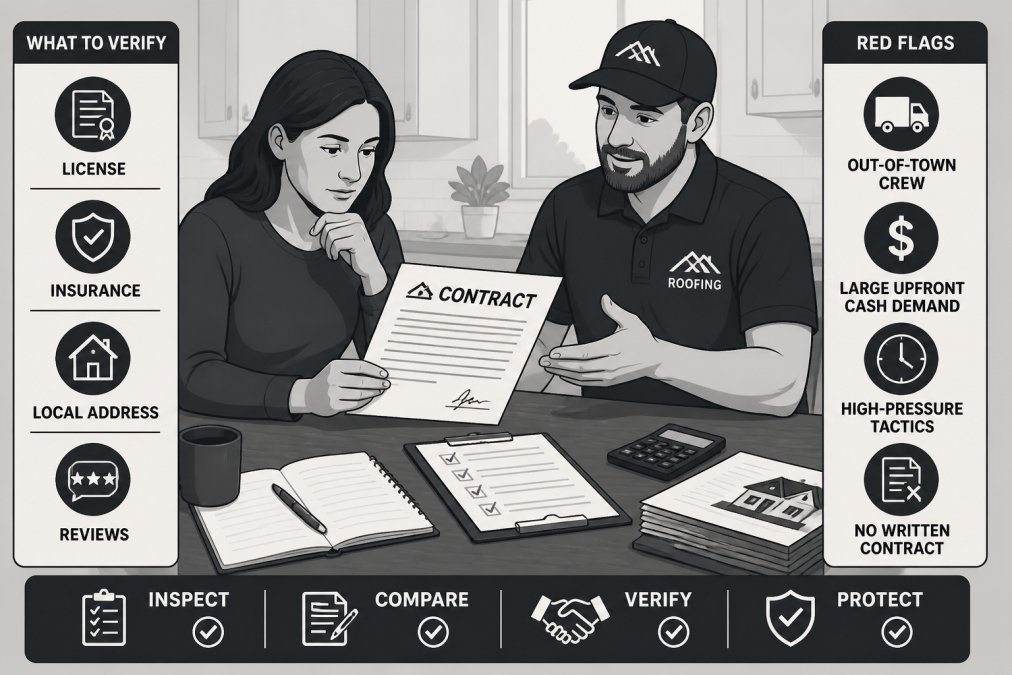
Red flags that signal a storm chasing or predatory contractor:
- They pressure you to sign a contract the same day
- They guarantee they can get insurance to pay for everything
- They offer to cover your deductible (often illegal in Oklahoma)
- They claim to have "special relationships" with insurance adjusters
- They won’t provide references from your own neighborhood
- They pressure you to use their preferred suppliers or subcontractors
- They demand cash payment or ask you to pay them before the insurance check arrives
Legitimate contractors don’t need to pressure you. They have steady work from referrals and established reputation. If a contractor is being aggressive, that’s a sign they’re not confident in their ability to earn your business through quality and professionalism.
After a major storm, take time before hiring. Get multiple estimates. Check licensing and insurance for each contractor. Call references. A reputable contractor will understand that homeowners need time to make an informed decision.
Understanding Roof Replacement Cost in Tulsa
Roof replacement cost in Tulsa varies based on several factors: roof size, material choice, complexity of the roof structure, and local labor rates. A single-story ranch home with a simple roof will cost significantly less than a two-story home with multiple peaks and valleys.
Material choice drives major cost differences. Asphalt shingles are the most affordable option and the most common in Tulsa. Metal roofing costs more upfront but lasts longer and requires less maintenance. Tile or slate are premium options with even higher price tags.
The best approach: get three to five detailed estimates from licensed contractors. Ensure each estimate breaks down labor, materials, and any additional costs separately. This transparency lets you compare apples to apples. One contractor’s estimate at $12,000 might include premium shingles and full roof inspection, while another at $9,000 might use standard materials and skip the inspection.
Ask each contractor to specify:
- The exact roofing material and brand they’ll use
- Whether they’ll remove old roofing or install over it
- Warranty terms (labor warranty and material warranty)
- Timeline for completion
- Whether they’ll handle permit acquisition
Don’t automatically choose the cheapest estimate. Contractors who underbid often cut corners, using cheaper materials, rushing the job, or leaving cleanup incomplete. The middle-range estimate from a reputable contractor usually offers the best value.
Roof replacement often qualifies for insurance coverage if storm damage is documented. Before paying out of pocket, contact your insurance company. Many homeowners discover they have coverage they didn’t know about.
Questions to Ask Before Hiring a Roofing Contractor
The right questions reveal whether a contractor is thorough, communicative, and genuinely interested in solving your problem.
About their experience:
- How long have you been in business?
- How many roofs similar to mine have you completed?
- Can you provide references from homeowners in my area?
- Are you insured and licensed? (Confirm the details yourself afterward.)
About the specific project:
- What’s your assessment of my roof’s condition? (A good contractor will explain what they see, not just recommend replacement.)
- What material do you recommend and why?
- What’s your timeline for this project?
- Will you handle permit acquisition?
- What warranty do you offer on labor and materials?
About communication and process:
- How will you keep me informed during the project?
- Who will I contact if I have questions or concerns?
- How do you handle unexpected issues discovered during work?
- What’s your process if I want to stop work and get a second opinion?
About insurance claims (if applicable):
- Have you worked with insurance companies on similar claims?
- Will you communicate directly with my insurance adjuster?
- Do you handle the full claim process, or do I manage it?
- What happens if the insurance payout doesn’t cover your estimate?
A contractor who answers these questions clearly and doesn’t pressure you is showing respect for your decision-making process. A contractor who rushes answers or dismisses questions is signaling they’re not invested in your satisfaction.
Insurance Claims and Contractor Support
If a storm damaged your roof, your homeowners insurance likely covers repairs or replacement. The process involves several steps: documenting the damage, filing a claim, having an adjuster inspect the damage, and receiving an insurance payout.
A good contractor simplifies this process. They’ll help document damage with photos and detailed descriptions. They’ll communicate directly with your insurance adjuster, explaining the damage and why specific repairs are necessary. They’ll answer the adjuster’s technical questions so you don’t have to become a roofing expert overnight.
Be cautious of contractors who promise to "handle everything" with insurance. While communication is valuable, you remain the policyholder and decision-maker. The contractor works for you, not the insurance company. Their job is to repair your roof properly, not to maximize the payout at the expense of quality.
If the insurance payout is less than the contractor’s estimate, you have options. You can pay the difference out of pocket, negotiate with the contractor to reduce scope, or get a second opinion on whether the damage truly requires the full repair the contractor recommends.
Rescue Roofing assists with the entire insurance claim process, from initial documentation through final communication with adjusters. This support removes stress from an already difficult situation and ensures your claim is handled professionally.
| Step | What Happens | Your Role |
|---|---|---|
| Documentation | Contractor photographs damage and creates detailed report | Review and approve documentation |
| Claim Filing | You contact insurance and file claim | Provide claim details and photos |
| Adjuster Inspection | Insurance adjuster visits to assess damage | Be present, point out damage areas |
| Estimate Review | Contractor and adjuster discuss repair scope | Ask questions if estimates differ |
| Payout | Insurance issues check for approved repairs | Decide on payment and contractor authorization |
| Repair | Contractor completes work per approved scope | Inspect work and approve final payment |
Conclusion
Finding reliable roofers in Tulsa comes down to verification, communication, and patience. Check licensing and insurance, review BBB accreditation and customer feedback, spot the red flags that signal predatory contractors, and ask detailed questions before signing anything. Don’t rush the decision. A few hours of diligent vetting prevents months of regret.
When storm damage or roof deterioration forces your hand, Rescue Roofing handles the complexity. We provide accurate aerial quotes, manage insurance claims from start to finish, and communicate directly with adjusters so you don’t have to navigate the process alone. Our team is available 24 hours for emergencies and offers flexible financing to make roof repairs and replacements accessible. Call Rescue Roofing today for a professional inspection and transparent estimate.
Oklahoma Construction Industries Board licensing verification
Better Business Bureau Tulsa area business profiles
Homeowners Insurance Institute guidance on roof damage claims
Frequently Asked Questions
How can I verify that a roofing contractor in Tulsa is properly licensed and insured?
Contact the Oklahoma Construction Industries Board to confirm the contractor holds a valid roofing license. Request proof of general liability and workers' compensation insurance directly from the contractor, and verify the policy is current with the insurance provider. Licensed and insured contractors provide this information readily. A reliable roofer will have no hesitation sharing these credentials, which protects both you and their workers.
What is the typical roof replacement cost in Tulsa, and what factors affect pricing?
Roof replacement cost in Tulsa depends on roof size (measured in squares), materials chosen (asphalt shingles, metal roofing, etc.), roof pitch, existing damage, and local labor rates. A professional roofing contractor will conduct a thorough inspection and provide an accurate estimate. Request quotes from multiple contractors to compare pricing. Financing options are often available to spread costs over time, making replacement more manageable for your budget.
How do I spot a storm chasing roofer and protect myself from roofing scams?
Storm chasing roofers typically appear after severe weather, use high-pressure sales tactics, demand large upfront payments, and lack local business history. Verify the contractor has been operating in Tulsa for several years, check their Better Business Bureau rating and complaint history, and never pay the full amount before work begins. Legitimate contractors provide transparent estimates, carry proper insurance, and have established local reputations backed by customer reviews.
What questions should I ask a roofing contractor before hiring them?
Ask about their licensing and insurance, how long they've served the Tulsa area, their warranty on workmanship and materials, project timeline, how they'll handle unexpected damage discovered during work, their experience with insurance claims, and whether they offer financing. Request references from recent projects and ask to see examples of their work. Understanding their process for communication with insurance adjusters is also critical if you're filing a claim.
Will a roofing contractor help me with my insurance claim, or will I be on my own?
Some roofing contractors provide full insurance claim support, including communication with adjusters and documentation of damage. This support varies by contractor, so ask directly about their claims assistance process before hiring. A contractor experienced in storm damage restoration can guide you through the claim process, help photograph damage, and coordinate with your insurance company to ensure fair assessment and coverage.
This article was written using GrandRanker