




Would you rather spend your morning reviewing a predictable five-year budget or fielding emergency calls because a midnight hailstorm just turned your warehouse ceiling into a sieve? In our corner of Oklahoma, the question isn’t if a severe weather event will happen, but how much it will cost your business when it does. Many local property owners feel trapped in a cycle of reactive repairs and unexpected budget spikes that drain resources. Implementing a commercial roof asset management plan is the most effective way to break that cycle and regain control over your facility’s most critical asset.
We understand the anxiety that comes with conflicting contractor advice and the frustration of losing track of vital warranty documentation. You deserve a clear, professional path forward that protects your investment and your peace of mind. This 2026 guide provides a strategic roadmap to help you transition from emergency fixes to proactive care. You will learn how to maximize the service life of your existing TPO or metal roof, simplify your insurance claim process with documented proof of maintenance, and finally achieve the financial stability of a documented ten-year roofing budget.
Key Takeaways
- Learn how a commercial roof asset management plan transforms unpredictable repair spikes into a stable, five-year financial roadmap for your property.
- Discover the five essential elements of a high-performance strategy, including why a comprehensive roof inventory is the foundation of asset protection.
- Understand the “Emergency Premium” and how proactive maintenance prevents the most common causes of flat roof failure in commercial buildings.
- Identify the specific ways Tulsa’s extreme thermal cycling and hail seasons stress your roof seams and how to implement effective post-storm protocols.
- See why local expertise and documented maintenance records are your strongest assets when filing insurance claims or extending the life of TPO and metal roofs.
What is a Commercial Roof Asset Management Plan and Why Does It Matter?
A commercial roof asset management plan is a proactive strategy for tracking, maintaining, and budgeting for your facility’s roofing assets over their entire lifespan. Instead of waiting for a ceiling to drip or a warehouse floor to flood, you use a documented system to monitor every seam, drain, and warranty date. By adopting a commercial roof asset management plan, you shift your facility management from a reactive model, where you fix leaks after damage occurs, to a proactive model, where you prevent them entirely. This shift isn’t just about maintenance; it’s about changing how you view your roof from an occasional headache to a managed financial asset.
In Tulsa’s 2026 economic climate, property owners face rising operational costs and a need for extreme budget predictability. You can’t afford a six-figure “surprise” repair bill in the middle of a fiscal year. A documented plan provides the data you need to forecast expenses years in advance. This documentation also serves as vital evidence for insurance adjusters after severe Oklahoma storm events. When you can show a clear history of professional care, you prove that you’ve met your “duty of care” as a property owner. This often leads to smoother claim approvals and protects you from accusations of “pre-existing neglect” that adjusters sometimes use to deny coverage.
The Financial Impact of Asset Management
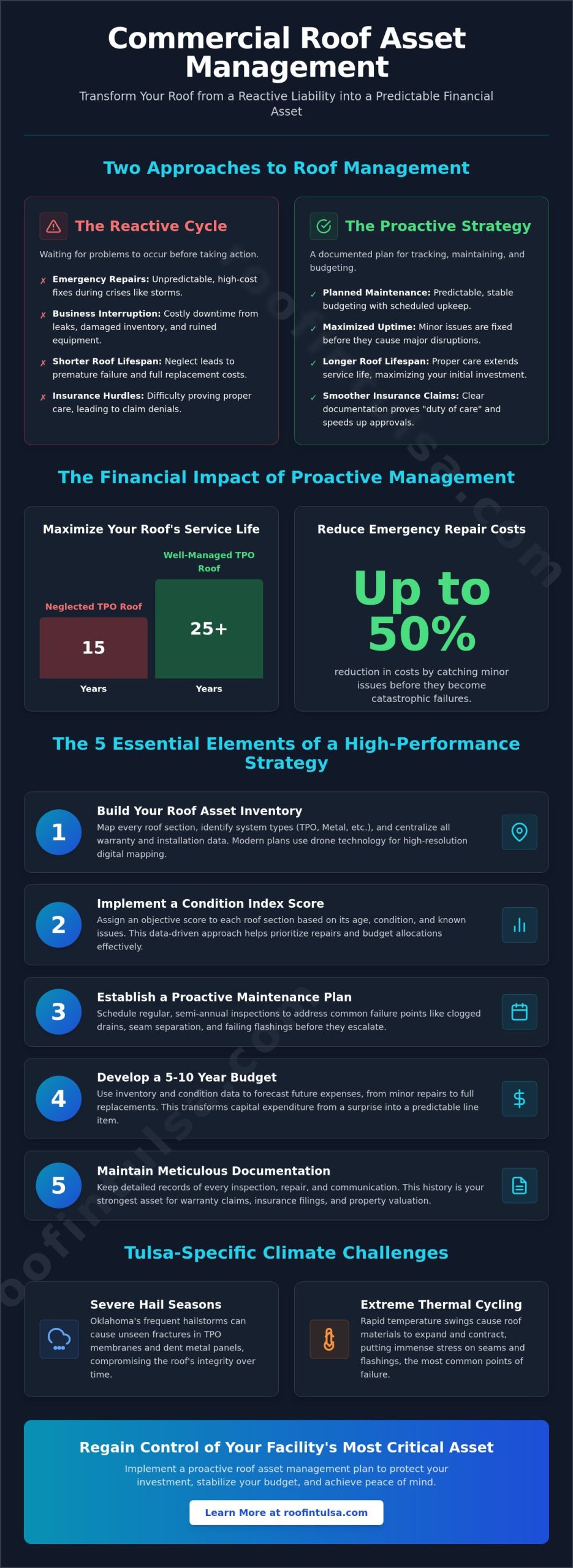
Proper management significantly extends a roof’s useful life. A neglected TPO system might only last 15 years before requiring a full tear-off, while a well-managed system can easily reach 25 years of service. Some industry professionals report that planned maintenance can reduce emergency repair costs by up to 50% because technicians catch minor issues before they escalate into structural failures. Life Cycle Cost (LCC) represents the total financial investment in a roofing system from the day of installation through its final removal, including all maintenance and repair expenses. By lowering your LCC, you keep more capital available for your core business operations.
Protecting Your Tulsa Business from ‘The Surprise Leak’
A surprise leak is rarely just a roofing problem; it’s a major business interruption. The hidden costs of downtime include damaged inventory, ruined electronics, and frustrated tenants who may eventually look for more reliable space. Regular Flat roof maintenance allows you to identify “ticking time bombs,” such as failing flashings or clogged scuppers, before the next Oklahoma spring storm arrives. By staying ahead of these issues, you ensure your commercial roofing remains a protective shield for your business rather than a liability that keeps you up at night.
The 5 Essential Elements of a High-Performance Roofing Strategy
Managing a commercial facility in Tulsa doesn’t have to be a source of constant stress. While some national consultants propose overly complex models, we find that a streamlined five-element approach works best for local property owners. A high-performance commercial roof asset management plan is built on clarity and consistency. It allows you to move away from the “fix it when it breaks” mentality and toward a model of total cost control. By focusing on these core pillars, you ensure that your roof protects your tenants and your inventory for its entire intended lifespan.
Step 1: Building Your Roof Asset Inventory
Every successful plan starts with knowing exactly what you own. This involves mapping every square foot of your facility and identifying the specific systems in place, whether they are TPO, EPDM, Modified Bitumen, or Metal. We gather original installation records and warranty data to establish a baseline for each section. In 2026, modern mapping relies heavily on drone technology. Drones allow us to create high-resolution digital twins of your roof, capturing every seam and penetration without causing unnecessary foot traffic on the membrane. This level of detail mirrors the high standards found in the NNSA Roof Asset Management Program, which manages critical infrastructure with data-driven precision.
Step 2: Implementing a Condition Index Score
Once your inventory and scores are established, the remaining elements of the commercial roof asset management plan keep the system running. Deficiency tracking ensures that small issues, like a pulling flashing or a backed-up drain, are repaired before they escalate. A documented maintenance history creates a digital paper trail that is essential for preserving warranty rights and satisfying insurance requirements. Finally, lifecycle budgeting uses all this data to project your repair and replacement costs over a 10-year horizon. This foresight prevents the sudden capital crises that often plague unmanaged properties.
Reactive vs. Proactive: The Real Cost of Commercial Roofing
Every property owner eventually faces a choice: pay for maintenance now or pay for a crisis later. Choosing the reactive path often leads to what we call the ‘Emergency Premium.’ When you call for a repair at 2 AM on a rainy Tuesday, you aren’t just paying for the fix. You’re paying for after-hours labor, emergency mobilization, and specialized lighting. These costs add up quickly. A commercial roof asset management plan eliminates these financial shocks by identifying weaknesses before they become emergencies. It’s the difference between a controlled budget and a series of stressful financial surprises.
Proactive care also safeguards your manufacturer’s warranty. Most commercial warranties require the owner to demonstrate ‘reasonable care’ through regular inspections and minor repairs. If you can’t provide a documented history of maintenance, a manufacturer might deny a claim for a premature failure. Additionally, a well-maintained roof is a powerful selling point in the Tulsa real estate market. Potential buyers and lenders look for a documented history of care, as it proves the building’s envelope is secure and the future capital expenditure is predictable.
The Cost of Neglect in Oklahoma
In the Tulsa market, insurance carriers are tightening their requirements. In 2026, adjusters are frequently asking for maintenance logs before approving wind or hail claims. Consider the case of a simple clogged drain. A $500 drain clearing is a minor expense that takes a few hours. However, if that drain remains blocked during a heavy spring downpour, the resulting standing water can lead to a $15,000 interior mold remediation project. This isn’t just a theory; it’s a reality for many who ignore regular roof maintenance. Proactive cleaning of gutters and drains prevents the #1 cause of flat roof failure.
Extending Roof Life with Coatings
Reflective commercial roof coatings are another powerful tool in your management plan. In Tulsa, our summer heat is relentless. Cool roofs reflect sunlight and can significantly lower your monthly cooling bills. A high-quality coating can reset the clock on an aging TPO system, adding years of life for a fraction of the cost of a full replacement. This strategy allows you to defer the high cost of a total tear-off while keeping the building protected and energy-efficient. It’s a smart way to maximize the ROI of your existing roofing assets.
International standards for building care, exemplified by the professional renovation work of Střechy Roguljič, demonstrate how focusing on the health of both roofs and facades can significantly protect a property’s long-term value.
Tulsa-Specific Challenges: Weathering the Oklahoma Climate
Operating a commercial facility in Tulsa requires an understanding of our unique and often aggressive weather patterns. National roofing guides often fail to account for the specific environmental pressures that Oklahoma property owners face every year. A successful commercial roof asset management plan must be tailored to these local realities. From the intense summer sun to the rapid temperature shifts in the spring, your roofing system is under constant physical stress. Managing these challenges requires more than just occasional patches; it requires a strategy designed for the Great Plains.
Thermal cycling is one of the most persistent threats to Tulsa rooftops. It is common for our region to experience 40-degree temperature swings within a single 24-hour period. These rapid changes cause roofing membranes and metal flashings to expand and contract at different rates. Over time, this “thermal shock” creates significant tension at the seams and fasteners. Without regular monitoring, these stress points can pull apart, creating small entry points for water. Additionally, the intense UV radiation of an Oklahoma summer accelerates the degradation of polymers in TPO and EPDM membranes, making them brittle and more susceptible to cracking during winter freezes.
Managing Hail Risk in Tulsa
Tulsa sits firmly within ‘Hail Alley,’ making impact damage an inevitability rather than a possibility. On TPO and other single-ply roofs, hail damage is often “hidden” from the untrained eye. While the membrane might look intact, the impact can create microscopic fractures or crush the underlying insulation board. These “bruises” eventually become leaks months after the storm has passed. Your commercial roof asset management plan should include a specific post-hail response plan. This includes a forensic inspection to document damage while it is fresh. If you suspect your facility has been hit, we can help you navigate the complex insurance claim process with the detailed documentation adjusters require.
Wind and Debris Management
High-velocity winds are a staple of the Oklahoma climate, placing immense pressure on the perimeter of your building. Most wind-related roof failures begin at the edges where the membrane is most vulnerable to uplift. We focus heavily on secure flashing and edge details to ensure your facility meets local Tulsa building codes. ANSI SPRI ES 1 is a national standard that specifies the wind resistance requirements for roof edge systems used with low-slope roofing. Ensuring your roof perimeter meets this standard is essential for preventing catastrophic blow-offs during severe weather events. If you are concerned about your building’s wind resistance, contact us today for a professional roof inspection to verify your edge security.
Partnering with Rescue Roofing Tulsa for Asset Protection
At Rescue Roofing Tulsa, we believe property management should be a source of stability, not stress. Our “Rescue” approach is built on the foundation of being a professional partner rather than just another contractor. While national portfolio managers might oversee assets from an office in another state, we are right here in the community. We see the same clouds on the horizon. We understand exactly how a Tuesday afternoon hailstorm affects a local warehouse. A commercial roof asset management plan with us means you have a neighbor looking out for your investment. We handle the technical complexities so you can focus on running your business.
Our process is methodical and designed to build your confidence step by step. It begins with a detailed condition assessment where we document every square foot of your facility. From there, we transition into 10-year budget forecasting. This gives you the financial foresight needed to avoid capital surprises. One of the most stressful parts of facility management is dealing with the administrative “red tape” of insurance companies. We provide expert Insurance Claim Assistance, using our documented maintenance records to prove your roof has been properly cared for. This evidence makes it much harder for adjusters to deny valid claims based on alleged neglect.
A Trusted Neighbor for Your Tulsa Facility
We are committed to transparent pricing and honest assessments. You won’t find hidden fees or aggressive sales tactics here. Our team leverages professional certifications to provide “No Dollar Limit” (NDL) warranty support. This ensures your manufacturer coverage remains fully intact. Many Tulsa business owners have discovered that investing in a managed plan actually saves them money over the long term. By catching a small leak before it ruins an interior ceiling, you protect your bottom line. You also protect your reputation with your tenants.
Getting Started with Your Asset Plan
When you choose us for your commercial roof asset management plan, you gain the advantage of emergency support. We prioritize our management clients during the chaotic days following a major Oklahoma storm. This reliability is why so many local facilities trust us to guard their building envelopes. You don’t have to wait for a crisis to start protecting your property. Scheduling a professional roof inspection is the first step toward total peace of mind.
Schedule your Commercial Roof Asset Consultation with Rescue Roofing Tulsa today to begin your journey toward predictable budgeting and total asset protection.
Protecting Your Tulsa Investment for the Long Term
Protecting your property from the unpredictable Oklahoma climate doesn’t have to be a source of constant anxiety. By moving away from reactive repairs, you gain the financial predictability and structural security your business deserves. We’ve explored how identifying your assets and tracking their health can extend the life of your TPO or metal roof by years. A professional commercial roof asset management plan is the single most effective tool for stabilizing your facility’s budget and simplifying the insurance claim process.
As a locally owned and operated business in Oklahoma, we understand the specific pressures of our region. We offer 24/7 emergency storm response in Tulsa and house certified insurance claim specialists to guide you through every challenge. You don’t have to navigate these technical and administrative burdens alone. Our team is committed to providing the steady, reliable support you need to maintain a high-performing building envelope.
Secure Your Facility’s Future with a Custom Asset Management Plan
We are here to help you build a durable strategy that protects your bottom line for a decade or more. Let’s work together to ensure your facility remains a strong, reliable asset for your business and our community. You can face the next storm season with confidence, knowing your roof is managed by experts who care about your success.
Frequently Asked Questions
How much does a commercial roof asset management plan cost in Tulsa?
The cost of a plan depends on the total square footage of your facility and the number of separate roofing sections involved. Most property owners find that the annual fee is a small fraction of the cost of a single emergency repair. While we provide custom quotes for every building, the goal is always to create a predictable expense that fits into your existing operational budget.
Can an asset management plan really help with my insurance claims?
Yes, a documented plan is one of the most effective tools for a successful insurance claim. Adjusters often look for evidence of neglect to deny coverage after a storm. When you can present a professional log of bi-annual assessments and minor repairs, you prove that you’ve met your duty of care. This documentation makes the claims process much smoother and faster for your business.
How often should a commercial roof be inspected in Oklahoma?
We recommend at least two professional inspections per year to handle the unique stresses of the Tulsa climate. The first should happen in the spring to prepare for the severe storm season. The second should occur in the fall to ensure all seams and sealants are secure before the winter freeze and thaw cycles begin. Additional inspections should follow any major hail or high-wind events.
Does having a management plan affect my roof’s manufacturer warranty?
A professional commercial roof asset management plan helps keep your manufacturer warranty valid. Most major manufacturers require property owners to perform regular maintenance to keep their “No Dollar Limit” (NDL) warranties in effect. Without a documented history of care, a manufacturer may deny a claim for a premature failure, leaving you to cover the full cost of repairs.
What is the difference between a roof inspection and a roof asset assessment?
A standard inspection is usually a reactive check to find the source of a current leak. A roof asset assessment is a proactive, data-driven look at the entire system’s health, including its material type, age, and estimated remaining service life. We use these assessments to build a long-term strategy rather than just fixing immediate problems.
What types of commercial roofs are best suited for an asset management plan?
All commercial systems benefit from management, but TPO, EPDM, and metal roofs are particularly well-suited for these plans. These systems are common in the Tulsa area and have specific maintenance requirements, such as checking heat-welded seams or tightening metal fasteners. A plan ensures these specific vulnerabilities are monitored regularly to prevent catastrophic failures.
Can I start a management plan on an older roof, or is it only for new ones?
You can start a plan at any time, and it is often most valuable for roofs that are already mid-way through their expected life. For an older system, the plan focuses on life-extension strategies like professional coatings and targeted repairs. This approach allows you to delay a full replacement and gives you more time to budget for the eventual capital expense.
How does an asset management plan help with my annual facility budgeting?
The plan provides a clear financial roadmap by projecting your maintenance and repair costs over a five-year or ten-year horizon. Instead of dealing with unpredictable “surprise” bills that disrupt your cash flow, you’ll have a documented schedule of upcoming expenses. This predictability allows you to manage your facility’s finances with confidence and avoid sudden capital crises.