


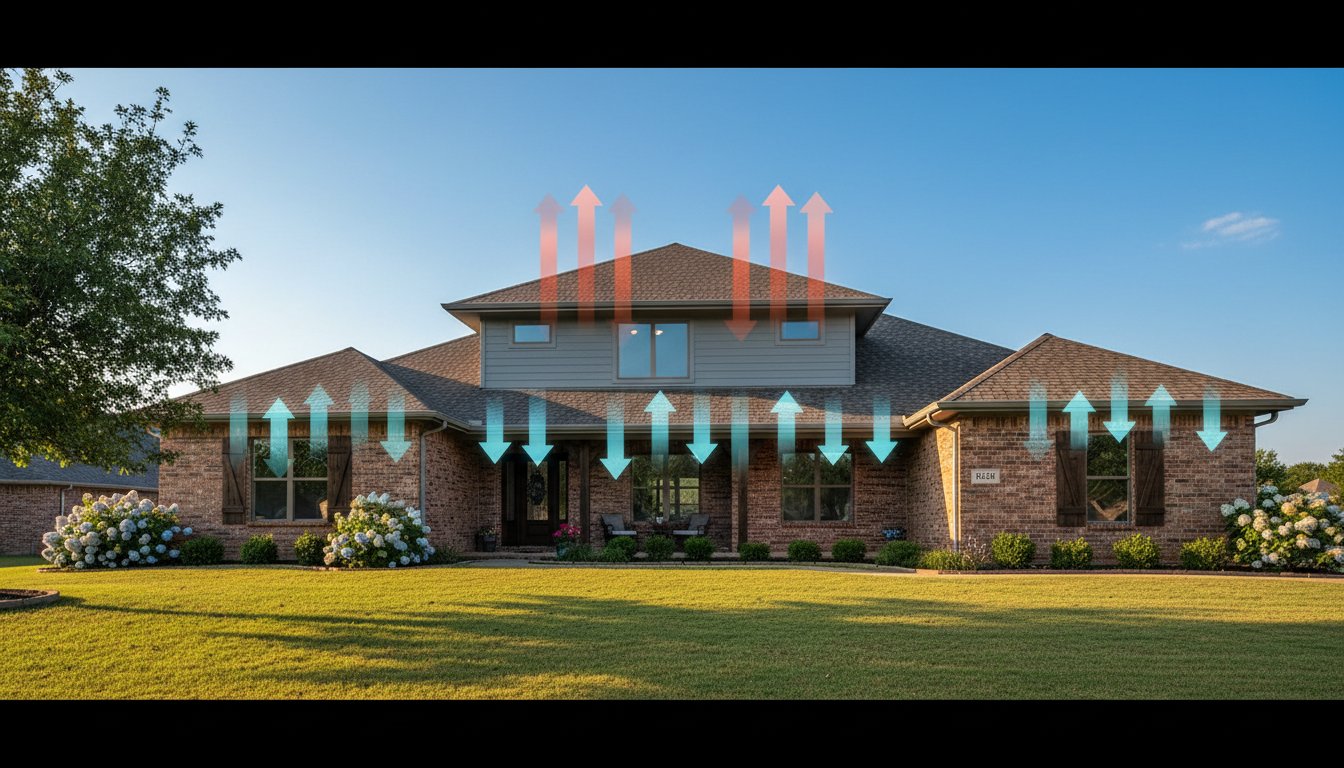

Is your upstairs unbearably hot during a Tulsa summer? Do your energy bills seem to climb higher right along with the temperature? It’s a common frustration for Oklahoma homeowners, and the problem often isn’t your air conditioner. The real issue is frequently the superheated air trapped right above your head, a challenge that can be solved with proper roof ventilation. This often-overlooked system is the unsung hero of a comfortable, protected, and energy-efficient home.
A poorly ventilated attic acts like an oven, putting immense stress on your home. It can damage your shingles from the inside out and force your AC unit to work overtime just to keep up. As your trusted, local roofing experts, we believe you deserve peace of mind. In this complete guide, we’ll provide the honest, straightforward information you need. You’ll learn exactly how a balanced ventilation system protects your home from moisture damage, lowers your monthly energy costs, and significantly extends the life of your roof.
Why Proper Roof Ventilation is Crucial for Your Tulsa Home
Many homeowners think of their roof as just a layer of shingles. But in reality, it’s a complex system designed to protect your home from the elements. A critical, yet often overlooked, part of that system is proper roof ventilation. Think of it as your attic’s breathing system-essential for maintaining a healthy, efficient home, especially here in Tulsa where our weather swings from one extreme to the other.
A well-ventilated attic regulates temperature and moisture year-round, preventing costly damage and making your home more comfortable. For Oklahoma homeowners, it’s not a luxury; it’s a necessity.
Fighting Summer Heat and High Energy Bills
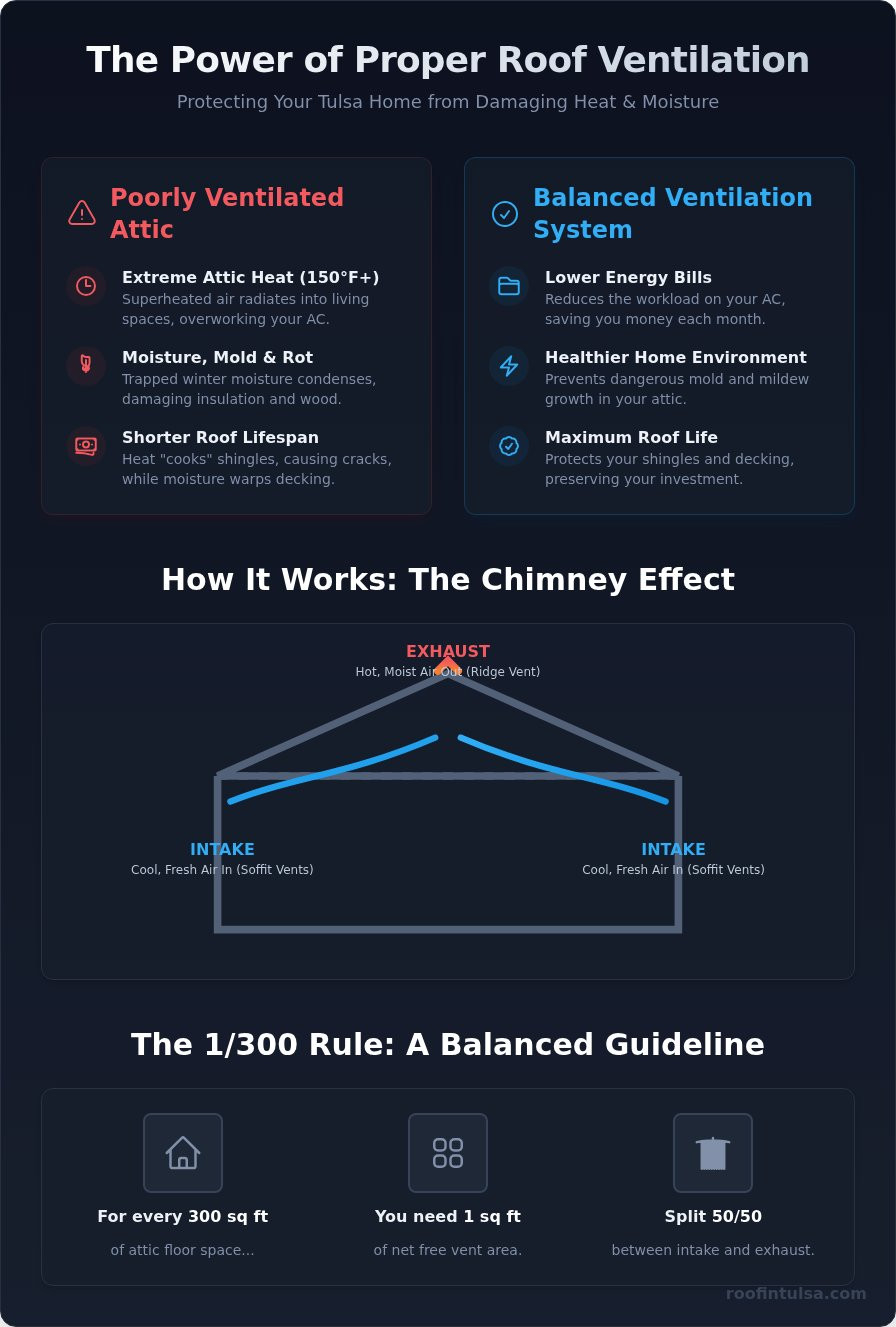
During a blistering Tulsa summer, an improperly ventilated attic can easily reach temperatures of 150°F or more. This superheated air doesn’t just stay put; it radiates down into your living spaces, forcing your air conditioner to work overtime. A balanced system-using a combination of intake and exhaust vents like soffits, ridge vents, or even Powered attic fans-creates a continuous airflow that pushes hot air out. The result is a cooler attic, a more comfortable home, and noticeable savings on your monthly energy bills.
Preventing Winter Moisture and Mold
The threat doesn’t disappear when the weather cools down. In winter, warm, moist air from everyday activities like cooking and showering rises into your attic. When it hits the cold underside of your roof deck, it condenses into water droplets. This trapped moisture is a serious problem that can lead to:
- Damp, ineffective insulation
- Wood rot in your roof’s framing and decking
- The growth of unhealthy mold and mildew
Ventilation gives this damp air a clear path to escape before it can cause lasting damage to your home’s structure and air quality.
Extending the Lifespan of Your Roof
Ultimately, controlling extreme heat and moisture is key to protecting your investment. Excessive heat can literally cook your asphalt shingles from the inside out, causing them to become brittle, crack, and curl years before their time. At the same time, chronic moisture can warp the roof decking, compromising the structural integrity of your entire roof. Proper roof ventilation isn’t just a feature; it’s fundamental maintenance that helps ensure your roof provides the durable protection your family deserves for years to come.
How a Balanced Ventilation System Works: Intake and Exhaust
When it comes to protecting your home, proper roof ventilation is more than just a few holes in your roof. The industry standard, and the only method we trust for Tulsa homes, is a balanced ventilation system. This system operates on a simple principle known as the “chimney effect” or “stack effect.”
Think of your attic as a large container. To move air through it effectively, you need an entry point and an exit point. Cool, fresh air is drawn in through vents located low on the roof (intake), and as it warms up inside the attic, it naturally rises and exits through vents placed high on the roof (exhaust). For this system to work correctly, the amount of intake ventilation must equal the amount of exhaust ventilation. An imbalanced system can be ineffective or, in some cases, even cause damage by pulling conditioned air from your living space into the attic.
Intake Vents: Where Fresh Air Enters
Intake vents are the starting point for a healthy attic. Typically installed in your soffits or eaves (the underside of your roof’s overhang), their job is to draw in cooler, drier air from outside. Without sufficient intake, exhaust vents have nothing to pull out, and the airflow cycle stalls. They are the essential “in-breath” for your home’s roof ventilation system, ensuring a constant supply of fresh air.
Exhaust Vents: Where Hot Air Escapes
Located at or near the roof’s peak, exhaust vents are where the hot, humid air makes its escape. As warm air rises, these vents-such as ridge vents or box vents-provide a clear exit path. This process not only cools your attic but is also critical for removing damaging humidity. This constant air exchange helps prevent the dangers of attic moisture, like mold growth and wood rot, which can compromise your roof’s structure over time.
The 1/300 Rule Explained Simply
Building codes provide a general guideline for ventilation known as the 1/300 rule. This rule suggests a minimum of 1 square foot of net free vent area for every 300 square feet of attic floor space, split evenly between intake and exhaust. While this is a good starting point, it’s just a minimum. A professional assessment is the only way to determine the precise needs for your specific roof design and our local Tulsa climate, ensuring your home gets the protection and peace of mind it deserves.
Common Types of Roof Vents Found on Oklahoma Homes
A balanced system is the key to effective roof ventilation. For every cubic foot of hot, moist air that escapes your attic, a cubic foot of fresh, cool air must be drawn in to replace it. This continuous cycle protects your home from moisture damage and can significantly lower your cooling costs during our hot Tulsa summers. In fact, the U.S. Department of Energy highlights proper attic ventilation as a critical component of an energy-efficient home. Understanding the different types of vents helps you see how this system works.
Here in Oklahoma, you’ll typically find a combination of the following intake and exhaust vents on local homes.
Popular Intake Vents
Intake vents are located at the lower part of your roof and are responsible for drawing cool, fresh air into the attic space.
- Soffit Vents: These are the most common intake vents, appearing as small, screened vents located in the soffit, which is the underside of your roof’s eaves. They are a standard feature on the many Ranch and Craftsman-style homes found throughout Tulsa and the surrounding communities.
- Gable Vents: Installed on the exterior walls at the very top of a gable, these vents can serve as either intake or exhaust, depending on the overall system design. On older homes, they were often the primary source of ventilation.
- Over-Fascia Vents: This is a modern and discreet solution for homes that have very small or nonexistent soffits, allowing air to enter just over the fascia board.
Popular Exhaust Vents
Positioned at or near the highest point of the roof, exhaust vents allow hot, humid air to escape the attic.
- Ridge Vents: Considered one of the most effective options, a ridge vent runs along the entire peak of the roof. It creates a continuous, even flow of air out of the attic, providing excellent performance and a clean look.
- Box Vents (or Louvers): These are static, box-like vents that are installed in openings cut near the roof’s ridge. Because they have no moving parts, they are a simple and durable choice often seen on older Oklahoma homes.
- Turbine Vents: Also known as whirlybirds, these vents use wind power to spin and actively pull air out of the attic. Their effectiveness depends directly on wind speed.
- Powered Attic Vents: These vents use an electric fan to actively push hot air out. They are often controlled by a thermostat and are a powerful solution for attics that are difficult to ventilate passively.
Choosing the right combination of these vents is essential for achieving proper roof ventilation and giving your home the protection and peace of mind it deserves.
Signs Your Tulsa Home Has a Ventilation Problem
Roofing issues can be subtle, and poor ventilation is often a silent problem until significant damage occurs. As your trusted local roofing experts, we’ve seen how Tulsa’s hot summers and cold winters can expose these weaknesses. Don’t worry-identifying the problem is the first step toward a solution. Use this simple checklist to see if your home is showing signs of an inadequate roof ventilation system.
Clues Inside Your Home
Many homeowners first notice something is wrong from inside the house. These are common symptoms that point directly to a stifled attic trying to breathe.
- A Hot Second Floor: If your upstairs is consistently warmer than your main floor, it’s a classic sign that heat is trapped in the attic and radiating down into your living space.
- Your AC Works Overtime: A constantly running air conditioner that struggles to keep up is often fighting a super-heated attic. Proper airflow would help cool this space and reduce the load on your HVAC system.
- Damp Spots or Ceiling Stains: Trapped, humid air in the attic can condense and lead to moisture buildup. This can cause water stains on your ceilings, even without a roof leak.
- Musty or Moldy Odors: A musty smell, especially in upstairs closets or the attic itself, is a major red flag for moisture and potential mold growth caused by stagnant, damp air.
Clues Outside Your Home
A quick walk around your property can also reveal tell-tale signs of ventilation trouble. Your roof and siding are often the first external parts of your home to show distress.
- Ice Dams in Winter: When heat escapes into your attic, it melts snow on the roof, which then refreezes at the colder eaves. This creates a destructive ridge of ice known as an ice dam.
- Curled or Wavy Shingles: Excessive heat from a poorly ventilated attic essentially “cooks” your asphalt shingles from the inside out, causing them to warp, crack, and deteriorate long before their time.
- Peeling Exterior Paint: Moisture trapped in the attic will try to escape any way it can. Often, it pushes its way out through the eaves, causing paint on your siding and soffits to blister and peel.
What to Look for in Your Attic
If you can safely peek into your attic, you can find the most direct evidence of a ventilation problem. Look for these clear indicators:
- Frost Under the Roof Deck: In winter, seeing frost on the underside of your roof sheathing means warm, moist air from your home is condensing and freezing before it can be vented out.
- Damp or Compacted Insulation: If your insulation feels damp to the touch or looks matted down, it has likely been compromised by moisture from condensation, making it far less effective.
- Blocked Soffit Vents: Look toward the eaves from inside the attic. If you can’t see daylight through the soffit vents because they are blocked by insulation or debris, your intake airflow is cut off.
If this checklist sounds a little too familiar, your home is likely telling you it needs help. A properly functioning roof ventilation system is essential for protecting your investment and keeping your family comfortable. For an honest, professional assessment, contact T-Town Roofing for a hassle-free inspection. We’re here to provide peace of mind.
Achieving Optimal Ventilation: A Professional Assessment
When it comes to your home’s attic, more is not always better. Many homeowners believe that adding a few extra vents will solve their heat and moisture problems, but this can often make things worse. A properly functioning roof ventilation system is a finely tuned balance between intake vents (at the lower part of your roof) and exhaust vents (near the peak). Creating an imbalance can cause negative pressure that pulls conditioned air from your living space into the attic, driving up energy bills and even drawing in dust and allergens. An improperly balanced system can also fail to protect against wind-driven rain.
Getting this balance right is a science that protects the integrity of your roof and the comfort of your home, and it requires a professional calculation.
Why DIY Can Be Risky
While a DIY approach can be tempting for home projects, ventilation work is best left to the professionals. The risks often outweigh the potential savings and can lead to significant, costly mistakes, including:
- Inaccurate Calculations: Simply following a general rule of thumb doesn’t account for your home’s unique roof pitch, attic size, and the specific challenges of the Tulsa climate.
- Improper Installation: Cutting into your roof deck without professional experience is a direct invitation for leaks. Even a small installation error can cause persistent water damage over time.
- Voiding Your Warranty: Most roofing material warranties have strict requirements. Unauthorized alterations, like installing new vents incorrectly, can void your coverage, leaving you unprotected.
What to Expect from a Rescue Roofing Ventilation Inspection
As your trusted local roofing experts, we take the guesswork out of achieving optimal ventilation. Our goal is to provide you with honest answers and lasting peace of mind. When you schedule an inspection with Rescue Roofing, our process is thorough, transparent, and designed to find the right solution for your home:
- Our expert will perform a complete inspection of your attic and existing ventilation components.
- We take precise measurements of your attic space to calculate the exact net free vent area your home requires.
- We check all existing intake and exhaust vents for common issues like blockages from insulation, damage, or improper installation.
- Finally, we provide a clear, easy-to-understand recommendation for creating a perfectly balanced system tailored to our local weather patterns.
We believe in providing real solutions, not just selling products. Our recommendations are always based on what is best for the long-term health and efficiency of your home. Worried about your ventilation? Get a free, no-obligation inspection.
Your Partner for a Healthy, Well-Ventilated Tulsa Home
Proper ventilation is not a luxury for a Tulsa homeowner; it’s a vital part of a healthy home. As this guide has shown, a balanced system of intake and exhaust vents is your first line of defense against damaging attic heat, moisture buildup, and premature roof aging. It protects your home’s structural integrity and can significantly lower your cooling bills during our hot Oklahoma summers.
Knowing if your system is performing correctly can be difficult. That is where our expertise provides peace of mind. As Tulsa’s trusted local roofing experts, we provide comprehensive roof system inspections to assess your home’s unique roof ventilation needs. You can always count on our team for honest recommendations and clear pricing, because we believe in building trust with our neighbors.
Protect your home and lower your bills. Schedule your free ventilation assessment today!
Frequently Asked Questions About Roof Ventilation
How much does it cost to improve roof ventilation?
The cost to improve your home’s roof ventilation can range from a few hundred to over a thousand dollars. The final price depends on the type and number of vents required, your roof’s specific design, and the overall complexity of the job. For an honest and accurate estimate, we recommend a professional inspection. This ensures you receive a quality, lasting solution that provides true peace of mind without hidden costs or surprises down the road.
Can you have too much roof ventilation?
While it is rare to have too much ventilation, it is critical to have a balanced system. An effective roof ventilation system needs an equal amount of intake ventilation (low on the roof, like soffit vents) and exhaust ventilation (high on the roof, like ridge vents). An imbalanced system can be inefficient and fail to protect your attic. As your trusted local experts, we ensure your system is perfectly balanced for optimal performance and protection.
Does a new roof automatically include proper ventilation?
Not always. A quality, professional roof replacement should always include a thorough ventilation assessment and any necessary upgrades, but some contractors may cut corners to lower their bids. A reputable roofer understands that ventilation is a critical part of a complete, healthy roofing system-not an optional add-on. We ensure every new roof we install has the correct ventilation to protect your home and validate your shingle warranty.
Will adding vents to my roof cause leaks?
This is a common and understandable concern for homeowners. When installed by an experienced, certified professional, new roof vents will not cause leaks. Proper installation involves precise cutting, expert flashing, and industrial-grade sealants to create a completely watertight barrier around the vent. Our GAF Master Elite certified team installs every component flawlessly, and we back our work with a 10-year workmanship warranty for your complete confidence.
How long does it take to install new roof vents?
The installation time is usually quite fast. If we are adding or upgrading vents as a standalone project, the work can often be completed in just a few hours with minimal disruption to your day. When new vents are part of a complete roof replacement, the installation is simply integrated into the overall project timeline. Our team works efficiently and safely to ensure your home is protected as quickly as possible.
What type of roof vent is the best for the Tulsa climate?
For the Tulsa climate, with its intense summer heat and humidity, a balanced system using a continuous ridge vent combined with soffit vents is often the most effective solution. This setup promotes natural, even airflow across the entire underside of the roof deck, efficiently removing trapped heat and moisture. It is also a durable, low-profile option that stands up well to the high winds and severe weather common in our community.